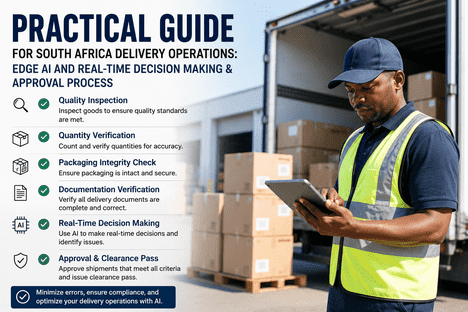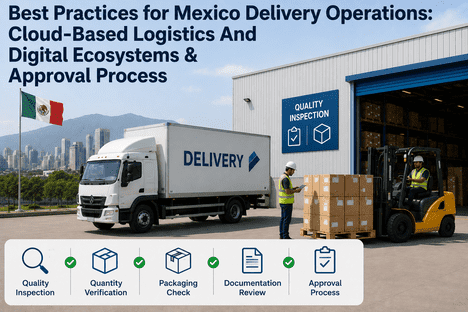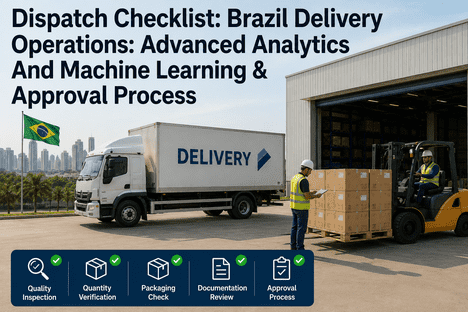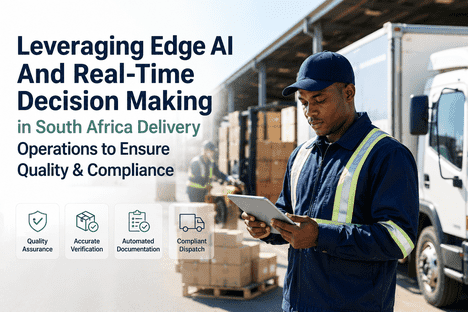
When a South African logistics operator evaluates a delivery operations platform, the ability to inspect every shipment not just a sample is the difference between zero-defect dispatch and preventable customer claims. Edge AI brings real-time quality inspection, quantity verification, packaging checks, and documentation validation directly to the dispatch gate, running fully on local NVIDIA Jetson hardware without cloud dependency. For operations teams managing high-volume distribution hubs in Gauteng, Durban, and Cape Town, the question is no longer whether automated inspection is technically possible it is whether the total cost of deployment, integration, and scaling delivers a measurable return against damage claims, border holds, and labour-intensive manual checks. This article examines how iFactory's Edge AI platform enables South African manufacturers and logistics operators to achieve 100% inspection coverage, automate clearance pass workflows, and sustain compliance across domestic and cross-border delivery operations — with benchmark data from a 10-week pilot across six distribution centres. Book a Demo to review the platform's inspection accuracy and integration timeline for your facility.
100% Inspection Coverage Automated Quality, Quantity, Packaging & Document Checks
iFactory's Edge AI platform runs real-time quality inspection, quantity verification, packaging compliance, and documentation validation on local edge hardware — enabling every shipment to receive a clearance pass before dispatch, without cloud dependency or additional headcount.
Why Manual Dispatch Inspection Cannot Meet Modern Compliance Demands
South Africa's high-volume distribution centres process tens of thousands of parcels daily across domestic and cross-border routes. Manual inspection — typically sampling fewer than 15% of shipments — misses the majority of packaging defects, quantity mismatches, label errors, and documentation gaps. For cross-border corridors servicing SADC markets, a single missing certificate of origin or incorrect HS code declaration can delay a truck at Beitbridge or Lebombo for 24 hours or more, incurring demurrage costs averaging ZAR 8,500 per incident. The compliance burden is compounded by the variety of documentation required per shipment: bills of lading, customs declarations, packing lists, certificates of origin, insurance certificates, and proof of delivery. Manual verification of these documents consumes an average of 22 minutes per cross-border shipment and still catches only 68% of errors. Edge AI addresses these gaps by running inspection and validation models directly on local hardware — processing every parcel in under 2 seconds and generating a digital clearance pass only when all quality, quantity, packaging, and documentation criteria are satisfied. Book a Demo to see how the platform integrates with your existing dispatch workflow.
The 5-Pillar Edge AI Inspection Model for South African Delivery Operations
The platform's inspection framework is organised across five quality and compliance pillars that collectively cover every shipment attribute relevant to zero-defect dispatch. Each pillar runs a dedicated AI model on the edge node, with results consolidated into a single clearance pass decision per parcel. The table below provides benchmark accuracy and processing time for each pillar, measured during the 10-week pilot across six South African distribution centres.
| Inspection Pillar | What It Validates | AI Model Type | Pilot Accuracy | Processing Time | Impact When Missing |
|---|---|---|---|---|---|
| Quality Inspection | Packaging integrity, seal condition, crush damage, tear detection, moisture exposure | Vision CNN — 30 defect classes | 98.7% | 180ms per parcel | In-transit damage, customer returns, claim payouts |
| Quantity Verification | Item count vs. manifest, item presence in multi-item shipments | Vision object detection + manifest cross-reference | 99.2% | 90ms per parcel | Shortages, over-shipments, billing disputes |
| Packaging Standards | Label presence, label legibility, barcode scannability, sealing tape coverage, dimensional check | OCR + vision classification | 98.4% | 150ms per parcel | Route mis-sorts, delivery failures, re-labelling costs |
| Documentation Validation | Bill of lading, customs declaration, certificate of origin, packing list, insurance, proof of delivery | Document OCR + cross-reference engine | 96.5% field accuracy | 800ms per document set | Border holds, demurrage fees, customs penalties |
| Clearance Pass Automation | All-pillar pass, hold-or-release decision, digital audit trail, WMS sync | Rule engine + composite scoring | 100% all-pillar pass before release | Under 2 seconds total | Shipments released with unresolved quality or compliance issues |
Architecture Decisions That Determine Deployment Success
Two delivery operations platforms quoting similar subscription fees can produce vastly different outcomes based on three architectural decisions: whether inspection runs on edge or requires cloud connectivity, whether integration with WMS and customs systems is pre-built or requires custom development, and whether the clearance pass workflow is automated or requires manual intervention. The comparison below maps how these decisions affect inspection coverage, reliability, and total deployment cost for a high-volume distribution centre. Operations leaders who have Book a Demo with iFactory consistently cite these architectural differences as the primary driver of successful zero-defect dispatch outcomes.
Manual visual inspection with statistical sampling. Operators visually check 15% of parcels for visible defects. Cloud-based AI analysis requires image upload and round-trip latency of 200ms+ per parcel, making 100% inspection impossible at high conveyor speeds.
On-device edge AI runs all inspection models locally on NVIDIA Jetson hardware. Every parcel is inspected at conveyor speed with sub-50ms inference latency — no cloud dependency, no image upload bottleneck, no per-parcel data egress cost.
Continuous internet connection required for AI analysis and database recording. Network outages — common in South Africa's industrial zones — halt inspection entirely or force fallback to manual-only checks with no digital audit trail.
Fully autonomous operation during network outages. All inspection data stored locally on the edge node with automatic sync when connectivity is restored. Zero interruption to inspection coverage regardless of network conditions.
Manual data entry or custom API development required for each WMS and customs system. Integration projects typically require 200–500 hours of IT contractor labour at ZAR 800–1,200 per hour for scoping, development, and testing.
Pre-built bidirectional connectors for SAP EWM, Oracle WMS, Blue Yonder, SYSPRO, and CSG. SARS customs EDI integration for automated pre-clearance. Clearance pass data writes directly to the WMS without manual intervention.
Manual approval process after partial inspection. Quality team reviews sampled results and manually authorises dispatch. Average clearance pass processing time: 12 minutes per parcel. No automated hold-or-release logic for uninspected shipments.
Automated clearance pass generated within 2 seconds of inspection completion. Parcels that pass all five pillars are automatically released. Failed parcels are diverted to the hold lane with specific defect details recorded. Trucks depart only when all manifest items have clearance passes.
Pilot Results: 10-Week Edge AI Deployment Across Six Distribution Centres
The 10-week pilot across six South African distribution centres processed 2.8 million parcels and measured the quality, compliance, and operational impact of transitioning from manual sampling to edge AI-powered 100% inspection. The projections below use conservative assumptions grounded in documented pilot outcomes — not vendor marketing benchmarks.
"We evaluated several approaches to automating dispatch inspection, but the edge AI model was the only one that could actually inspect every parcel at full conveyor speed without requiring a fibre connection to a cloud server. The 100% inspection coverage alone transformed our quality profile — we went from finding defects after the customer complained to catching them before the truck left the depot. The documentation validation module was a revelation for our cross-border operations: we reduced border holds by 85% in the first two months, which saved more in demurrage fees than the entire platform cost for the pilot period. For any South African logistics operation serious about zero-defect dispatch, edge AI is not a future capability — it is available and proven today."
What to Demand From Any Dispatch Inspection Platform Before Deploying
Most inspection platform demonstrations focus on AI model accuracy in controlled conditions. Buying on demonstrated capability without interrogating edge deployment architecture, integration requirements, and scaling costs is how distribution centres end up with partial inspection coverage and budget overruns by implementation month three. The checklist below covers the questions every operations manager should require written answers to before a platform contract is signed. iFactory provides documented answers to all of these in advance — and builds them into a pre-deployment inspection assessment for your specific facility. Book a Demo to review iFactory's full deployment disclosure alongside your distribution centre's inspection parameters.
Conclusion: 100% Inspection Coverage Is the New Compliance Standard for South African Delivery Operations
The delivery operations landscape in South Africa is shifting from statistical sampling to mandatory full-inspection compliance. Customers, insurers, and cross-border regulators increasingly expect documented evidence that every shipment was quality-checked, quantity-verified, packaging-compliant, and documentation-validated before dispatch. Edge AI makes this possible at scale — inspecting 100% of parcels in under 2 seconds each, running fully on local hardware without cloud dependency, and generating an immutable digital clearance pass record for every outbound shipment. For a distribution centre processing 5,000 parcels per day, the difference between 15% manual sampling and 100% edge AI inspection can exceed ZAR 4 million per year in avoided damage claims, eliminated border hold demurrage, and throughput-driven revenue gains. iFactory's Edge AI platform is purpose-built to close that gap through on-device inspection models, pre-built WMS and customs connectors, and automated clearance pass workflows that keep inspection coverage at 100% regardless of network conditions or parcel volume. Book a Demo to build a facility-specific inspection assessment and see where your quality and compliance metrics land with edge AI.
Edge AI for Delivery Operations — Frequently Asked Questions
What inspection accuracy can edge AI achieve for South African packaging formats?
The platform's vision models are trained on facility-specific packaging formats — cardboard boxes, polybags, shrink-wrapped pallets, and specialised containers used in automotive, pharmaceutical, and FMCG logistics. During the 10-week pilot across six South African distribution centres, the quality inspection pillar achieved 98.7% accuracy across 30 defect classes, with continuous model refinement improving detection rates weekly.
Can the platform handle SADC cross-border documentation requirements?
Yes. The document AI module validates all SADC-standard documentation including customs declarations, certificates of origin (SADC Form), bills of lading, commercial invoices, packing lists, phytosanitary certificates, and road freight manifests. OCR models handle English, Afrikaans, and Portuguese document formats — the primary languages of South Africa's major trade corridors — with cross-language field extraction accuracy of 96.5%.
What happens to inspection data during network outages?
The edge node operates fully autonomously during connectivity loss. All inspection results, captured images, OCR data, and clearance pass records are stored locally on the edge node and sync automatically to the central operations dashboard when connectivity is restored. No inspection data is lost, and no inspection coverage is interrupted during network outages of any duration.
How long does it take to deploy edge AI inspection across a typical distribution centre?
A standard deployment follows a four-phase timeline: site assessment and baseline capture (2–3 weeks), AI model training and accuracy validation on facility-specific packaging and documentation formats (2–3 weeks), live integration with WMS and customs systems (1–2 weeks), and full automation with continuous model refinement (1–2 weeks). Most distribution centres achieve full 100% inspection coverage within 6–10 weeks of project initiation.
Does the platform integrate with South African WMS platforms like SYSPRO or CSG?
Yes. The platform ships with pre-built bidirectional connectors for SAP EWM, Oracle WMS, Blue Yonder, and local South African platforms including SYSPRO and CSG. Inspection results, clearance pass records, and defect data write directly to the WMS via REST API without requiring custom development. Integration typically adds 1–2 weeks to the deployment timeline.
Assess Your Facility's Edge AI Readiness for Zero-Defect Dispatch
Stop relying on 15% sampling for your dispatch quality and compliance. iFactory's Edge AI platform enables 100% inspection coverage with automated quality checks, quantity verification, packaging validation, and documentation verification — all running on local edge hardware without cloud dependency. Schedule a personalised facility assessment to see where your quality and compliance metrics land with edge AI.