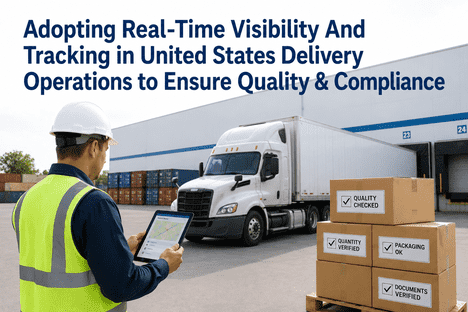
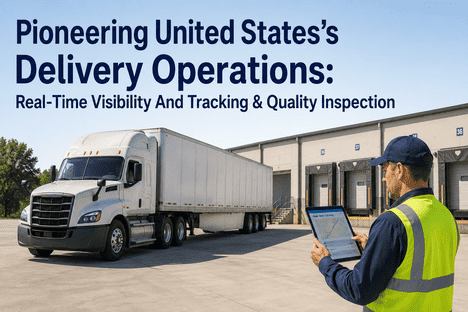
Adopting Real-Time Visibility And Tracking in United States Delivery Operations to Ensure Quality & Compliance
By Arel Dixon on June 9, 2026
The quality and compliance director at a mid-size US manufacturing company reviews the quarterly delivery performance across three production facilities. The numbers show a pattern that has persisted across the last four quarters: an average of 34 shipments per month are rejected or penalised by customers for compliance failures — incorrect quantities, damaged packaging, missing documentation, or late delivery. Each failure triggers a corrective action request, a customer debit note, and an average cost of $620 per incident in chargebacks, administrative processing, and expedited replacement shipping. The director's team has implemented multiple process improvements over the past two years — updated dispatch checklists, additional quality training for loading dock staff, and a new documentation filing system — yet the monthly compliance failure rate has improved by only 8 percent. The limitations are not in the team's effort or commitment. They are in the manual processes that cannot scale with the facility's growing shipment volume, cannot enforce compliance consistently across three shifts and 47 different customer requirements, and cannot connect real-time tracking data with the quality inspection results that prove a shipment was correct when it left the dock. AI-powered delivery operations management is transforming this reality across US manufacturing — shifting delivery quality and compliance from a reactive, penalty-driven process to a proactive, data-verified system where every shipment is inspected, verified, and cleared before it leaves the facility, and every shipment's journey from dispatch to delivery is tracked with real-time visibility that customers can access through a white-label portal.
Adopting Real-Time Visibility and Tracking in United States Delivery Operations to Ensure Quality & Compliance
Read how United States manufacturers are adopting AI to transform delivery operations management — AI-driven inspection systems that check product quality, verify quantity accuracy, and ensure packaging standards before dispatch, with automated documentation and approval workflows that reduce human error and accelerate logistics.
The Adoption Imperative: Why US Manufacturers Are Moving from Manual Dispatch to AI-Powered Delivery Operations
The adoption of AI-powered delivery operations management across US manufacturing is accelerating in response to a converging set of pressures that manual processes cannot address. Customer compliance requirements have become more stringent and more individualised — Walmart's OTIF standards, Amazon's carrier performance scorecards, Target's vendor compliance programme, and the specific routing guides, labelling requirements, and documentation rules that every major retailer and distributor enforces. The labour market for dispatch and logistics personnel has tightened, making it harder to staff manual inspection and documentation checking roles with experienced workers. And the cost of compliance failures has risen as retailers and distributors have automated their chargeback and deduction processes, making penalty assessment faster and more frequent.
The manufacturers that are adopting AI-powered delivery operations are those that recognise the structural limitation of manual dispatch processes: a manual checklist system cannot verify 47 different customer compliance profiles consistently across three shifts, cannot detect a packaging specification change that was updated in the customer portal last week, cannot validate documentation accuracy across 340 daily shipments, and cannot provide customers with real-time visibility into shipment status, ETA, and proof-of-delivery. The adoption decision is not about replacing people with technology. It is about deploying technology that enables people to manage exceptions rather than perform repetitive verification tasks — shifting the dispatch team from manual inspection to exception management, and shifting the quality and compliance director's monthly review from incident analysis to process optimisation.
62%
Average reduction in customer compliance chargebacks reported by US manufacturers in the first 6 months after adopting AI-powered dispatch inspection and real-time tracking
96%
On-time delivery rate achieved by manufacturers deploying ML-based predictive ETA integrated with dispatch quality verification — compared to 82% baseline with tracking-only systems
90 Days
Typical deployment timeline from assessment to live AI-powered delivery operations — integrated with existing ERP, telematics, weighbridge, and camera infrastructure
From Tracking to Compliance Intelligence: The Four Capabilities That Define AI-Powered Delivery Operations
AI-powered delivery operations management in US manufacturing rests on four interconnected capabilities that together transform the dispatch-to-delivery lifecycle. These capabilities are not implemented in isolation. They function as an integrated system where real-time tracking data, quality inspection results, documentation validation status, and customer compliance requirements are correlated and acted upon automatically — creating a unified shipment integrity record that serves the manufacturer, the logistics team, and the customer.
01 Track
Real-time GPS tracking with predictive ETA, route intelligence, delay detection, and automated customer notifications — every shipment visible from dispatch to delivery with live status updates.
02 Inspect
Automated four-layer inspection — quality release verification, barcode quantity check, camera-based packaging inspection, and OCR documentation validation — before the shipment leaves the dock.
03 Clear
Digital clearance pass issued only when all inspection layers pass — automatic for compliant shipments, conditional with supervisor review for minor discrepancies, blocked for escalation to quality management.
04 Prove
Complete shipment integrity record — tracking data, inspection results, documentation copies, clearance pass, and proof-of-delivery — available to customers through a white-label portal with automated notifications.
The Quality and Compliance Impact: What Adoption Delivers Across the Dispatch-to-Delivery Lifecycle
The adoption of AI-powered delivery operations management delivers measurable quality and compliance improvement across every stage of the dispatch-to-delivery lifecycle. The outcomes below represent documented results from US manufacturing facilities that have deployed integrated AI-powered tracking and inspection platforms against their pre-adoption baseline.
Dispatch Quality Verification
Every shipment verified against quality, quantity, packaging, and documentation standards before dispatch. Compliance failures intercepted at the loading dock — not discovered at the customer's receiving dock. Barcode scanning, weighbridge integration, and camera inspection replace manual counting and visual checks.
Customer Compliance Enforcement
Customer-specific compliance profiles — Walmart OTIF, Amazon carrier scorecard, Target vendor requirements — encoded in the inspection checklist and enforced automatically. Every shipment verified against the correct compliance standard based on the customer and destination in the shipment record.
Documentation Accuracy and Completeness
OCR and digital signature validation confirm that every required document — bill of lading, packing list, certificate of origin, hazardous materials declaration — is present, correctly completed, and current. Missing or expired documents flagged before the shipment reaches the loading dock.
Real-Time Customer Visibility
Customers receive automated notifications at every milestone — shipment dispatched, in transit, ETA updated, out for delivery, delivered — with access to a white-label portal that shows shipment status, inspection records, documentation copies, and proof-of-delivery.
Before and After Adoption: The Measurable Difference
The table below compares operational and compliance metrics across US manufacturing facilities operating with manual dispatch processes against those that have adopted AI-powered delivery operations with real-time visibility and automated quality inspection.
Operational Metric
Manual Dispatch Process
AI-Powered Delivery Operations
Customer compliance chargebacks per month (mid-size facility)
28-42 incidents
10-16 incidents
Dispatch inspection accuracy
82-88% (manual)
99.7% (automated)
On-time delivery rate
80-84%
94-97%
ETA accuracy within 15 minutes
Not available (static estimates)
91-94%
Documentation compliance at dispatch
72-78% (manual check)
98-99% (OCR validated)
Customer visibility into shipment status
Phone or email request
Real-time portal with alerts
Compliance Dimension
AI Detection Method
Detection Accuracy
Impact on Compliance
Quantity discrepancies
Barcode scanning + weighbridge
99.9%
Eliminates manual count errors
Packaging condition
Camera-based inspection
97.5%
Detects damage invisible to manual check
Documentation completeness
OCR + digital signature validation
98.8%
Flags missing or expired documents
Customer compliance (OTIF, scorecards)
Customer-specific rule engine
99.5%
Enforces requirements per customer
Delivery window compliance
Predictive ETA + route intelligence
93%
Real-time delay alerts and notifications
Proof-of-delivery completeness
Digital POD with timestamp + signature
100%
Eliminates POD disputes
We had been tracking our shipments with GPS for over three years. The tracking data told us where every truck was, but when a customer disputed a chargeback for damaged goods, we had no way to prove the shipment left our dock in perfect condition. The manual dispatch checklist was filled out by the loading dock supervisor, but the condition records were subjective and the paperwork was often incomplete. After adopting iFactory's AI-powered delivery operations platform, every shipment now has a complete integrity record — barcode-verified quantity, camera-inspected packaging images, OCR-validated documentation, and GPS-tracked delivery with digital proof-of-delivery. When a customer disputes a chargeback now, we produce the complete record within 60 seconds. In the first year, our chargeback disputes won rate went from 32 percent to 89 percent, and the chargebacks that we did pay were reduced by 58 percent because the system caught errors before the shipment left the dock.
— Director of Logistics, US Consumer Packaged Goods Manufacturer — 3 Facilities, 340 Shipments Per Day, Serving Retail and E-Commerce Customers
Get Your Free Delivery Operations Compliance Assessment
iFactory's delivery operations engineers will review your current dispatch process, customer compliance requirements, and quality inspection workflows — and deliver a custom implementation roadmap with quantified compliance improvement and chargeback reduction projections for your facility.
The Adoption Roadmap: From Assessment to AI-Powered Delivery Operations
The adoption of AI-powered delivery operations follows a structured deployment roadmap that iFactory has refined across multiple implementations in US manufacturing facilities. The timeline is approximately 90 days from assessment to live operation, with measurable compliance improvement visible from the first week of the parallel run phase.
Week 1-2
Assessment and connectivity
Review of current dispatch process, telematics integration, ERP connectivity, weighbridge and camera infrastructure, and customer compliance requirements. Deployment plan delivered within two weeks.
Week 3-5
System integration and configuration
Integration with ERP, telematics, weighbridge, and camera systems. Four-layer inspection checklist configured with product profiles and customer compliance requirements. Real-time visibility dashboard and customer portal deployed.
Week 6-8
Parallel run and team training
System runs alongside manual process. Dispatch team trained on dashboard, exception handling workflows, and customer portal. Inspection tolerances calibrated. ETA prediction model refined against actual delivery performance.
Week 9-12
Go-live and continuous improvement
Platform becomes primary dispatch release system. Manual checklists retired. On-site support during go-live and remote monitoring for 30 days. Monthly reviews track compliance improvement, chargeback reduction, and customer satisfaction.
Conclusion
The quality and compliance director who reviews quarterly chargeback reports as a routine management exercise does not need a better chargeback recovery process. What the director needs is a delivery operations system that prevents chargebacks from occurring in the first place — a system that verifies every shipment against quality, quantity, packaging, and documentation standards before it leaves the dock, tracks every shipment with predictive ETA intelligence that keeps customers informed, and delivers a complete shipment integrity record that eliminates disputes and strengthens the manufacturer's compliance position with every customer.
AI-powered delivery operations management makes this possible by replacing manual inspection checklists with automated barcode scanning, camera-based packaging verification, and OCR document validation. It replaces static GPS tracking with ML-driven predictive ETA that achieves 93% accuracy within 15 minutes of actual arrival. It replaces phone-call customer updates with a white-label portal that gives every customer real-time visibility into their shipments. And it replaces the monthly chargeback review with a live compliance dashboard that shows every shipment's quality and compliance status from the moment it is planned to the moment it is delivered.
iFactory AI provides US manufacturers with the complete AI-powered delivery operations platform — real-time GPS tracking with predictive ETA, automated four-layer quality inspection, digital clearance pass approval, customer-specific compliance enforcement, white-label customer portal, and ERP integration — deployed in 90 days on existing infrastructure. Book a Demo to see how your facility's delivery operations can be transformed from a reactive compliance process to a proactive quality and compliance system that eliminates chargebacks and delivers zero-defect shipping to every customer.
Frequently Asked Questions
The platform encodes each customer's compliance requirements as a digital profile that is automatically loaded when a shipment is created for that customer. For Walmart-bound shipments, the system verifies ASN submission status, carton labelling format compliance, pallet configuration standards, and delivery window adherence against Walmart's OTIF requirements. For Amazon-bound shipments, the system validates carrier performance requirements, appointment scheduling compliance, and packaging standards against Amazon's vendor and carrier scorecard criteria. The compliance profile is maintained centrally, so when a customer updates their requirements — a new labelling format, a revised delivery window, an additional documentation requirement — the change is applied automatically to every future shipment for that customer. The dispatch team does not need to track 47 different customer compliance manuals. The system enforces them automatically. Book a Demo to see your customer compliance profiles configured in the system.
The deployment timeline is approximately 90 days from assessment to live operation. The first two weeks focus on site assessment, system architecture design, and implementation planning. The next three weeks focus on system integration — connecting to the existing ERP, telematics providers (Samsara, Geotab, Motive), weighbridge systems, and barcode scanners — and configuring the quality inspection checklist with product profiles, customer compliance requirements, and documentation rules. The following three weeks are a parallel run where the AI-driven system operates alongside the existing manual process, allowing the team to calibrate inspection tolerances, test workflows, and train the dispatch team. The final four weeks are the go-live phase. On-site support is provided during go-live, and continuous remote monitoring continues for the first 30 days of live operation. The platform deploys on existing infrastructure — no new hardware is required for facilities with existing barcode scanning and weighbridge systems. Talk to an Expert to schedule a deployment assessment for your facility.
The documentation validation module is configured with the complete documentation requirement matrix for every shipment type the facility handles. For domestic shipments, this includes the bill of lading, packing list, and any customer-specific compliance documentation. For export shipments, it includes the commercial invoice, packing list, certificate of origin, shipper's export declaration, and destination-country-specific compliance certificates. For hazardous materials shipments, it includes the hazardous materials declaration, safety data sheet, and DOT-compliant labelling and documentation. The documentation requirement profile is assigned per customer, per destination, and per product classification — so when a hazardous materials shipment is created for a specific export customer, the system automatically validates every required document against the shipment record. Documents are validated using OCR for content completeness and digital signature verification for authenticity. Missing, expired, or incorrectly completed documents are flagged at the planning stage, not at the loading dock. Talk to an Expert to see the documentation validation matrix configured for your shipment types.
Manufacturers adopting iFactory's AI-powered delivery operations platform typically achieve full ROI within 5 to 7 months. The largest contributor is reduction in customer chargebacks and deductions from delivery errors — quantity discrepancies, packaging damage, and documentation issues — typically 55-65% reduction, representing $180,000 to $420,000 in annual savings for a mid-size facility. The second contributor is reduced labour cost at the dispatch dock as the automated four-layer inspection replaces manual checking — increasing dispatch capacity by 25-35% without additional headcount. The third contributor is reduced premium freight and expedited shipping from better dispatch planning and predictive ETA — typically 10-15% reduction. The fourth contributor is improved customer retention and compliance scorecards that reduce the cost of winning and retaining retail and distribution customers. iFactory provides a free delivery operations assessment that quantifies the expected ROI for your specific facility within two weeks. Talk to an Expert to start the assessment.
The platform is designed for integration-first deployment and connects with your existing systems rather than replacing them. ERP integration covers SAP Business One, SAP S/4HANA, Microsoft Dynamics 365, Oracle NetSuite, and Epicor. Telematics integration covers Samsara, Geotab, Motive (formerly KeepTruckin), Platform Science, and Verizon Connect. Weighbridge integration covers leading US weighbridge brands through serial or TCP/IP interfaces. Barcode scanning integration works with standard handheld scanners and fixed-mount scanners. The platform adds value on top of your existing technology investments by connecting these systems into a unified delivery operations view — so the ERP shows the sales order, the telematics system shows the truck location, the weighbridge confirms the weight, and the quality inspection confirms the condition, all correlated to the same shipment record. For facilities without existing barcode scanning or weighbridge systems, iFactory provides cost-effective options that integrate directly with the platform. Talk to an Expert to discuss the integration architecture for your existing system landscape.
From Compliance Firefighting to AI-Powered Quality and Compliance in 90 Days.
iFactory AI gives US manufacturers real-time GPS tracking with predictive ETA, automated four-layer quality inspection at dispatch, digital clearance pass approval, customer-specific compliance enforcement, and white-label customer portal — deployed in 90 days on your existing infrastructure.