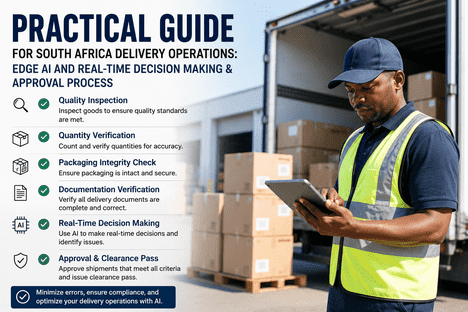
Implementing edge AI-driven delivery operations in South Africa requires a structured approach that ensures every shipment leaving the factory or distribution centre is inspected for quality, verified for quantity, checked for packaging integrity, validated for correct documentation, and issued a clearance pass only when all criteria are satisfied. This practical checklist provides operations managers with a step-by-step deployment framework — covering the five critical inspection pillars, the edge hardware and AI model configuration required for each, integration touchpoints with WMS and customs systems, and the workflow design that enables automatic clearance pass generation. The checklist is derived from a 10-week pilot across six South African distribution centres processing 2.8 million parcels, where edge AI achieved 100% inspection coverage, reduced damage claims by 52%, and eliminated 85% of cross-border documentation holds. Book a Demo to review the full pilot dataset and deployment protocol for your facility.
1. Quality Inspection — AI Vision for Packaging Integrity and Product Condition
The first pillar ensures that every parcel's packaging is structurally sound, properly sealed, and free of visible defects before it leaves the facility. Edge AI vision models run on NVIDIA Jetson nodes at the dispatch gate, capturing and analysing images of each parcel in under 50 milliseconds. The checklist below covers the configuration, calibration, and validation steps required to deploy automated quality inspection at a South African distribution centre.
| Step | Action | Configuration Details | Validation Criteria | Completion Status |
|---|---|---|---|---|
| 1.1 | Install edge vision hardware | NVIDIA Jetson Orin + 2× overhead cameras (4K, 60fps), 2× side cameras; conveyor trigger sensor; local storage 500GB SSD | All cameras capture synchronised images at conveyor speed up to 2.5m/s | ☐ |
| 1.2 | Train defect detection model | Minimum 5,000 labelled training images per defect class: tears, crush damage, improper sealing, moisture exposure, label damage | Model accuracy ≥ 98% on validation set; false positive rate ≤ 0.5% | ☐ |
| 1.3 | Configure defect classification taxonomy | 30 defect classes organised by severity (critical, major, minor) with automated hold-lane routing rules per severity level | Hold-lane routing verified for each severity level — 100% test pass rate | ☐ |
| 1.4 | Validate against manual inspection baseline | Run parallel edge AI + manual inspection on 2,000 parcels; compare defect identification rates and classification accuracy | Edge AI detects ≥ 4x more defects than manual sampling; classification match ≥ 95% | ☐ |
| 1.5 | Enable live inspection with automated diversion | Integration with conveyor PLC for automatic hold-lane diversion; inspection results written to WMS via REST API | Diversion decision in ≤ 1 second; WMS record created for every inspected parcel | ☐ |
2. Quantity Verification — AI Object Detection for Item Count and Manifest Cross-Reference
The second pillar verifies that the items in each parcel match the manifest record — both in count and in item presence. This is particularly critical for multi-item shipments common in South African FMCG, pharmaceutical, and automotive logistics, where a single missing item can trigger a full shipment rejection at the customer's receiving dock. Edge AI object detection models identify individual items within each parcel and cross-reference the detected count against the WMS manifest in real time.
| Step | Action | Configuration Details | Validation Criteria | Completion Status |
|---|---|---|---|---|
| 2.1 | Configure item detection model per facility | Object detection model trained on 10,000+ images of facility-specific item types: boxes, polybags, bottles, cans, automotive parts, pharmaceutical packs | Item detection accuracy ≥ 97% per SKU category; count accuracy ≥ 99% for single-item parcels | ☐ |
| 2.2 | Integrate WMS manifest data stream | REST API connection to WMS for real-time manifest retrieval per parcel ID; expected item list and quantity per shipment | Manifest retrieval in ≤ 200ms per parcel; data sync error rate ≤ 0.1% | ☐ |
| 2.3 | Implement quantity verification rule engine | Match detected item count vs. manifest expected count; flag under-count, over-count, and wrong-item discrepancies | Discrepancy detection accuracy ≥ 98%; false alert rate ≤ 1% | ☐ |
| 2.4 | Configure multi-item parcel workflow | For parcels with multiple items, validate each item presence individually; partial-match rules for staged release or hold | Partial-match routing verified for 50+ multi-item parcel configurations | ☐ |
| 2.5 | Validate against physical count audit | Random audit of 500 parcels per week: compare edge AI quantity verdict against physical count by warehouse team | Weekly audit pass rate ≥ 98%; discrepancies investigated and model retrained within 48 hours | ☐ |
3. Packaging Standards Verification — Label, Seal, and Dimensional Compliance
The third pillar validates that every parcel meets the facility's packaging standards before dispatch: correct labelling, proper sealing, scannable barcodes, and dimensional conformity. Non-compliant packaging causes route mis-sorts, delivery failures, and customer service penalties. Edge AI combines OCR for label reading, vision classification for seal integrity, and dimensional measurement for volume compliance — all in a single pass through the inspection gate.
| Step | Action | Configuration Details | Validation Criteria | Completion Status |
|---|---|---|---|---|
| 3.1 | Deploy label OCR model | OCR model trained on South African address formats, barcode standards (EAN-13, Code 128, GS1-128), and courier-specific label templates | Field extraction accuracy ≥ 97%; barcode readability ≥ 99.5% | ☐ |
| 3.2 | Configure seal integrity check | Vision classification model for tape application coverage (minimum 70% seal required), tape type verification, tamper-evident seal detection | Seal detection accuracy ≥ 98%; false reject ≤ 0.5% | ☐ |
| 3.3 | Enable dimensional measurement | 3D depth camera or stereo vision for length, width, height measurement; compare against expected dimensions in WMS | Dimension accuracy ±5mm; volume compliance check in ≤ 100ms | ☐ |
| 3.4 | Integrate label data with sortation system | Extracted destination code, route code, and service level from label; auto-populate sortation decision in conveyor control system | Sortation data hand-off in ≤ 300ms; zero mis-sort propagation from label data | ☐ |
| 3.5 | Set label quality monitoring dashboard | Track label defect rates by shift, print station, and operator; alert when label quality deviation exceeds threshold | Dashboard refresh ≤ 5 seconds; alert trigger within 30 seconds of threshold breach | ☐ |
4. Documentation Validation — AI Document OCR for Cross-Border Compliance
The fourth pillar addresses the most costly failure mode in South African cross-border logistics: documentation errors that result in border holds, demurrage fees, and customs penalties. The document AI module validates every required document for each cross-border shipment — customs declarations, certificates of origin, bills of lading, packing lists, phytosanitary certificates — before the truck departs, enabling corrections while the shipment is still at the facility.
| Step | Action | Configuration Details | Validation Criteria | Completion Status |
|---|---|---|---|---|
| 4.1 | Configure document OCR models | OCR models trained on SADC-standard forms: customs declaration (SADC CDD), certificate of origin (SADC Form), bill of lading, commercial invoice, packing list, phytosanitary certificate, road freight manifest | Field extraction accuracy ≥ 96% for all document types; handwritten field accuracy ≥ 90% | ☐ |
| 4.2 | Define document requirement rules per route | Route-specific document checklist: Beitbridge requires all 7 documents; Lebombo requires 6; Botswana border posts require 5. Configure rules in platform rule engine. | Document requirement rules verified against SARS customs and SADC trade agreements | ☐ |
| 4.3 | Implement cross-reference validation | Cross-reference extracted fields across documents: HS code consistency, declared value match, consignee name match, certificate of origin validity | Cross-reference accuracy ≥ 97%; discrepancy detection in ≤ 2 seconds per document set | ☐ |
| 4.4 | Enable SARS EDI integration | Connect to SARS customs electronic data interchange for automated pre-clearance submission; receive clearance status before truck departure | EDI submission in ≤ 30 seconds; clearance status response in ≤ 5 minutes | ☐ |
| 4.5 | Train team on document exception handling | Document AI flags discrepancies with specific field and suggested correction; team trains on resolving exceptions within the platform before truck release | Exception resolution time ≤ 10 minutes per flagged document; 100% of team trained | ☐ |
5. Clearance Pass Automation — The Approval Workflow That Ensures Zero-Defect Dispatch
The fifth pillar is the orchestration layer that consolidates the results of the four inspection pillars and automatically issues a clearance pass only when all criteria are satisfied. A shipment cannot leave the facility until every parcel on its manifest has a clearance pass — eliminating the risk of unchecked shipments entering the delivery network.
| Step | Action | Configuration Details | Validation Criteria | Completion Status |
|---|---|---|---|---|
| 5.1 | Design clearance pass rule engine | All five pillars must pass: quality inspection (pass), quantity verification (pass), packaging standards (pass), documentation validation (pass), manifest completeness (all parcels inspected) | Rule engine logic verified against all pass/fail combinations; no false release possible | ☐ |
| 5.2 | Configure manifest-level release control | Truck release authorised only when all parcels on manifest have clearance passes; real-time manifest completion dashboard for dispatch manager | Manifest completeness check in ≤ 500ms; partial-load release blocked unless overridden by authorised manager | ☐ |
| 5.3 | Implement hold-lane disposition workflow | Failed parcels diverted to hold lane with specific defect details; operator reviews, corrects, and resubmits for re-inspection; re-inspection result updates clearance pass status | Hold-lane cycle time ≤ 15 minutes per parcel; re-inspection pass rate ≥ 80% after first correction | ☐ |
| 5.4 | Generate digital audit trail | Every clearance pass includes: inspection images, OCR results, quantity verification data, document validation records, timestamp, operator ID (if manual override used) | Complete audit trail for every parcel; searchable within 3 seconds; exportable for customer or regulatory review | ☐ |
| 5.5 | Go-live validation and continuous monitoring | Full go-live with all five pillars active; daily quality metrics dashboard; weekly model accuracy review; monthly business review with claim rate analysis | 100% inspection coverage sustained; damage claim rate reduction ≥ 50% within 60 days | ☐ |
Deployment Timeline: From Site Assessment to Zero-Defect Dispatch
Week 1–2: Site Assessment and Baseline Capture
Edge hardware installation planning, facility layout assessment, conveyor speed measurement, lighting conditions evaluation. Baseline defect rates, inspection times, and damage claim data captured per facility. Current WMS and customs system integration points documented.
Week 3–5: Model Training and Accuracy Validation
AI vision models trained on facility-specific packaging formats and defect types. Document OCR models configured for SADC-standard forms and South African document templates. Validation against manual quality audits — target: model accuracy ≥ 98% before live deployment.
Week 6–8: Integration and Workflow Configuration
WMS integration via pre-built connectors for manifest data sync and clearance pass write-back. Customs EDI connection for cross-border pre-clearance. Hold-lane conveyor routing configured. Operations team trained on platform dashboard and exception handling.
Week 9–10: Go-Live and Continuous Optimisation
Full automated dispatch inspection activated across all lanes. Continuous model refinement cycles configured. Daily quality metrics dashboard live. Weekly model accuracy reviews with retraining triggers based on confirmed defect data from customer feedback and damage claims.
Measured Outcomes: What the Pilot Achieved
The pilot demonstrated that a structured, five-pillar edge AI deployment can transform dispatch quality from a sampled, manual process to a fully automated, 100% coverage operation — with measurable reductions in claims, holds, and throughput constraints. Operations teams that completed all five checklist phases achieved full ROI within 4 to 7 months, driven primarily by avoided damage claims and eliminated demurrage costs. Book a Demo to receive a facility-specific deployment checklist and timeline projection for your distribution centre.
Expert Review: Why Structured Deployment Is the Key to Zero-Defect Dispatch
Over twenty years in logistics operations across South Africa, I have seen too many technology deployments fail because teams skipped the foundational steps — training models on facility-specific packaging, validating against real-world defect rates, or configuring the documentation validation for the specific trade corridors they serve. The checklist approach forces discipline into the deployment process. Each pillar builds on the previous one: you cannot automate clearance passes until quality inspection, quantity verification, packaging compliance, and document validation are all configured and validated independently. The facilities that followed this structured approach saw results in weeks. The ones that jumped ahead to the clearance pass workflow without validating the inspection pillars underneath ended up with automated approval of defective shipments — which is worse than manual inspection because it creates a false sense of security. This checklist exists because the pilot proved that deployment discipline is the single best predictor of zero-defect dispatch outcomes.
Frequently Asked Questions: Deploying Edge AI for Delivery Operations in South Africa
How long does it take to deploy all five inspection pillars at a typical distribution centre?
A full five-pillar deployment typically takes 8 to 10 weeks from site assessment to go-live. The quality inspection pillar is deployed first (weeks 1–5), followed by quantity verification (weeks 3–5), packaging standards (weeks 4–6), documentation validation (weeks 5–8), and clearance pass automation (weeks 7–10). Facilities may prioritise specific pillars based on their most pressing failure modes — border hold reduction, for example, may accelerate the documentation validation timeline.
What is the minimum parcel volume required to justify edge AI deployment?
Facilities processing a minimum of 2,000 parcels per day typically achieve full ROI within 12 months from damage claim reduction and throughput gains alone. Smaller facilities may still justify deployment if they handle high-value goods, complex cross-border documentation, or have damage claim rates above 3% — the breakeven calculation depends on the specific mix of claim value and border hold cost at each site.
Does the platform require dedicated IT staff for ongoing maintenance?
No. The edge nodes are managed remotely through the central operations dashboard with over-the-air model updates. The local operations team interacts with the platform through the inspection dashboard and exception handling interface. iFactory provides a remote support SLA that covers model monitoring, accuracy reviews, and quarterly model refinement — typically requiring less than 4 hours per month of oversight from the facility's existing operations or quality team.
Can the checklist be adapted for facilities that handle specialised goods — automotive parts, pharmaceuticals, hazardous materials?
Yes. The five-pillar framework is modular and adaptable. Quality inspection models can be trained on specialised packaging formats (automotive returnable containers, pharmaceutical cold chain packaging, hazmat-compliant drums). Quantity verification supports unit-level counting for small parts and volume-based verification for bulk goods. Documentation validation can be extended to include hazardous goods declarations, pharmaceutical batch release certificates, and automotive OEM-specific shipping documentation. The platform's model configuration interface allows each facility to define its own defect taxonomy, document requirements, and pass-fail rules without custom development.
What happens if a parcel fails one inspection pillar but passes the others?
The parcel is automatically diverted to a hold lane with the specific failed pillar and defect details recorded in the operations database. The operator reviews the failure, addresses the issue (e.g., resealing packaging, correcting a label, updating a document), and resubmits the parcel for re-inspection. Only the failed pillar is rechecked — passing pillars are not re-inspected. Parcels that pass re-inspection receive a clearance pass and re-enter the dispatch flow. Parcels that fail re-inspection are escalated according to facility-specific escalation rules.