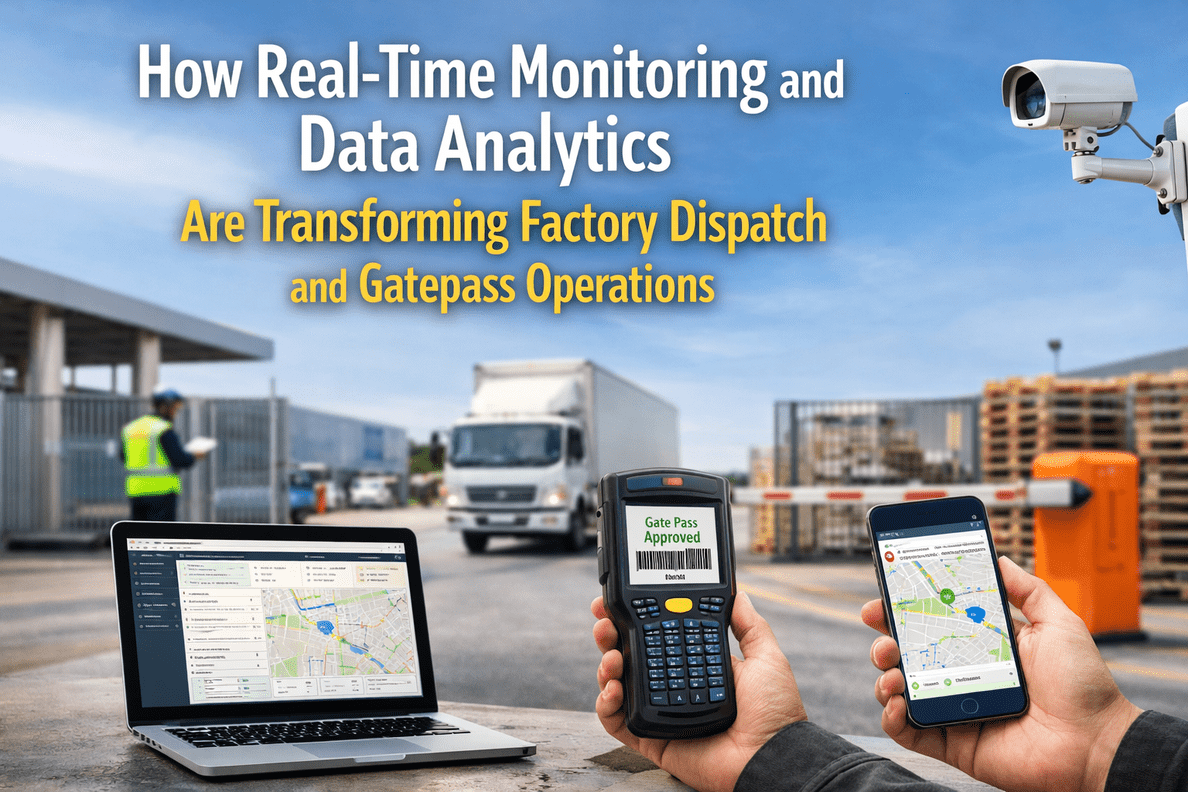
How Real-Time Monitoring and Data Analytics Are Transforming Factory Dispatch and Gatepass Operations

By Blunt Vogue on March 5, 2026

real-time-tracking-delivery-analytics

Factory dispatch and gatepass operations have spent decades generating zero usable data. Every inbound vehicle cleared on paper, every dispatch decision made from a whiteboard, every material movement untracked between dock and production floor — all of it disappears without a trace. The cost of this data vacuum is not abstract: it is 280+ minutes of recoverable dock time lost daily at a 20-vehicle factory, dispatch SLA misses discovered only when the customer complains, and production stoppages logged as material unavailability that are actually material search failures. In 2026, real-time monitoring and data analytics have reached the factory delivery department — and the results are transforming what operations managers can see, measure, and act on. The global delivery management software market stands at $11.6B in 2025 and is growing to $25.5B by 2035, with factory internal delivery operations as the fastest-growing adoption segment. This guide breaks down exactly how real-time data changes every function in your delivery department, which KPIs it unlocks for the first time, and how iFactory's platform connects monitoring to measurable results from the first shift. Questions about your specific facility? Talk to our support team directly.

iFactory  ·  Factory Delivery Department Module

Your production floor has dashboards. Your delivery department deserves the same visibility.

iFactory digitizes every gate pass, inbound receipt, material transfer, vehicle inspection, dispatch event, and incident report — giving your operations team real-time visibility into the department that controls everything that enters and exits your plant. Deploy in 7–14 days. No IT project. No hardware procurement. Results visible from day one.

87%
Gate pass processing time reduction — from 15–20 min to under 2 min per vehicle
78%
Faster inbound receiving — from 45–60 min per shipment to under 10 min with mobile verification
100%
Audit trail coverage — every gate event, receipt, transfer, and dispatch timestamped and person-attributed
14 Days
Full deployment — from decision to live real-time factory delivery dashboard with zero IT project
The Visibility Gap

86% of Manufacturers Track OEE in Real Time. Almost None Track What Happens at the Gate and Dock.

Data Your Factory Already Generates in Real Time
Production OEE — tracked by 86% of manufacturers continuously
Machine downtime reasons — logged per shift, per asset, per stoppage
Quality inspection results — timestamped, attributed, traceable
Outbound shipment proof of delivery — documented per order
Energy consumption per production line — metered and reported
Maintenance work order history — per asset, per component, per technician
Inventory stock levels — updated per ERP transaction in real time
Employee attendance and shift assignment — HR system tracked daily
Data Your Delivery Department Has Never Generated — Until Now
Gate pass dwell time per vehicle — zero measurement, zero trend data
Inbound receiving cycle time — no start/end timestamp per shipment
Dispatch SLA compliance rate — misses undetected until customer complaint
Vehicle inspection pass/fail rates — paper checklists generate no analytics
Material location after dock entry — chain of custody stops at the gate
Receiving discrepancy frequency — no per-supplier quality trend visible
Gate queue length over time — no pattern data for staffing decisions
Incident response time — discoveries delayed, no escalation timestamp
8 Operational KPIs

The 8 Factory Delivery Department KPIs Real-Time Monitoring Unlocks — and What the Data Actually Shows

87%
Gate Pass Processing Time Cut
Pre-arrival digital registration and mobile gate verification drops processing from 15–20 min to under 2 min — generating the first real dwell-time KPI most factories have never measured.
Manual: 15–20 min/vehicle, zero dataDigital: under 2 min, per-vehicle timestamp
78%
Inbound Receiving Cycle Reduced
Mobile PO verification and photo proof of delivery timestamps every receiving event — creating the first continuous dataset of receiving cycle time per shipment, per supplier, and per dock bay.
Manual: 45–60 min, no trend dataDigital: under 10 min, per-shipment log
90%
Dispatch Error Rate Eliminated
SLA-priority dispatch sequencing produces a live error rate metric — showing dispatch performance as a continuous trend, not just at the moment a customer complains about a missed delivery window.
Manual: 2–3% error rate, no alertDigital: under 0.3%, pre-miss alerts active
100%
Audit Trail Coverage Achieved
Every gate event, receiving transaction, material transfer, dispatch decision, and inspection result is timestamped and person-attributed — the first complete operational dataset the delivery department has ever produced.
Manual: incomplete, unstructured recordsDigital: 100% coverage, structured data
40%
Inbound Delay Reduction
Gate queue analytics reveal peak arrival windows and staffing gaps that compound delay. Operations managers act on this data — adjusting arrival windows and resequencing dock assignments in real time rather than discovering the bottleneck at shift review.
Manual: 280+ min lost/day, no cause dataDigital: 40% reduction, root cause visible
30–40%
Production Material Search Eliminated
Most production stoppages attributed to material unavailability are locating failures, not stock-outs. Real-time internal transfer tracking turns physical searches into dashboard lookups — eliminating 30–40% of preventable production floor interruptions.
Manual: location unknown after dock entryDigital: real-time location at every transfer
3–6 mo
Full Platform Payback Period
Recovered dock time, eliminated dispatch errors, reduced compliance overhead, and avoided production stoppages combine to deliver full platform payback within 3–6 months. The data from day one builds the ROI case with no manual reporting required.
Legacy: 18–24 month paybackiFactory: 3–6 months, live from day one
$25.5B
Market Growth — Delivery Analytics
The global delivery management software market grows from $11.6B in 2025 to $25.5B by 2035. Factory internal delivery monitoring is the fastest-growing segment — driven by manufacturers discovering the data gap for the first time.
2025: $11.6B market size2035: $25.5B projected
Your delivery department generates operational data every shift. iFactory captures it — and turns it into the live dashboard your operations team has never had.
Gate dwell time, receiving cycle time, dispatch SLA compliance, material location, vehicle inspection pass rates — live from day one. Deploy in 7–14 days. Talk to our support team to understand what analytics your facility can start generating immediately.
How Data Flows

5 Data Capture Points That Build Your Real-Time Factory Delivery Dashboard From the First Shift

Each iFactory workflow generates a structured data stream as a direct byproduct of the operational action — not as a separate reporting step. Together, these five streams create the first complete intelligence layer your delivery department has ever produced.

01
Gate Pass Data Stream — Arrival, Dwell Time, Exit, and Vehicle Compliance
Every pre-arrival registration creates a scheduled arrival record. Every gate verification generates an actual arrival timestamp. Every exit generates a departure timestamp and calculated dwell time. The data stream captures vehicle type, driver identity, cargo description, security staff attribution, and vehicle compliance status. Analytics built on this stream include average dwell time by vehicle class, peak arrival windows by hour, gate queue length patterns by day and shift, and compliance pass rate by vehicle type — data that no factory had access to before digitizing gate pass operations. For a factory receiving 20 vehicles per day on manual gate passes, the first week of data typically reveals 280+ minutes of recoverable dock time lost daily to processing delays alone.
Gate dwell time analytics Peak queue identification Vehicle compliance tracking Security staff performance
02
Inbound Receiving Data Stream — PO Match, Discrepancy Rate, and Cycle Time per Supplier
Every receiving event generates a structured record: PO number, supplier, carrier, material description, quantity ordered versus received, discrepancy type with photo evidence, and receiving cycle time from dock arrival to completion. Analytics built on this stream reveal average receiving cycle time per supplier, discrepancy rate by supplier and material category, the most common shortage and overdelivery patterns, and dock bay utilization by time of day. This is the data that transforms receiving from a physical activity into a supplier quality measurement system — enabling procurement and operations to act on evidence rather than individual complaints. Receiving discrepancy rates that previously went undocumented become actionable supplier scorecards within the first month of go-live.
Supplier discrepancy rate Receiving cycle time trend Dock bay utilization Chain of custody log
03
Dispatch Data Stream — SLA Performance, Error Rate, and Order Velocity per Vehicle
Every dispatch event generates a structured record: order ID, SLA tier, assigned vehicle, departure timestamp, driver attribution, and completion status. Pre-miss alerts are generated automatically when any order is projected to miss its SLA window — configurable at 30, 45, or 60 minutes before the deadline. Analytics built on this stream include dispatch SLA compliance rate by tier, error rate trend week-over-week, on-time performance by vehicle and driver, and daily order velocity. Manual dispatch operations running at 2–3% error rates typically see this metric visible for the first time in Week 1 — and trending toward under 0.3% by Week 6. The pre-miss alert log also reveals which vehicle assignments and time windows produce the highest SLA risk, enabling structural dispatch schedule improvements that paper systems cannot generate.
SLA compliance rate Dispatch error trend Pre-miss alert log Driver performance data
04
Vehicle Inspection Data Stream — Pass Rate, Defect Frequency, and Block Events
Every inspection generates a structured record: vehicle ID, checklist completion rate, pass/fail result per item, failed item description with photo, operator attribution, timestamp, and linked maintenance work order. Analytics built on this stream include fleet-wide pass rate by vehicle type, most frequent defect categories by vehicle class, vehicles with recurring inspection failures, and blocked-vehicle events per shift — enabling the first quantitative view of yard and delivery fleet condition without conducting manual fleet audits. Vehicles that fail inspection are automatically blocked from dispatch until a verified repair work order is completed — creating an enforcement mechanism that paper checklists structurally cannot provide.
Fleet pass rate analytics Recurring defect identification Block event log Inspection completion rate
05
Internal Transfer Data Stream — Material Location, Chain of Custody, and Search Event Elimination
Every barcode scan at an internal transfer point generates a location record: material ID, current location, previous location, operator attribution, and timestamp. Production requests for materials resolve to a real-time location rather than a physical search. Analytics built on this stream reveal materials most frequently lost between transfer points, locations with the highest dwell time before next transfer, and production requests resolved by location lookup versus physical search — directly quantifying the 30–40% of production stoppages that are locating failures rather than actual stock-outs. The chain of custody extends from dock entry through every internal movement all the way to production line delivery — giving stores managers and plant managers the full material visibility picture that no paper-based system has ever provided.
Real-time material location Transfer point gap analysis Search event elimination Full chain of custody
Measured Results

What iFactory Customers Measure Within 90 Days of Go-Live — Real Numbers from Real Delivery Departments

87%
Gate Processing Time Cut
Average gate processing drops from 15–20 minutes to under 2 minutes per vehicle. A factory receiving 20 vehicles daily recovers 280+ minutes of dock time — visible on the first day the digital gate pass workflow runs.
78%
Receiving Cycle Time Reduced
Inbound receiving drops from 45–60 minutes to under 10 minutes per shipment. The receiving cycle time dashboard shows which suppliers and dock bays drive remaining variance — enabling targeted improvement rather than blanket process changes.
90%
Dispatch Errors Eliminated
Dispatch SLA compliance trends from 2–3% error toward under 0.3% within the first 30 days. Pre-miss alerts prevent remaining errors from reaching customers — creating a data-driven improvement loop that paper-based dispatch cannot run.
100%
Audit Trail Coverage
Every event timestamped, every person attributed, every record retrievable in under 60 seconds. The audit dashboard produces the first complete operational picture of what actually happens in the delivery department every shift.
72%
Manufacturers Already Digitizing
72% of manufacturers have partially implemented smart factory strategy — but delivery departments lag behind every other function. Factories deploying real-time delivery monitoring now build a 2–3 year data and operational advantage over competitors still on paper.
14 Days
From Decision to Live Dashboard
iFactory deploys in 7–14 days. The real-time monitoring dashboard is live from the first shift — populating from the first gate pass processed, first receiving event logged, and first dispatch order created. No historical data required.
Before vs. After

Factory Delivery Department — Paper and Manual Operations vs. iFactory Real-Time Platform

Swipe to view full table
Department Function
Manual Operations — Zero Data
iFactory Real-Time Dashboard
Gate Pass Monitoring
No dwell time data. No queue analytics. Performance measured by gut feel and complaints from production teams.
Live dwell time per vehicle. Queue length trend. Peak arrival analytics. Security staff performance by shift.
Inbound Receiving Analytics
No cycle time measurement. Discrepancies found at stock count, not at dock. Supplier quality performance invisible.
Live receiving cycle time per shipment. Discrepancy rate per supplier. Dock bay utilization. Photo evidence per event.
Dispatch SLA Performance
SLA compliance unknown. 2–3% errors found only at customer complaint. No driver performance view at all.
Live SLA compliance rate. Pre-miss alert 45 min before risk. Under 0.3% error rate. Driver performance trend.
Vehicle Inspection Data
Paper checklists generate zero analytics. Fleet condition unknown. Recurring defects undiscovered until breakdown.
Fleet pass rate dashboard. Defect frequency by vehicle. Recurring failure identification. Block event log per shift.
Internal Material Location
Location unknown after dock entry. 30–40% of production stoppages are locating failures logged as shortages.
Real-time location at every transfer point. Search events eliminated. Chain of custody complete dock to production line.
Incident Response
Incidents discovered days after occurrence. No escalation timestamp. Root cause based on recall, not operational data.
Real-time incident capture. Auto-escalation with timestamp. Response time measured. Linked to vehicle and driver record.
Compliance Documentation
4–8 hours of manual assembly per audit event. Incomplete records across paper binders and fragmented spreadsheets.
Retrievable in under 60 seconds. All records auto-generated from daily operational data. Audit-ready at all times.
Operations Dashboard
No dashboard exists. Operations visibility depends on verbal updates and end-of-shift paper reports from each team.
Live multi-depot dashboard. Every KPI visible in real time. Supervisor alerts pushed without manual check-in required.
iFactory  ·  Factory Delivery Department Module

Your production floor has dashboards. Your delivery department deserves the same visibility.

iFactory digitizes every gate pass, inbound receipt, material transfer, vehicle inspection, dispatch event, and incident report — giving your operations team real-time visibility into the department that controls everything that enters and exits your plant. Deploy in 7–14 days. No IT project. No hardware procurement. Results visible from day one.

87%Gate pass time reduction
78%Faster inbound receiving
100%Audit trail coverage
14 DaysFull deployment
Frequently Asked Questions

Real-Time Monitoring and Data Analytics in Factory Dispatch and Gatepass — What Operations Leaders Ask First

What data does real-time gatepass monitoring actually generate — and what operational decisions does it enable?
Real-time gate pass monitoring generates six categories of data that most factories have never had access to before. First, per-vehicle dwell time — the exact duration from arrival timestamp to gate clearance, calculated automatically for every vehicle every day. Second, vehicle compliance status at time of entry, including vehicle type, registration, and cargo manifest. Third, driver identity and credential verification result. Fourth, cargo description and delivery destination record. Fifth, gate queue length patterns derived from arrival timing and clearance rates across shifts. Sixth, security staff performance data by shift — clearance speed and checklist completion rate per operator. The operational decisions this data enables are immediate. Operations managers can identify peak arrival windows and deploy additional security staff before queue formation. Transport coordinators can identify which supplier vehicles consistently take longer to clear and address the root cause — whether incomplete documentation, cargo discrepancy, or compliance gaps. Plant managers can see average dwell time trending week-over-week and measure the direct impact of process changes with quantified evidence. Regulatory auditors receive a timestamped, per-vehicle record rather than a paper logbook. iFactory captures all six data categories automatically from the gate verification workflow — no additional data entry required. For questions about your specific gate volume and staffing configuration, talk to our support team.
How does dispatch SLA monitoring work in real time — and what does a pre-miss alert look like in practice for a factory dispatch supervisor?
iFactory's real-time dispatch monitoring compares the current status of every active dispatch order against its SLA deadline at continuous intervals. Each dispatch order carries a priority tier — critical, standard, or economy — a committed delivery or collection window, a vehicle assignment, and a driver attribution. The system tracks departure time, estimated transit duration based on route data, and projected completion time against the SLA deadline. When the projected completion approaches the SLA window with insufficient buffer — configurable at 30, 45, or 60 minutes before the deadline — an automated pre-miss alert is generated and pushed to the dispatch supervisor's mobile dashboard immediately. The alert identifies the specific order at risk, the current vehicle and driver assignment, estimated time of arrival, and the SLA commitment window. The supervisor has time to act: reassign to a faster available vehicle, contact the customer with a short-delay notification, or escalate to management if a miss is unavoidable. Without this system, the same miss is discovered only when the customer contacts the factory — after the SLA has failed, any penalty has been triggered, and the relationship has been damaged. The dispatch error rate data generated by this system — tracking pre-miss alerts resolved versus actual SLA misses — gives dispatch supervisors and operations managers the first quantitative view of dispatch performance in their department's history. Book A Demo to see the dispatch SLA monitoring dashboard running in a live factory environment.
Why does real-time internal material tracking eliminate production stoppages that are currently logged as material shortages?
The gap between a material appearing in ERP or WMS inventory records and its physical location inside the plant is where most production stoppages actually originate — and why 30–40% of stops logged as material unavailability are actually locating failures rather than genuine stock-outs. When a component is received at the dock and entered into the inventory system, the system shows it as available. But the system has no mechanism to track where the component is physically located after that entry. The component moves from dock to staging, staging to main stores, main stores to sub-stores, sub-stores to kitting, kitting to the production line — and none of these movements generate a location update in most factories running on paper transfer records. When the production line requests the component and it is not in the expected location, the system reports adequate stock — because the component exists — but production stops because nobody can physically find it. iFactory's internal transfer tracking closes this gap by requiring a barcode scan at every physical transfer point. The scan takes 3–5 seconds per item and generates an immediate location update visible in the material location dashboard. Production requests resolve to the current scan location rather than the last ERP entry point. The physical search stops. The production stoppage does not start. The analytics also reveal which transfer points most frequently lose material continuity — allowing the operations team to focus process improvement effort exactly where the chain of custody breaks. For questions about how internal tracking maps to your specific plant layout and material flow patterns, talk to our support team.
How quickly does iFactory's real-time monitoring dashboard generate actionable analytics after go-live — and does it require historical data to function?
iFactory's real-time dashboard is fully functional from the first operational shift after go-live — which occurs within 7–14 days of deployment start. There is no historical data requirement. The system begins generating analytics from the first gate pass processed, the first receiving event logged, and the first dispatch order created in the platform. What develops over time is analytical depth rather than basic functionality. On Day 1, live dwell time per vehicle, receiving cycle time, dispatch status, material location, and inspection results are all visible in real time. After Week 1, daily averages and shift-over-shift comparisons become visible as the first dataset accumulates — typically revealing the gate dwell time breakdown by shift and vehicle type that operations managers find most immediately impactful. After Month 1, weekly trends emerge: supplier discrepancy rate patterns, vehicle inspection pass rate by class, and dispatch SLA performance over 30 days generate the first statistical baseline your delivery department has ever had. After 90 days, the full KPI suite — quarterly averages, peak period patterns, supplier performance rankings, and vehicle fleet condition scores — delivers the operational intelligence most factories have never had access to. The transition from reactive management to data-led decision-making typically becomes visible in supervisor behaviour within the first two to three weeks as team members begin referencing dashboard data rather than verbal shift-end reports. Book A Demo to see what the analytics dashboard looks like from a live factory deployment.
Can iFactory's real-time monitoring integrate with existing ERP, WMS, or production management systems — and does it function without those integrations?
iFactory integrates with ERP systems including SAP, Oracle, Microsoft Dynamics, and others through APIs and pre-built connectors. The integration architecture is bidirectional: iFactory pulls PO and dispatch order data from the ERP to pre-populate receiving and dispatch workflows, and pushes completed transaction records back to the ERP as timestamped receiving confirmations, dispatch completions, and material transfer logs. This closes the gap between ERP inventory records and physical plant operations that currently drives the material locating failures most factories experience daily. For production management systems and MES platforms, iFactory's material transfer and receiving data can trigger production schedule updates when critical inbound materials are confirmed — enabling JIT production adherence without manual planner intervention. Critically, the real-time monitoring dashboard operates independently of ERP integration and is fully functional as a standalone system from day one. Integration is additive — it extends the value of both platforms — but is not required for the core delivery department monitoring to function. Most factories deploy iFactory as a standalone system first and add ERP integration as a subsequent phase once the operational workflows are stable. Talk to our support team about your specific integration environment and available connection options for your ERP and production systems.
How does iFactory handle real-time monitoring across multiple factory sites or depots — and what does the multi-site dashboard show to operations directors?
iFactory is built as a multi-depot, multi-site platform from the ground up — a single deployment covers all facilities in your portfolio under one unified dashboard with site-specific data streams and access controls. The multi-site dashboard gives operations directors and regional managers a portfolio-level view in real time: total gate volume by site, average dwell time comparison across sites, dispatch SLA compliance rate per depot, vehicle inspection pass rate by location, and material tracking coverage across the full network. Each site manager sees only their own site's real-time data and analytics, while corporate operations and group management see the full comparative view. Alert logic is configured per site — a critical dispatch pre-miss at Site A triggers the Site A dispatch supervisor, while the regional operations director receives a summary of all active pre-miss events across the portfolio simultaneously. Compliance documentation is maintained site-specifically for local regulatory requirements while remaining accessible centrally for group audits. For factories operating across multiple countries, iFactory supports different regulatory documentation templates per site — OSHA and DOT in the USA, Schedule M GMP in India, LkSG in Germany, Vision 2030 standards in UAE — while sharing the same real-time operational monitoring framework across all locations. Book A Demo to see multi-site real-time monitoring configured for a portfolio similar to yours.
iFactory  ·  Factory Delivery Department Intelligence

The last unmonitored department in your factory is also the one that controls everything that enters and exits your plant.

iFactory gives your gate, receiving dock, dispatch bay, and yard the same real-time monitoring your production floor has had for years. Live dashboards. Automated alerts. Full audit coverage. Deploys in 7–14 days with no IT project and no hardware procurement. Book a demo to see real-time factory delivery monitoring running in a live plant environment.

87%Gate pass time reduction
90%Fewer dispatch errors
100%Audit trail coverage
14 DaysFull deployment

Share This Story, Choose Your Platform!