How Illinois Is Transforming Factory Dispatch Operations with Real-Time Tracking

By Dean Barrecs on March 6, 2026

illinois-real-time-tracking-deliveries

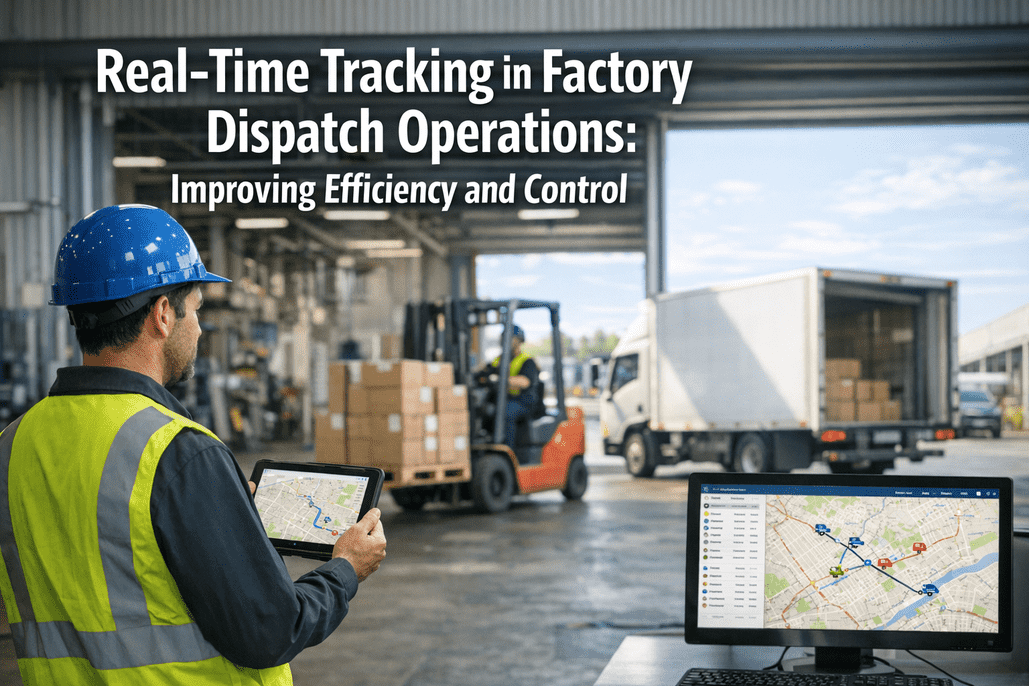
Illinois is the manufacturing backbone of the Midwest — with 574,000+ manufacturing employees as of 2025, the largest industrial output of any Midwest state, and more industrial sites than any other state in the region. Yet inside thousands of Illinois factories, the dispatch department — the one function that connects inbound receiving, internal material movement, yard vehicle operations, and gate pass management — is still running on paper logs, phone calls, and clipboards. U.S. business logistics costs hit $2.58 trillion in 2024, and more than 35% of manufacturers now identify transportation and logistics expenses as a primary business challenge. Illinois manufacturers operating manual factory dispatch departments are contributing to that figure daily — through idle gate queues, dispatch sequencing errors, material location failures, and zero real-time visibility into what is actually moving inside their facilities. Real-time tracking in the factory dispatch department is not a logistics industry innovation. It is a factory floor operational imperative. This guide breaks down exactly how Illinois manufacturers are transforming their factory dispatch operations with real-time digital tracking — and what that transformation delivers in measurable operational results. For questions, talk to our support team.

Logistics Technology  ·  Illinois Manufacturing  ·  2025–2026

How Illinois Is Transforming Factory Dispatch Operations with Real-Time Tracking

Illinois has 574,000+ manufacturing employees and the Midwest's largest industrial output. But most Illinois factories still run their dispatch department on paper — with no real-time visibility into gate queues, internal material movement, yard vehicle status, or dispatch SLA compliance. The plants that digitize first are creating a measurable operational advantage that manual competitors cannot close.

Book A Demo
574K+
Illinois manufacturing employees in 2025 — Midwest's largest industrial workforce, generating 23,000 graduates annually from manufacturing programs
$2.58T
U.S. business logistics costs in 2024 — up 5.4% from 2023, now 8.8% of GDP (CSCMP State of Logistics 2025)
35%+
Of manufacturers identify transportation and logistics costs as their primary business challenge (Deloitte 2025)
87%
Gate pass processing time reduction with digital real-time tracking — from 15–20 minutes manual to under 2 minutes
Illinois Context

Why Illinois Factory Dispatch Departments Are Under More Operational Pressure Than Any Other Midwest State

Illinois holds a unique position in U.S. manufacturing geography — and that position creates specific factory dispatch operational pressures that plants in other states simply don't face at the same intensity. Understanding these pressures is the first step toward understanding why real-time tracking delivers disproportionate value in Illinois manufacturing environments.

#1
Midwest Manufacturing Output
Illinois generates the largest manufacturing output in the Midwest — creating a high-velocity factory environment where inbound supplier deliveries, internal material movements, and outbound dispatch events occur at a pace that manual tracking systems cannot sustain without errors, delays, and visibility gaps. The density of manufacturing activity per facility is a compounding pressure multiplier.
Multi-modal
Road, Rail, Air, Port — All Converging at the Gate
Illinois is ranked a top state in the nation for infrastructure — with simultaneous access via road, rail, air, and port. For factory dispatch departments, this means inbound deliveries arrive from multiple transport modes on tight, overlapping schedules. Without real-time gate management and digital pre-registration, the result is queuing, sequencing conflicts, and dock congestion that compounds across every shift.
I-4.0
Industry 4.0 Pressure from Chicago's Manufacturing Corridor
Illinois manufacturers — particularly those in the Chicago metro manufacturing corridor and the Rockford industrial zone — face direct competitive pressure from Industry 4.0 adoption. Illinois-based manufacturers like Rahco Rubber and Caterpillar's Illinois facilities have publicly committed to smart factory programs. Plants without real-time dispatch tracking are increasingly at a competitive documentation disadvantage in supplier qualification audits and customer SLA evaluations.
JIT
Just-In-Time Production Schedules That Cannot Absorb Gate Delays
Illinois's high-output automotive, food manufacturing, and steel processing sectors — all operating on JIT production schedules — treat a 20-minute manual gate processing delay per inbound vehicle as a production-threatening event, not an administrative inconvenience. At 20 vehicles per day, a manual gate department loses 280–400 minutes of inbound velocity daily that JIT schedules have zero tolerance for.
The Dispatch Data Problem

What Illinois Factory Dispatch Departments Are Flying Blind On Right Now — The 6 Visibility Gaps That Cost Real Money Every Shift

Real-time tracking is not about knowing where a delivery truck is on a highway. In a factory context, it is about knowing what is happening inside your own facility — at the gate, on the dock, in the yard, on the production floor — in real time, not after the fact. These are the six visibility gaps that Illinois factory dispatch departments are experiencing right now.

01
Gate Queue — No Visibility Until the Driver Calls
Cost: 15–20 min per vehicle · 280+ min/day per 20-vehicle facility
Manual gate pass processing requires a security officer to physically verify credentials, log vehicle details on paper, call the relevant department for dock assignment, and issue a paper pass — a process averaging 15–20 minutes per vehicle arrival. Without pre-registration and digital verification, there is no visibility into queue buildup until drivers begin calling the facility. By that point, the queue is already costing the production schedule. Illinois factories with multiple inbound deliveries per hour during peak receiving windows experience systematic gate congestion that compounds throughout the shift.
02
Inbound Material Location — Disappears After the Dock
Cost: 30–40% of production stoppages are location failures, not stock-outs
In most Illinois manufacturing facilities, inbound materials are digitally tracked from supplier order creation to delivery receipt — and then disappear into the physical facility with no further location record. Materials signed in at the receiving dock may be in stores, staging, quality hold, or already partially consumed in production — but the dispatch department has no real-time view of any of this. The result: production teams spend hours searching for materials that are physically present but untraceable, generating the unnecessary internal vehicle movements and production delays that real-time internal tracking eliminates entirely.
03
Yard Vehicle Status — Unknown Until It Breaks Down
Cost: Unplanned breakdowns cost 3–4× more than scheduled maintenance
Forklifts, yard tractors, shunters, and dock equipment operating in Illinois factory yards are typically tracked through paper pre-use inspection checklists — when they are tracked at all. Without digital inspection logging and real-time status monitoring, factory dispatch managers have no visibility into which yard vehicles are serviceable, which are on active operations, and which are approaching maintenance thresholds. The first indication of a problem is frequently a breakdown during a critical receiving window — the exact scenario that digital yard vehicle tracking eliminates.
04
Dispatch Sequencing — SLA Misses Go Undetected Until the Complaint
Cost: 2–3% dispatch error rate in manual operations · $50K–$200K annually
Manual dispatch sequencing in factory delivery departments is performed by dispatchers working from whiteboards, spreadsheets, and phone coordination — a system that produces 2–3% error rates in dispatch sequencing (wrong vehicle, wrong priority, wrong destination, wrong load). In Illinois factories operating on tight production and customer delivery SLAs, each dispatch error generates re-dispatch costs, SLA penalty exposure, and management escalation time. Real-time tracking with SLA-priority automated sequencing reduces this error rate to under 0.3% — and alerts dispatchers proactively when any vehicle deviates from its assigned route or schedule.
05
Incident Documentation — Discovered Days Late, Unattributed
Cost: Hours of retroactive investigation · Compliance gaps in DOT/OSHA records
Incidents in factory dispatch environments — vehicle damage at the gate, dock loading accidents, material handling incidents, vehicle defects discovered mid-operation — are documented after the fact in Illinois factories that lack real-time reporting tools. By the time an incident is formally reported, key details are lost, attribution is disputed, and the timestamped evidence chain that insurance and regulatory investigations require no longer exists. Real-time incident reporting with photo capture, GPS location, and automatic escalation preserves the complete documentation record at the moment the incident occurs.
06
Performance Analytics — No Baseline, No Improvement Path
Cost: Operations improvement is impossible without measurement baselines
Illinois factory managers who have never tracked gate processing time, dispatch error rates, yard vehicle utilization, or inbound receiving duration have no baseline against which to measure improvement — and no data to present in customer SLA audits, supply chain qualification reviews, or internal operations reviews. The absence of analytics is not just an efficiency problem — it is a competitive disadvantage in the growing number of customer and supplier qualification processes that require documented operational performance data as a prerequisite for doing business.
How iFactory Solves It

The 5 Real-Time Tracking Capabilities That Transform Illinois Factory Dispatch Departments from Paper-Based to Data-Driven

iFactory's digital platform was built specifically for the factory delivery department — not the highway fleet, not the warehouse, not the ERP. It addresses every one of the six visibility gaps above through five core real-time tracking capabilities that run simultaneously across every dispatch operation every day.

01
Digital Gate Pass with Real-Time Queue Visibility
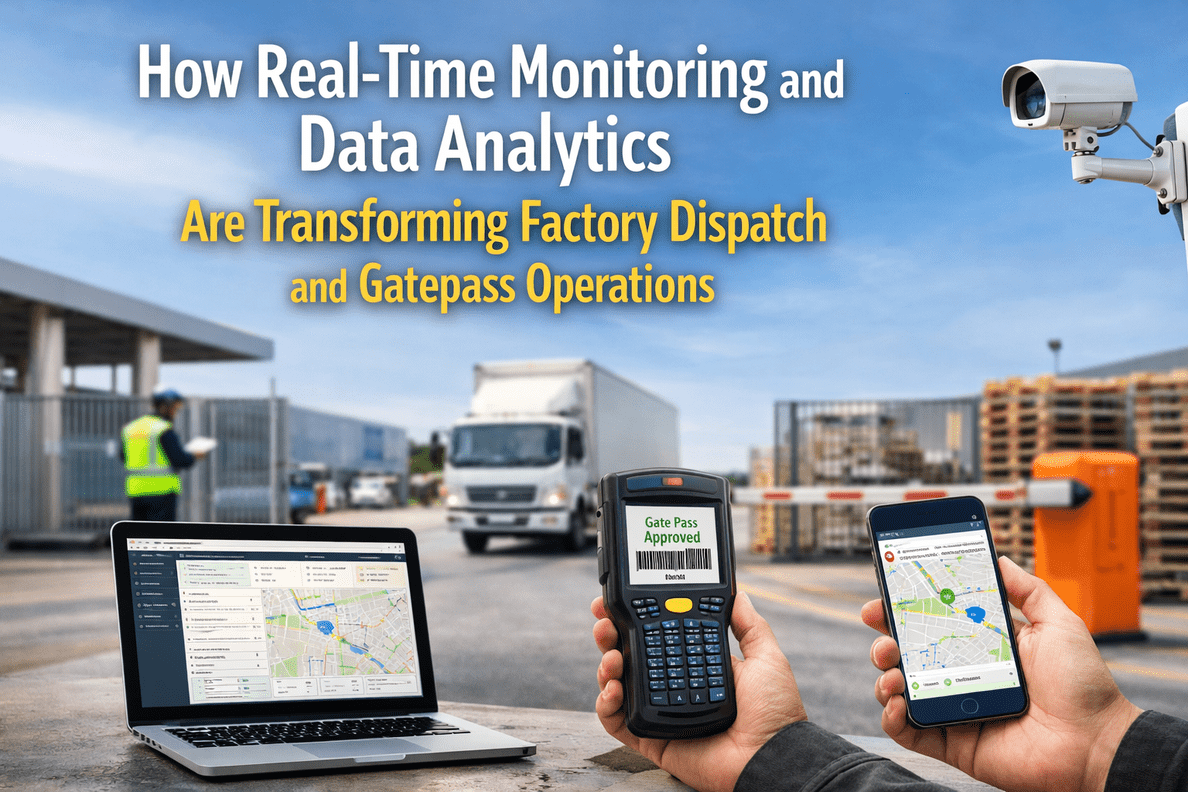
Drivers pre-register via mobile before arrival, submitting vehicle details, driver credentials, and cargo manifest digitally. Security verifies against the pre-registration record on a mobile device at the gate — completing the entire process in under 2 minutes. The system displays real-time gate queue status to dispatchers and dock coordinators, enabling dock assignment before the vehicle arrives. Every gate event is timestamped — arrival time, processing start, clearance time, exit time — generating dwell-time data that Illinois factories operating near residential areas can use for environmental compliance documentation.
Result: 87% reduction in gate processing time · From 15–20 min to under 2 min
02
Mobile Inbound Receiving with Instant PO Verification
Receiving staff verify inbound materials against purchase orders on a mobile device — scanning barcodes, comparing quantities, photographing discrepancies, and logging receiving exceptions in real time. Every inbound shipment generates a digital record linking supplier, carrier, material, quantity received vs. ordered, and timestamp. Receiving exceptions — short deliveries, damaged goods, wrong materials — are immediately documented with photos and escalated to the purchasing team automatically. The same workflow generates a complete supply chain chain-of-custody record from supplier to factory floor without any additional step.
Result: 78% faster receiving completion · From 45–60 min to under 10 min per shipment
03
Yard Vehicle Inspection with Real-Time Status Dashboard
Every yard vehicle — forklift, yard tractor, shunter, dock leveler — completes a digital pre-use inspection checklist on mobile before each operational period. Inspection results are logged with timestamp, operator ID, and GPS location. Vehicles with failed inspection items are automatically blocked from dispatch until a verified repair work order is completed and closed. The dispatch manager's dashboard shows real-time status of every yard vehicle — available, on-task, in maintenance, blocked — eliminating the guesswork that generates mid-operation breakdowns and dispatch delays in Illinois factory yards.
Result: 45% reduction in unplanned yard vehicle downtime · Inspection record auto-generated
04
SLA-Priority Dispatch Sequencing with Real-Time Deviation Alerts
Dispatch orders are sequenced automatically by SLA priority tier, vehicle type, load capacity, compliance status, and route efficiency. Each dispatch event records vehicle ID, driver, departure timestamp, assigned route, and expected return time. If any vehicle deviates from its assigned route or schedule, the dispatcher receives a real-time alert — enabling proactive intervention rather than reactive SLA breach management. Dispatch SLA compliance rates are tracked per vehicle, per driver, and per customer — generating the documented performance record that Illinois manufacturers increasingly require for customer and supplier qualification audits.
Result: 90% reduction in dispatch errors · From 2–3% to under 0.3% error rate
05
Internal Material Tracking at Every Transfer Point
Materials are logged at every internal transfer point — dock to stores, stores to staging, staging to production, production to quality, quality to dispatch. Each transfer generates a timestamped, person-attributed digital record. The real-time location dashboard shows every active material batch's current physical location within the facility — eliminating the search time that masquerades as production downtime in most Illinois factories. When a production team reports a material unavailability, the tracking system instantly identifies whether the material is present but mislocated — the root cause of 30–40% of production stoppage events that are incorrectly classified as stock-outs.
Result: 30–40% production search time eliminated · Full internal chain of custody generated
Measurable Results

What Illinois Factory Dispatch Departments Measure Within 90 Days of iFactory Go-Live

These are the operational improvements Illinois manufacturers achieve within 90 days of deploying iFactory's real-time tracking platform across their factory dispatch department. Each metric has a direct monetary value — and each is measurable from day one of go-live.

87%
Gate Processing Time Reduction
Before: 15–20 min/vehicle manual
After: Under 2 min digital
A 20-vehicle/day Illinois factory recovers 280+ minutes of dock time daily — the equivalent of more than 4 productive labor hours per shift previously lost to gate queue management.
78%
Faster Inbound Receiving
Before: 45–60 min/shipment manual
After: Under 10 min digital
Mobile PO verification and photo POD cut receiving time to a fraction of manual processing — while generating the complete chain-of-custody record simultaneously.
90%
Dispatch Error Reduction
Before: 2–3% manual error rate
After: Under 0.3% digital
SLA-priority automated sequencing eliminates the sequencing errors, wrong-vehicle assignments, and missed priority dispatches that cost Illinois factories $50,000–$200,000 annually in re-dispatch and SLA penalty exposure.
45%
Reduction in Unplanned Downtime
Before: Reactive maintenance
After: Digital inspection + alerts
Digital yard vehicle inspection with auto-block for failed items eliminates the mid-operation breakdowns that cost 3–4× more than scheduled maintenance — and generate cascade delays across the entire dispatch operation.
100%
Audit Coverage
Before: Paper records, incomplete
After: Timestamped digital audit trail
Every gate event, receiving transaction, vehicle inspection, material transfer, and dispatch decision is timestamped and person-attributed — retrievable in under 60 seconds for any compliance, insurance, or customer audit request.
14 days
Go-Live Timeline
Before: Legacy systems 6–18 months
After: iFactory 7–14 days
Cloud-based, mobile-first deployment with no server infrastructure, no IT department project, and no hardware procurement required. Illinois manufacturers go live in two weeks — not two quarters.
iFactory  ·  Illinois Factory Operations

Illinois Manufacturers Are Competing at Industry 4.0 Speed. Your Dispatch Department Should Too.

iFactory gives Illinois factory dispatch departments real-time gate pass tracking, digital inbound receiving, yard vehicle status monitoring, SLA-priority dispatch sequencing, and internal material location — all in a single mobile-first platform that deploys in 7–14 days with no IT infrastructure required.

Book A Demo
87%
Gate processing time reduction — from 15–20 min to under 2 min per vehicle

90%
Dispatch error reduction — from 2–3% manual to under 0.3% with SLA-priority automation

3–6 mo
Full platform payback period for Illinois manufacturers through recovered dock time and eliminated errors

14 days
iFactory go-live timeline — no IT project, no hardware, no server infrastructure required
Frequently Asked Questions

Illinois Factory Dispatch Operations and Real-Time Tracking — What Operations Managers Ask First

Practical answers for Illinois plant managers, dispatch supervisors, and operations directors evaluating real-time tracking for their factory delivery department. For specific questions about your facility's dispatch operations, talk to our support team directly or book a demo.

What exactly is a "factory dispatch department" and how is real-time tracking different from tracking delivery trucks on a highway?
A factory dispatch department is the operational unit inside a manufacturing facility responsible for managing all vehicle and material movements in and out of the plant — including inbound supplier deliveries, internal material transfers between departments, yard vehicle operations (forklifts, shunters, yard tractors), gate pass management for all incoming vehicles and personnel, and outbound dispatch of finished goods. This is fundamentally different from tracking highway delivery fleets. Highway tracking follows a vehicle's GPS position on public roads. Factory dispatch real-time tracking monitors what is happening inside your facility — which vehicles are at which dock, what materials have been received and where they currently are inside the plant, which yard vehicles are serviceable vs. under maintenance, and whether inbound deliveries are being processed on schedule. For Illinois manufacturers operating JIT production schedules, the real-time visibility that matters most is not what is happening on Interstate 90 — it is what is happening between your gate and your production floor. That 15-minute gap between a truck's arrival and the materials reaching their production staging location is where JIT schedules fail, and it is exactly what iFactory's digital tracking eliminates. Book a demo to see iFactory's factory dispatch tracking dashboard in a live Illinois manufacturing environment.
How does digital gate pass management reduce dock congestion and what does the technology actually look like at the gate?
Digital gate pass management works through a mobile pre-registration and verification system that eliminates the paper-based processing delay at the gate entry point. Here is how it works in an Illinois factory context. Pre-arrival: the driver registers via a mobile web link sent with the delivery order confirmation — submitting vehicle registration, driver ID, cargo details, and delivery PO number before leaving the supplier. This data is available to the gate security team before the truck arrives. At the gate: security scans the driver's digital pass QR code or license plate — the system instantly displays the pre-verified record, the assigned dock, and any entry requirements. The entire verification takes 60–90 seconds. Gate-to-dock coordination: the system simultaneously notifies the relevant receiving department and dock coordinator that the vehicle has been cleared and is en route to the assigned dock — so dock staff are ready to begin receiving before the truck is backed in. Dwell time tracking: the system records exact arrival time, gate clearance time, dock assignment time, loading/unloading completion time, and departure time per vehicle — generating a complete dwell time record that shows every minute the vehicle spent inside your facility. For Illinois factories receiving 20–50 vehicles per day, the difference between 90-second digital processing and 15-minute manual processing represents 4–7 recovered dock hours daily. Talk to our support team for a gate pass workflow demonstration.
Why do 30–40% of Illinois factory production stoppages actually stem from material location failures rather than genuine stock-outs?
This figure reflects a consistent finding across manufacturing operations research and factory floor experience: materials that are physically present inside the facility but untraceable after the receiving dock entry generate production delays that are symptomatically identical to stock-out delays — but have an entirely different root cause. Here is why it happens in Illinois factories. The receiving dock captures the inbound transaction — PO number, supplier, quantity received, timestamp — and this record typically enters the ERP or inventory system. But the physical movement of that material from the dock to its interim location — stores, staging, quality hold, the production floor — is usually not tracked digitally. It happens through informal handoffs, verbal communication, or paper transfer notes. By the time a production supervisor reports that a specific material is unavailable, it may be physically present in one of multiple possible locations: still on the dock waiting for put-away, in the stores room on a shelf, in quality inspection hold, or partially consumed and stored in a non-obvious staging location. Without digital internal transfer tracking, identifying the material's actual location requires physical search — which takes 30–40 minutes on average in a mid-size Illinois factory. iFactory's internal tracking module logs every material transfer between functional areas digitally — generating a real-time location map that answers "where is this material right now?" in under 10 seconds. When a production team reports unavailability, the dispatcher can instantly determine whether the material is present and mislocated (requiring immediate internal re-dispatch) or genuinely out of stock (requiring emergency procurement). This distinction alone eliminates 30–40% of production stoppages in Illinois factories that deploy real-time internal material tracking. Book a demo to see the internal material tracking dashboard.
How does iFactory's real-time dispatch tracking support Illinois manufacturer compliance and audit requirements?
Illinois manufacturers face a growing range of compliance and audit requirements that directly intersect with factory dispatch department operations — and most are currently unable to produce the documentation these requirements demand on short notice. The specific audit categories that iFactory's real-time tracking supports: Customer SLA audits: major automotive, food manufacturing, and distribution customers in Illinois increasingly require documented delivery SLA compliance rates from their manufacturing suppliers — specifically, timestamped records showing each dispatch event and its on-time performance against committed delivery windows. iFactory generates these automatically from dispatch records. DOT and OSHA inspections: for factories with commercial vehicle movements, DOT requires Driver Vehicle Inspection Reports (DVIRs) and vehicle maintenance records that are timestamped and person-attributed. iFactory's digital vehicle inspection module generates compliant DVIR records automatically. ISO and supply chain audits: ISO 9001 and ISO 14001 certification audits require documented process records for material handling and logistics operations. iFactory's timestamped transfer records and dispatch logs satisfy these documentation requirements. Incident documentation: when accidents or property damage occur in the factory dispatch environment, insurance and legal investigations require contemporaneous documentation — timestamped, photo-evidenced, and person-attributed. Paper-based incident reports created after the fact routinely fail this standard. iFactory's real-time incident reporting captures complete records at the moment of the event. All documentation categories are retrievable from iFactory's audit dashboard in under 60 seconds — compared to hours of manual record assembly from paper binders. Talk to our support team about compliance documentation specific to your Illinois facility.
What is the realistic implementation timeline and cost for an Illinois mid-size factory to deploy iFactory's real-time dispatch tracking?
iFactory deploys in 7–14 days for a standard Illinois factory dispatch department — covering gate pass management, inbound receiving, yard vehicle inspection, dispatch sequencing, and internal material tracking simultaneously. The implementation timeline breaks down as follows. Days 1–3 (data onboarding): uploading vehicle registry, driver roster, supplier list, PO templates, and dock configuration. iFactory's onboarding team handles this with your operations team directly — no IT department involvement required. Days 4–7 (configuration and training): setting up inspection checklists specific to your yard vehicle types, dispatch SLA rules for your customer priority tiers, gate pre-registration workflows, and user access by role. Training for security staff, receiving teams, dispatch coordinators, and drivers takes 2–4 hours via the mobile app. Days 8–14 (go-live and verification): live operations with iFactory support monitoring data quality and resolving workflow gaps. The platform is cloud-based and mobile-first — no server infrastructure to install, no hardware procurement required, no IT project. For cost: iFactory's pricing scales with facility size and feature set. Full platform payback is consistently achieved within 3–6 months of go-live through a combination of recovered dock time (280+ minutes per 20-vehicle/day facility), eliminated dispatch errors ($50K–$200K annually depending on volume), and compliance documentation overhead reduction. Illinois manufacturers considering iFactory should request an ROI estimate based on their specific vehicle volume, shift schedule, and current error rates. Book a demo to see a deployment timeline specific to your facility, or talk to our support team for a cost estimate based on your operations profile.
Get Started  ·  iFactory

Illinois's Manufacturing Output Is the Midwest's Largest. Your Dispatch Department Should Match That Standard.

iFactory digitalizes every function of your Illinois factory dispatch department — real-time gate pass tracking, inbound receiving, yard vehicle inspection, SLA-priority dispatch sequencing, and internal material location — and goes live in 7–14 days with no IT infrastructure project required. The factories that deploy now are building the operational data advantage that manual competitors cannot close.

Book A Demo
574K+
Illinois manufacturing employees — the Midwest's largest industrial workforce competing in an Industry 4.0 environment

$2.58T
U.S. business logistics costs in 2024 — 5.4% higher than 2023 and climbing. Manual operations compound this trend.

280+
Minutes of dock time recovered daily at a 20-vehicle/day Illinois facility by switching from manual to digital gate processing

7–14 days
iFactory go-live timeline for Illinois factory dispatch departments — cloud-based, mobile-first, no IT project

Share This Story, Choose Your Platform!