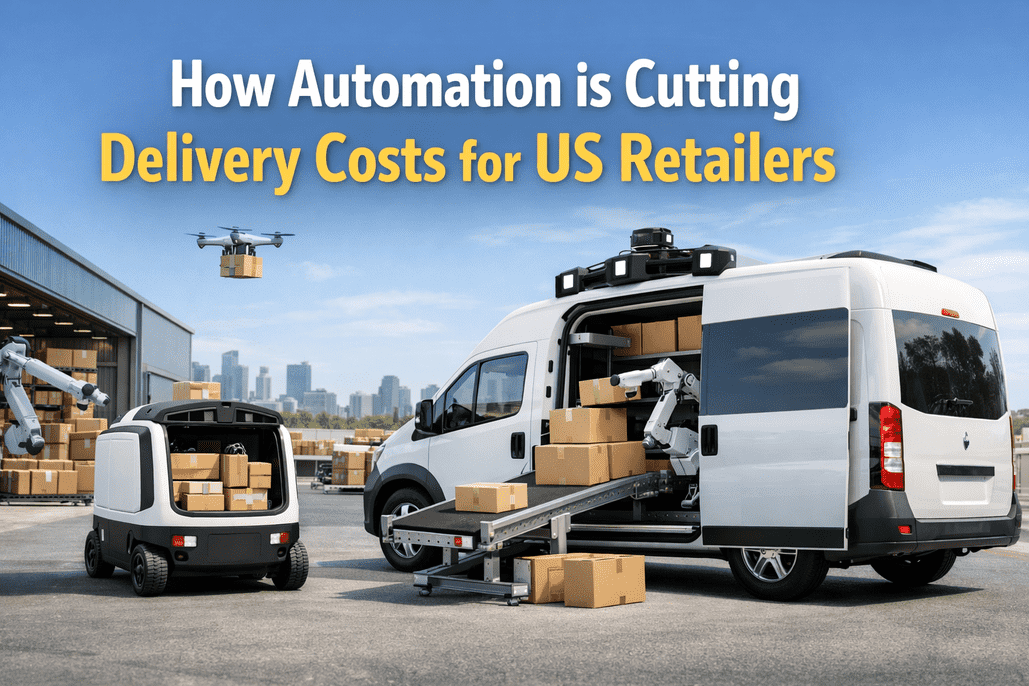
How Automation is Cutting Delivery Costs for US Retailers

By Jonas Plum on March 7, 2026

automation-deliveries-costs-us-retailers
A regional home goods retailer in the Midwest was operating 31 delivery vehicles across 6 states, processing 1,600 orders per week through spreadsheet-based route planning, phone-dispatched driver updates, and end-of-day paper manifest reconciliation. Their operations manager could tell you total weekly delivery cost — but not cost per delivery by zone, driver, or day of week. They knew they were losing money on certain routes but couldn't identify which ones without multi-hour manual analysis. Meanwhile, Amazon launched same-day delivery in their primary market. Their largest competitor cut delivery fees by 30% and advertised it aggressively. The retailer's average cost per delivery was $11.40 — more than twice the $4.80–$5.50 benchmark achieved by automated operations at similar volume. After deploying iFactory AI — AI route optimization, automated dispatch, digital proof of delivery, real-time cost analytics — the transformation took 60 days. Cost per delivery dropped from $11.40 to $5.90. Fleet mileage fell 24%. Failed deliveries dropped from 6.8% to 1.1%. The operations manager who previously spent 3 hours building weekly cost reports now had a live dashboard updating with every completed stop. They didn't just close the cost gap with Amazon — they built a delivery cost structure that could sustain profitable free delivery thresholds their competitor couldn't match. Book a demo with iFactory AI to see the cost-per-delivery reduction your specific fleet and volume would achieve with automation.
Automation in Retail Logistics  ·  Blog Post

The Role of Automation in Reducing Delivery Costs for US Retailers

US retailers running manual delivery operations pay $7–$12 per delivery. Automated operations at identical volume pay $4–$6. That gap — compounded across thousands of daily shipments — is why Amazon offers free same-day while manual operators calculate whether delivery fees even cover costs. In 2026, delivery automation is no longer a competitive advantage. It is the minimum entry requirement for sustainable retail logistics.

48%
average delivery cost reduction — full automation vs. manual operations

$216B
annual US retail revenue lost to delivery failures and inefficiencies

24%
average fleet mileage reduction when AI routing replaces manual planning

3.8×
average first-year ROI reported by US retailers deploying delivery automation
Why Automate Now

Three Forces Making Manual Delivery Operations Economically Untenable in 2026

The competitive pressure on retail delivery cost has reached a structural inflection point. Three forces are converging simultaneously — and each independently creates a compelling case for automation. Together they make inaction the most expensive option available to any US retailer still running manual delivery operations.

01
The Amazon Benchmark Effect
Amazon's per-delivery cost in dense US markets is $4.00–$5.50, built on a decade of automation investment at scale. Every US retailer now competes against a consumer expectation baseline — free delivery, same-day or next-day, live tracking — built by a competitor whose cost structure manual operators cannot replicate without automation. 66% of US consumers expect same-day or next-day delivery. 53% actively compare delivery experience before their next purchase. The retailers closing this gap are doing it through automation, not through scale.
Amazon: $4–$5.50/delivery  ·  Manual retailer: $9–$12/delivery
02
The Labor Cost Squeeze
The US trucking industry faces a shortage of 60,000+ drivers in 2026, with average driver wages up 18% since 2022. Manual dispatch operations require 1 dispatcher per 8–12 drivers — a ratio that compounds labor cost as fleets grow. Automation restructures this: AI-managed dispatch supports 40–60 drivers per dispatcher, cutting dispatcher headcount requirements in half while improving route execution quality. For a 20-vehicle fleet, this restructuring alone saves $55,000–$90,000 in annual dispatcher labor at equivalent operational volume.
Driver shortage: 60,000+ unfilled  ·  Wages up 18% since 2022
03
The Customer Expectation Ratchet
84% of consumers will not reorder from a retailer after two delivery failures. 21% permanently lose trust after just one. Manual operations structurally cannot achieve the 97–99% on-time rates that retain customers at the level modern retail economics require. The cost of customer churn from delivery failure is typically 3–5× greater than the direct cost of the failed delivery itself when lifetime value is included — a cost category that rarely appears in delivery cost spreadsheets but dominates true delivery economics.
84% won't reorder after 2 failures  ·  21% permanently lost after just one
The Cost Gap — Layer by Layer

Exactly Where Manual Delivery Operations Are Bleeding Money

The $5–$6 per-delivery cost gap between manual and automated retail logistics is not a single inefficiency — it is the compounding sum of five separate cost categories, each addressable through a specific automation mechanism. Most retailers are bleeding from all five simultaneously without knowing the precise breakdown.

Cost Layer
Manual Operation Cost
How Automation Eliminates It
Reduction
Route Planning Labor
2–4 dispatcher hours daily × $28/hr = $56–$112/day. At 250 working days — $14,000–$28,000 annually in pure planning labor, before counting routing errors that add cost downstream.
AI generates optimized routes across the full fleet in under 60 seconds. Dispatchers review and approve instead of build — shifting from a 3-hour daily planning session to a 15-minute review.
85–95%
Excess Fuel & Mileage
Manually planned routes average 22% more miles than AI-optimized equivalents. At $0.18/mile and 200 deliveries/day, excess mileage costs $9,000–$13,500 annually per 10-vehicle fleet segment.
AI optimizes stop sequence, vehicle assignment, and load consolidation simultaneously — eliminating backtracking, cross-zone routing errors, and suboptimal vehicle-to-route matching.
18–27%
Failed Delivery Re-Attempts
At 5–8% failure rate and $17.78 cost per failed delivery, a 200-delivery/day operation loses $18,000–$29,000 monthly before accounting for driver time, fuel waste, and customer churn downstream.
Proactive SMS notifications + real-time address verification reduce failure rates to under 1.5%. Customers notified 60 minutes out are present 94% of the time vs. 72% without alerts.
75–82%
Customer Support Overhead
20% of orders generate at least one inbound support contact at $9 per interaction. For 200 daily deliveries — $360/day, $90,000/year — 73% of which are "where is my order" calls providing zero operational value.
Automated dispatch confirmations, 60-minute SMS alerts, live tracking links, and arrival notifications eliminate the information vacuum driving inbound call volume before customers pick up the phone.
81%
Administrative Reconciliation
3–5 hours daily across POD collection, exception logging, dispute documentation, and reporting. At $32/hr loaded cost — $24,000–$40,000 annually in overhead producing zero operational value.
Digital POD auto-syncs to platform. Exception workflows trigger automatically. Dashboards update in real time. Entire reconciliation process replaced by a 10-minute morning review of automated reports.
90%+
Combined Annual Cost — 20-Vehicle Manual Operation (200 deliveries/day)
Route planning labor$28,000
Excess fuel & mileage$26,000
Failed delivery re-attempts$260,000
Customer support overhead$90,000
Administrative reconciliation$32,000
Total addressable waste$436,000/yr
Recoverable with iFactory AI
$290,000+
average annual savings — 20-vehicle fleet, 200 deliveries/day
Typical payback period: 45–75 days
The 5 Automation Layers

The 5 Automation Layers That Separate $4 Deliveries from $11 Deliveries

Retail delivery automation is a stack of five interconnected layers. Each independently reduces cost. Together they produce the 48% cost-per-delivery reduction defining the gap between automated operations and their manual competitors. Here is what each layer does, what it costs to leave running manually, and what deploying it returns.

Layer 1
AI Route Optimization
The highest-ROI single automation in retail delivery. AI simultaneously ingests all pending orders, vehicle types, weight capacities, delivery windows, real-time traffic, driver hours-of-service, and historical stop times — generating optimal route sequences across the entire fleet in under 60 seconds. Human planners build routes sequentially, one driver at a time, missing the cross-fleet optimizations AI finds automatically: a stop that belongs on Driver B's route because of a micro-cluster AI detects but human planners never see. Routes planned by AI consistently outperform manually planned routes by 18–27% on mileage, 15–22% on delivery time, and 12–18% on fuel consumption. For a 20-vehicle fleet, mileage reduction alone saves $22,000–$34,000 annually. The continuous re-optimization capability — rerouting the entire fleet in response to a traffic incident, driver break, or emergency order insertion — is operationally impossible to replicate manually at any staffing level.
24% fewer miles driven
18% more stops/driver/day
60s route generation vs. 3 hrs manual
$22K+ fuel savings annually (20 vehicles)
Layer 2
Automated Dispatch & Driver Communication
Manual dispatch consumes 40–60% of a dispatcher's day in routine communications: calling drivers with route updates, communicating address corrections, re-sequencing stops after exceptions, confirming ETAs when customers call in. Automated dispatch eliminates this entirely — route changes, traffic re-routing, exception escalations, and schedule adjustments push directly to driver mobile apps in real time without dispatcher involvement. Dispatchers shift from communication managers handling 40–80 calls per day to exception handlers available for the 5% of situations requiring genuine human judgment. The driver-to-dispatcher ratio improves from 8–12:1 to 40–60:1, fundamentally restructuring labor cost at scale. A fleet previously requiring 3 dispatchers can operate at greater efficiency with 1 — freeing 2 positions for customer-facing roles, volume growth coverage, or cost reduction.
78% fewer dispatcher calls
<30s exception response time
3hrs dispatcher capacity freed daily
50:1 driver-to-dispatcher ratio vs. 10:1
Layer 3
Digital Proof of Delivery & Exception Automation
Paper manifests create three cost categories digital POD eliminates: reconciliation labor (3–5 hours daily at $32/hr loaded = $24,000–$40,000 annually), dispute cost (average $8,400 per commercial delivery dispute when documentation is insufficient), and exception latency (manual exception reporting averages 47 minutes from occurrence to dispatcher awareness vs. under 30 seconds with digital capture). When exceptions occur, automated workflows trigger simultaneously across all affected parties — the customer receives a rescheduling SMS, the dispatcher sees an alert with the driver's GPS position, the next available re-attempt slot is pre-populated in the route plan, and the operations log is updated — all without a single phone call. No documentation gaps, no manual re-entry, no 47-minute blind spots where route disruption compounds undetected.
100% delivery documentation coverage
Zero manual reconciliation hours
<30s exception-to-alert time
$8,400 average dispute cost eliminated
Layer 4
Customer Notification Automation
Automated SMS and email notifications at dispatch confirmation, 60-minute ETA alert, 10-minute arrival, delivery completion, and exception — all triggered by live GPS position with zero dispatcher involvement. Customers who receive a 60-minute advance warning are present for delivery 94% of the time. Without notification, that drops to 72%. Closing this 22-point gap is the single fastest lever for reducing failed delivery rates and direct re-attempt costs. Beyond presence, proactive notifications eliminate the information vacuum driving 73% of inbound support calls. When customers receive an SMS confirming delivery is 45 minutes away, they do not call support to ask where their order is. For a 200-delivery/day operation, this notification layer alone reduces annual support costs by $72,000+.
81% fewer inbound support calls
99% SMS open rate vs. 21% email
94% customer presence with 60-min alert
+1.1pt CSAT improvement average
Layer 5
Real-Time Cost Analytics & Performance Intelligence
Manual operations produce weekly Excel summaries that are already 5–7 days obsolete when finished. By the time a cost anomaly appears in a weekly report, it has compounded across hundreds of deliveries. Real-time analytics generate live cost-per-delivery metrics by zone, driver, vehicle type, time window, order size, and delivery day — updating with every completed stop. Operations managers identify a zone running 40% above cost benchmark within 24 hours, investigate the cause, and adjust the next day's routing before the anomaly compounds further. Over time this live intelligence enables continuous cost optimization: identifying which customers are profitable to deliver direct vs. consolidate, which time windows generate the most failed attempts, and which zones should trigger delivery fee adjustments. This layer does not just reduce cost in the short term — it builds compounding operational intelligence that widens cost advantages quarter over quarter as the AI model learns your geography, customer base, and seasonal variation patterns.
Real-time cost dashboard per stop
Zero manual reporting hours
24hr anomaly detection vs. 7-day lag
Continuous cost optimization loop
Your delivery cost gap vs. automated competitors is not closing on its own. Every week of manual operations is another week of compounding cost disadvantage — in fuel, in failed deliveries, in customer support overhead, and in customer lifetime value erosion.
iFactory AI's 5-layer automation stack deploys in 2–3 weeks without rebuilding your technology infrastructure — AI route optimization, automated dispatch, digital POD, customer notification automation, and real-time cost analytics from day one.
Retail Segment Breakdown

Delivery Automation Cost Impact — By US Retail Segment

The specific mechanisms and magnitude of cost reduction vary by segment. The primary cost driver differs across retail verticals — which means the automation layer delivering the fastest return also differs. Here is what the data shows by category.

Grocery & Food Retail
$8.20
manual cost/delivery
$4.40
automated cost/delivery
Primary driver: Dense stop sequences and tight time-window compliance. Manual planners optimizing for either proximity or time window miss the combined optimization AI achieves simultaneously — producing 28–35% more stops per driver per day and a 41% reduction in time-window violations. Temperature compliance documentation is also automated, eliminating manual cold-chain logging overhead entirely.
Furniture & Home Goods
$64
manual cost/delivery
$38
automated cost/delivery
Primary driver: Appointment window failures and re-attempts. At $64–$85 per delivery, a single failed attempt wastes 40–60% of the route's contribution margin. Proactive scheduling confirmation and automated 60-minute customer preparation notifications cut failed attempt rates from 12% to under 3%. Two-person crew scheduling is automated — ensuring the right team configuration for each order type without manual dispatch intervention.
Apparel & General Merchandise
$9.80
manual cost/delivery
$5.10
automated cost/delivery
Primary driver: High return rates (18–30%) creating costly reverse logistics overhead. Automation builds return pickups into outbound routes — same driver, same route segment, no dedicated return trip — eliminating the $12–$18 per-item cost of standalone reverse logistics runs. Customer-initiated return scheduling is also automated, reducing service overhead that high-return verticals generate on top of direct return logistics cost.
Electronics & High-Value Retail
$14.50
manual cost/delivery
$7.20
automated cost/delivery
Primary driver: Dispute resolution and chargeback costs from insufficient proof of delivery. Digital photo POD, GPS-timestamped confirmations, and automated dispute evidence packages eliminate the $45–$150 per-dispute administrative overhead in high-value segments. Signature-required deliveries through the mobile app eliminate clipboard manifests that create documentation gaps exploited in "not received" fraud claims.
Performance Comparison

Manual vs. Automated Retail Delivery — Every Metric That Matters

The performance difference between manual and automated delivery operations extends far beyond cost per delivery. Every metric that drives customer retention, fleet utilization, and sustainable growth diverges significantly — and the gaps are widening every quarter as automation adoption compounds.

Metric
Manual Operations
Automated — iFactory AI
Cost per delivery
$9–$12
$4.50–$6.50
Failed delivery rate
5–8%
<1.5%
On-time delivery rate
82–88%
96–99%
Route planning time
2–4 hours daily
Under 60 seconds
Support call volume
20% of orders trigger call
4% of orders (81% reduction)
Delivery documentation
Paper manifests, gaps common
100% digital, GPS-timestamped
Exception response time
15–47 minutes average
Under 30 seconds automated
Driver-to-dispatcher ratio
8–12 drivers per dispatcher
40–60 drivers per dispatcher
Fuel cost per delivery
Baseline manual routing
18–27% lower from AI routing
CSAT score (delivery)
3.4–3.8 / 5.0 typical
4.5–4.8 / 5.0 typical
Cost reporting lag
7-day lag (weekly Excel)
Real-time per stop
Return logistics cost
Dedicated trips: $12–$18/item
Integrated outbound-return routing
ROI by Fleet Size

Delivery Automation ROI — What It Returns at Different Fleet Scales

Automation ROI is a function of daily delivery volume, current cost inefficiencies, and which automation layers are deployed. Here is the estimated annual return across three common US retailer fleet profiles, calculated conservatively from the five addressable cost categories.

Small Fleet
10–15 vehicles  ·  80–120 deliveries/day
Route optimization savings$11,000/yr
Failed delivery reduction$62,000/yr
Support cost reduction$36,000/yr
Admin time elimination$16,000/yr
Dispatcher restructuring$28,000/yr
Estimated Annual Savings$153,000
Payback period: 30–55 days
Most Common Profile
Mid-Size Fleet
20–35 vehicles  ·  180–300 deliveries/day
Route optimization savings$28,000/yr
Failed delivery reduction$145,000/yr
Support cost reduction$73,000/yr
Admin time elimination$34,000/yr
Dispatcher restructuring$65,000/yr
Estimated Annual Savings$345,000
Payback period: 45–75 days
Large Fleet
40–60 vehicles  ·  350–600 deliveries/day
Route optimization savings$58,000/yr
Failed delivery reduction$290,000/yr
Support cost reduction$162,000/yr
Admin time elimination$68,000/yr
Dispatcher restructuring$130,000/yr
Estimated Annual Savings$708,000
Payback period: 30–60 days
Implementation Timeline

How iFactory AI Deploys in 3 Weeks Without Disrupting Your Operation

The most common concern retail logistics managers raise before deploying delivery automation is implementation disruption — the fear that switching systems will create a period of degraded operations. iFactory AI's phased deployment approach is designed to make this a non-issue. The first cost improvements arrive before the full platform is even live.

Phase 01
Data Integration & Baseline
Days 1–7 — Your operation runs unchanged
iFactory AI connects to your order management system, GPS telematics platform, and existing delivery data sources via API. No driver tools are activated. No routes are changed. The platform ingests your historical delivery data to build baseline analytics, calibrate the AI routing model for your specific geography and order patterns, and map your existing vehicle types and capacity constraints. Your team continues exactly as before — this phase is entirely invisible to drivers, customers, and dispatchers.
Baseline cost-per-delivery calculated
AI routing model calibrated to your geography
Zero operational disruption during integration
Phase 02
Parallel Run & Validation
Days 7–14 — Side-by-side comparison
iFactory AI generates optimized routes alongside your existing manual planning process for 5–7 days. Dispatchers compare AI routes against their manually built routes daily, building familiarity and validating that AI recommendations are sound for your specific geography. Driver mobile apps are introduced with dedicated onboarding support. The parallel run typically demonstrates 18–24% mileage reductions in the first week — making the case for full deployment visible in concrete numbers before any operational commitment is required.
18–24% mileage reduction visible immediately
Driver app onboarding completed
Dispatcher confidence established with real data
Phase 03
Full Live Deployment
Day 14+ — All 5 layers active
AI routing becomes the primary route generation method, dispatchers in review-and-approve role. Automated customer notifications go live. Digital POD replaces paper manifests. Real-time cost analytics dashboard activates. The full live state is typically reached within 3–4 weeks of contract signing, with cost improvements already measurable from Phase 2. By end of Month 2, all five automation layers operate at full effectiveness and the 40–48% cost-per-delivery reduction is achieved and documented.
Full 40–48% cost reduction achievable
All 5 automation layers simultaneously active
Live cost dashboard with per-stop analytics
Market Context 2026

The US Retail Delivery Automation Landscape — What's Happening Right Now

Understanding where the US retail delivery automation market stands in 2026 provides critical context for deployment urgency. The competitive gap between early adopters and laggards is not static — it widens every quarter automation adoption continues to compound operational advantages.

17%
Fully Automated
Only 17% of US transportation companies were fully automated in 2025. These operations are achieving $4–$6 cost-per-delivery benchmarks and 97–99% on-time rates — building cost structures that will be nearly impossible for manual operators to match within 2–3 years without significant catch-up investment and operational disruption.
37%
Still Mostly Manual
37% of US transportation companies remained heavily or mostly reliant on manual processes in 2025. These operations are the primary competitive displacement targets — retailers still running paper manifests and spreadsheet routing while automated competitors build delivery cost advantages that directly translate into pricing power and customer retention.
$200B
Last-Mile Market Size 2026
The US last-mile delivery market reached $200 billion in 2026, growing 15% year-over-year. This growth is disproportionately captured by automated operations that scale volume without proportionally scaling cost — the core structural advantage automation creates at every fleet size over manual operations locked into linear cost scaling.
53%
Of Total Shipping Cost Is Last Mile
The last mile represents 53% of total shipping cost in retail logistics — making it the single highest-leverage area for cost reduction. A 40% cost reduction on 53% of total shipping cost produces a 21% reduction in total logistics spend. For a retailer with $5M annual shipping costs, that means $1.05 million in annual savings from last-mile automation alone.
84%
Facing Rising Last-Mile Costs
84% of e-commerce businesses reported last-mile cost increases in the past year. For manual operators, this is an annual trend with no structural relief — labor costs rise, fuel fluctuates, and delivery failure costs compound. For automated operators, cost-per-delivery is declining year-over-year as AI models learn and route efficiency compounds. The trajectories diverge, they do not converge.
2.1×
Repeat Purchase Rate Advantage
Customers who rate their delivery experience 4+ stars repurchase at 2.1× the rate of customers rating it 3 stars or lower. Automated operations consistently produce CSAT scores of 4.5–4.8 vs. 3.4–3.8 for manual operations. This repeat purchase multiplier is the hidden revenue impact of delivery automation — typically larger than direct cost savings when customer lifetime value is properly included in the analysis.
Frequently Asked Questions

Delivery Automation for US Retailers — Detailed Questions Answered

These are the questions retail logistics directors, operations VPs, and e-commerce fulfillment managers most frequently ask when evaluating delivery automation and its cost reduction potential. The answers are detailed because the decisions are significant.

How quickly does delivery automation actually reduce cost per delivery — what is a realistic timeline?
The cost reduction timeline varies by automation layer. Route optimization delivers measurable fuel and mileage reduction within the first week of deployment — every route from Day 1 uses the optimized sequence rather than the manual approach. For a fleet completing 150 deliveries daily, a 20% mileage reduction is visible in the weekly fuel bill immediately. Customer support cost reduction from automated notifications typically shows up in the first 30 days as inbound call volume drops progressively. Failed delivery rate improvement follows a 30–60 day curve as address verification and proactive notifications work through the backlog of problematic addresses in your customer base. Administrative cost elimination is immediate from the day digital POD goes live and paper manifests stop being used. The full 40–48% cost-per-delivery reduction encompassing all five automation layers is typically achieved within 60–90 days of deployment. Most retailers see the full platform cost recovered within 45–75 days from fuel savings and failed delivery elimination alone, before counting dispatcher time savings and customer service reduction. The cost trajectory then continues to improve in Year 2 and beyond as the AI routing model learns your specific geography, customer patterns, and seasonal variations.
We have 15–30 vehicles. Is automation cost-effective at our scale, or is it built for large enterprise operations?
The 15–30 vehicle range is the sweet spot where delivery automation delivers the fastest and clearest ROI — not a scale threshold that needs to be cleared. Very large enterprise retailers (100+ vehicles) have often already implemented partial automation and are optimizing at the margins. Very small operations (under 10 vehicles) generate limited absolute dollar savings despite good percentage improvements. Mid-size operations have large enough absolute volumes to generate significant dollar savings from percentage improvements — at 20 vehicles, a 40% cost reduction saves $290,000+ annually — while simultaneously having enough operational complexity that manual planning is genuinely suboptimal compared to AI optimization. The key threshold question is not "are we big enough for automation?" — it is "are we making enough deliveries that manual inefficiency has material cost impact?" At 100+ daily deliveries, the answer is definitively yes. iFactory AI can run a preliminary ROI calculation with your specific numbers during the demo process, typically showing payback periods of 45–75 days for retailers in the 15–30 vehicle range.
How does delivery automation affect our drivers — will we need fewer, and how do we manage the workforce transition?
Delivery automation typically produces 18–22% more stops per driver per day through route optimization. What you do with that capacity is a strategic choice your leadership team controls: handle more orders with the same fleet (volume growth without headcount addition), eliminate overtime (often the fastest dollar savings), reduce per-driver hours if appropriate, or make a headcount reduction decision. iFactory AI does not dictate this choice — it gives you the operational data to make it strategically rather than reactively. On the dispatcher side, the restructuring is more direct: the 40–60:1 driver-to-dispatcher ratio automation enables means a fleet requiring 3 dispatchers under manual operations can achieve better performance with 1. The 2 freed dispatcher positions can be redirected or removed from the cost structure depending on your priorities. Driver experience typically improves significantly: routes are more logical, dispatch communication is faster and clearer, and paper manifest administrative burden is eliminated. Driver adoption rates in properly managed iFactory AI deployments are 90%+ within two weeks, even with older driver demographics, because the tools genuinely reduce daily friction rather than adding complexity. The transition requires clear communication about business reasons for the change, 45–90 minutes of mobile app training per driver, and a parallel run period where drivers use the app alongside familiar paper processes before paper is retired.
How does automation help us compete directly with Amazon on delivery speed and free delivery pricing?
Amazon's delivery competitive advantage rests on two pillars: cost structure and visibility infrastructure. The cost structure advantage comes from automation at scale — Amazon's per-delivery cost in dense US markets is $4–$5.50. The visibility infrastructure advantage comes from real-time tracking, proactive notifications, and reliable ETAs that meet and set customer expectations. iFactory AI closes both gaps for mid-size retailers. On cost: the 40–48% cost reduction automation delivers brings your cost-per-delivery into the $4.50–$6.50 range — within the competitive range of Amazon's cost structure in most non-rural markets. This makes free delivery economically viable at order thresholds capturing most of your customer base, removing Amazon's free delivery pricing advantage. On visibility: same-day proactive SMS notifications, live tracking links, and accurate ETA windows give your customers a delivery experience matching Amazon's visibility layer — which independent research shows is what consumers value most, more than same-day speed in many retail categories. The strategic advantage automation unlocks for local and regional retailers is that it lets you stop competing on cost disadvantage and start competing on differentiation advantages you structurally have: local product knowledge, personalized service, flexible delivery accommodations, and community relationships Amazon cannot replicate at any automation level.
How disruptive is the implementation transition to existing daily operations?
iFactory AI deployments follow a structured 3-phase implementation designed to minimize operational disruption. The most common friction points in retail delivery automation deployments are: dispatcher adjustment (the shift from route builder to route reviewer is psychologically significant for experienced dispatchers — this requires specific acknowledgment and clear framing of how their role evolves to higher-judgment exception handling), driver app adoption (a small percentage of drivers resist technology change — having your most influential drivers trained first and positioned as informal champions improves team-wide adoption speed significantly), and customer data quality (the initial discovery of how many addresses in your customer base have issues can be surprising — plan for a 2-week period of address correction work early in deployment). The typical deployment timeline is: Week 1 — API integration and baseline data ingestion, zero operational change. Week 2 — Parallel route comparison, dispatcher training, driver app introduction. Week 3 — Phase 3 live deployment of AI routing and automated notifications. Weeks 4–6 — Digital POD rollout, paper manifest retirement, analytics dashboard activation. The full 5-layer automation stack is typically live within 4–6 weeks, with measurable cost improvements visible from Week 2. Book a demo to walk through the specific deployment plan for your fleet size and technology environment.
How do we calculate the specific ROI for our operation before committing to deployment?
The ROI calculation for delivery automation has five components, each calculable from data you already have. Route efficiency savings: take your current weekly fuel spend, multiply by 0.20 (conservative mileage reduction estimate), multiply by 52 weeks — this is annual fuel savings from route optimization. Failed delivery cost savings: take your current failed delivery rate (typically 5–8%), multiply by daily order volume, multiply by $17.78 per failed delivery, multiply by 250 working days — this is your total annual failed delivery cost. Apply 70% reduction factor to get conservative savings. Dispatcher time reallocation: calculate your current dispatcher count multiplied by $60,000 loaded annual cost. Identify how many positions the 40–60:1 automation ratio would eliminate or redeploy. Customer service reduction: take your current inbound support call volume, multiply by 0.73 (proportion that are delivery status calls), multiply by $9 per call, multiply by 250 days, apply 80% reduction. Administrative elimination: calculate daily hours spent on POD reconciliation, exception logging, and report building at your loaded labor rate, multiply by 250 days. Sum these five components and compare against iFactory AI's platform pricing. Based on the fleet profiles in the ROI section above, payback periods range from 30–75 days depending on fleet size, with first-year ROI multiples of 3×–6×. iFactory AI runs this specific calculation with your numbers during the demo, producing a personalized ROI projection you can present to your leadership team.
The US Retailers Winning on Delivery Cost in 2026 Are Not Bigger Than You. They Are More Automated Than You.

iFactory AI's 5-layer delivery automation stack gives US retailers of all sizes the AI route optimization, automated dispatch, digital POD, customer notification automation, and real-time cost analytics that separate $4–$6 cost-per-delivery operations from $9–$12 manual ones — deploying in 2–3 weeks without disrupting your existing operation. Payback period: 45–75 days. First-year ROI: 3–6×. Cost advantage vs. manual competitors: permanent and compounding.
Share This Story, Choose Your Platform!