The production floor has been automated for years. Robotic assembly, CNC precision, real-time OEE dashboards, automated quality inspection — manufacturing has invested relentlessly in eliminating human error from every process that builds value. But walk through the factory to the delivery department and you will find the same paper gate log that existed in 2005. The same whiteboard dispatch queue. The same 45-minute receiving process. The same binders of vehicle inspection sheets that nobody can locate during an audit. PwC's Global Industrial Manufacturing Outlook 2026 found that the share of manufacturers expecting to highly automate key processes will more than double by 2030, from 18% to 50%. Yet the factory delivery department — gate pass management, inbound receiving, dispatch sequencing, vehicle inspection, internal material tracking — is conspicuously absent from most automation roadmaps. The industrial automation market reached $221.64 billion in 2025 and is projected to reach $325.51 billion by 2030. Meanwhile, 90% of manufacturing leaders identify automation as essential for competitive success — yet only 9% have automated the delivery department that feeds their production floor. This guide covers exactly how automation applies to factory dispatch operations, what it delivers in measurable terms, and how iFactory closes the gap in 7–14 days. For questions about your specific facility, talk to our support team directly.
Automation in Logistics · Factory Dispatch · 2026
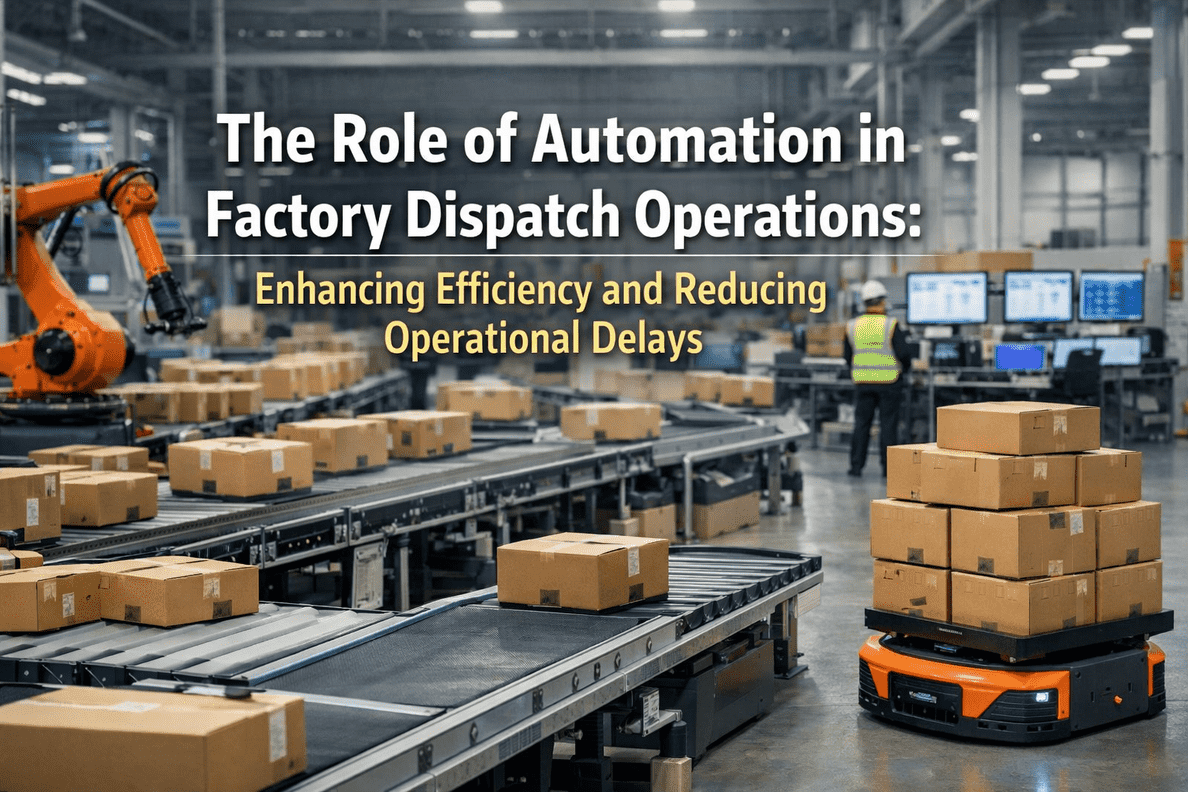
The Role of Automation in Factory Dispatch Operations: Enhancing Efficiency and Reducing Operational Delays
Factory dispatch automation replaces paper gate logs, whiteboard queues, and manual receiving processes with real-time digital workflows — eliminating the delays, errors, and compliance gaps that manual delivery departments generate every single day. 90% of manufacturing leaders say automation is essential. The delivery department is the last function yet to benefit.
50%
Of manufacturers will highly automate key processes by 2030 — more than double today's 18% (PwC 2026)
$221B
Industrial automation market in 2025 — growing to $325.51B by 2030 at 7.99% CAGR
90%
Of manufacturing leaders identify automation as essential for competitive success going forward
14 days
iFactory go-live timeline — from decision to fully automated factory delivery department
iFactory · Factory Delivery Department Module
Your production floor has dashboards. Your delivery department deserves the same visibility.
iFactory digitizes every gate pass, inbound receipt, material transfer, vehicle inspection, dispatch event, and incident report — giving your operations team real-time visibility into the department that controls everything that enters and exits your plant. Deploy in 7–14 days. No IT project. No hardware procurement. Results visible from day one.
87%Gate pass time reduction
78%Faster inbound receiving
100%Audit trail coverage
14 DaysFull deployment
The Automation Gap
Where Factory Automation Has Reached — and Where It Has Not
Already Automated in Most Factories
Production OEE monitoring — tracked by 86% of manufacturers in real time
Robotic assembly and CNC machining — precision automation at line speed
Automated quality inspection — vision systems and sensor-based defect detection
ERP-driven production scheduling — MRP and APS in most mid-size plants
Warehouse management systems — bin locations and barcode-based movements
Maintenance work order systems — CMMS platforms managing equipment uptime
Energy and utilities monitoring — real-time consumption per production zone
Outbound shipment documentation — carrier integrations for finished goods
Still Running Manual in Most Factories
Gate pass processing — paper logs, phone verification, 15–20 min per vehicle
Inbound vehicle scheduling — no pre-arrival coordination, unannounced arrivals
Receiving verification — paper POD, manual PO matching, 45–60 min per shipment
Dispatch sequencing — whiteboard queues, 2–3% error rate, SLA misses undetected
Internal material tracking — location unknown after dock entry
Vehicle inspection — paper checklists, no timestamps, not enforceable
SLA compliance monitoring — misses found after customer complaint, not before
Incident management — paper forms reaching management days after the event
8 Automation KPIs
The 8 Factory Dispatch KPIs That Automation Transforms — Benchmarks and iFactory Outcomes
87%
Gate Pass Processing Time Reduction
Automated pre-arrival registration and mobile gate verification cuts processing from 15–20 minutes to under 2 minutes per vehicle. A 20-vehicle/day facility recovers 280+ minutes of dock capacity every day.
Manual: 15–20 min/vehicleAutomated: under 2 min
78%
Faster Inbound Receiving Completion
Mobile PO verification and photo proof-of-delivery reduces receiving from 45–60 minutes to under 10 minutes per shipment — with digital chain of custody generated simultaneously, no separate documentation step.
Manual: 45–60 min/shipmentAutomated: under 10 min
90%
Dispatch Error Rate Reduction
SLA-priority automated sequencing drops the manual 2–3% error rate to under 0.3% — eliminating the re-dispatch cascade events that cost 30–45 minutes of recovery time each and propagate delays through the remainder of the shift.
Manual: 2–3% error rateAutomated: under 0.3%
100%
Audit Trail Coverage
Every gate event, receiving transaction, inspection result, material transfer, and dispatch decision is timestamped and person-attributed automatically. Full audit documentation retrievable in under 60 seconds for any date range.
Manual: incomplete, fragmentedAutomated: 100% coverage
40%
Reduction in Inbound Delivery Delays
Automated gate workflows, pre-arrival dock assignment, and coordinated vehicle scheduling eliminate the queue buildup that creates inbound material delays — recovering dock time that feeds directly into production schedule adherence.
Manual: 280+ min lost/dayAutomated: 40% delay reduction
30–40%
Production Stoppage Prevention
Most production stoppages attributed to "material unavailability" are locating failures, not true stock-outs. Automated internal transfer records give real-time material location — eliminating the search time responsible for 30–40% of avoidable production stoppages.
Manual: no location after dockAutomated: real-time location
3–6 mo
Full Platform Payback Period
Recovered dock time, eliminated dispatch errors, production stoppage prevention, and compliance overhead reduction combine to deliver full payback within 3–6 months of go-live — versus 18–24 months for legacy system implementations.
Legacy: 18–24 mo paybackiFactory: 3–6 months
72%
Smart Factory Gap — Delivery Lags Behind
72% of manufacturers have partially implemented smart factory strategy — yet the delivery department lags behind every other function. 86% track OEE in real time. Almost none track gate pass processing time or dispatch error rates. That gap is where competitive advantage is waiting.
OEE tracked: 86% of plantsGate pass tracked: under 14%
86% of manufacturers track OEE in real time. Almost none track gate pass dwell time, dispatch error rates, or inbound receiving cycle time — the exact data your operations efficiency requires.
iFactory closes this gap with purpose-built automation for every factory delivery department function — live in 7–14 days, no IT project required.
Talk to our support team for a deployment assessment specific to your facility.
How It Works
How iFactory Automates Each Stage of Factory Dispatch Operations
Factory dispatch automation does not require a new department or a separate compliance program. It requires the operational data your delivery department should already be generating digitally. iFactory automates this across 5 core workflows that run every day in every factory.
01
Automated Gate Pass — Pre-Arrival to Exit
Drivers pre-register via mobile before arrival — entering vehicle details, driver credentials, and cargo manifest. Security verifies pre-loaded data at the gate rather than creating records from scratch. Gate processing completes in under 2 minutes. The system automatically records arrival timestamp, dwell time, dock assignment, and exit time — generating complete vehicle movement data without any manual logging step. Pre-arrival data also triggers automatic dock scheduling, eliminating the queue buildup that results when multiple vehicles arrive without coordination.
15–20 min → under 2 min
Auto dock scheduling
Real-time dwell time data
02
Automated Inbound Receiving — Mobile PO Verification and Photo POD
Receiving staff verify inbound materials against purchase orders on mobile — scanning barcodes, confirming quantities, photographing discrepancies, and logging exceptions in real time at point of delivery. Every shipment automatically generates a complete digital record linking supplier, carrier, material, quantity received vs. ordered, condition, and timestamp. Shortages and damages are photo-documented before the vehicle leaves — creating an undeniable evidence record that eliminates the disputes that paper receiving notes consistently generate. The 30–45 minute lag between dock arrival and system confirmation is eliminated entirely.
45–60 min → under 10 min
Instant system confirmation
Photo discrepancy record
03
Digital Vehicle Inspection — Checklists with Auto-Block on Failures
All yard vehicles complete digital pre-use inspection checklists on mobile before every shift. Failed inspection items are logged with timestamp, operator ID, and photo documentation. The system automatically blocks failed vehicles from all dispatch assignments until a verified repair work order is completed and confirmed — preventing the dock congestion and safety incidents caused by uninspected or defective yard equipment. Inspection records are stored in a searchable compliance log retrievable on demand without manual assembly.
Auto-block on failed items
Timestamped inspection log
Full compliance audit trail
04
SLA-Priority Automated Dispatch Sequencing
Dispatch orders are automatically ranked and sequenced by SLA priority tier, vehicle availability, load capacity, and cut-off window proximity — updating in real time as conditions change. Dispatchers review AI-generated queues rather than building them from scratch under time pressure. When an SLA cut-off window is approaching, the system automatically escalates an alert before the breach occurs — enabling proactive intervention instead of reactive penalty management. The structural 2–3% manual sequencing error rate drops below 0.3% immediately on deployment.
Replaces whiteboard dispatch
Real-time cut-off alerts
90% fewer sequencing errors
05
Internal Material Tracking — Location at Every Transfer Point
Materials are logged at every internal handoff — dock to stores, stores to production, production to quality, quality to dispatch staging. Each transfer automatically generates a timestamped, person-attributed record that extends the chain of custody from dock arrival to production floor usage. This eliminates the locating failures responsible for 30–40% of production stoppages — every authorized person can see where every material is in real time without walking the floor or making a phone call. Unnecessary yard vehicle movements generated by material searches are eliminated as a byproduct.
Real-time material location
30–40% stoppages prevented
Full internal chain of custody
Measurable Results
What iFactory Customers Measure Within 90 Days of Automated Dispatch Go-Live
87%
Gate Pass Time Reduction
15–20 minutes per vehicle drops to under 2 minutes across every inbound vehicle every day. A 20-vehicle/day facility recovers 280+ minutes of dock capacity — equivalent to hours of productive receiving time previously lost to idle gate queues.
78%
Faster Receiving Completion
Inbound receiving drops from 45–60 minutes to under 10 minutes per shipment. Materials are confirmed in the system immediately — eliminating the documentation lag that disrupts production schedules and creates unnecessary reorder triggers based on unconfirmed stock.
90%
Fewer Dispatch Errors
Manual 2–3% sequencing error rate drops below 0.3% with SLA-priority automation. Re-dispatch events and their 30–45 minute cascade delays are eliminated from standard operations — recovering shift time and eliminating SLA penalty exposure.
100%
Audit Trail Coverage
Every gate event, receiving transaction, inspection result, and dispatch decision is timestamped and person-attributed automatically. Audit-ready documentation is retrievable in under 60 seconds for any vehicle, any date range, any inspection type.
3–6 mo
Full Platform Payback
Recovered dock time, eliminated dispatch errors, production stoppage prevention, and compliance overhead reduction combine to deliver full payback within 3–6 months of go-live. iFactory deploys in 7–14 days — ROI accumulation begins within the first week.
14 days
Go-Live Timeline
From decision to fully automated delivery department in 7–14 days. Cloud-based, mobile-first deployment. No server installation, no IT infrastructure project, no hardware procurement required. Security staff and receiving teams productive on day one of go-live.
Before vs. After
Factory Dispatch Operations — Manual vs. iFactory Automated Platform
iFactory · Factory Delivery Department Module
Your Production Floor Is Automated. Your Delivery Department Should Be Too — in 14 Days.
iFactory automates every function of your factory delivery department — gate pass management, inbound receiving, vehicle inspection, dispatch sequencing, internal material tracking, and incident management — giving your operations team the same real-time visibility your production floor already has. Live in 7–14 days. No heavy implementation fees. No IT infrastructure project. Book a demo to see iFactory running in a live factory delivery environment.
Frequently Asked Questions
Automation in Factory Dispatch Operations — What Operations Managers Ask First
What does "automation" specifically mean in the context of a factory dispatch department — and how is it different from production floor automation?
Factory dispatch automation refers to software-driven automation of the internal delivery operations function within a manufacturing facility — specifically the workflows that manage all vehicle movements through the factory gate, coordinate inbound material receiving, sequence outbound deliveries, inspect yard vehicles, and track material handoffs between internal zones. This is operationally distinct from production floor automation (robotics, CNC, automated assembly) in two important ways. First, production automation operates on predictable, repeatable physical processes — a robotic arm performs the same movement thousands of times per shift. Factory delivery automation deals with variable, event-driven workflows — different vehicles, different cargo, different SLA urgencies, different receiving exceptions on every shift. Second, production automation has been the primary technology investment target for manufacturing since the 1980s. Factory delivery department automation is receiving serious investment attention for the first time in the 2020s, as the data gap between what production floor systems track and what delivery departments track has become an operational liability. The core automation targets in factory dispatch are the five workflows that generate the most measurable delay, error, and compliance exposure every day: gate pass processing, inbound receiving, vehicle inspection, dispatch sequencing, and internal material tracking. iFactory automates all five simultaneously.
Talk to our support team about how these specific automations map to your facility's current delivery workflows.
How does automated dispatch sequencing work — and what happens when an urgent production run requires human override of the automated queue?
Automated dispatch sequencing works by applying a priority ranking algorithm to all pending dispatch orders in real time — scoring each order against SLA tier, cut-off window proximity, vehicle availability, load compatibility, and route constraints, then presenting dispatchers with an optimized queue rather than an unordered pile of requests. The system updates this queue continuously as conditions change — when a vehicle becomes available earlier than expected, when a new urgent order is added, or when a cut-off window moves closer. The proactive alert mechanism is the most operationally significant feature: when a delivery is approaching its SLA cut-off with insufficient queue position to complete in time, the system alerts the dispatcher before the breach rather than recording it afterward. This converts SLA management from reactive (discovering a miss after the customer complains) to proactive (preventing the miss 15–30 minutes before it becomes inevitable). For human override situations — urgent production runs, special customer requests, force majeure circumstances — dispatchers can manually reposition any order in the queue with a single tap. The override is logged with the operator ID, timestamp, and reason field — creating the documented audit trail that compliance programs require and that verbal override decisions on whiteboard systems never produce. In mature deployments, override rates are typically under 5%, meaning 95%+ of dispatch decisions are handled by the automated sequence without human intervention.
Book a demo to see the SLA-priority dispatch queue running with live data.
How does automated internal material tracking prevent the production stoppages that are currently attributed to material unavailability?
The root cause of most production stoppages attributed to "material unavailability" is not that the material is absent from the facility — it is that no one knows where it is within the facility. This distinction is critical and consistently misunderstood. When material is received at the dock without a digital transfer record, its location is captured in the minds of the receiving staff who handled it — not in any system. Once a shift ends, that staff member goes home, or the material is moved to a secondary location during a busy receiving window, the location is unknown until someone physically walks the floor to find it. For large manufacturing facilities with multiple storage zones, multiple docks, and parallel receiving operations, this locating failure can consume 20–45 minutes per incident. Research consistently shows 30–40% of production stoppages are this type of locating failure — materials physically present in the facility but not confirmable through any system. iFactory's automated internal material tracking closes this gap by logging every transfer between zones — dock to receiving inspection, receiving inspection to stores, stores to production floor, production floor to quality holding, quality holding to production line — with a timestamp and the operator who performed the transfer. Every authorized user can query material location in real time from any mobile device without walking the floor. The stoppage events that were recorded in ERP as "material shortage" are revealed to be location failures and are eliminated.
Talk to our support team about implementing internal material tracking in your specific facility layout.
How long does iFactory take to deploy and what does the implementation process involve?
iFactory goes live in 7–14 days for a standard factory delivery department deployment covering all five core automation workflows simultaneously: gate pass management, inbound receiving, vehicle inspection, dispatch sequencing, and internal material tracking. The implementation follows three phases. Phase 1 — Configuration (Days 1–3): Your operations team works with iFactory's implementation team to configure gate pass workflows, inspection checklists, dispatch SLA priority tiers, internal zone structure, and vehicle and driver registries. This phase runs in parallel with existing manual operations — no cutover yet, no disruption to active delivery operations. Phase 2 — Mobile Onboarding and Parallel Running (Days 4–7): Gate security staff, dispatch coordinators, receiving teams, and yard vehicle operators complete mobile app onboarding, typically 2–4 hours per role. iFactory runs in parallel with manual processes for 3–5 days — allowing the team to compare automated outputs against their existing manual decisions and build operational confidence before full cutover. Phase 3 — Go-Live and Verification (Days 8–14): Manual processes are replaced by iFactory automation as the primary operational system. iFactory's implementation team monitors data quality and resolves any workflow gaps during the first live week. Because iFactory is cloud-based and mobile-first, there is no server installation, no IT department project, and no hardware procurement required for the core deployment. The most consistent feedback from operations teams is that the transition is faster and less disruptive than anticipated.
Book a demo to walk through the deployment process step by step against your facility's specific configuration.
What compliance documentation does automated factory dispatch generate — and how does it differ from what manual operations produce?
Automated factory dispatch generates six categories of compliance-relevant documentation as a byproduct of daily operations — without any separate reporting step or compliance program. Gate pass records capture every vehicle entry and exit with exact timestamps, driver identity verification, vehicle details, cargo manifest, dock assignment, and dwell time — creating the complete vehicle movement history that regulatory inspections require. Inbound receiving records link every shipment to its purchase order, supplier, carrier, material description, quantity received versus ordered, condition at receipt, and receiving staff identity — creating the supply chain traceability documentation that is increasingly mandatory under global regulatory frameworks. Vehicle inspection records capture timestamped, operator-attributed inspection results with photo documentation of all flagged items and linked repair work orders — providing the continuous maintenance compliance record that safety regulators require. Dispatch records capture every dispatch assignment with vehicle ID, operator, departure timestamp, SLA tier, and completion confirmation — creating the operational compliance record that customer SLA audits and internal performance reviews require. Incident records capture every exception event with timestamp, vehicle, operator, description, photo evidence, and resolution timeline — creating the incident management record that OSHA, DOT, and insurance claims require. Internal transfer records capture every material movement between zones with timestamp, operator, and quantity confirmation — creating the internal chain of custody that quality management systems and regulatory audits require. Manual operations produce none of these six categories reliably. Paper records are incomplete, lack timestamps, cannot confirm operator identity, and cannot be retrieved in under hours. iFactory produces all six automatically and makes them retrievable in under 60 seconds.
Talk to our support team about how iFactory's compliance documentation maps to your specific regulatory requirements.
Can iFactory automate factory delivery department operations across multiple plant locations from a single platform?
Yes — iFactory is built as a multi-depot, multi-site platform from the ground up, designed for manufacturing organizations managing multiple production facilities under unified operations oversight. A single iFactory deployment covers all facilities in your portfolio under one corporate dashboard, with each site maintaining its own gate pass workflows, inspection checklists, dispatch SLA rules, vehicle registries, and compliance documentation templates. Corporate operations managers and logistics directors see aggregated performance across all sites — gate processing times by facility, dock utilization rates, dispatch SLA compliance by depot, receiving completion times, and incident frequency — from a single dashboard without logging into each facility separately. Multi-site visibility enables identification of performance differences between facilities that manual operations make structurally invisible. When one plant's average receiving cycle is 40% longer than comparable facilities, the data becomes immediately visible and actionable rather than buried in facility-specific spreadsheets that nobody compares. For regional compliance requirements, iFactory configures documentation templates to local standards — OSHA and DOT in the USA, Schedule M and FSSAI in India, Supply Chain Due Diligence in the UK, LkSG traceability requirements in Germany, and Vision 2030 smart manufacturing standards in the UAE. The underlying data model — timestamped, person-attributed records for every gate, receiving, inspection, dispatch, and transfer event — satisfies all regional frameworks from the same operational dataset without separate compliance programs per region.
Book a demo to see multi-site dispatch automation configuration and unified reporting running in a live environment.
iFactory · Factory Delivery Department Module
The Automation Gap in Your Factory Is the Delivery Department. iFactory Closes It in 14 Days.
72% of manufacturers have partially implemented smart factory strategy. Almost none have automated the delivery department that feeds their production floor. iFactory closes this gap in 7–14 days — purpose-built for factory dispatch operations, not adapted from courier logistics tools. Gate pass automation. Automated inbound receiving. SLA-priority dispatch. Digital vehicle inspection. Real-time material tracking. All live on day one. No IT project. No hardware procurement. Book a demo to see iFactory running in a live factory delivery environment.