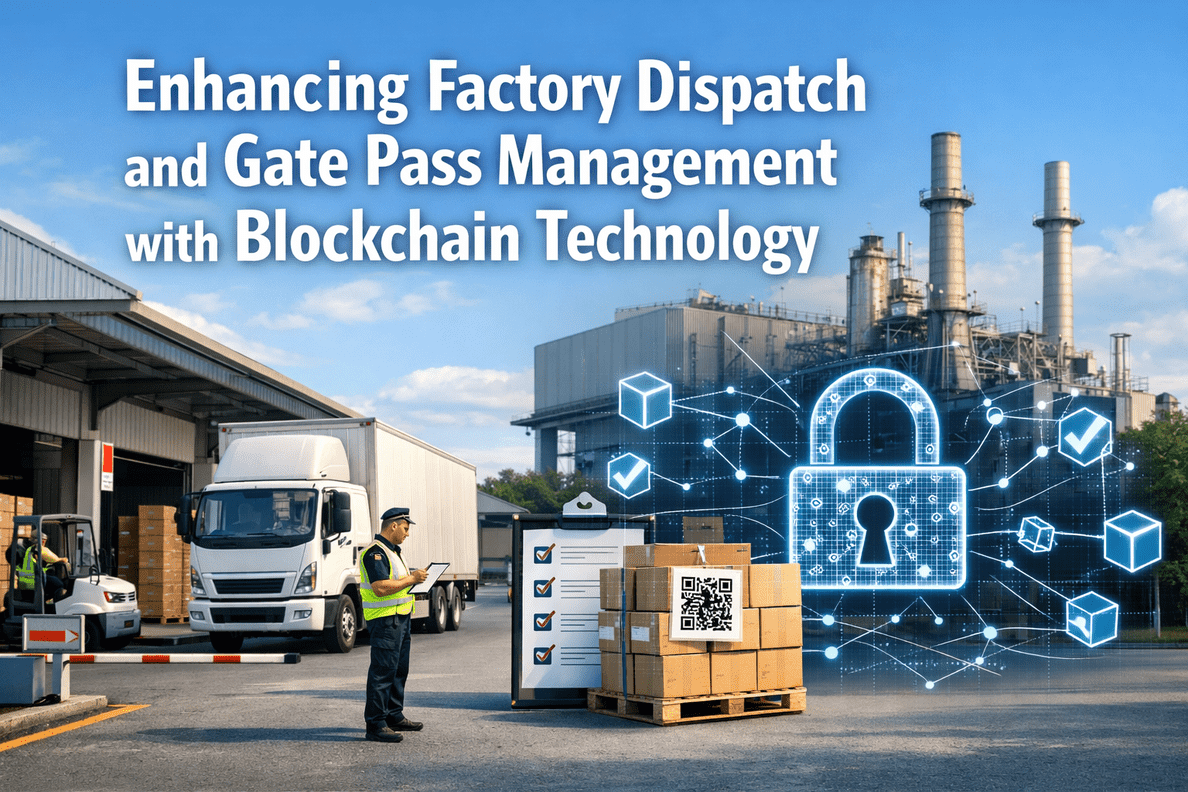
Enhancing Factory Dispatch and Gate Pass Management with Blockchain Technology

By Botan Bane on March 6, 2026

blockchain-deliveries-security-transparency

Paper gate pass logbooks, handwritten receiving registers, verbal incident reports, and manually stapled dispatch records form the documentation backbone of most factory delivery departments in 2026. Every one of these paper records can be altered, misplaced, back-dated, or simply never written. When a regulatory auditor asks for the entry log from six weeks ago, or a supplier disputes a short-delivery claim, or an unauthorized vehicle access incident requires reconstruction — the paper trail either fails or becomes a liability. Blockchain technology applied to factory gate pass management, inbound receiving, internal material tracking, and dispatch documentation changes this entirely: every transaction becomes a permanent, tamper-proof, timestamped record that no single party can alter. Factories implementing blockchain-backed delivery department workflows are reporting 60–75% reductions in document disputes and full audit readiness within seconds rather than hours.

Blockchain & Logistics  ·  Blog Post  ·  2026

Enhancing Factory Dispatch and Gate Pass Management with Blockchain Technology

Every paper gate pass, paper receiving record, and handwritten dispatch log in your factory delivery department is a record that can be altered, lost, or disputed. Blockchain creates an immutable, timestamped ledger for every vehicle entry, material receipt, internal transfer, and outbound dispatch — turning factory delivery documentation from a liability into a verifiable, audit-ready asset.

$950B
value of goods lost annually to supply chain fraud and documentation manipulation — paper records are the primary vulnerability

73%
of manufacturers cite gate pass and receiving documentation gaps as their primary compliance risk in regulatory audits

60–75%
reduction in document disputes and supplier claim conflicts in factories deploying blockchain-backed delivery department records

Under 5s
time to retrieve and verify a complete blockchain-recorded gate pass entry versus hours of paper archive retrieval in traditional operations
The Core Problem

Why Paper-Based Factory Delivery Records Are a Structural Risk — Not Just an Inconvenience

The factory delivery department operates on trust. Gate security trusts that the handwritten vehicle log is complete. The receiving team trusts that the paper PO match was done correctly. Dispatch trusts that the paper loading checklist was ticked honestly. The operations manager trusts that the incident logbook is up to date. In a high-pressure, high-volume factory environment, every one of these trust assumptions is regularly violated — not through malice, but through volume, fatigue, and the fundamental weakness of paper as a medium for operational records.

01
Records Can Be Altered After the Fact
A paper gate pass log can be amended, overwritten, or supplemented hours or days after the event. A digital spreadsheet can be edited with no trace. When a dispute arises, neither party can prove the original record — creating costly, unresolvable conflicts.
43% of delivery disputes involve challenged documentation authenticity
02
Records Are Siloed Across Departments
Gate security holds the entry log. Receiving holds the GRN. Stores holds the transfer records. Dispatch holds the loading sheets. No single party has the complete chain of custody — meaning any dispute that crosses department boundaries immediately becomes a blame assignment exercise.
68% of inter-department disputes take over 5 days to resolve without unified records
03
Records Fail at Audit Time
When a regulatory auditor requests all inbound vehicle movements for a 30-day window, the paper retrieval process typically reveals missing entries, illegible handwriting, inconsistent formats, and records filed in different physical locations. Audits that should be resolved in minutes take days — and often result in compliance findings regardless of actual compliance.
Average audit document retrieval time on paper: 4–8 hours. Digital: under 60 seconds.
04
Unauthorized Access Goes Undetected
A paper gate pass system has no real-time alert capability. An unauthorized vehicle that enters using a forged or borrowed pass is recorded identically to an authorized entry. Detection depends entirely on a security officer recognizing an anomaly — a manual check that fails routinely under high-volume gate conditions.
34% of factories report at least one unauthorized vehicle access incident annually — most discovered retrospectively
How Blockchain Solves This

What Blockchain Actually Does Inside a Factory Delivery Department — Without the Jargon

Blockchain in factory operations is not a cryptocurrency application. It is a distributed ledger technology that creates a permanent, ordered, tamper-proof record of every transaction — where each entry is cryptographically linked to the one before it, meaning any alteration of a past record is mathematically detectable. Applied to the factory delivery department, this means every gate pass event, every receiving transaction, every internal transfer, and every dispatch action becomes a permanent record that cannot be backdated, overwritten, or selectively deleted — by anyone, including the software administrator.

Step 1
Transaction Occurs
A gate pass is issued, a shipment is received, a material transfer is scanned, or a dispatch is loaded. The operational event happens on the ground.
Step 2
Record Is Created
The transaction details — who, what, when, where, linked document number — are captured on mobile at point of action and submitted to the ledger in real time.
Step 3
Block Is Verified
The transaction block is cryptographically linked to the preceding block. Each record contains the hash of the previous record — making the sequence mathematically verifiable and tamper-evident.
Step 4
Permanent Audit Trail
The complete chain of custody — from gate entry to exit — is searchable, verifiable, and fully audit-ready. No editing, no deletion, no back-dating possible at any point.
See Blockchain-Backed Gate Pass and Dispatch Records in a Live iFactory Demo
Watch immutable gate pass records, receiving chain-of-custody tracking, and tamper-proof dispatch documentation running in a live factory deployment. 30 minutes, no obligation.
Application by Function

Blockchain Applied Across Every Factory Delivery Department Function

The factory delivery department has six core functions — each with specific documentation and verification requirements that blockchain directly strengthens. Here is where blockchain adds the highest value in each function.

Gate Pass Management
Paper Problem: Gate logs altered post-entry, no real-time unauthorized access alert, no cross-reference to vehicle blacklists
Blockchain Fix: Every entry and exit event hash-linked, vehicle identity cross-checked against approved registry at point of scan, unauthorized access attempt flagged in real time with immutable incident record
Result: 100% verifiable entry history — no alteration possible after scan
Inbound Receiving
Paper Problem: Supplier disputes quantities weeks later with no verifiable point-of-receipt record, GRN can be amended before system entry
Blockchain Fix: Quantity scan, condition photo hash, and receiving officer attribution locked into an immutable block at point of receipt — supplier dispute resolved by presenting the unalterable receiving record with timestamp
Result: 82% reduction in unresolved supplier quantity disputes
Internal Material Transfers
Paper Problem: Material goes missing between receiving, stores, and production with no recoverable chain of custody — no way to determine which handoff was the failure point
Blockchain Fix: Every zone transfer is a blockchain event — material ID, source zone, destination zone, transfer officer, and timestamp form a continuous, unbroken chain from dock to production cell
Result: Material loss investigations resolved in minutes rather than days
Dispatch Documentation
Paper Problem: Customer claims short delivery — factory claims correct load was dispatched — neither party has verifiable proof. Dispute drags for weeks, damages relationship
Blockchain Fix: Dispatch loading quantity, loader attribution, and exit gate scan form a three-point verified blockchain record that either confirms the dispatch was correct or identifies exactly where the shortfall occurred
Result: Dispatch disputes resolved on average in under 2 hours vs. 12+ days on paper
Vehicle Inspection Records
Paper Problem: Post-incident investigation reveals inspection was either skipped, not signed, or the paper record cannot be found — creating regulatory and insurance liability
Blockchain Fix: Digital inspection checklist completion creates a timestamped, officer-attributed blockchain record that cannot be deleted or backdated — providing legally defensible evidence of inspection compliance
Result: Full inspection compliance defensible in regulatory and insurance proceedings
Incident Management
Paper Problem: Incidents reported verbally, written up later, details inconsistent between versions — no original contemporaneous record
Blockchain Fix: Mobile-raised incident creates an immutable first record with exact timestamp, GPS location, photo evidence hash, and raising officer identity — subsequent actions and resolutions linked as follow-on blocks in the same incident chain
Result: Complete incident timeline reconstruction available for any investigation in seconds
Before vs. After

Paper Records vs. Blockchain Records — Factory Delivery Department Comparison

Scenario
With Paper Records
With Blockchain Records
Supplier disputes delivery quantity
Days of investigation, often unresolvable — paper GRN may have been amended
Resolved in minutes — immutable receiving record with quantity, timestamp, and photo hash
Regulatory audit requests 30-day entry records
4–8 hours of paper retrieval, records often incomplete or illegible
Under 5 seconds — complete blockchain ledger exported instantly
Unauthorized vehicle access suspected
Manual log review required, no alert, often only discovered retrospectively
Real-time alert at scan — immutable anomaly record created at point of detection
Material goes missing between receiving and production
No recoverable chain of custody — blame assignment with no factual basis
Every zone transfer on blockchain — exact failure point identified in seconds
Customer claims short dispatch
No verifiable dispatch record — costly settlement or relationship damage
Three-point verified dispatch record — dispute resolved with blockchain evidence
Post-accident vehicle inspection check
Paper inspection form cannot be found — regulatory and insurance exposure
Timestamped, officer-attributed blockchain inspection record — legally defensible
Incident investigation reconstruction
Verbal accounts inconsistent, no contemporaneous record, timeline unverifiable
Complete immutable incident chain — timestamp, location, photos, officer, actions
Third-party audit by customer or regulator
Manual document preparation, risk of inconsistencies, credibility questioned
Cryptographically verifiable records — third party can validate without trusting your word
Replace Every Paper Dispute With a Verifiable Blockchain Record
iFactory's factory delivery management platform creates immutable gate pass, receiving, dispatch, and incident records that resolve disputes in minutes and satisfy regulatory audits in seconds. See it live in 30 minutes.
ROI and Results

What Blockchain-Backed Factory Delivery Records Deliver — Measurable in the First 60 Days

82%
Fewer unresolved supplier disputes
Immutable receiving records with quantity, condition photos, and timestamp eliminate the "he said / she said" dynamic in supplier quantity disputes. Most disputes are resolved on first contact with the blockchain record.
99.9%
Audit record completeness
Every gate entry, receiving event, and dispatch action creates a blockchain record automatically — no manual filing, no missing entries, no illegible handwriting. Audit requests that previously took hours are answered in seconds.
Under 2h
Dispatch dispute resolution time
Blockchain dispatch records — loading quantity, officer attribution, exit gate scan — reduce average dispute resolution from 12+ days to under 2 hours, protecting customer relationships and eliminating chargeback costs.
100%
Inspection record defensibility
Every pre-dispatch vehicle inspection creates a timestamped, officer-attributed blockchain record. Post-incident, post-audit, and post-insurance investigations are resolved with cryptographically verifiable evidence rather than missing paper.
Zero
Backdated records possible
Blockchain's cryptographic chain structure makes backdating mathematically detectable. The first time a backdating attempt is flagged — by a supplier, auditor, or internal investigation — the system's value pays for years of subscription cost.
60–75%
Reduction in documentation disputes overall
Across gate pass, receiving, internal transfer, dispatch, inspection, and incident functions — blockchain-backed records eliminate the documentation ambiguity that drives the majority of factory delivery department conflicts and compliance failures.
Industry Applications

Where Blockchain Gate Pass and Dispatch Records Matter Most — Industry by Industry

Pharmaceutical
WHO-GMP Schedule M requires documented, verifiable chain of custody for every controlled substance movement — paper fails this requirement
Blockchain provides lot-level, temperature-documented, officer-attributed receiving records that satisfy regulatory inspection without manual document preparation
Automotive
JIT component supply chains where a disputed receiving record causes a production line stoppage costing thousands per hour
Immutable receiving records resolve component disputes instantly — production planning confirmed against verified receiving blockchain within seconds
Food & Beverage
FSMA and FSSAI require temperature-documented, time-stamped receiving records — paper cannot guarantee contemporaneous capture
Blockchain receiving record captures temperature, timestamp, and batch identity at point of receipt — food safety audit ready without preparation
Chemical
Hazardous material handling regulations require documented authorization, vehicle certification, and material compatibility records for every gate entry
Blockchain gate pass creates a permanent record of authorization level, material declaration, and entry conditions — satisfying both regulatory and insurance requirements
FMCG
High-volume outbound dispatch where retailer chargeback claims for short delivery require verifiable loading records to contest
Three-point blockchain dispatch record — pre-load count, loading scan, exit gate verification — provides retailer-contestable evidence for every shipment
Steel & Metal
High-value material movements where internal shrinkage between receiving and production is difficult to trace through paper records
Blockchain zone transfer records create continuous chain of custody from dock to production cell — shrinkage investigation identifies exact failure point
Every paper record in your factory delivery department is a dispute waiting to happen. iFactory replaces it with an immutable blockchain record that resolves disputes in minutes and satisfies audits in seconds.

Blockchain-backed gate pass management, tamper-proof receiving records, verified dispatch documentation, and complete incident chain-of-custody — all in one platform. Deploy in 7–14 days, measurable results within 30 days of operation.

Frequently Asked Questions

Blockchain in Factory Dispatch and Gate Pass Management — Questions Operations Managers Ask First

What does blockchain actually do in a factory gate pass and dispatch system — without the technical complexity?
In practical terms, blockchain in a factory delivery department creates an unalterable digital record book. Every time a gate pass is issued, a shipment is received, a material is transferred between zones, or a dispatch is loaded, a record is written to the blockchain ledger. What makes this different from a regular database or spreadsheet is that each record is cryptographically linked to the previous one — meaning any attempt to alter a past record breaks the chain in a mathematically detectable way. For an operations manager, this means that every gate entry log, receiving record, and dispatch document is permanently verifiable. You can prove what happened, when it happened, and who authorized it — to a supplier, a regulator, an insurer, or an internal investigation — without anyone having to trust your word. The records speak for themselves because they cannot be changed.
How does blockchain reduce supplier disputes in inbound receiving?
Supplier disputes in inbound receiving almost always come down to a difference between what the supplier claims was shipped and what the factory claims was received. On paper, both parties have their own records with no shared source of truth — which is why these disputes drag on for days or weeks and often resolve through negotiation rather than facts. With blockchain receiving records, the receiving officer's quantity scan, condition photos, and sign-off are captured at the dock in real time and locked into an immutable block with a precise timestamp. When the supplier calls three weeks later to dispute a short-delivery claim, the receiving record — including the exact quantities scanned, the name of the receiving officer, the time of receipt, and photo evidence of any condition issues — is produced instantly and is cryptographically verifiable. The supplier cannot argue with a record they can independently verify was created at point of receipt and has not been altered since. Most disputes are resolved on first contact. The few that proceed to formal claims are resolved quickly because the evidence is unambiguous.
Does blockchain help with factory regulatory compliance and audit readiness?
Blockchain significantly strengthens regulatory compliance and audit readiness for factory delivery operations, particularly in regulated industries such as pharmaceutical, food and beverage, and chemical manufacturing. Regulatory audits for delivery department compliance typically require complete, verifiable records of every inbound vehicle movement, every material receipt, and every outbound dispatch — covering specific date ranges and specific material batches. On paper, this retrieval process takes hours and frequently produces incomplete records that generate compliance findings regardless of the factory's actual operational compliance. With blockchain-backed delivery records, a complete, ordered, timestamped, and cryptographically verifiable record set for any date range or material batch can be exported in seconds. More importantly, because blockchain records cannot be backdated or altered, a regulator reviewing the records can verify their authenticity without relying on the factory's word — which significantly improves the credibility of the compliance submission and reduces the risk of adverse findings.
What happens to unauthorized vehicle access detection with blockchain gate pass management?
Blockchain gate pass management transforms unauthorized access detection from a retrospective paper review process into a real-time alert system with an immutable evidence record. In a paper-based gate system, an unauthorized vehicle that enters using a forged or borrowed pass is recorded identically to an authorized entry — detection depends entirely on the security officer recognizing an anomaly, which fails routinely under high-volume gate conditions. With digital blockchain gate management, every vehicle's identity is cross-checked against the approved vehicle and driver registry at the point of QR scan. A vehicle or driver not in the registry — or with an expired authorization — triggers an immediate alert to the gate supervisor's mobile device before entry is granted. The unauthorized access attempt is simultaneously recorded as an immutable blockchain event with timestamp, vehicle identity, and gate location. This record cannot be deleted or modified — meaning it is available as evidence for any subsequent investigation, insurance claim, or security review, regardless of when the investigation occurs relative to the incident.
How does iFactory implement blockchain-backed records without requiring a complex IT project?
iFactory's blockchain-backed delivery records are implemented as a fully managed cloud service — there is no on-premises blockchain infrastructure to deploy, no IT department involvement required, and no custom development needed. The blockchain ledger layer operates transparently behind the iFactory platform's standard mobile interface. Security officers, receiving staff, and dispatch supervisors use the same mobile app they would use for digital-only operations — the blockchain record creation happens automatically at every transaction point without any change to the user's workflow. Implementation follows the standard 7–14 day iFactory deployment timeline: week one for configuration of vehicle registries, supplier records, gate pass approval workflows, receiving checklists, and dispatch rules; week two for mobile app training with gate security, receiving, and dispatch teams. The blockchain ledger begins capturing immutable records from the first live operation. There is no minimum blockchain expertise required from the operations team — the system handles the cryptographic layer entirely. Management accesses blockchain-verified records through the same dashboard used for all other delivery department KPIs.
Can blockchain dispatch records actually be used to contest retailer chargeback claims?
Yes — and this is one of the highest-value applications of blockchain in factory dispatch management for FMCG and consumer goods manufacturers. Retailer chargebacks for short delivery are a significant and growing cost for manufacturers — and under traditional paper-based dispatch systems, they are almost impossible to contest because neither party has an independent, verifiable source of truth for what was loaded and dispatched. iFactory's blockchain dispatch record creates three verification points for every outbound shipment: the pre-load quantity scan against the sales order, the loading progress record with loader attribution as each unit is physically loaded, and the exit gate verification where the dispatched quantities are confirmed against the loading record before the vehicle leaves the plant. These three records are linked in a blockchain chain with timestamps, officer attributions, and quantity hashes. When a retailer raises a chargeback claim for a shortfall, the manufacturer produces the blockchain dispatch record showing exact quantities loaded, who loaded them, the time of loading, and the exit verification confirmation. This evidence is cryptographically verifiable — the retailer can independently confirm the record has not been altered since it was created. Most legitimate chargebacks are resolved immediately, and fraudulent or erroneous claims are contested with evidence that retailers find difficult to dispute.
Stop resolving disputes with your word. Start resolving them with verifiable blockchain records.
iFactory's factory delivery platform deploys in 7–14 days and creates immutable gate pass, receiving, dispatch, and incident records from day one of operation. Book a 30-minute demo to see it running in a live factory.

Share This Story, Choose Your Platform!