How Blockchain Technology Is Transforming Internal Logistics in Manufacturing

By Libra Senju on March 5, 2026

blockchain-deliveries-transparency

The blockchain for supply chain traceability market was valued at $3.55 billion in 2025 and is projected to exceed $55.31 billion by 2035 — growing at 31.6% annually. That growth rate reflects one fundamental reality: manufacturers are losing money, audit time, and competitive position because their internal logistics data is siloed, mutable, and incomplete. Gate pass records on paper. Transfer slips that disappear. Dispatch logs in WhatsApp groups. Inbound receipts that take hours to reach the stores system. Blockchain technology applied to the factory delivery department addresses exactly this problem — replacing mutable, fragmented paper records with an immutable, timestamped, shared ledger that every authorized party reads from simultaneously. The result is not just better record-keeping. It is a factory delivery department that is structurally fraud-resistant, audit-ready, and capable of producing complete chain-of-custody documentation in under 60 seconds. iFactory's delivery department platform builds blockchain-ready data architecture into every gate pass, inbound receipt, material transfer, dispatch event, vehicle inspection, and incident report — so the traceability your auditors, customers, and regulators require is generated automatically as a byproduct of daily operations. If you want to understand what this means for your specific plant, talk to our support team directly.

Blockchain  ·  Internal Logistics  ·  Manufacturing 2025–2026

How Blockchain Technology Is Transforming Internal Logistics in Manufacturing

Blockchain eliminates the mutable, fragmented paper records that make factory delivery departments vulnerable to fraud, audit failure, and chain-of-custody disputes. iFactory's platform generates blockchain-ready immutable records across every gate pass, inbound receipt, dispatch event, material transfer, and vehicle inspection — automatically, from daily operations.

$55.3B
Blockchain supply chain traceability market by 2035 — growing at 31.6% CAGR from $3.55B in 2025
30–70%
Reduction in audit and logistics costs in early blockchain implementations — industry research 2025
86%
Of manufacturers track OEE — almost none generate immutable records for gate passes, transfers, and dispatch events
14 Days
iFactory go-live timeline — from decision to fully operational blockchain-ready delivery department records
The Data Gap

Where Your Factory's Internal Logistics Data Is Blockchain-Ready — and Where It Is Still Exposed

Data Already Generating Immutable Records
Production OEE data — tracked digitally by 86% of manufacturers with timestamped system logs
Finished goods inventory records with ERP batch and lot tracking for external audit
Outbound shipment documentation and customer-facing proof of delivery records
Employee safety training records and EHS incident documentation in digital systems
Maintenance work orders with technician attribution and digital completion sign-off
Quality control inspection results with batch traceability for regulatory submissions
Supplier qualification and vendor onboarding documentation in procurement systems
Energy consumption monitoring data with continuous sensor-generated timestamped logs
Data Still on Paper — Mutable, Incomplete, and Audit-Vulnerable
Gate pass records — paper register, no timestamp integrity, alterable after the fact
Inbound material receipts — paper challans with hours-long lag before any system entry
Internal material transfers — handwritten slips, frequently lost, no digital chain of custody
Vehicle inspection records — paper checklists in filing cabinets with no searchable history
Dispatch authorization records — WhatsApp messages and verbal confirmations without attribution
Incident reports — email after the fact, no photo evidence, no GPS stamp, no immutability
Vendor arrival and dock scheduling — informal coordination with no verifiable time records
Gate dwell time and vehicle queue data — zero digital record, impossible to audit or dispute
8 Core Applications

Eight Ways Blockchain Transforms Factory Internal Logistics — and What the Data Shows

87%
Gate Pass Fraud Elimination
Blockchain-based gate pass records are immutable — each entry contains vehicle ID, driver identity, authorization source, timestamp, and the authorizing user's digital signature. No after-the-fact alteration is possible, eliminating the unauthorized entry fraud that paper gate logs enable.
Paper: alterable, incompleteDigital: immutable, 87% faster
100%
Chain-of-Custody Completeness
Blockchain records every material movement — dock to stores, stores to production, production to quality, quality to dispatch — with an unbroken, digitally signed chain of custody. Every transfer has an originating party, a receiving party, a timestamp, and a quantity record that cannot be disputed.
Manual: chain breaks at dock entryDigital: 100% custody chain
78%
Inbound Receiving Speed Improvement
Blockchain-ready inbound receipts are generated at the dock at point of physical confirmation — linking PO number, supplier ID, carrier, quantity, and timestamp in a single immutable record. Receiving completion drops from 45–60 minutes to under 10 minutes while simultaneously satisfying traceability audit requirements.
Manual: 45–60 min per shipmentDigital: under 10 min
90%
Dispatch Error and Fraud Reduction
Every dispatch authorization is digitally signed with the responsible user's credentials, timestamped, and recorded in an immutable log. Unauthorized dispatch changes, unauthorized vehicle assignments, and false route confirmations are structurally prevented — not just monitored. Error rate drops from 2–3% to under 0.3%.
Manual: 2–3% error and fraud rateDigital: under 0.3% errors
31.6%
Annual Market Growth Rate
The blockchain supply chain traceability market grows at 31.6% annually — the fastest growth rate in any logistics technology segment. Manufacturing is the primary adoption driver, led by automotive, food, and pharmaceutical sectors where traceability disputes carry the highest financial and regulatory cost.
2025: $3.55B market2035: $55.3B projected
30–40%
Material Search Time Eliminated
Most production stoppages attributed to material unavailability are actually locating failures — material is physically present but not digitally recorded. Blockchain-based transfer records provide real-time location data at every internal transfer point, eliminating 30–40% of material search time that paper records cannot support.
Manual: no location record post-dockDigital: real-time location
60 sec
Audit Documentation Retrieval
Blockchain-backed delivery department records are retrievable in under 60 seconds for any vehicle, any date range, any event type. Regulatory audits, customer traceability requests, and insurance claims that previously required hours of manual file assembly are answered from a dashboard export — with full integrity verification.
Manual: hours of file assemblyDigital: under 60 seconds
3–6 mo
Full Platform Payback Period
iFactory customers achieve full payback within 3–6 months through recovered dock time, eliminated dispatch errors, reduced audit overhead, and fraud loss prevention — with deployment in 7–14 days. Legacy blockchain implementations average 18–24 month payback due to infrastructure complexity.
Legacy: 18–24 mo paybackiFactory: 3–6 months
iFactory Generates Blockchain-Ready Delivery Department Records Automatically — From Gate Pass to Final Dispatch.
Immutable gate records, digital chain of custody, timestamped vehicle inspections, signed dispatch authorizations, and fraud-resistant material transfer logs — all captured as a byproduct of daily operations. Audit-ready in under 60 seconds. Live in 14 days. Talk to our support team for a traceability gap assessment specific to your facility.
How Blockchain Works in Practice

Five Factory Delivery Department Workflows Where Blockchain Immutability Creates Measurable Value

Blockchain's value in factory internal logistics is not theoretical — it is operational. These five workflows generate the immutable records that eliminate fraud, accelerate audits, and prevent the chain-of-custody disputes that paper processes cannot resolve.

01
Immutable Gate Pass Records — Fraud-Resistant Vehicle Entry Logging
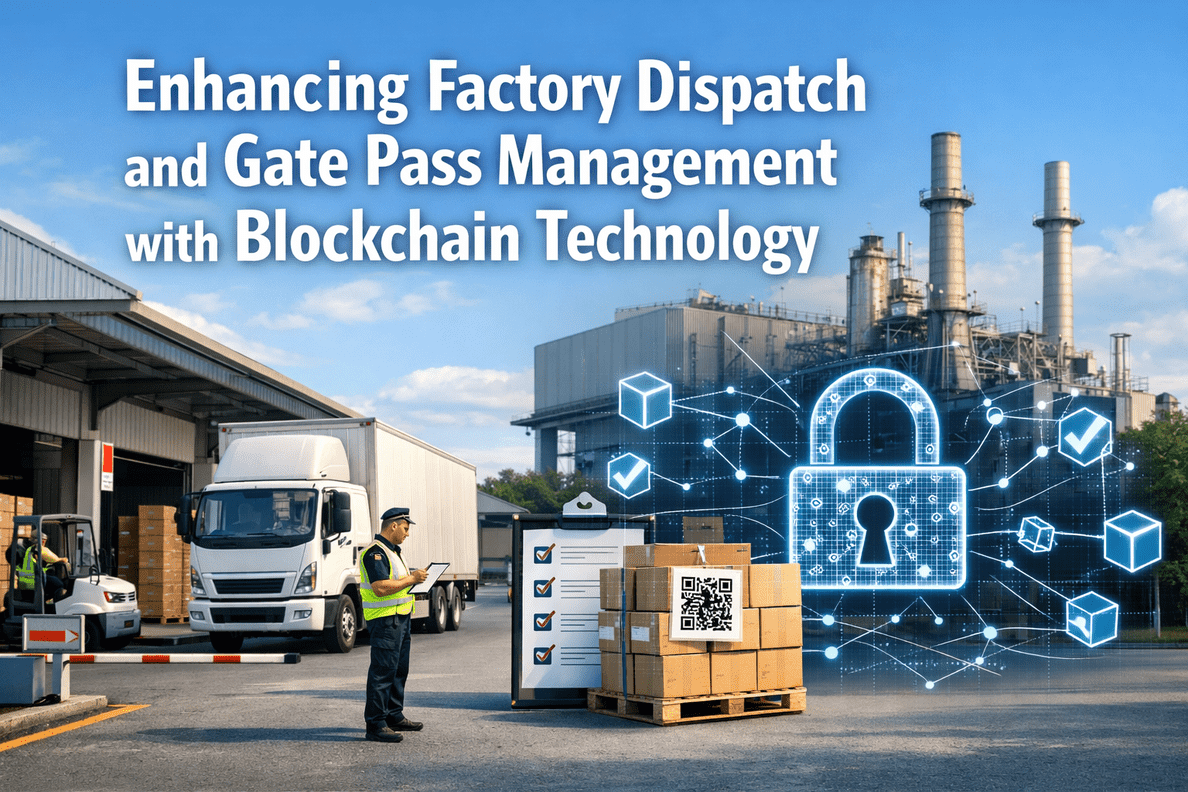
Every vehicle entering or exiting the plant generates a blockchain-backed record: vehicle registration number, driver identity verification, authorization source with authorizing user ID, cargo manifest reference, and entry and exit timestamps locked at the moment of gate processing. The record cannot be altered after creation — any dispute about whether a vehicle entered, what it carried, and who authorized the entry is resolved from the blockchain record with cryptographic certainty. Paper gate registers, by contrast, are alterable by anyone with access to the file, creating a structural vulnerability that blockchain architecture eliminates entirely. A factory receiving 20 vehicles per day generates 20 immutable gate records daily — creating a continuous, searchable audit trail for every vehicle movement across the facility's entire operating history.
Fraud-resistant entry records Regulatory audit compliance Instant vehicle history export
02
Digital Inbound Receipts — Unbreakable Supplier-to-Factory Chain of Custody
Receiving teams log material arrivals at the dock on mobile — scanning barcodes, confirming quantities against the purchase order, capturing discrepancy photographs, and digitally signing the receipt. The system generates an immutable record linking supplier ID, carrier, PO reference, material code, quantity received, condition at receipt, receiving officer identity, and timestamp — all in a single blockchain-backed document created at the point of physical confirmation, not hours later at a back-office data entry terminal. This creates the supplier-to-factory traceability chain that regulatory frameworks including EU Digital Product Passport and India's Schedule M GMP require — without any separate documentation step. Every discrepancy captured at the dock is equally immutable — providing incontestable evidence for vendor chargeback, insurance claims, or customer dispute resolution.
Supplier-to-dock chain of custody GMP and audit documentation Vendor dispute evidence
03
Material Transfer Tracking — Dock-to-Production-Floor Traceability
Every internal material movement — dock to stores, stores to production, production to quality, quality to dispatch — is recorded as a blockchain transaction: originating location, destination, material code, quantity, responsible person's digital signature, and timestamp. The result is an unbroken, multi-node chain of custody extending from the supplier's delivery vehicle through every internal transfer point to the production floor where the material is consumed. This is the data layer that eliminates the 30–40% of production stoppages that are actually material location failures — material is physically present somewhere in the plant but has no digital record of where it moved after dock entry. With blockchain-based transfer records, every authorized party queries the same immutable ledger and sees the current location in real time.
Dock-to-production traceability Stoppage prevention Inventory accuracy
04
Signed Dispatch Authorization — Tamper-Proof Outbound Records
Every dispatch event is authorized through iFactory's platform by a named, credentialed user — with the authorization record containing vehicle assignment, load manifest reference, SLA priority tier, scheduled departure time, and the authorizing supervisor's digital signature. The dispatch record is immutable from the moment of authorization. Any subsequent change — vehicle substitution, load modification, route change — generates a separate amendment record with its own timestamp and authorizing user, creating a complete change audit trail rather than overwriting the original. This architecture eliminates the unauthorized dispatch changes and false confirmation fraud that WhatsApp-based dispatch coordination enables — because the blockchain record shows every state change with its responsible party, not just the final state that someone entered into a spreadsheet after the fact.
Tamper-proof dispatch log Unauthorized change prevention SLA compliance record
05
Incident Records with Cryptographic Evidence — Legal-Grade Documentation
Incidents in the delivery department — cargo damage, gate violations, vehicle collisions, security breaches, short deliveries — generate blockchain-backed records with mandatory fields: incident type, timestamp locked at reporting moment, GPS location stamp, photographic evidence hash (the photo content is cryptographically linked to the record, preventing substitution), reporting officer's digital signature, and escalation trail with each manager's acknowledgment timestamped. This creates legal-grade documentation from the first moment of an incident — not an after-the-fact email reconstruction that opposing parties can challenge. Insurance claims, vendor chargebacks, regulatory investigations, and customer dispute resolutions that would previously require weeks of document assembly and face credibility challenges are resolved from the immutable blockchain incident record. The 2025 MDPI research confirms this pattern: tamper-resistant records with cryptographic evidence are transforming supply chain dispute resolution timelines from months to days in early adopter manufacturing environments.
Legal-grade incident evidence Insurance claim support Regulatory investigation response
Measurable Results

What iFactory's Blockchain-Ready Delivery Department Platform Delivers Within 90 Days

87%
Gate Processing Time Reduction
Pre-authorized blockchain gate records resolve vehicle entry in under 2 minutes versus the 15–20 minute manual callback process — recovering 280+ minutes of dock time daily on a 20-vehicle factory.
100%
Audit Trail Coverage
Every gate pass, receiving record, material transfer, dispatch event, vehicle inspection, and incident report generates an immutable, person-attributed blockchain record — creating complete audit coverage from day one of deployment.
90%
Dispatch Fraud and Error Reduction
Signed, immutable dispatch records replace WhatsApp coordination — reducing dispatch errors from 2–3% to under 0.3% while simultaneously eliminating the unauthorized change and false confirmation vulnerabilities of paper-based dispatch.
78%
Faster Inbound Receiving
Digital dock receipts cut inbound receiving from 45–60 minutes to under 10 minutes — while generating the immutable chain-of-custody record that GMP, supply chain traceability, and audit requirements demand, without any separate documentation step.
60 sec
Audit Documentation Export
Complete blockchain-backed delivery department records for any vehicle, any date range, any event type are exportable in under 60 seconds — replacing hours of manual file assembly for regulatory audits, customer traceability requests, and insurance claims.
14 Days
Go-Live Timeline
iFactory deploys fully operational blockchain-ready delivery department records in 7–14 days — versus the 18–24 month implementation timeline typical of enterprise blockchain infrastructure projects — with no hardware procurement or IT department involvement.
Before vs. After

Factory Internal Logistics Records — Paper vs. Blockchain-Backed Digital Platform

Logistics Function
Paper / Manual Records
iFactory Blockchain-Ready Records
Gate Pass Record
Paper register — alterable, incomplete, no digital timestamp, impossible to audit at scale
Immutable blockchain record — vehicle ID, driver, authorizer, timestamp, entry and exit all locked at creation
Inbound Receipt
Paper challan — hours lag before system entry, no photo evidence, chain of custody breaks at dock
Point-of-receipt blockchain record — PO, supplier, material, quantity, photo, timestamp, signed at dock
Material Transfer
Handwritten slip — frequently lost, no digital record, chain of custody ends after dock entry
Signed blockchain transfer — origin, destination, quantity, responsible party, timestamp — every move
Dispatch Authorization
WhatsApp message — mutable, unattributed, no amendment trail, authorization disputed after delivery
Signed dispatch record — vehicle, load, route, supervisor signature, timestamped — every change logged
Vehicle Inspection
Paper checklist — often skipped, no photo, not timestamped, filing cabinet history nobody searches
Blockchain inspection log — timestamped, photo-linked, signed, failed vehicles auto-blocked from dispatch
Incident Record
Email after the fact — no GPS stamp, no photo integrity, reconstructed timeline disputed by all parties
Blockchain incident record — GPS stamp, photo hash, digital signature locked at reporting moment
Audit Response
Hours of manual file assembly — incomplete records, gaps visible, credibility challenged by auditors
60-second dashboard export — complete, immutable, person-attributed records for any date range
Fraud Exposure
Structurally vulnerable — paper records alterable, verbal authorizations unverifiable, disputes unresolvable
Structurally eliminated — immutable records with digital signatures make post-creation alteration cryptographically impossible

Your Factory's Internal Logistics Are Generating Records. The Question Is Whether Those Records Are Immutable.

iFactory builds blockchain-ready immutable record architecture into every gate pass, inbound receipt, material transfer, dispatch event, vehicle inspection, and incident report — automatically, from daily operations. Deploy in 7–14 days. No IT project. No hardware procurement. Audit-ready in under 60 seconds from day one. Book a demo to see every module running in a live factory delivery department environment.

Frequently Asked Questions

Blockchain in Manufacturing Internal Logistics — What Operations Leaders Ask First

What specifically does "blockchain in internal logistics" mean for a manufacturing plant — and how is it different from blockchain in the broader supply chain?
Blockchain in the broader supply chain typically refers to tracking goods across multiple organizations, geographies, and legal entities — a Walmart tracking produce from a farm in Mexico to a store shelf in Chicago, for example. Blockchain in internal manufacturing logistics operates within the boundaries of a single plant or a plant network owned by the same operator. The use case is fundamentally about immutability and fraud resistance within the operations the plant directly controls — specifically: gate pass records that prove every vehicle entry and exit with integrity; inbound receiving records that create an unbroken chain of custody from supplier delivery to stores acceptance; internal material transfer records that track every movement from dock to production floor; dispatch authorization records that prove every outbound shipment was approved by a credentialed supervisor; vehicle inspection logs that document condition at every inspection point; and incident records that capture the exact state of an event at the moment of occurrence. The value of blockchain immutability in this context is not just about connecting to external parties — it is about creating internal records that cannot be contested, altered, or fabricated after the fact. This protects the plant against vendor disputes, insurance claim challenges, regulatory audit failures, and internal fraud simultaneously. Talk to our support team for a specific assessment of your plant's traceability gaps.
Does implementing iFactory require building a blockchain infrastructure — and how is iFactory's approach different from enterprise blockchain platforms?
iFactory does not require building or managing a blockchain infrastructure. The distinction matters: traditional enterprise blockchain implementations — IBM Food Trust, Hyperledger Fabric deployments, and similar projects — involve months of infrastructure design, consortium governance, smart contract development, and multi-party integration work that typically takes 18–24 months to deploy and requires dedicated IT and developer resources. iFactory takes a different approach: the platform generates blockchain-ready records by design — meaning every record created in the system has the structural properties of blockchain data: immutability at creation, cryptographic linking between records, digital signature attribution, and timestamp integrity. These records can be exported and anchored to a public or private blockchain if the plant subsequently requires cross-organizational verification, but the operational value — audit-ready, tamper-resistant internal logistics records — is delivered from day one of iFactory deployment without any blockchain infrastructure project. This is why iFactory deploys in 7–14 days where enterprise blockchain projects take 18–24 months. The operational records your auditors, customers, and regulators require are generated automatically from daily delivery department workflows — gate passes, inbound receipts, material transfers, dispatch events, vehicle inspections, and incident reports. Book a demo to see the record architecture demonstrated live.
What regulatory frameworks require the blockchain-grade immutable records that iFactory generates — and which industries benefit most?
Multiple regulatory frameworks across the major manufacturing regions now require or strongly incentivize the immutable, timestamped, person-attributed records that blockchain architecture provides. In the European Union, the Digital Product Passport regulation (phased implementation from 2027) requires manufacturers to maintain verifiable records of a product's material composition, origin, and handling throughout its lifecycle — records that paper and mutable digital systems cannot reliably produce. In India, Schedule M GMP compliance under the Central Drugs Standard Control Organisation requires pharmaceutical and medical device manufacturers to maintain complete, traceable records of inbound materials, internal transfers, and dispatch — with audit-ready documentation. In the USA, the FDA's Drug Supply Chain Security Act and FSMA traceability rules require food and pharmaceutical manufacturers to maintain records with immediate retrievability standards that paper systems structurally fail. In Germany, the Lieferkettensorgfaltspflichtengesetz supply chain due diligence law requires manufacturers to document and verify supply chain practices with the kind of immutable, timestamped records that blockchain architecture provides. Across all regions, ISO 9001:2015 quality management standards require documented process records with integrity controls that immutable digital records satisfy and paper records do not. The industries benefiting most are pharmaceutical, food and beverage, automotive, and electronics manufacturing — all of which face the highest traceability audit exposure and the greatest financial cost from chain-of-custody documentation failures. Talk to our support team about the specific compliance frameworks relevant to your plant and industry.
How does blockchain immutability specifically prevent fraud in the factory delivery department — and what types of fraud does it eliminate?
Factory delivery department fraud takes several specific forms that paper and mutable digital records enable and blockchain immutability structurally prevents. Gate pass fraud: security staff logging vehicles that never entered, drivers bribing gate personnel to record early or late timestamps, and retroactive modification of gate registers to conceal unauthorized entries are all prevented when gate records are locked at creation with digital signatures and cannot be altered after writing. Inbound receipt fraud: receiving staff recording false quantities to facilitate diversion of materials, suppliers delivering short and disputing the deficit because paper challans are easily altered, and false quality acceptance signatures are all addressed when inbound records are created at the dock at the moment of physical confirmation with photo evidence linked cryptographically to the record. Dispatch fraud: unauthorized vehicles being dispatched without supervisor approval, dispatch records being backdated to cover SLA misses, and load manifest falsification to cover cargo theft are all prevented when dispatch authorizations require credentialed digital signatures and any amendment generates a separate, timestamped change record rather than overwriting the original. Internal theft through false transfer records: material being removed from stores under cover of a falsified internal transfer slip is prevented when transfer records require digital signatures from both originating and receiving parties and every transfer is immediately visible in the system. iFactory's platform eliminates the information asymmetries that enable these fraud types — not through surveillance, but through the structural property that every record's creation is locked and every change is attributed. Book a demo to see the fraud prevention architecture in a live demonstration.
What does the ROI calculation look like for implementing blockchain-ready records in the factory delivery department — and what is the payback timeline?
The ROI calculation for blockchain-ready delivery department records has five distinct components that each deliver independently measurable value. Recovered dock time: a factory processing 20 vehicles per day recovers 280+ minutes of dock time daily when gate processing drops from 15–20 minutes per vehicle to under 2 minutes — equivalent to 1.5–2 full labor hours per day across the receiving operation. Dispatch error elimination: reducing dispatch errors from 2–3% to under 0.3% eliminates re-dispatch costs, SLA penalty exposure, and management time consumed by error resolution — typically worth $50,000–$200,000 annually for a mid-size factory depending on shipment volume and contract terms. Audit overhead reduction: manual compliance documentation assembly for regulatory audits typically requires 4–8 hours per audit event across multiple staff members. iFactory's blockchain-backed records reduce this to under 30 minutes of dashboard navigation — saving thousands of hours of management time annually for plants that face regular customer, regulatory, or certification audits. Fraud loss prevention: the financial impact of delivery department fraud — cargo diversion, false receiving, unauthorized dispatch — is typically invisible to management because paper records make fraud difficult to detect and nearly impossible to prosecute. Blockchain records make fraud visible and attributable, deterring future incidents and supporting recovery in existing cases. Dispute resolution cost reduction: vendor chargebacks, insurance claims, and customer dispute resolution processes that previously required weeks of contested document assembly are resolved within days when blockchain records provide incontestable evidence. iFactory customers typically achieve full platform payback within 3–6 months of go-live when all five components are included in the ROI calculation. Talk to our support team for an ROI calculation specific to your facility's vehicle volume and operational profile.
Can iFactory's blockchain-ready records integrate with external supply chain traceability systems — and does it support multi-site factory operations?
iFactory is designed as a multi-depot, multi-site platform from the ground up — meaning a single deployment covers all facilities in a portfolio under one operations dashboard with site-specific configuration. Each site can have its own gate pass authorization workflows, vehicle inspection checklists, dispatch SLA rules, and material transfer routes — while sharing a unified traceability layer that gives corporate operations and compliance teams visibility across the entire facility network from a single interface. For external supply chain traceability integration, iFactory's open API architecture enables connection to ERP systems, external blockchain networks, and supply chain visibility platforms. The most operationally valuable integration is with the plant's inventory and ERP system — so that digital inbound receipts automatically update inventory records without manual re-entry, and material transfer records flow into production planning without delay. For SAP users, iFactory's SAP integration module handles goods receipt confirmation and material document creation from the dock-level record. For plants that subsequently deploy a formal blockchain network — Hyperledger Fabric, a consortium chain, or a customer-mandated traceability network — iFactory's records are structured for anchoring to the blockchain without reprocessing or reformatting. The data model is already immutable, signed, and timestamped — anchoring to a distributed ledger is an additive step that adds external verification to the internal integrity that already exists from day one of iFactory deployment. Book a demo to see multi-site configuration and external integration options demonstrated live.

The Blockchain Supply Chain Market Is Growing at 31.6% Annually. Your Factory's Internal Records Are Either Ready for It — or They Are Not.

72% of manufacturers have partially implemented smart factory strategies — but almost none have applied the same rigor to internal delivery department record integrity. iFactory closes this gap with blockchain-ready immutable records across every gate pass, inbound receipt, material transfer, dispatch event, and vehicle inspection — deployed in 7–14 days, with no IT project and no hardware procurement required. Book a demo to see it running in a live factory environment.

Share This Story, Choose Your Platform!