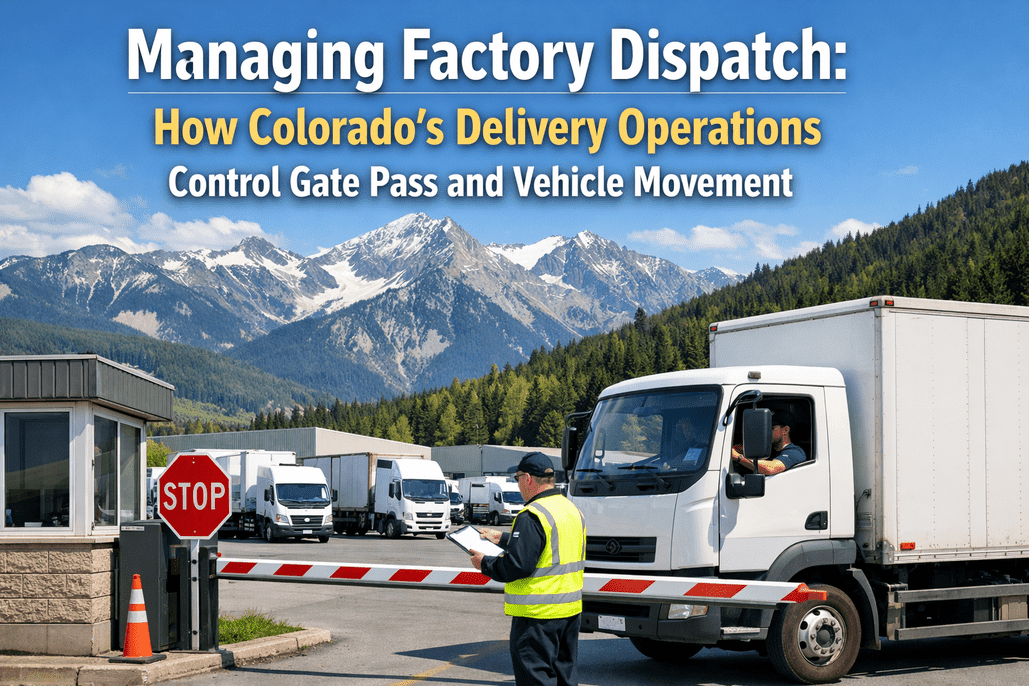
Managing Factory Dispatch: How Colorado’s Delivery Operations Control Gate Pass and Vehicle Movement

By Cilian Ceri on March 6, 2026

colorado-deliveries-operations-altitude-terrain

Colorado is home to nearly 5,900 manufacturing firms and 150,700 manufacturing employees — producing $21.74 billion in economic output annually across aerospace, food and beverage, energy, electronics, and biomedical sectors. But inside these Colorado factories — from the defense contractors in Colorado Springs to the food processors in Fort Morgan to the energy manufacturers along the Front Range — the dispatch department runs on the same paper gate passes, phone call verifications, and clipboard receiving logs that factories everywhere have used for decades. Colorado's geography makes this problem uniquely expensive. High-altitude terrain, extreme weather windows, and supply chain routes that funnel through mountain passes mean factory dispatch departments here face inbound delivery disruptions that flatland plants never encounter. When a supplier truck arrives 90 minutes late because of a mountain pass closure and the factory's manual gate takes another 20 minutes to process it, the production schedule has already absorbed a hit it didn't budget for. Digital factory dispatch management is not a technology upgrade for Colorado manufacturers — it is an operational necessity. This guide covers exactly how Colorado's factory delivery departments are modernizing gate pass management, vehicle movement tracking, inbound receiving, and dispatch operations to match the pace their manufacturing environments demand. For questions about your specific facility, talk to our support team.

Regional Delivery Challenges  ·  Colorado Manufacturing  ·  2025–2026

Managing Factory Dispatch: How Colorado's Delivery Operations Control Gate Pass and Vehicle Movement

Nearly 6,000 Colorado manufacturers run their factory dispatch departments on paper — processing gate passes manually, tracking vehicle movements by phone, and receiving inbound materials without a digital chain of custody. High altitude, mountain pass supply routes, and extreme weather make Colorado's factory dispatch operations among the most disruption-prone in the nation. The factories that digitize gate pass management, vehicle tracking, and dispatch sequencing first are gaining a measurable operational edge that manual operations cannot replicate.

Book A Demo
5,900
Manufacturing firms in Colorado — aerospace, food processing, energy, electronics, biomedical (OEDIT 2025)

$21.74B
Annual manufacturing economic output in Colorado — 12 of the nation's 500 largest manufacturers have Colorado offices

87%
Gate pass processing time reduction with digital pre-registration — from 15–20 min manual to under 2 min

14 days
iFactory go-live timeline for Colorado factory dispatch departments — no IT infrastructure required
Colorado Context

Why Colorado's Geography Creates Unique Factory Dispatch Pressures That Flatland Operations Simply Don't Face

Colorado's manufacturing environment is unlike any other state. The combination of altitude, terrain, weather variability, and dispersed industrial geography creates factory dispatch challenges that demand more operational resilience — and more real-time visibility — than plants in less demanding environments require.

Altitude & Engine Performance
High Altitude Reduces Diesel Engine Output by 3–5% Per 1,000 Feet
Colorado's Front Range industrial zones sit at 5,000–6,000 feet elevation. Mountain-corridor facilities reach 7,000–9,000 feet. At altitude, diesel engines produce measurably less power — meaning heavily loaded inbound trucks arrive later than their schedule predicts, yard vehicles require more frequent maintenance, and fuel consumption per vehicle trip is significantly higher than sea-level benchmarks. A factory dispatch department without real-time vehicle status visibility has no early warning when altitude-stressed vehicles begin developing mechanical issues mid-operation.
Mountain Pass Disruptions
I-70, US-40, US-285 — Supply Routes That Close With Zero Notice
Colorado's primary mountain supply corridors — Interstate 70 through the Eisenhower-Johnson Tunnel, US-40 through Rabbit Ears Pass, and US-285 through Kenosha Pass — close for hours at a time due to weather events, rockfall, or accidents without advance warning. Colorado DOT issued more than 400 mountain corridor closure events in 2024. For factory dispatch departments receiving inbound materials from suppliers via these routes, a closure with no digital pre-registration system means the gate has no way to anticipate which vehicles will be late, cannot proactively reassign docks, and cannot notify the relevant production departments to adjust their schedule before the impact is already felt.
Weather Windows
300+ Days of Sun Masked by 60+ Weather Events Affecting Dispatch Per Year
Colorado averages 300 days of sunshine — but also generates significant winter storm events, hailstorms, and rapid temperature swings that affect dispatch operations. Temperature ranges of 30–40°F in a single day stress yard vehicle hydraulic systems and affect yard tractor fuel performance. Winter operations require factory dispatch departments to manage vehicle pre-heating, road traction conditions in the yard, and extended inbound ETA windows — all without real-time data in facilities still using paper-based dispatch logs.
Colorado Manufacturing Geography
Denver Metro & Front Range
Aerospace, defense, electronics — Ball Aerospace (Boulder), Raytheon (Aurora), Lockheed Martin (Littleton). High vehicle density, complex inbound scheduling, multi-supplier coordination pressure.
Colorado Springs Corridor
Defense manufacturing, medical devices — L3Harris, DRS Technologies, Vectrus. ITAR compliance and strict vehicle access control requirements add gate pass complexity beyond standard commercial operations.
Northern Colorado (Ft. Collins, Greeley, Fort Morgan)
Food processing, agriculture manufacturing — Cargill (Fort Morgan), JBS (Greeley), Leprino Foods. High-volume perishable inbound receiving with strict temperature window compliance during vehicle dwell time.
Mountain Corridor (Grand Junction, Pueblo)
Energy equipment, ceramics, construction materials — CoorsTek (Golden), CF&I Steel (Pueblo). Supply routes cross multiple mountain passes with seasonal closure risk. Extended vehicle dwell and dispatch lead times are operational baseline.
The Dispatch Visibility Problem

6 Factory Dispatch Department Failures That Cost Colorado Manufacturers Real Money Every Shift

These are the operational failures that paper-based Colorado factory dispatch departments generate systematically — and the specific financial cost each one produces. Every failure on this list is preventable with digital real-time tracking.

01
Manual Gate Pass: 15–20 Minutes Per Vehicle
280–400 min/day lost · 20-vehicle/day facility
Security verifies credentials by phone, logs vehicle details by hand, issues a paper pass, and contacts the dock coordinator verbally — every single time. A facility receiving 20 inbound deliveries per day loses 280–400 minutes of dock processing time to gate administration alone. In Colorado facilities where inbound trucks arrive late due to mountain pass delays, adding a 15–20 minute manual gate process on top compounds the production schedule impact into a measurable daily deficit.
02
No Material Location After Receiving Dock
30–40% of "stock-out" production stops are location failures
In most Colorado factories, inbound materials are logged when they arrive at the receiving dock — and then physically disappear into the facility with no further digital record. Production teams request materials that are physically present in stores, staging, or quality hold — but cannot be located without a manual search. These location failures generate production stoppages that are indistinguishable from genuine stock-outs until someone physically finds the material, typically 30–40 minutes later. Real-time internal tracking eliminates this entirely.
03
Yard Vehicle Breakdown During Critical Receiving Window
Unplanned breakdowns cost 3–4× scheduled maintenance
Colorado's altitude and temperature swing environment accelerates wear on yard vehicles — forklifts, shunters, yard tractors — faster than sea-level operations. Without digital pre-use inspection checklists and real-time vehicle status monitoring, dispatch managers have no visibility into which yard vehicles are approaching maintenance thresholds until one breaks down mid-shift during a critical receiving or dispatch operation. A forklift breakdown during a high-volume receiving window in a northern Colorado food processing facility can cascade into a temperature compliance event for perishable inbound materials — a consequence with direct cost and quality implications.
04
Manual Dispatch Sequencing: 2–3% Error Rate
$50K–$200K annually in re-dispatch and SLA penalty costs
Manual dispatch sequencing — by whiteboard, spreadsheet, or verbal instruction — produces consistent 2–3% error rates in vehicle assignments, priority sequencing, and load matching. In Colorado facilities where outbound dispatch involves navigating mountain routes with weight limits, seasonal restrictions, and altitude-adjusted fuel calculations, a dispatch error has compounded consequences beyond the simple re-routing cost. Wrong vehicle on a weight-restricted mountain route, wrong priority assignment for a time-sensitive aerospace component, wrong load allocation for a hazmat shipment — each costs multiples more than the equivalent error on a flatland operation.
05
Incident Documentation Gaps at the Gate and Yard
Hours of retroactive investigation · Insurance attribution failures
Vehicle incidents in Colorado factory environments — gate damage, dock loading accidents, yard vehicle contacts with pedestrians or equipment, material drop events — are documented after the fact in facilities without real-time incident reporting. By the time a supervisor completes a paper incident report, the timestamped evidence chain is broken, witness attribution is uncertain, and the insurance documentation required for claim processing is incomplete. Colorado's combination of altitude-stressed equipment and weather-affected yard surfaces creates higher-than-average incident frequency in factory dispatch environments — making real-time incident documentation not optional, but operationally critical.
06
Zero Analytics on Dispatch Performance Baselines
Improvement impossible without measurement · Audit risk without records
Colorado factory dispatch managers operating on paper have no baseline data on gate processing times, dock utilization rates, vehicle dwell times, dispatch error rates, or receiving completion durations. This absence of analytics prevents any systematic operational improvement — and creates direct vulnerability in customer SLA audits, aerospace and defense contractor qualification reviews, and food safety chain-of-custody verifications. Colorado's advanced manufacturing sector increasingly requires documented operational performance data as a supplier qualification prerequisite — a requirement that paper-based dispatch departments structurally cannot meet.
iFactory Solution

How iFactory's Digital Platform Solves Colorado Factory Dispatch Operations — Gate Pass, Vehicle Movement, Receiving, and Dispatch in One System

iFactory was built for the factory delivery department — specifically for the gate, the dock, the yard, and the dispatch sequence. Not for highway fleets, not for warehouse management. For the operational space between your factory gate and your production floor. Here is what each module delivers in a Colorado manufacturing environment.

MODULE 01
Digital Gate Pass with Pre-Arrival Registration and Real-Time Queue Dashboard
87% gate processing time reduction · Under 2 min per vehicle

Suppliers submit vehicle registration, driver credentials, and cargo details via a mobile pre-registration link before departure. By the time the truck arrives at the Colorado factory gate, security has already verified the record, assigned the dock, and notified the receiving team. Gate clearance takes 60–90 seconds — not 15–20 minutes. The system tracks real-time queue status, vehicle dwell time, arrival and departure timestamps, and dock assignment duration — generating the operational data that Colorado dispatch managers currently have no visibility into.

Pre-arrival registration Real-time queue dashboard Dwell time tracking Auto dock assignment
MODULE 02
Mobile Inbound Receiving with PO Verification, Discrepancy Capture, and Chain of Custody
78% faster receiving · Full chain of custody auto-generated

Receiving staff verify inbound materials against purchase orders on a mobile device — scanning barcodes, capturing discrepancy photos, and logging receiving exceptions in real time. Every inbound shipment generates a digital record linking supplier, carrier, material, quantity received vs. ordered, and timestamp. For Colorado food processors handling perishable inbound deliveries, the receiving record includes a time-of-receipt field that documents temperature compliance window adherence per shipment. For defense and aerospace manufacturers, the chain of custody record satisfies ITAR and DCSA traceability requirements without a separate documentation step.

Barcode PO verification Photo discrepancy capture Chain of custody record Exception auto-escalation
MODULE 03
Yard Vehicle Inspection Dashboard with Auto-Block and Real-Time Status Monitoring
45% reduction in unplanned yard vehicle downtime

Every yard vehicle completes a digital pre-use inspection checklist on mobile before each operational period. In Colorado's altitude and temperature environment — where hydraulic fluid viscosity changes significantly between morning pre-heat and midday operation — these inspection checklists are configured to include altitude-specific items: hydraulic fluid level check, battery voltage verification for electric forklifts at altitude, tire pressure adjusted for temperature swing conditions. Vehicles with failed inspection items are automatically blocked from dispatch and generate a maintenance work order instantly. The dispatch manager's dashboard shows real-time status of every yard vehicle — available, on-task, in maintenance, blocked — before any vehicle is assigned to a critical operation.

Digital pre-use checklists Auto-block on failure Real-time status dashboard Maintenance auto-trigger
MODULE 04
SLA-Priority Dispatch Sequencing with Route Compliance and Real-Time Deviation Alerts
90% dispatch error reduction · Under 0.3% error rate

Dispatch orders are sequenced automatically by SLA priority tier, vehicle type, load capacity, weight limit compliance, and route eligibility. In Colorado, route eligibility includes mountain corridor weight restrictions, seasonal road closures, and altitude-adjusted fuel range calculations per vehicle type. Each dispatch event records vehicle ID, driver, departure timestamp, assigned route, and expected return. If any vehicle deviates from its assigned route or schedule, the dispatcher receives a real-time alert — enabling intervention before an SLA breach, not after. Mountain route alternates can be pre-configured so the system auto-suggests compliant alternatives when primary routes report closures from CDOT feeds.

SLA-priority sequencing Route eligibility check Real-time deviation alerts Dispatch audit trail
MODULE 05
Internal Material Tracking — Real-Time Location from Dock to Production Floor
30–40% production search time eliminated

Materials are logged at every internal transfer point — dock to stores, stores to staging, staging to production, production to quality, quality to dispatch. Each transfer generates a timestamped, person-attributed digital record. When a production supervisor reports material unavailability, the dispatch manager can identify the material's current physical location in under 10 seconds — immediately distinguishing a genuine stock-out from a location failure. This single capability eliminates the 30–40% of Colorado factory production stoppages that are misclassified as stock-outs but are actually materials that are present in the facility and simply untracked after the receiving dock.

Transfer-point digital logging Real-time location map Person-attributed records Production stop prevention
Before vs. After

Colorado Factory Dispatch Department — Manual vs. iFactory Digital: The Complete Operational Comparison

Dispatch Function Manual Operations (Current State) iFactory Digital Platform
Gate Pass Processing 15–20 min/vehicle — paper log, phone verification, zero pre-registration, no dwell time data captured Under 2 min — digital pre-registration, mobile verification, auto dwell time tracking
Inbound Receiving 45–60 min/shipment — paper POD, manual PO matching, no discrepancy photo, no chain of custody Under 10 min — mobile scanning, photo capture, automatic chain of custody generated
Yard Vehicle Status Paper checklists — incomplete, no timestamp, no auto-block, breakdowns discovered mid-operation Digital inspection — timestamped, auto-block on failure, real-time availability dashboard
Dispatch Sequencing Manual whiteboard — 2–3% error rate, SLA misses undetected, no route eligibility check for mountain corridors SLA-priority automation — under 0.3% errors, real-time deviation alerts, mountain route compliance built-in
Internal Material Location No location record after dock — 30–40% of production stoppages are location failures not stock-outs Real-time location at every transfer — production stoppages from location failures eliminated
Incident Documentation Paper report after the fact — timestamp lost, attribution disputed, insurance chain incomplete Real-time photo capture — timestamped, GPS-located, person-attributed, auto-escalated
Compliance Documentation Hours of manual assembly — records fragmented across paper binders, audit gaps common Retrievable in under 60 seconds — auto-generated from daily operations, audit-ready at all times
Deployment Timeline Legacy systems: 6–18 months implementation, IT project, hardware procurement required iFactory: 7–14 days — cloud-based, mobile-first, no IT infrastructure required
iFactory  ·  Colorado Factory Operations

5,900 Colorado Manufacturers. Most Still Running Factory Dispatch on Paper. The Window to Build a Digital Advantage Is Now.

iFactory gives Colorado factory dispatch departments digital gate pass management, mobile inbound receiving, yard vehicle status tracking, SLA-priority dispatch sequencing, and real-time internal material location — all in one platform that deploys in 7–14 days with no IT infrastructure required.

Book A Demo
87%
Gate processing time reduction — 15–20 min manual to under 2 min digital per vehicle

90%
Dispatch error reduction — 2–3% manual rate to under 0.3% with SLA-priority automation

3–6 mo
Full platform payback for Colorado manufacturers through recovered dock time and eliminated errors

14 days
iFactory go-live timeline — no IT project, no hardware, no server infrastructure needed
Frequently Asked Questions

Colorado Factory Dispatch Management — Questions Operations Managers Ask First

Answers for Colorado plant managers, dispatch supervisors, and operations directors evaluating digital gate pass and vehicle movement management for their factory delivery department. For your facility's specific questions, talk to our support team or book a demo.

How does digital gate pass management work in a Colorado factory where inbound trucks frequently arrive late due to mountain pass closures?
Digital gate pass management in a Colorado factory context operates on a pre-registration model that decouples the verification step from the physical arrival — which is precisely what makes it effective in mountain supply corridor environments where inbound vehicles frequently arrive outside their scheduled windows. Here is how the workflow handles late arrivals from mountain pass disruptions. At the time of order confirmation, the supplier receives a pre-registration link and submits vehicle details, driver credentials, and cargo information before departure. This record is available to the factory gate 24–48 hours before the scheduled arrival. When CDOT reports a mountain pass closure on Interstate 70 or US-40, the factory dispatch manager can immediately identify which inbound vehicles are affected — and proactively reassign their dock slots to other arriving vehicles, notify production departments of the adjusted receiving sequence, and update the gate queue without waiting for supplier phone calls. When the delayed vehicle eventually arrives, gate clearance still takes under 2 minutes because the verification record is already complete — the delay does not add a manual gate processing delay on top of the transit delay. For northern Colorado food processors receiving perishable inbound shipments with temperature compliance windows, the pre-registration system also allows the receiving team to track whether a delayed vehicle's temperature compliance window has been compromised before the truck even reaches the dock — enabling immediate decision-making about receiving vs. rejection rather than discovering the issue during manual unloading. Book a demo to see iFactory's gate pass management dashboard in a live factory environment.
Colorado factories use forklifts and yard tractors in extreme temperature swings. How does iFactory's vehicle inspection module handle altitude and weather-specific maintenance requirements?
iFactory's yard vehicle inspection module uses fully customizable digital checklists — which means Colorado factory dispatch departments can configure inspection items that are specifically relevant to high-altitude, wide-temperature-range operating conditions, rather than using generic sea-level checklists that don't capture Colorado-specific failure modes. For a Colorado factory at 5,500 feet elevation with morning temperatures of 15°F and midday temperatures of 55°F, the pre-use inspection checklist can include: hydraulic fluid level and viscosity check at operating temperature (hydraulic systems in cold starts at altitude behave differently than at sea level), battery voltage check for electric forklifts (battery capacity is reduced at altitude and cold temperatures simultaneously), tire pressure verification adjusted for daily temperature swing (tire pressure drops approximately 1 PSI for every 10°F temperature decrease), and LPG fuel pressure check for propane-powered forklifts (propane vaporization pressure is reduced at high altitude). When a technician fails any of these items during the morning pre-use inspection, iFactory automatically blocks the vehicle from dispatch assignment and generates a maintenance work order for the specific failed item. The dispatch manager's real-time dashboard immediately shows the vehicle as unavailable — so no dispatcher can assign it to a critical receiving or outbound operation before the failed item is verified as corrected. This inspection-to-dispatch-block workflow is the direct prevention mechanism for the mid-operation breakdowns that Colorado altitude conditions make more likely than in lower-elevation factory environments. Talk to our support team to discuss your facility's yard vehicle configuration.
Colorado aerospace and defense manufacturers have strict access control requirements. How does iFactory handle ITAR and security-sensitive gate pass scenarios?
Colorado's aerospace and defense manufacturing sector — Ball Aerospace in Boulder, Lockheed Martin in Littleton, Raytheon in Aurora, L3Harris in Colorado Springs — operates under vehicle access control requirements that go significantly beyond standard commercial manufacturing security protocols. ITAR (International Traffic in Arms Regulations) governs what personnel and vehicles can access secure manufacturing areas, and DCSA (Defense Counterintelligence and Security Agency) sets physical security standards for facilities handling classified programs. iFactory's gate pass module supports these requirements through role-based access controls that restrict gate pre-registration approvals to authorized personnel, vehicle whitelist configuration that flags unregistered vehicles for escalated manual review, cargo manifest verification linked to purchase order security classification, visitor and contractor access log generation with timestamps and purpose-of-visit documentation, and configurable hold/escalate triggers that require supervisor authorization before specific vehicle types receive gate clearance. The audit trail generated by iFactory's gate pass module — timestamped, person-attributed, with vehicle identity and cargo details — satisfies the visitor and vehicle access logging requirements that ITAR-regulated facilities must maintain and produce for DCSA facility security reviews. For Colorado defense manufacturers currently managing gate access through paper sign-in sheets and phone-based verification, iFactory replaces a process that is both slow and audit-inadequate with one that generates compliant access records automatically as a byproduct of daily gate operations. Book a demo to see access control configuration options for security-sensitive facilities.
How does iFactory's internal material tracking solve the production stoppage problem that comes from materials being present but unlocatable after the receiving dock?
The internal material tracking problem is one of the most underappreciated operational failures in Colorado factory dispatch departments — because it generates production stoppages that look identical to genuine stock-outs but have a completely different root cause and a completely different solution. Here is how iFactory's internal tracking module works in practice. When an inbound shipment is received at the dock using iFactory's mobile receiving module, the materials are logged with a digital record including material ID, quantity, and condition. Every subsequent physical movement of that material — dock to stores, stores to staging, staging to line-side production, production to quality hold, quality hold to pass or rework — is logged by the person performing the transfer using the iFactory mobile app. The transfer takes 15–30 seconds: the technician scans the material tag or enters the material ID, selects the destination location, and confirms. The system records their user ID, timestamp, and destination. The result is a real-time location map that shows where every active material batch is physically located at any moment inside the facility. When a Colorado production supervisor calls dispatch to report that a critical component is unavailable and the line is stopping, the dispatch manager opens iFactory's location dashboard, searches the material ID, and sees that the component is in the quality hold area — not genuinely out of stock, but held for inspection following a receiving discrepancy noted 3 hours earlier. The dispatcher can immediately contact the quality team, expedite the hold release, and dispatch an internal vehicle to transfer the component to the production line. Total resolution time: 8–12 minutes. Without iFactory, this resolution requires a physical search of stores, staging, quality, and production areas — typically 30–60 minutes in a mid-size Colorado facility — during which the production line is idle. At Colorado manufacturing wage rates, a 45-minute production stoppage from a material location failure costs $2,000–$8,000 depending on line staffing and output value. Talk to our support team about configuring internal material tracking for your facility layout.
What does iFactory's deployment timeline actually look like for a Colorado factory, and what is the realistic payback period?
iFactory deploys in 7–14 days for a standard Colorado factory dispatch department covering all five core modules: gate pass management, inbound receiving, yard vehicle inspection, dispatch sequencing, and internal material tracking. The deployment has three phases. Days 1–3 (data onboarding): your vehicle registry, driver roster, supplier contact list, PO template library, and facility location map are uploaded into iFactory by the onboarding team working directly with your operations or IT contact. No system integrations are required for initial deployment — iFactory operates as a standalone platform with API options for ERP connection in a later phase. Days 4–7 (configuration): inspection checklists are configured to your yard vehicle types and Colorado-specific maintenance requirements; dispatch SLA rules are set for your customer priority tiers; gate pre-registration workflows are configured with your security requirements; and user access is set by role for gate security, receiving staff, yard technicians, and dispatch coordinators. Training takes 2–4 hours per role group via the mobile app. Days 8–14 (go-live and verification): live operations with iFactory support monitoring data quality for the first week. For payback period: a Colorado factory receiving 20 vehicles/day that reduces gate processing from 18 minutes to 2 minutes recovers 280 minutes of dock time daily — at average Colorado manufacturing support staff costs of approximately $28–$35/hour, this represents $130–$165 in recovered daily labor value, or $33,000–$42,000 annually just from gate time recovery. Dispatch error reduction from 2–3% to under 0.3% saves $50,000–$200,000 annually depending on volume. The combination of these two improvements alone typically produces full platform payback within 3–6 months of go-live. Book a demo or talk to our support team for an ROI estimate based on your facility's specific vehicle volume and shift schedule.
Get Started  ·  iFactory

Colorado's Manufacturing Output Is Built for Precision. Your Factory Dispatch Department Should Be Too.

Digital gate pass management, real-time yard vehicle tracking, mobile inbound receiving, SLA-priority dispatch, and internal material location — all in one platform built specifically for the factory delivery department. Live in 7–14 days with no IT infrastructure required.

Book A Demo

5,900
Colorado manufacturing firms — aerospace, food, energy, defense — competing in an Industry 4.0 environment

280+ min
Dock time recovered daily at a 20-vehicle/day facility moving from manual to digital gate processing

45%
Reduction in unplanned yard vehicle downtime through digital inspection and real-time status monitoring

100%
Audit coverage — every gate, dock, yard, and dispatch event timestamped and retrievable in under 60 seconds

Share This Story, Choose Your Platform!