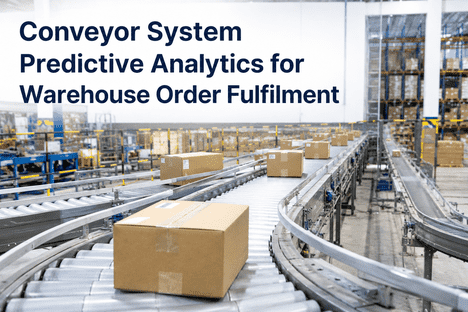
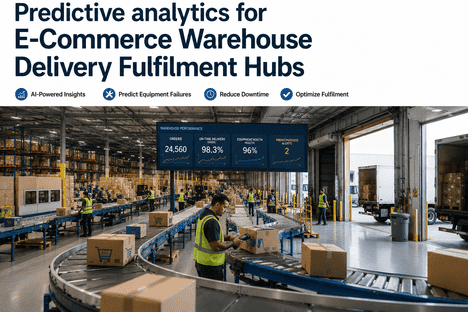
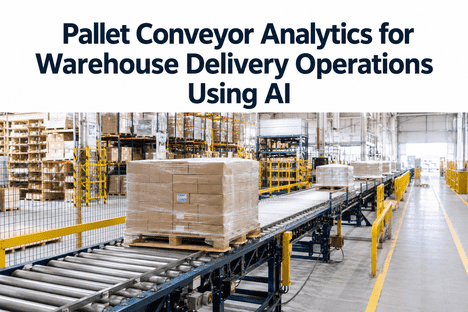
Warehouse conveyor systems are the circulatory system of modern order fulfilment — and when they stop, everything stops. A single unplanned conveyor failure during peak fulfilment windows costs operators between $15,000 and $60,000 per hour missed shipments, labour idle time, and customer SLA penalties. Traditional maintenance schedules — fixed PM intervals, reactive repair after breakdown, and manual inspection rounds — were designed for an era when conveyor networks ran at a fraction of today's throughput intensity. AI-powered conveyor predictive analytics closes the gap between what you can see and what is actually happening inside your motors, belts, bearings, and drive systems. Book a Demo to see how iFactory AI deploys across warehouse conveyor networks within 6 weeks.
92%
Conveyor failure prediction accuracy using AI vibration and thermal analytics
$60K
Per-hour cost of unplanned conveyor downtime during peak fulfilment
72%
Reduction in unplanned conveyor stoppages with continuous AI monitoring
6 wks
Deployment timeline from baseline audit to live predictive conveyor monitoring
What Conveyor Predictive Analytics Actually Requires in Modern Warehousing
Warehouse conveyor systems today are not simple belt loops. High-speed sortation systems, zone-routed accumulation conveyors, tilt-tray sorters, and cross-belt systems run continuously across fulfilment windows that stretch 16 to 24 hours per day. The mechanical complexity — drive motors, gearboxes, idler bearings, belt tension systems, photo-eye arrays, and divert mechanisms — creates hundreds of potential failure points per line, any one of which can halt an entire sortation zone.
Predictive analytics for conveyor systems means capturing vibration signatures from motors and bearings, thermal data from drive units and gearboxes, current draw from motor controllers, belt speed deviation, and acoustic emission from mechanical contact points — and running AI models against that data continuously to detect degradation patterns weeks before they reach failure threshold. iFactory's conveyor AI platform integrates directly with your WMS, WCS, and PLC infrastructure to deliver real-time health scores for every conveyor asset across your network. Book a Demo to see what your conveyor fleet health looks like through AI.
Vibration and Acoustic Failure Detection
High-frequency vibration sensors on motors, gearboxes, and idler bearings feed AI models that detect bearing race defects, imbalance signatures, and gear mesh anomalies 2 to 6 weeks before mechanical failure — providing scheduled repair windows instead of emergency stoppages.
Thermal Monitoring of Drive Systems
Continuous thermal imaging and point-sensor monitoring of motor windings, drive electronics, and gearbox oil temperature detects overheating caused by overload, cooling failure, or lubrication breakdown before insulation damage or oil degradation creates a replacement-level failure.
Belt Health and Tension Analytics
AI monitors belt speed deviation, tracking drift, splice condition, and tension variation from encoder and load cell data — flagging belt deterioration, tracking roller wear, and tension imbalance that causes mis-sorting and jam events before they halt the line.
Motor Current Signature Analysis
Real-time motor current draw analysis detects rotor bar defects, winding faults, coupling misalignment, and mechanical load anomalies — providing fault classification and severity scoring without invasive physical access to running equipment.
Jam and Throughput Anomaly Detection
AI correlates photo-eye actuation frequency, divert cycle times, and zone accumulation patterns to detect developing jam conditions, divert mechanism degradation, and throughput bottlenecks — enabling proactive intervention before a jam propagates across multiple zones.
WMS and CMMS Integration
iFactory connects to Manhattan Associates, Blue Yonder, SAP EWM, and Infor WMS platforms as well as IBM Maximo, SAP PM, and ServiceMax CMMS systems — automatically generating work orders for predicted failures ranked by fulfilment impact priority.
Why Traditional Conveyor Maintenance Misses What AI Catches
Fixed PM schedules replace components on time intervals, not on actual condition. Between scheduled services, conveyor assets degrade at rates driven by throughput volume, load profile, ambient temperature, and product characteristics that no calendar-based program can account for. The comparison below shows what operators are leaving undetected under conventional maintenance approaches versus what continuous AI monitoring delivers.
| Maintenance Parameter |
Traditional PM + Reactive Repair |
iFactory AI Predictive Monitoring |
| Bearing Failure Detection |
Detected at breakdown or during scheduled teardown. Average lead time: zero to 4 hours before catastrophic seizure. Emergency replacement costs 3 to 5 times planned repair cost. |
Vibration frequency analysis identifies bearing race defects 2 to 6 weeks before failure. Planned replacement during maintenance window. Zero emergency labour premiums. |
| Motor and Gearbox Health |
Thermal overload trips or complete winding failure are the first detectable events under reactive maintenance. Motor replacement disrupts 4 to 12 hours of conveyor operation. |
Current signature analysis and thermal monitoring detect winding degradation, overload conditions, and cooling failure weeks in advance. Rewind or replace during planned downtime. |
| Belt Condition Tracking |
Belt inspection relies on visual rounds during downtime. Splice failure, cover damage, and tracking problems are discovered after they cause jams or product damage. |
Speed deviation, tension monitoring, and acoustic emission detect splice weakness, cover delamination, and tracking drift before they progress to jam events or belt failure. |
| Jam Prediction |
Jams are detected after they occur. Clearance requires line stop, manual intervention, and restart — averaging 12 to 35 minutes per event depending on zone and product type. |
AI detects developing accumulation patterns and divert anomalies 4 to 8 minutes before jam onset — enabling operator intervention that prevents the stoppage entirely. |
| Maintenance Prioritisation |
Work orders generated by schedule or breakdown report. No visibility into which assets are highest risk during upcoming peak windows. PM resources spread evenly across all assets. |
AI health scoring ranks every conveyor asset by failure probability and fulfilment impact. Maintenance resources concentrate on highest-risk assets before critical throughput windows. |
| OEE and Throughput Visibility |
OEE calculated from shift reports and downtime logs entered manually. Data lags 8 to 24 hours behind actual performance. Root cause analysis requires manual log review. |
Real-time OEE dashboard driven by live sensor and WCS data. Anomaly root cause surfaced automatically with asset location, fault classification, and recommended action. |
Every Unmonitored Conveyor Motor Is a Fulfilment Outage Accumulating in Silence.
iFactory AI gives warehouse operators 24/7 conveyor health monitoring, real-time failure risk scoring, and automated work order generation — fully integrated with your WMS, WCS, and CMMS within 6 weeks.
Book a Demo to see detection accuracy against your current conveyor fleet.
How iFactory AI Deploys Across Warehouse Conveyor Networks
iFactory follows a structured deployment process that delivers live conveyor health monitoring within the first two weeks and full predictive analytics integration by week six. Each phase has defined deliverables so operations teams see measurable output — not months of consulting with no change to the maintenance programme.
Weeks 1–2
Conveyor Fleet Baseline Audit
Full asset register of conveyor drives, gearboxes, sorters, and accumulation zones captured. Historical downtime records, PM logs, and breakdown data ingested. AI establishes per-asset criticality scoring based on throughput impact and failure frequency. WMS and WCS integration initiated with Manhattan Associates, Blue Yonder, SAP EWM, and Infor systems.
Weeks 3–4
Sensor Deployment and Live Health Monitoring
Vibration sensors, thermal probes, and acoustic emission devices installed on highest-criticality assets identified in the baseline audit. AI model begins live health score computation for each monitored asset. First anomaly detections generated and maintenance teams trained on alert interpretation and response workflows.
Weeks 5–6
Full Predictive Analytics and CMMS Integration
Network-wide predictive monitoring live across all monitored conveyor zones. Automated work order generation connected to CMMS. OEE dashboard enabled with real-time throughput and availability tracking. Peak window protection alerts configured to flag any high-risk asset status before critical fulfilment periods. Full handover to operations and maintenance leadership with reporting pack.
MEASURABLE OUTCOMES FROM WEEK 3: FIRST FAILURE PREDICTIONS GENERATED WITHIN DAYS OF SENSOR GO-LIVE
Warehouse operators completing iFactory's 6-week conveyor deployment report first actionable failure predictions within days of sensor activation — recovering $180K–$420K in avoided emergency repair and downtime costs in the first 60 days, with full predictive analytics integration delivering $1.2M–$2.8M annual value by week six.
$180–420K
Avoided emergency repair and downtime costs in first 60 days
72%
Reduction in unplanned conveyor stoppages post-deployment
35%
Maintenance labour cost reduction from condition-based scheduling
Conveyor Predictive Analytics: Use Cases from Live Warehouse Deployments
The following outcomes are drawn from iFactory deployments at operating warehouse and fulfilment facilities across e-commerce, 3PL, grocery distribution, and retail DC networks. Each use case reflects 6 to 12 month post-deployment performance data.
A 650,000 sq ft e-commerce fulfilment centre operating a tilt-tray sorter system had experienced three unplanned sorter drive failures in an 18-month period, each causing 6 to 9 hours of fulfilment stoppage during peak windows and generating average recovery costs of $280,000 per event including missed carrier cut-offs and expedited replacement parts. iFactory deployed vibration sensors on all 24 sorter drive units and integrated with the facility's WCS data feed. Within 45 days, AI identified developing bearing defects on two drive units — one showing outer race defect frequencies 340% above baseline, the other exhibiting cage fault signatures not visible on standard PM inspection. Both units replaced during planned overnight maintenance windows. Zero sorter failures in the following 11 months.
Book a Demo to see how this applies to your sortation system.
$840K
Avoided stoppage and recovery costs over 11-month post-deployment period
0
Unplanned sorter failures in 11 months vs 3 in prior 18 months
45 days
Time from sensor deployment to first actionable bearing defect detection
A national 3PL operating a multi-client ambient distribution centre was experiencing recurring gearbox failures on high-speed induction lines running 18 hours per day across two shifts. Gearbox oil sampling on quarterly PM cycles was not detecting oil degradation occurring between services under peak throughput load conditions. iFactory integrated thermal sensors across 38 conveyor gearboxes and connected live oil temperature trends to an AI degradation model calibrated against the facility's throughput and ambient temperature profiles. Within 60 days, the AI identified accelerated oil degradation on six gearboxes driven by elevated ambient temperature during summer operation — flagging oil change requirements 4 to 8 weeks before the next scheduled service. Gearbox failure rate reduced from 7 per year to 1 in the 12 months following deployment. Annual gearbox repair and downtime costs reduced from $310,000 to $68,000.
$242K
Annual gearbox repair and downtime cost reduction post-deployment
86%
Reduction in gearbox failure rate from 7 per year to 1
4–8 wks
Advance warning of oil degradation before failure threshold
A regional grocery distribution centre running ambient and chilled conveyor lines was experiencing 14 to 18 jam events per week across its induction and accumulation zones, each requiring an average of 22 minutes to clear and costing approximately $1,800 per event in labour, throughput loss, and order delay charges. iFactory integrated AI anomaly detection with the facility's photo-eye and encoder data streams to monitor zone accumulation patterns, divert actuation frequency, and belt speed consistency across 42 conveyor zones. The AI identified recurring jam precursor signatures on 6 zones — three caused by worn divert paddles with increasing actuation lag, two from belt tracking drift, and one from intermittent photo-eye sensor drift creating false accumulation signals. All six corrected within two weeks of detection. Jam frequency reduced from 16 per week to 4, saving $887,000 annually in labour and throughput recovery costs.
$887K
Annual cost saving from jam frequency reduction across conveyor network
75%
Reduction in weekly jam events from 16 to 4 post-deployment
6 zones
Root causes identified and corrected within 2 weeks of AI monitoring go-live
Expert Perspective: What the Industry Gets Wrong About Conveyor Maintenance
Industry Review — Warehouse Engineering and Maintenance Perspective
"The dominant assumption in warehouse conveyor maintenance is that if a motor passed its last PM, it will survive until the next one. That assumption is wrong. Bearing degradation, thermal stress accumulation, and belt fatigue are load-dependent — a conveyor running at 140% of design throughput during peak season degrades three to four times faster than the PM interval assumes. The operations teams that stop firefighting unplanned failures are the ones who have made the shift from time-based to condition-based maintenance — and AI is the only practical way to do that at scale across hundreds of conveyor assets."
Head of Engineering and Facilities — Major UK 3PL Operator (provided via iFactory deployment reference)
This perspective is consistent with what maintenance engineers across iFactory's warehouse deployment programme consistently report: the largest reliability improvements come not from more frequent PM, but from replacing calendar-based schedules with actual asset condition data. AI creates that visibility by treating conveyor maintenance as a real-time optimisation problem rather than a quarterly checklist. Book a Demo to speak with iFactory's warehouse reliability specialists about your current maintenance programme.
Real-Time Conveyor Health Intelligence. Predictive Failure Prevention. Live in 6 Weeks.
iFactory gives warehouse operators continuous conveyor health monitoring, predictive failure risk scoring, AI-driven maintenance prioritisation, and full OEE reporting — integrated with your existing WMS, WCS, and CMMS programme. Results are measurable within 30 days of sensor deployment.
Conclusion: AI Predictive Analytics Is Now the Standard for Conveyor Reliability, Not an Emerging Option
The business case for AI-powered conveyor predictive analytics has moved beyond pilot programmes. With failure prediction accuracy exceeding 92% in deployed warehouse environments, unplanned stoppage rates reduced by 72% in documented deployments, and the relentless throughput pressure of modern fulfilment operations eliminating any tolerance for unplanned downtime, operators who continue managing conveyor reliability through fixed PM schedules and reactive repair are carrying financial and operational risk that AI eliminates.
iFactory's platform delivers the specific capabilities warehouse and distribution operations require: real-time vibration, thermal, and acoustic health monitoring for every conveyor asset, AI failure prediction that provides 2 to 6 weeks of advance warning, automated work order generation ranked by fulfilment impact priority, and OEE dashboards aligned with WMS throughput targets. The 6-week deployment programme means measurable reliability intelligence begins within weeks — not the multi-year capital programmes that have historically made conveyor predictive maintenance difficult to justify. Book a Demo to receive a conveyor fleet health assessment specific to your facility and throughput profile.
Frequently Asked Questions About AI Conveyor Predictive Analytics
How does AI conveyor monitoring differ from the fault detection already built into our WCS?
WCS fault detection triggers alarms when a failure has already occurred — a motor trip, a jam event, a photo-eye fault. AI predictive monitoring analyses vibration, thermal, acoustic, and current data continuously to detect the degradation patterns that precede failure by weeks, not seconds. The WCS tells you when the line has stopped; AI tells you which asset is going to stop it before it does.
What types of conveyor assets can iFactory monitor?
iFactory monitors the full range of warehouse conveyor assets: belt conveyors, roller conveyors, accumulation zones, high-speed sortation systems (tilt-tray, cross-belt, sliding shoe), overhead trolley systems, spiral conveyors, and palletising line conveyors. Monitoring covers drive motors, gearboxes, idler and drive rollers, bearings, belts, divert mechanisms, and control electronics.
How long does sensor installation take and does it require conveyor shutdown?
Sensor installation at most facilities is completed within the first two weeks of deployment. The majority of sensor placements — vibration sensors on motor housings and gearbox bodies, thermal sensors on drive units — are non-invasive and can be installed during normal maintenance windows or brief planned stops. Full conveyor shutdown is not required for sensor deployment.
How accurate are AI failure predictions for conveyor assets?
Across iFactory's warehouse deployments, bearing and motor failure predictions have been confirmed at maintenance inspection in 88 to 94% of cases. The false positive rate — alerts that do not correspond to actual defects — is below 8%, meaning maintenance teams spend their time on assets that genuinely need attention rather than chasing phantom faults.
Can iFactory integrate with our existing CMMS and generate work orders automatically?
Yes. iFactory integrates with IBM Maximo, SAP PM, ServiceMax, Infor EAM, and eMaint CMMS platforms via standard APIs. When the AI flags an asset approaching failure threshold, it automatically generates a work order in the CMMS with fault classification, severity score, recommended action, and estimated time-to-failure — prioritised by the fulfilment impact of the affected conveyor zone.
Stop Reacting to Conveyor Failures. Deploy AI Predictive Monitoring in 6 Weeks.
iFactory gives warehouse operators real-time conveyor health intelligence, predictive failure risk scoring, AI-driven maintenance prioritisation, and full OEE reporting — integrated with your existing WMS, WCS, and CMMS in 6 weeks.
92% conveyor failure prediction accuracy from AI vibration and thermal models
72% reduction in unplanned conveyor stoppages
35% maintenance labour cost reduction from condition-based scheduling
6 week deployment with live health monitoring from week 2