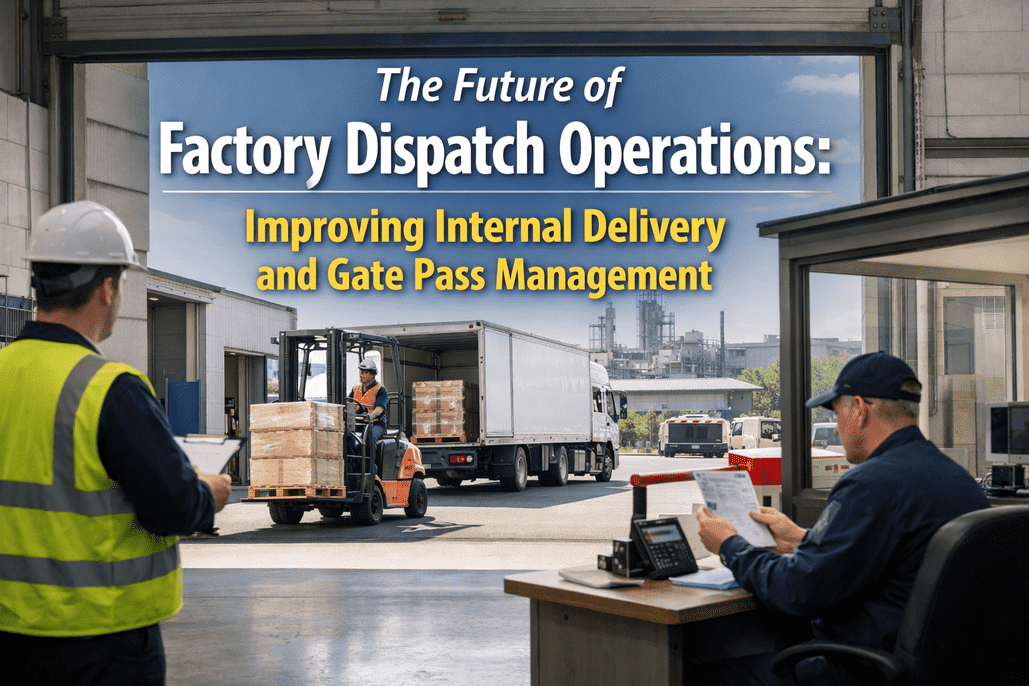
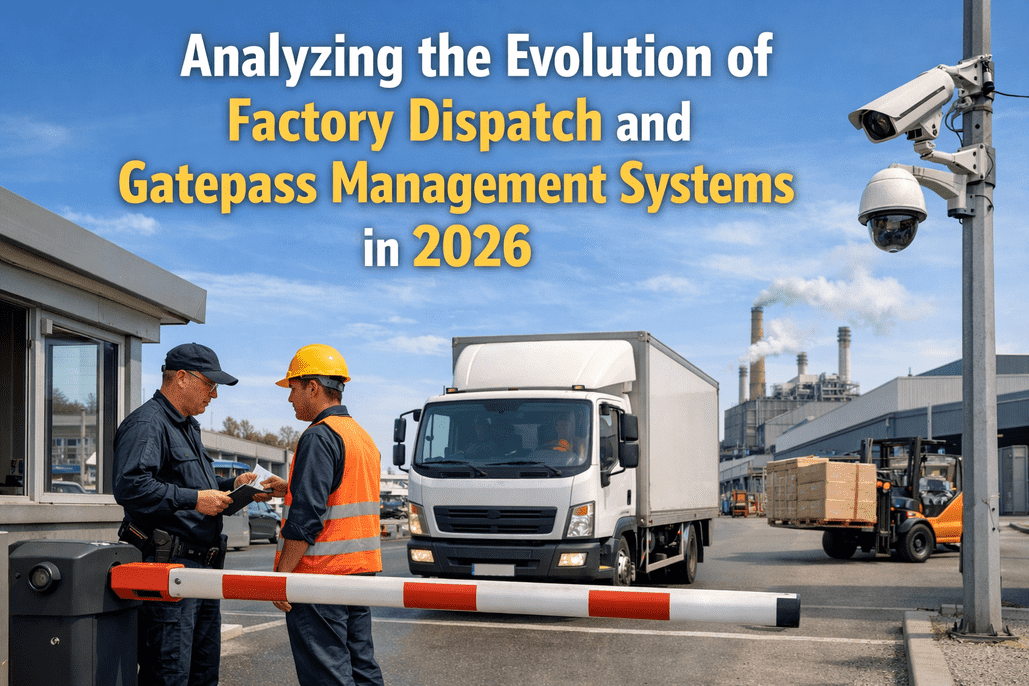
When global e-commerce penetration reaches 19.7% of all retail transactions by the end of 2026, the pressure does not land only on delivery carriers or fulfillment centers. It lands directly on factory dispatch departments — the internal teams managing what goes out the gate, when, and in what sequence. The e-commerce logistics market was valued at $624 billion in 2026 and is projected to surpass $2.4 trillion by 2034, growing at a CAGR of nearly 19%. Parcel volumes are forecast to rise 20–25% over the next five years. But the factory dispatch department — the function that stages finished goods, sequences outbound vehicles, coordinates with inbound material, and manages gate events — is still operating on the same manual processes it used when order volumes were half this size. The problem is compounded by a structural shift in what e-commerce orders demand: smaller, more frequent dispatches; tighter SLA windows; higher SKU variety; and customer-facing delivery commitments that flow back through the supply chain to the factory floor itself. For dispatch supervisors and plant managers, this is not a future challenge to plan for. It is the operational reality they are managing today, with tools built for a volume profile that no longer exists. For questions, talk to our support team directly.
E-Commerce Logistics · Factory Dispatch · 2026
The Impact of E-Commerce Growth on Factory Dispatch Departments: Adapting to New Operational Demands
E-commerce penetration is rising to nearly 20% of global retail in 2026. Factory dispatch departments built for weekly bulk shipments are now processing daily multi-SKU orders under SLA windows that leave no margin for manual sequencing errors, gate pass delays, or receiving backlogs. This guide shows what changes — and what to do about it.
19.7%
Global e-commerce retail penetration expected by end of 2026 — up from under 10% in 2019
$624B
E-commerce logistics market size in 2026 — growing to $2.4 trillion by 2034
20–25%
Projected parcel volume growth over the next five years — absorbing factory dispatch capacity
14 Days
iFactory go-live timeline — from decision to fully operational digital dispatch department
How E-Commerce Is Restructuring What Factory Dispatch Departments Must Do
Factory dispatch was designed around bulk outbound shipments — full truckloads leaving on scheduled runs to distribution centers or large retail customers. E-commerce has inverted this model entirely. The same factory floor that shipped 20 large orders per week in 2019 may now ship 200+ smaller orders per day in 2026, each with its own SLA commitment, packaging specification, customer-facing tracking event, and carrier requirement.
Traditional Factory Dispatch (Pre-E-Commerce Scale)
Weekly bulk shipments to distribution centers
Single carrier per route — predictable vehicle schedule
Manual dispatch logs — 2–3 vehicles processed per hour
SLA measured in days — 48–72 hour windows tolerated
Gate passes processed on paper — 15–20 min per vehicle
Materials staged once daily — one receiving window
Dispatch errors surfaced only on customer complaint
No real-time visibility into gate queue or vehicle location
E-Commerce Scale Factory Dispatch (2026 Reality)
Daily multi-SKU order waves — 10× the outbound event count
Multiple carriers per day — dynamic assignment by SLA tier
Digital dispatch sequencing — SLA-priority automation required
SLA measured in hours — same-day and next-day commitments standard
Digital gate pass — under 2 minutes per vehicle to clear volume
Continuous inbound receiving — materials arrive in waves throughout the day
Dispatch errors immediately customer-visible — tracking expectations set
Real-time gate and yard status required for dispatch sequencing decisions
The 6 Operational Pressure Points E-Commerce Creates in a Factory Dispatch Department
When order volumes increase 10× without corresponding changes to dispatch systems, the pressure concentrates in predictable places. These are the six functions that break first — and what each failure costs at e-commerce scale.
01
Gate Pass Volume — The Bottleneck That Scales With Every Order
Every inbound and outbound vehicle requires a gate pass event. At e-commerce volumes, a factory that once processed 8–10 vehicles per day may now process 40–60. Manual gate processing at 15–20 minutes per vehicle consumes 600–1,200 minutes of gate time daily — 10 to 20 person-hours — before a single vehicle has been loaded or unloaded. This creates cascading delays: receiving dock backlogs, staging area congestion, and dispatch SLA failures that begin at the gate before the order has even been touched. Digital gate pre-registration and mobile verification processes each vehicle in under 2 minutes — cutting gate time from a 1,200-minute daily burden to under 120 minutes at the same vehicle volume.
Cost at E-Commerce ScaleGate bottleneck at 40+ vehicles/day: 600–1,200 minutes of dock time lost daily to manual processing
02
Dispatch Sequencing — SLA Priority Decisions That Manual Systems Cannot Make
Manual dispatch assigns vehicles by availability and habit. At e-commerce volumes, this produces an error rate of 2–3% across 200+ daily dispatch events — meaning 4 to 6 mis-sequenced shipments per day generating customer complaints, SLA penalties, and re-dispatch costs. The compounding issue: e-commerce customers have real-time tracking visibility. A dispatch error that would have surfaced as a complaint call 48 hours later in traditional logistics is now visible to the customer in the tracking portal within 2 hours — and to their review platforms immediately after. SLA-priority automated dispatch reduces errors to under 0.3% and sequences every outgoing vehicle by urgency tier, carrier, route, and vehicle availability without manual intervention.
Cost at E-Commerce Scale2–3% error rate on 200 daily dispatches = 4–6 SLA failures per day — each immediately customer-visible via tracking
03
Inbound Receiving — Continuous Wave Receiving vs. Single-Window Processing
Traditional factory receiving operated on scheduled inbound windows — materials arriving in predictable batches once or twice per day. E-commerce component supply chains deliver in smaller, more frequent shipments matched to production sequences that now change daily based on order profiles. Manual receiving at 45–60 minutes per shipment cannot process the 8–15 inbound deliveries per day that e-commerce production schedules require. Receiving backlogs create staging congestion that blocks outbound dispatch lanes — directly causing outbound SLA failures from inbound processing delays. Mobile inbound receiving with barcode scanning and photo POD cuts per-shipment processing to under 10 minutes, enabling continuous wave receiving without dock congestion.
Cost at E-Commerce Scale8–15 inbound shipments/day at 45–60 min each = 6–15 hours of receiving time blocking outbound dock lanes
04
Internal Material Location — The Search Problem That Grows With SKU Count
E-commerce order profiles require higher SKU variety from the same factory floor. A factory producing 50 SKUs for bulk retail now produces 200+ SKUs for e-commerce channels — with materials, components, and finished goods spread across more staging locations. Without digital internal tracking, the 30–40% of production stoppages attributable to material location failures scale proportionally with SKU count. A dispatch supervisor staging a 200-SKU order wave has no reliable way to locate every component or finished unit without a digital transfer log. Each failed location triggers a yard vehicle search run — generating avoidable fuel consumption and further congesting the dock.
Cost at E-Commerce Scale30–40% of production stoppages are locating failures — each triggering yard search runs and dock congestion at e-commerce SKU counts
05
Vehicle Inspection Compliance — Volume That Paper Checklists Cannot Sustain
At e-commerce vehicle volumes, the yard fleet — forklifts, shunters, yard tractors — operates at significantly higher utilization rates than traditional factory dispatch cycles allowed. Higher utilization accelerates equipment wear and increases the probability of inspection-relevant defects. Paper inspection checklists completed under time pressure at e-commerce volumes produce incomplete, inaccurate records. Vehicles with legitimate safety defects are dispatched because manual processes cannot block them reliably. Digital pre-use inspection checklists on mobile complete in 3–5 minutes, auto-block vehicles with failed inspection items, and generate a continuous compliance log that manual systems cannot sustain at any volume.
Cost at E-Commerce ScaleHigher yard utilization = faster equipment wear + paper inspection processes that cannot block defective units reliably
06
Incident Management — Response Time That E-Commerce SLAs Demand
Traditional factory dispatch incident management operated on a delayed discovery cycle — incidents surfaced through phone calls, paper reports, and end-of-shift reviews. At e-commerce SLA windows measured in hours, an incident that delays a dispatch by 3 hours is not recoverable within the same-day delivery window. Digital real-time incident capture with automatic escalation routes alerts to the right supervisor within minutes — not hours. Every incident record is timestamped, photo-documented, and linked to the affected vehicle and order — giving dispatch supervisors the information needed to re-sequence affected shipments before the SLA window closes.
Cost at E-Commerce ScaleE-commerce SLA windows measured in hours: a 3-hour incident discovery delay eliminates same-day delivery recovery entirely
iFactory gives factory dispatch departments the digital tools e-commerce volumes demand. Gate passes in 2 minutes. Dispatch errors under 0.3%. Live in 14 days.
Gate pass automation, SLA-priority dispatch sequencing, mobile inbound receiving, real-time material tracking, and incident management — purpose-built for the volume and speed e-commerce requires.
Talk to our support team about your dispatch volume and SLA configuration.
The E-Commerce Dispatch Data Layer — What Digital Operations Generate That Paper Cannot
E-commerce customers, carriers, and compliance requirements demand operational data that paper-based dispatch departments cannot produce. Here is the specific data that iFactory generates automatically from daily factory dispatch operations at e-commerce scale.
Gate & Yard
Per-vehicle dwell time — exact gate duration per inbound and outbound event
Vehicle type and carrier ID at every gate entry
Gate queue depth over time — peak hour analysis for dock resource planning
Yard vehicle utilization rate — per unit per shift at e-commerce volumes
Dispatch & SLA
Per-order SLA compliance rate — on-time dispatch vs. committed window
Dispatch error rate per period — auto-calculated from sequencing records
Vehicle assignment log — every dispatch with driver, vehicle, route, timestamp
Re-dispatch count and cause — tracks recovery events from initial errors
Inbound & Materials
Per-shipment receiving time — from dock arrival to verified PO completion
Chain of custody from supplier to production floor — every transfer timestamped
Discrepancy rate per supplier — quality and quantity variance tracking
Material location at every internal transfer point — eliminates search events
Inspection & Incidents
Daily inspection completion rate per vehicle — with failed item documentation
Auto-blocked vehicle log — units removed from dispatch via failed inspection
Incident response time — from event capture to supervisor escalation
Incident-to-resolution timeline — per event, per vehicle, per operator
How iFactory Adapts Factory Dispatch Departments for E-Commerce Operational Demands
iFactory is purpose-built for the factory delivery department — the internal function managing every gate event, inbound receipt, dispatch, inspection, and material transfer. At e-commerce volumes, these five core workflows run continuously and in parallel. iFactory manages all five from a single cloud-based platform that deploys in 7–14 days.
01
Digital Gate Pass — Pre-Registration to Exit in Under 2 Minutes
Drivers pre-register on mobile before arrival. Security verifies carrier, vehicle, and cargo manifest on a mobile checklist. Gate processing completes in under 2 minutes — clearing 40–60 vehicles per day without dock congestion. Every gate event records vehicle type, carrier ID, arrival timestamp, and dwell time — generating the gate queue analytics and carrier performance data that e-commerce dispatch management requires.
87% gate time reductionReal-time queue visibilityCarrier performance tracking
02
SLA-Priority Dispatch Sequencing — Automated, Error-Free, E-Commerce Ready
Dispatch orders are sequenced automatically by SLA priority tier, carrier requirement, vehicle type, load capacity, and route. At 200+ daily dispatch events, manual sequencing produces 4–6 SLA failures per day. iFactory's automated sequencing reduces this to under 0.3% — with real-time SLA alerts firing before windows close rather than after customer complaints arrive. Every dispatch event is logged with vehicle ID, departure time, route, and carrier.
90% fewer dispatch errorsSLA alerts before breachPer-trip dispatch log
03
Mobile Inbound Receiving — Wave Processing Without Dock Congestion
Receiving staff verify inbound materials against purchase orders on mobile — scanning barcodes, capturing photo proof of delivery, and logging discrepancies in real time. Per-shipment processing drops from 45–60 minutes to under 10 minutes — enabling the continuous wave receiving that e-commerce component supply chains require without blocking outbound dispatch lanes.
78% faster receivingWave processing enabledAutomatic chain of custody
04
Real-Time Internal Material Tracking — Every Transfer, Every Location
Materials are logged at every internal transfer — dock to stores, stores to production, production to staging, staging to dispatch lane. At e-commerce SKU counts of 200+ product variants, real-time location at every transfer point eliminates the material search events causing 30–40% of production stoppages. Dispatch supervisors can confirm staging completion for every SKU in an outbound order wave before vehicles arrive.
30–40% fewer stoppagesSKU location at every transferStaging confirmation before dispatch
05
Real-Time Incident Management — Escalation Before the SLA Window Closes
Incidents are captured on mobile with timestamp, photo documentation, vehicle link, and operator attribution. Auto-escalation routes alerts to the responsible supervisor immediately — enabling dispatch re-sequencing decisions before the affected SLA window closes. At e-commerce SLA windows measured in hours, the difference between a 2-minute digital incident alert and a 3-hour manual discovery cycle is the difference between SLA recovery and confirmed SLA breach.
Real-time escalationSLA recovery window preservedFull incident audit trail
Measurable Results
What iFactory Delivers for Factory Dispatch at E-Commerce Scale
87%
Gate Pass Time Reduction
From 15–20 min manual to under 2 min digital. A 40-vehicle/day factory recovers 560+ minutes of dock time daily — the difference between cascading dock congestion and a dispatch operation running on schedule.
90%
Fewer Dispatch Errors
2–3% manual error rate drops to under 0.3%. At 200 daily dispatch events, this eliminates 4–6 SLA failures per day that are immediately visible to e-commerce customers via tracking platforms.
78%
Faster Inbound Receiving
Receiving drops to under 10 minutes per shipment. Continuous wave receiving for 8–15 daily inbound deliveries without creating dock backlogs that block outbound dispatch lanes at e-commerce volumes.
100%
Audit Trail Coverage
Every gate event, dispatch, receiving transaction, material transfer, inspection, and incident is timestamped and person-attributed. SLA audits, carrier performance reviews, and compliance records retrievable in under 60 seconds.
3–6 mo
Full Payback Period
Recovered dock time, eliminated SLA penalties, reduced dispatch error costs, and compliance overhead reduction combine to deliver full payback within one to two quarters at e-commerce dispatch volumes.
14 Days
Go-Live Timeline
Cloud-based, mobile-first deployment. Vehicle registry, driver roster, supplier list, SLA rules configured in days. No server installation, no IT project, no hardware procurement required.
Frequently Asked Questions
Questions plant managers and dispatch supervisors ask when evaluating how to adapt their factory delivery department to e-commerce operational demands.
How exactly does e-commerce growth change what a factory dispatch department must do compared to traditional bulk distribution?
The fundamental difference is order profile: traditional bulk factory dispatch was built around a small number of large shipments on predictable schedules. E-commerce shifts this to a large number of small shipments on SLA-constrained windows that change daily. Volume increases 10× in dispatch event count without a proportional increase in dock space, staff, or vehicle count. Inbound component deliveries also increase to match production sequences that now change daily, converting scheduled receiving windows to continuous wave processing. E-commerce customers have real-time tracking visibility, meaning a dispatch delay that surfaces as a complaint call 48 hours later in traditional logistics is now visible in a customer's tracking portal within 2 hours. Same-day and next-day delivery commitments flow back through the supply chain to factory dispatch, compressing acceptable recovery time from days to hours. A factory dispatch department built for traditional bulk distribution cannot absorb this profile change with the same manual gate, dispatch, and receiving workflows — the processing speed required at e-commerce volumes exceeds what paper-based systems can sustain.
Talk to our support team about your current dispatch volume and how iFactory scales with your e-commerce order profile.
What is the actual cost of running a manual factory dispatch department at e-commerce volumes?
The cost has five components that each stand independently. Gate processing loss: at 40–60 vehicles per day and 15–20 minutes manual processing per vehicle, a factory loses 600–1,200 minutes of gate time daily — equivalent to 10–20 person-hours consumed in paper-based gate administration before a single vehicle is loaded or unloaded. Dispatch error costs: at a 2–3% manual error rate on 200 daily dispatch events, 4–6 shipments are mis-sequenced per day. Each error triggers re-dispatch costs, SLA penalty exposure per carrier contract (typically $50–$500 per event), and customer satisfaction damage that compounds over time. Receiving dock congestion: 8–15 inbound shipments at 45–60 minutes each generates 6–15 hours of receiving time daily — blocking outbound dispatch lanes and creating staging congestion that causes SLA failures from inbound delays. Material search cost: 30–40% of production stoppages at e-commerce SKU counts are material locating failures, each triggering yard vehicle runs and downstream dispatch delays. Incident recovery cost: a 3-hour incident discovery cycle at e-commerce SLA windows eliminates the same-day delivery recovery window entirely. Total annual cost from all five components at a mid-size factory is typically $200,000–$600,000.
Book a demo to see a cost calculation specific to your dispatch volume.
How does iFactory's SLA-priority dispatch sequencing work at e-commerce volumes?
iFactory's dispatch sequencing engine assigns every outgoing vehicle and order wave based on four parameters simultaneously: SLA tier (same-day, next-day, standard), carrier requirement (specific carriers assigned to specific customer contracts), vehicle availability and capacity (matching load size to available units without under-loading), and route efficiency (grouping orders by geography where compatible with SLA requirements). At e-commerce volumes of 200+ daily dispatch events, the sequencing runs continuously as new orders enter the dispatch queue — not as a batch assignment at the start of each shift. This is the fundamental difference from manual dispatch: manual systems assign vehicles at the beginning of a period and cannot re-optimize when new priority orders arrive mid-shift. iFactory re-sequences the dispatch queue in real time — a new same-day order arriving at 11 AM is inserted into the priority queue ahead of standard orders already staged without requiring a supervisor decision. SLA alerts fire when any shipment is at risk of missing its committed window — giving supervisors the lead time to make recovery decisions rather than confirmation that a breach has already occurred.
Talk to our support team about configuring SLA rules for your specific carrier contracts and customer commitments.
How quickly can iFactory be deployed in a factory dispatch department already operating at e-commerce volumes?
iFactory deploys in 7–14 days for a full factory dispatch department deployment — even in operations already managing e-commerce volumes. The deployment does not require a system migration, an IT infrastructure project, or hardware procurement. Days 1–3 cover data onboarding: iFactory's team loads your vehicle registry, driver roster, carrier list, SLA rule set, and PO templates from existing records in parallel with ongoing operations. Days 4–7 cover configuration and parallel operation: iFactory gate pass, dispatch, and receiving workflows run alongside existing manual processes. Staff use both systems simultaneously, with iFactory capturing records that paper processes miss. Training for gate security, dispatch supervisors, and receiving staff takes 2–4 hours via the mobile app. Days 8–14: full cutover with iFactory support monitoring data quality and resolving workflow gaps in real time. For factories already under e-commerce volume pressure, the 14-day deployment timeline is typically the most compelling aspect of the evaluation — because every day of continued manual operations is a day of avoidable SLA failures and dispatch errors.
Book a demo to see iFactory configured for an e-commerce volume dispatch environment.
Can iFactory handle multi-carrier, multi-SLA dispatch for factories serving both e-commerce and traditional wholesale customers simultaneously?
Yes — mixed-channel dispatch management is one of the most common configuration requirements iFactory handles. Factories serving both e-commerce platforms with same-day SLAs and traditional wholesale accounts with 48–72 hour windows need dispatch sequencing that prioritizes correctly across both channels without manual SLA tier management. iFactory's dispatch sequencing engine handles unlimited SLA tiers simultaneously — each with its own priority weighting, carrier assignment, and alert threshold. An e-commerce same-day shipment automatically outranks a wholesale standard shipment in the queue regardless of when either order entered the system. Carrier-specific requirements — documentation formats, load specifications, check-in procedures — are configured per carrier profile and auto-applied when that carrier's vehicle arrives at the gate. The dispatch log records which SLA tier each shipment was processed under, providing the per-channel performance data that e-commerce platform compliance reviews require separately from wholesale account SLA reporting.
Talk to our support team about configuring mixed-channel SLA rules for your specific customer and carrier portfolio.
E-Commerce Growth Is Not Slowing. Your Factory Dispatch Department Needs to Keep Up.
iFactory digitizes every function of your factory dispatch department — gate pass management, SLA-priority dispatch sequencing, inbound wave receiving, real-time material tracking, yard vehicle inspection, and incident management — and gives you the operational speed and accuracy that e-commerce volumes demand. Live in 14 days. No IT project. No hardware procurement.