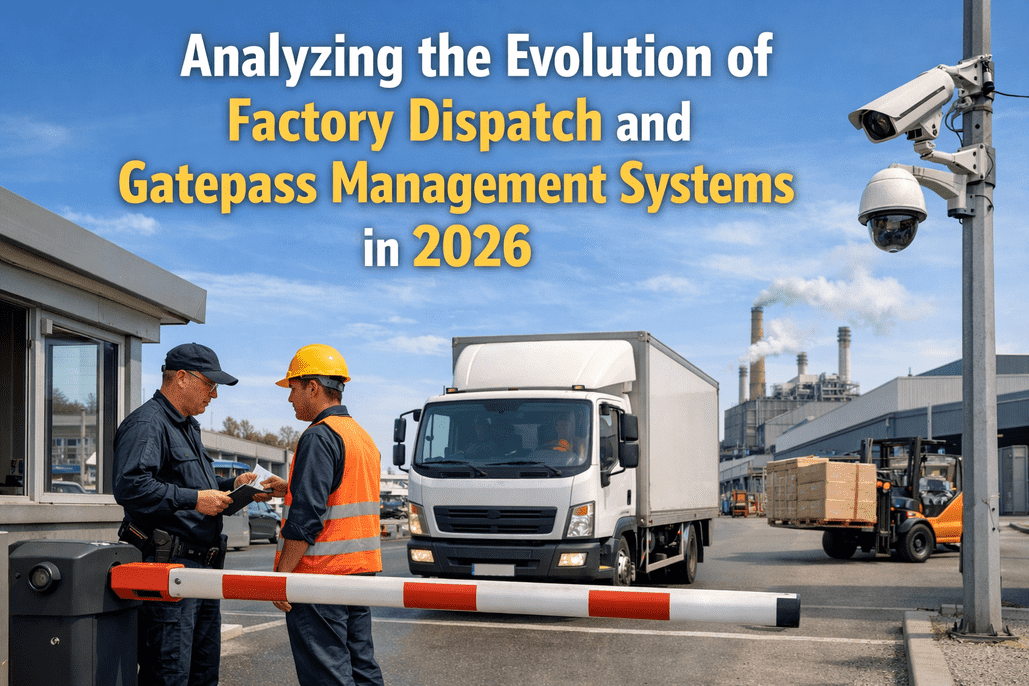
Florida is not becoming a logistics hub — it already is one. With $78.3 billion in annual freight and logistics activity, 16 deepwater seaports, and over 1,000 new residents arriving every single day, the state is generating inbound delivery volume that is reshaping what factory delivery departments must be capable of in 2026. But this pressure is not arriving through shipping lanes alone. It enters every Florida factory through the receiving dock, the gate pass queue, the dispatch sequence, and the incident log. E-commerce growth in Florida is an internal operations challenge — not an external logistics story. The factories and industrial facilities adapting their delivery departments now, with digital gate pass management, real-time inbound receiving, automated dispatch sequencing, and documented incident management, will absorb this growth profitably. Those still managing these functions on paper are accumulating compounding operational debt that e-commerce volumes will make impossible to ignore. For facility-specific questions, talk to our support team directly.
E-Commerce Logistics · Factory Delivery Operations · 2026
How Florida's Logistics Industry Is Adapting to E-Commerce Growth
Florida's 16 deepwater seaports, $78B freight market, and 1,000+ daily new residents are driving a volume surge that hits factory delivery departments hardest — through dock appointment overload, receiving bottlenecks, dispatch SLA compression, and gate incidents that paper-based systems cannot manage. This guide covers what is actually changing and how digital factory delivery operations are the competitive separator in 2026.
$78.3B
Florida freight and logistics market size in 2025 — 4th largest US economy by GSP
1,000+
New Florida residents per day — each generating additional fulfillment demand
14%
Annual freight demand surge — Florida among fastest-growing US logistics markets
16
Deepwater seaports — all expanding capacity simultaneously to handle e-commerce growth
Florida's Logistics Pressure Points
Why Florida's E-Commerce Surge Hits Factory Delivery Departments — Not Just Shipping Lanes
Florida's port infrastructure, population growth, and nearshoring trends are combining to produce an inbound delivery volume surge that factory operations teams are experiencing directly — at the gate, at the dock, and at the dispatch desk. These are the five pressure points landing hardest on factory delivery departments across the state in 2026.
Pressure Point 01
Dock Appointment Volume Surge
E-commerce replenishment cycles have pushed inbound delivery frequency from 8–12 scheduled arrivals per day to 20–35+ at high-volume facilities. Manual gate pass processing at 15–20 minutes per vehicle creates 300–700 minutes of avoidable dwell time daily — backing up logistics partners, delaying production starts, and creating SLA penalty exposure in supplier agreements.
Manual: 300–700 min lost daily at 20 vehicles
Pressure Point 02
Inbound Receiving Accuracy Collapse
Florida's nearshoring acceleration — driven by Hurricane Helene supply chain disruptions in late 2024 — is increasing inbound shipment frequency from Latin American suppliers with shorter lead times and tighter documentation windows. Paper-based PO matching generates a 3–7% error rate that at 30 shipments/day produces 1–2 receiving failures daily, each triggering hours of production-stalling resolution.
Paper receiving error rate: 3–7% vs. digital: under 0.5%
Pressure Point 03
Dispatch SLA Compression
Florida's centrality in retailers' same-day and next-day shipping strategies is tightening the outbound dispatch windows that factories must hit as supply partners. Manual dispatch sequencing generates a 2–3% priority error rate that creates $50,000–$200,000 in annual penalty exposure for mid-size facilities — before management time and re-dispatch costs are counted.
Manual dispatch error: 2–3% → $50K–$200K annual exposure
Pressure Point 04
Gate Incident Liability — Elevated Insurance Environment
Higher inbound vehicle frequency means more gate incidents, cargo discrepancies, and yard vehicle interactions at greater velocity than factory delivery departments were built to handle. Florida's commercial insurance premiums rose 20–30% annually in recent years due to storm risk. Any undocumented incident at the factory gate is an undefended liability exposure in a market where insurers are scrutinizing claims aggressively.
Florida commercial insurance: 20–30% annual premium increase
Pressure Point 05
Zero Expansion Buffer — Under 6% Warehouse Vacancy
South Florida industrial warehouse vacancy sits below 6% as of 2025 — meaning factories cannot absorb inbound volume pressure by expanding footprint. The only absorptive capacity available is digital processing speed at the gate and dock. Facilities that cut gate processing from 20 minutes to under 2 minutes per vehicle gain 6+ hours of operational capacity daily without adding a square foot of floor space.
South Florida warehouse vacancy: under 6% — no physical expansion room
Port Infrastructure Impact
How Florida's Port Expansion Is Reaching Your Factory Receiving Dock
Florida's port capacity expansions are frequently reported as shipping industry news — but their operational impact lands directly on factory receiving departments. Larger vessels, faster unloading, and more frequent cargo releases mean inbound batches arrive faster, larger, and with less scheduling lead time than manual receiving workflows were designed to handle.
MIA
PortMiami — Intermodal Rail Expansion to 5 Tracks in 2026
PortMiami is expanding from 3 to 5 intermodal rail tracks in 2026, increasing the frequency and volume of container movements reaching inland distribution points — accelerating the pace at which inbound material arrives at factory docks across South Florida. Handling 9M+ tons of cargo annually and operating as the first US port of call from South America and Europe, PortMiami means inbound material from these regions reaches Miami factories with minimal ocean-to-dock lead time. Factories receiving from these trade lanes are managing faster, more frequent inbound cycles without proportionally more receiving staff — making digital PO verification and photo documentation a structural requirement rather than a productivity upgrade.
9M+ tons cargo/yearFirst US call from South America + Europe5 rail tracks by 2026
EVG
Port Everglades — $471M Southport Expansion Adding 1,500 ft of New Berth
Port Everglades' Southport Turning Notch Extension adds 1,500 feet of new berth with Super Post-Panamax crane capacity — meaning larger vessels unloading larger cargo batches simultaneously in South Florida. For factories with paper-based receiving processes, larger inbound batches create compounding bottlenecks: more PO matching to do manually, more discrepancy documentation on paper, more dock appointments to coordinate by phone. The $53M EPA emissions reduction project funded in 2025 also signals environmental scrutiny of industrial vehicle activity near port-connected facilities — relevant for Florida factories managing inbound logistics vehicle dwell time at the gate.
$471M Southport expansion1,500 ft new berthSuper Post-Panamax cranes
MIA
Miami International Airport — 2.3M Tons Air Cargo, 80% of US-Latin America Air Freight
Miami International Airport handles 2.3M+ tons of air cargo annually and processes more than 80% of all US-Latin America air freight — making it the primary entry point for time-sensitive goods reaching Florida factories on compressed delivery schedules. Air freight moves faster than sea, which means factory receiving departments that cannot schedule inbound dock appointments in real time create costly dwell time for air cargo carriers whose vehicles cannot queue in manual processing lines. For factories dependent on air freight inbound material — common in pharma, electronics, and high-value manufacturing — digital gate appointment systems are operationally necessary, not optional.
2.3M+ tons air cargo/year80%+ of US-Latin America air freight$45B+ FTZ activity annually
NF
JAXPORT + Tampa Bay + Port Canaveral — Statewide Pressure, Not Only South Florida
The factory delivery department pressure from Florida's logistics growth is not confined to Miami-Dade and Broward. JAXPORT serves as the Southeast's primary automotive and consumer goods gateway. Tampa Bay port handles pharmaceutical, automotive, and industrial import flows for Central Florida manufacturers. Port Canaveral's projected $211M revenue for 2025 reflects growth in industrial cargo serving the Space Coast's advanced manufacturing cluster. Orlando, Tampa, and Jacksonville facilities face the same dock frequency pressure as Miami — making this a statewide challenge. Factories with multiple Florida locations need a platform managing gate, receiving, and dispatch across all sites under a single dashboard.
JAXPORT: automotive + consumer goods gatewayTampa: pharma + industrial importsCanaveral: $211M 2025 revenues
The Operational Data Gap
Where Florida's E-Commerce Volume Growth Meets Your Factory Delivery Department's Data Reality
Data Your Factory Delivery Department Likely Has
Production OEE — tracked by 86% of manufacturers across all verticals
Maintenance work orders for production equipment and fixed plant assets
Outbound shipment documentation and proof of delivery to customers
Employee safety training records and EHS incident documentation
Energy consumption data for production floor operations
Finished goods inventory and warehouse location records
Supplier qualification and vendor management records
Data Your Delivery Department Almost Certainly Does Not Have
Per-vehicle gate dwell time — the idle metric creating compounding operational exposure
Inbound vehicle arrival record with cargo manifest at time of gate entry
Digital chain of custody from supplier through dock to production floor
Yard vehicle inspection logs with timestamps and operator attribution
Dispatch SLA compliance rate — misses undetected until customer complaint arrives
Real-time internal material location — tracking stops at receiving dock entry
Gate queue length over time — the incident frequency and liability documentation metric
Florida's E-Commerce Volume Growth Is Arriving at Your Factory Gate. iFactory Manages What Happens When It Gets There.
Digital gate pass processing, mobile inbound receiving, automated dispatch sequencing, yard vehicle inspection, and incident documentation — live in 14 days. No infrastructure project.
Talk to our support team for a factory-specific assessment.
Before vs. After
Factory Delivery Department — Manual Operations vs. iFactory in Florida's 2026 E-Commerce Environment
The performance gap between a paper-based and a digitally managed factory delivery department is always significant. In Florida's environment — where freight demand surges 14% annually and dock appointment frequency is compounding — this gap widens every quarter.
Function
Manual Operations
iFactory Platform
Gate Pass
15–20 min/vehicle · paper logs · zero dwell data · queue buildup at dock
Under 2 min · digital pre-registration · full dwell record · auto timestamp
Inbound Receiving
45–60 min/shipment · 3–7% error rate · paper POD · no chain of custody
Under 10 min · under 0.5% error · photo POD · digital record auto-generated
Dispatch Sequencing
Manual priority · 2–3% errors · SLA misses undetected until customer complaint
SLA-automated · under 0.3% errors · real-time SLA alerts per dispatch event
Yard Inspections
Paper checklists · incomplete · no auto-block on failed inspection items
Digital checklists · timestamped · failed vehicles auto-blocked until repair verified
Material Tracking
No location data after dock entry · stoppages from material search failures
Real-time location at every transfer · 30–40% material stoppages eliminated
Incident Records
Paper logs · no photo documentation · discovered days later · no defensible record
Real-time photo + timestamp · auto-escalation · audit-ready on demand
ROI Payback
Legacy systems: 18–24 months · heavy IT involvement · high upfront cost
iFactory: 3–6 months · 14-day go-live · no infrastructure project required
Florida's E-Commerce Growth Is Not Slowing Down. Your Factory Delivery Department Needs to Keep Up.
$78B logistics market. 14% freight demand surge. 1,000+ new residents daily. 16 deepwater seaports expanding simultaneously. iFactory gives factory delivery departments across Florida the digital platform to absorb this volume growth — with digital gate pass management, mobile inbound receiving, automated dispatch sequencing, yard vehicle inspection, internal material tracking, and incident documentation. Live in 14 days. No infrastructure project.
Frequently Asked Questions
Florida E-Commerce Logistics and Factory Delivery Operations — What Operations Leaders Ask First
Have a question specific to your Florida facility? Talk to our support team for a factory-specific assessment.
How is Florida's e-commerce growth specifically affecting factory delivery departments — not external logistics providers or shipping carriers?
Florida's e-commerce boom enters factory operations through four pressure points that are consistently misattributed to external logistics. First, inbound delivery frequency: factories supplying e-commerce fulfillment centers face more frequent, smaller-batch inbound deliveries that increase daily dock appointment volume — sometimes doubling historical receiving schedules without any change in total annual volume, creating gate processing bottlenecks that delay production starts. Second, dispatch SLA compression: Florida's role in retailers' same-day and next-day shipping strategies creates tighter outbound dispatch windows for manufacturer supply partners — with financial penalties for misses that paper-based dispatch sequencing cannot reliably avoid. Third, receiving accuracy pressure: nearshoring acceleration from Latin America (significantly amplified after Hurricane Helene's supply chain disruption in late 2024) means more inbound shipments with shorter documentation lead times, compressing the window for manual PO verification. Fourth, incident documentation exposure: higher vehicle frequency at factory gates increases gate incidents, cargo discrepancies, and yard vehicle interactions in an insurance environment where Florida commercial premiums have risen 20–30% annually.
Talk to our support team for a gap assessment specific to your facility.
What does iFactory's factory delivery department platform actually do — and how is it different from a last-mile delivery or routing app?
iFactory is a factory delivery department management system — not a consumer delivery app or a fleet routing platform. The distinction matters because factory delivery departments have fundamentally different operational requirements than third-party logistics providers. A factory delivery department manages inbound vehicle gate access with security verification and cargo manifest checking, internal material receiving with PO verification and discrepancy documentation, yard vehicle safety with pre-use inspection checklists and failed vehicle blocking, internal dispatch sequencing with SLA-priority assignment, and internal material transfer tracking from dock through production floor. iFactory digitizes all five functions in a single mobile-first platform that security staff, receiving teams, yard vehicle operators, and dispatch coordinators use from smartphones — with no separate hardware, no IT infrastructure project, and no third-party logistics integration required. In a Florida factory with 20–35 daily dock appointments driven by e-commerce replenishment cycles, this platform replaces approximately 15–25 hours of manual administration per day with automated digital workflows.
Book a demo to see it running in a live factory environment.
How does Florida's port infrastructure expansion — PortMiami rail tracks, Port Everglades berth addition — directly affect factory receiving operations inside the plant?
Port infrastructure expansion has a direct and frequently underestimated impact on factory receiving departments. When Port Everglades adds 1,500 feet of new berth with Super Post-Panamax cranes capable of handling larger vessels, the practical operational effect is that larger cargo batches arrive simultaneously in South Florida — meaning factories receive larger, more complex inbound shipments that strain manual receiving processes. PortMiami's expansion from 3 to 5 intermodal rail tracks in 2026 increases the frequency and velocity of container movements reaching inland distribution points — accelerating the pace at which inbound material arrives at factory docks. For factories with paper-based receiving processes, larger and more frequent inbound batches create compounding bottlenecks: more PO matching to do manually, more discrepancies to document on paper, and more dock appointments to coordinate by phone. iFactory's mobile inbound receiving module scales to any batch size or appointment frequency without adding headcount, and generates supply chain traceability records that major retail customers increasingly require from their manufacturer supply partners.
Talk to our support team about configuring iFactory for your inbound volume and supplier base.
How quickly can a Florida factory deploy iFactory across its delivery department — and what does the process actually involve?
iFactory deploys in 7–14 days for a standard factory delivery department covering gate pass management, inbound receiving, yard vehicle inspection, dispatch sequencing, and internal material transfer tracking simultaneously. The process has three phases. Days 1–3: data onboarding — uploading vehicle registry, driver roster, supplier list, and PO templates. iFactory's onboarding team handles this directly with your operations team without IT department involvement. Days 4–7: configuration and training — setting up inspection checklists, dispatch SLA rules, gate pre-registration workflows, and user access levels. Mobile app training for security staff, receiving teams, and drivers takes 2–4 hours. Days 8–14: go-live and verification — live operations with iFactory support monitoring data quality and resolving any workflow gaps in real time. Because iFactory is cloud-based and mobile-first, there is no server infrastructure to install, no hardware to procure, and no multi-month IT implementation project. For Florida factories facing immediate volume pressure from e-commerce growth, the 14-day deployment timeline means operational improvement can be in place within the same fiscal quarter as the decision to act.
Book a demo to see the platform and discuss your specific timeline.
What is the measurable ROI for a Florida factory that digitalizes its delivery department in response to e-commerce volume growth?
The ROI calculation for factory delivery department digitalization in a Florida e-commerce context has five compounding components. Recovered dock time: a factory processing 25 vehicles/day at 15–20 minutes manual gate time recovers up to 6 hours of dock time daily — equivalent to 1.5–2 full-time equivalent labor hours across the receiving operation. Dispatch error elimination: reducing errors from 2–3% to under 0.3% eliminates SLA penalty exposure of $50,000–$200,000 annually for mid-size facilities operating under retailer supply agreements. Receiving error reduction: dropping receiving error rates from 3–7% to under 0.5% eliminates per-error resolution cost of $200–$800 across potentially 1–2 errors per day at high-volume Florida facilities. Incident liability protection: in Florida's elevated commercial insurance environment, a single irrefutably documented gate incident defense can offset months of iFactory subscription cost — and undocumented incidents become undefended liability exposures. Production schedule adherence: eliminating 30–40% of production stoppages caused by material locating failures directly increases production output without capital investment. Full platform payback is typically within 3–6 months of go-live when all five components are included.
Talk to our support team for an ROI model specific to your factory's volume and operating profile.
Does iFactory support multi-site factory delivery department management across multiple Florida locations or across states?
iFactory is built as a multi-depot, multi-site platform from the ground up. A single deployment covers all facilities in your portfolio under one dashboard with site-specific configuration — each site can have its own gate pass workflows, vehicle inspection checklists, dispatch SLA rules, and receiving process templates, while sharing a unified reporting layer that gives corporate operations visibility across the entire network. For Florida manufacturers operating across Miami, Tampa, Orlando, Jacksonville, and other locations simultaneously, this means standardized delivery department operations across all sites without separate system deployments. Corporate operations managers get a consolidated view of gate processing times, receiving error rates, dispatch SLA compliance, and incident frequency across all facilities. The platform also supports non-Florida sites on the same deployment — including facilities in other US states, Latin America, and internationally — making it suitable for manufacturers whose supply chain spans multiple geographies as Florida's nearshoring trends continue to evolve.
Book a demo to see multi-site configuration running live.
Your Factory Delivery Department Is the Last Undigitized Function. iFactory Changes That in 14 Days.
86% of manufacturers track OEE. Almost none track gate pass processing time, inbound dwell time, or dispatch SLA compliance — the exact data Florida's e-commerce volume growth is making operationally critical. iFactory closes this gap with a purpose-built digital platform for factory delivery departments that deploys in 7–14 days and starts delivering measurable results within the first week of go-live. Book a demo to see it running in a live factory environment.