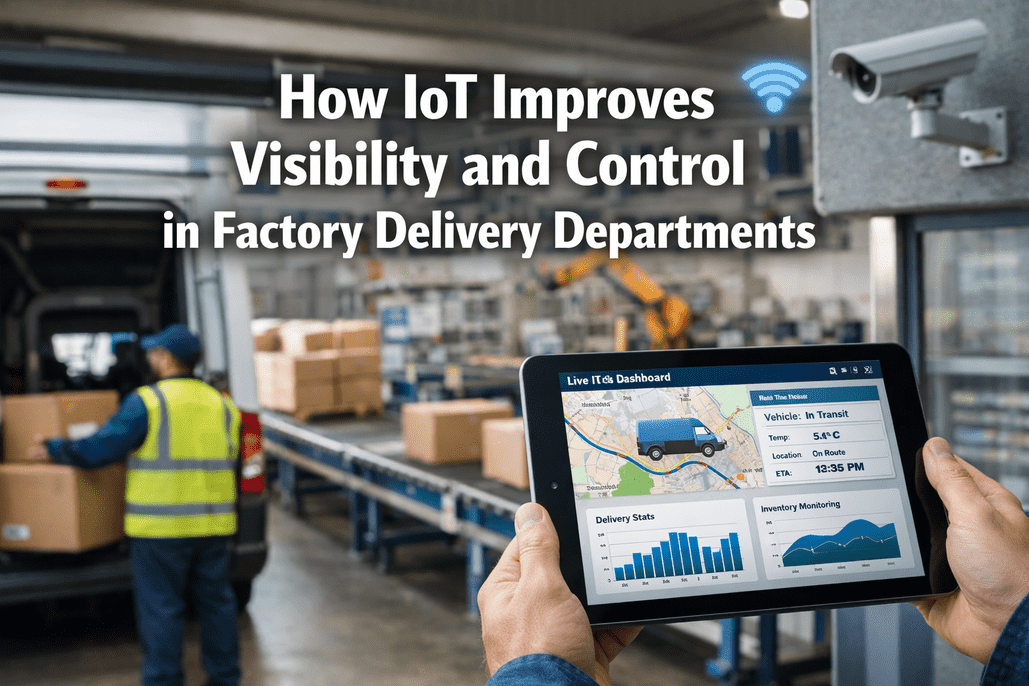
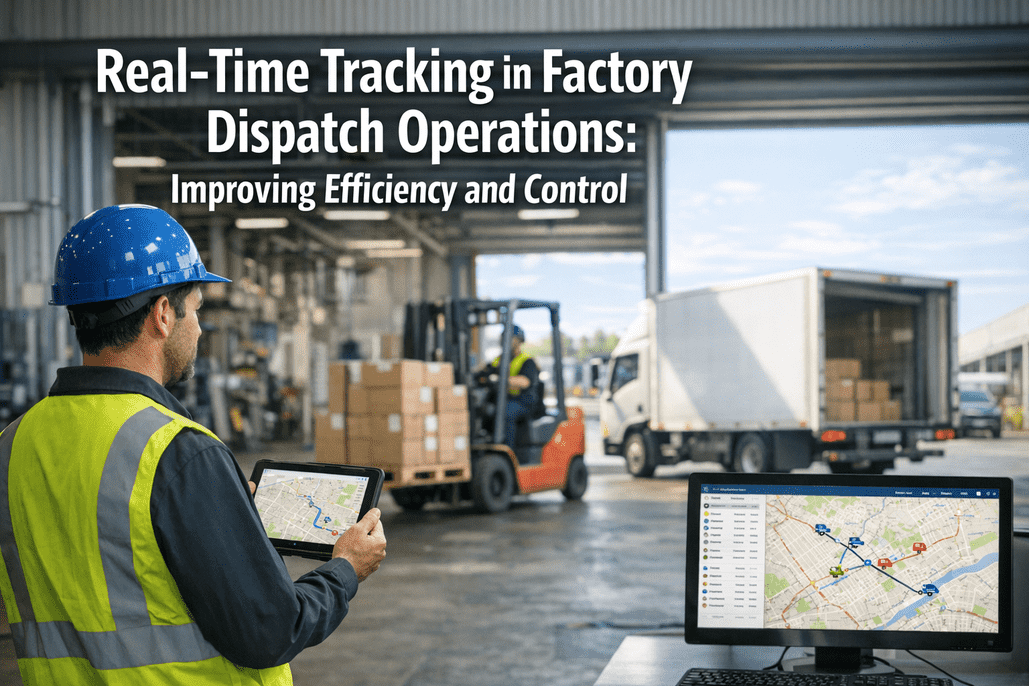
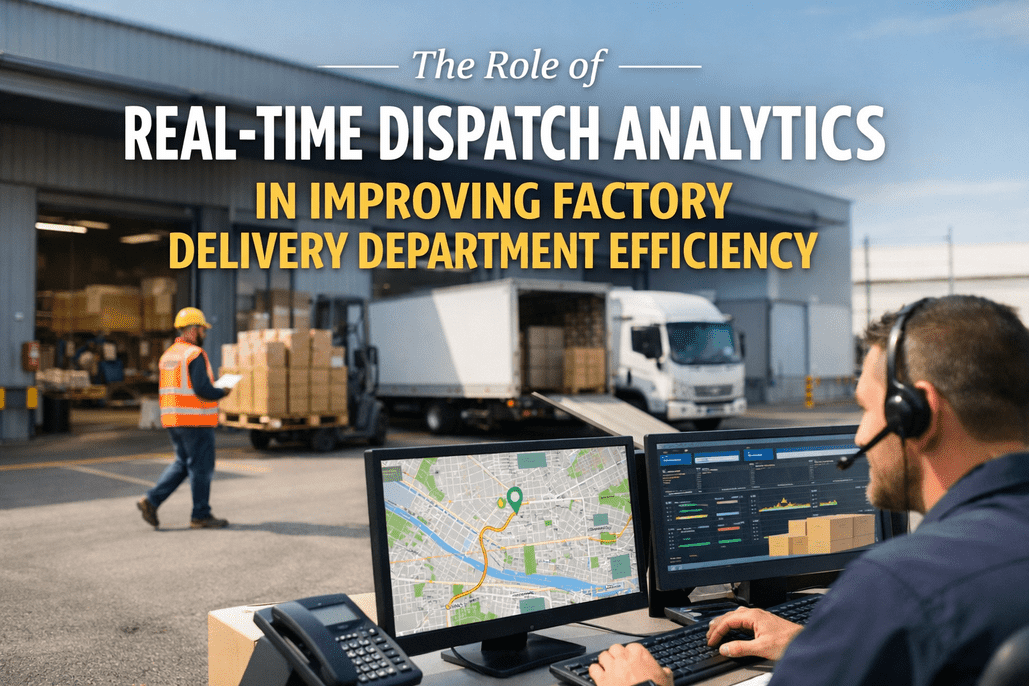
The factory delivery department is the last place most plant managers think to digitize — and the first place IoT delivers measurable operational impact. Gate passes processed on paper, inbound receiving logged in binders, vehicle inspections completed with clipboards, dispatch sequenced on whiteboards — these workflows are not just slow, they are blind. Every vehicle movement, every material transfer, every dispatch decision produces zero structured data that management can act on. IoT changes this entirely. By connecting entry points, receiving docks, yard vehicles, and internal material flows to a real-time data layer, the factory delivery department transforms from a cost center that absorbs delays and generates audit gaps into a precision operation with full visibility from gate to production floor. Manufacturing leads all industries in IoT adoption, accounting for 34% of total IoT device deployments in 2025 — yet delivery departments inside those same factories remain the least connected function in the plant. iFactory closes that gap in 7–14 days. For questions specific to your facility, talk to our support team directly.
iFactory · Factory Delivery Department · 2026
How IoT Gives Factory Delivery Departments the Visibility and Control the Production Floor Already Has
Your production floor has OEE dashboards, sensor alerts, and real-time throughput data. Your delivery department has a whiteboard, a phone, and a paper gate pass log. IoT-connected delivery operations change that — with live gate status, digital receiving records, mobile inspection workflows, and sensor-triggered material tracking that makes every movement visible and every audit instant.
Book A Demo
87%
Gate pass processing time reduction — from 15–20 min to under 2 min per vehicle
34%
Of total IoT deployments in manufacturing — yet delivery departments remain unconnected
40%
Inbound delay reduction achievable with IoT-connected digital delivery workflows
14 Days
iFactory go-live timeline — from decision to fully IoT-connected delivery department
iFactory · Factory Delivery Department Module
Your production floor has dashboards. Your delivery department deserves the same visibility.
iFactory connects IoT sensors, mobile checklists, and real-time data capture across every delivery department workflow — gate pass, inbound receiving, vehicle inspection, dispatch, and material tracking — giving your operations team live visibility from the first vehicle at the gate to the last material transfer at the production line.
87%Gate pass time reduction
78%Faster inbound receiving
100%Audit trail coverage
14 DaysFull deployment
What IoT Actually Monitors in a Factory Delivery Department
IoT in the factory delivery context is not about highway fleet tracking or last-mile GPS. It is about instrumenting the physical flows that happen between your factory gate and your production floor — and generating the structured data that makes every movement visible, traceable, and improvable. Here is the data layer IoT adds to each delivery department function.
Gate Entry & Exit
What IoT Captures
Vehicle arrival timestamp, pre-registration verification, driver credential check, cargo manifest scan, vehicle type (EV/diesel/hybrid), exact dwell time at gate, exit timestamp
What This Replaces
Paper gate pass books, manual logbook entries, phone verification calls, whiteboard queue tracking, 15–20 minute manual processing cycles
Operational Impact
Gate processing drops to under 2 minutes — recovering 280+ minutes of dock time daily at a 20-vehicle factory. Every entry is auditable in under 60 seconds.
Inbound Receiving
What IoT Captures
Barcode/QR scan of incoming material, PO verification against supplier database, quantity check vs. ordered, discrepancy photo documentation, receiving timestamp, dock staff attribution
What This Replaces
Paper receiving reports, manual PO book matching, handwritten shortage logs, phone calls to procurement for discrepancy resolution — 45–60 min per shipment
Operational Impact
Inbound receiving drops to under 10 minutes per shipment. Discrepancies are documented with photo evidence and escalated instantly — supplier disputes resolved in hours, not weeks.
Vehicle Inspection
What IoT Captures
Digital pre-use checklist completion, failed item documentation with photo, inspection timestamp, operator ID, repair work order auto-creation, vehicle dispatch block on failed inspection
What This Replaces
Paper inspection forms, inspection steps skipped under time pressure, failed items discovered during incident investigation rather than pre-use check
Operational Impact
100% inspection coverage enforced — vehicles with failed items cannot proceed to dispatch. Every inspection result is timestamped and retrievable for safety and compliance audits.
Internal Material Tracking
What IoT Captures
Material location at every internal transfer — dock to stores, stores to production, production to QC, QC to dispatch. Each scan generates a timestamped, person-attributed transfer record.
What This Replaces
No location record after dock entry — materials disappear into the plant with no tracking. 30–40% of production stoppages blamed on "material unavailability" are actually locating failures, not stock-outs.
Operational Impact
Real-time material location eliminates the search time that stops production lines. Chain of custody from supplier to production floor created automatically as a byproduct of daily operations.
5 Delivery Department Problems IoT Solves — With Data
01
The Gate Queue That Nobody Measures
Manual gate processing creates queues that nobody tracks. Drivers idle for 15–20 minutes while security staff process paper forms, make phone verification calls, and hand-write log entries. A factory processing 20 vehicles per day loses 280–400 minutes of productive dock time daily to this invisible inefficiency — equivalent to 1.5–2 full-time staff members doing nothing but waiting at the gate. IoT-connected gate processing with pre-arrival registration, mobile credential verification, and digital manifest scanning cuts this to under 2 minutes per vehicle. The time savings appear in dock throughput within the first week of deployment.
280+ minutes/day lost — recovered with IoT gate processing
02
Receiving Discrepancies That Cost More to Dispute Than Accept
When inbound materials arrive short-shipped, damaged, or incorrectly substituted, the resolution process on paper is so slow and evidence-poor that many procurement teams simply write off the discrepancy rather than contest it. Without a timestamped photo of the short shipment, a barcode scan confirming the item received, and an automated discrepancy notification to the supplier, the evidence for a claim degrades within hours as materials are moved and repackaged. IoT-connected receiving generates all three automatically — timestamped photo POD, confirmed quantity against PO, and instant discrepancy escalation — turning every receiving event into an auditable transaction rather than a verbal account.
45–60 min/shipment → under 10 min with IoT receiving
03
Vehicle Inspections That Protect No One
Paper pre-use inspection checklists for yard vehicles — forklifts, shunters, yard tractors, delivery vehicles — are the compliance record that protects your plant in the event of an incident. In practice, under time pressure, items get ticked without being physically checked. Failed conditions go unrecorded to avoid the delay of raising a repair work order. The result is a checklist that records compliance but generates none — and a vehicle with a known defect dispatched into a yard where the next incident is already in progress. IoT-enforced digital checklists lock in every step: the checklist cannot be submitted unless every item is completed, failed items automatically create a maintenance work order, and the vehicle is blocked from dispatch until the work order is closed and verified.
100% inspection enforcement — auto-block on failed vehicles
04
Dispatch Errors That Reach Customers Before Anyone Inside Knows
Manual dispatch sequencing on whiteboards and paper runs a 2–3% error rate — wrong vehicle, wrong load, wrong sequence, wrong SLA priority. In a factory dispatching 50 shipments per day, that is 1–2 errors daily that are typically discovered when a customer calls with a complaint, not when the dispatch supervisor reviews the board. IoT-connected dispatch automation sequences every order by SLA priority tier, vehicle type, load compliance status, and departure schedule — reducing errors to under 0.3% and generating a pre-miss alert when any order is at risk of missing its SLA window. The supervisor sees the problem 45 minutes before it becomes a customer complaint.
2–3% manual error rate → under 0.3% with IoT dispatch
05
Materials That Disappear Between the Dock and the Production Line
Most production stoppages attributed to "material unavailability" are not stock-outs — they are locating failures. Materials received at the dock are moved to staging, then to stores, then to kitting, then to the production line — and at each transfer point, their location is recorded nowhere. When production calls asking where a component is, the answer is a physical search of the plant. Studies show that 30–40% of production stoppage time attributed to material shortages is actually material search time. IoT-connected internal transfer tracking logs every movement with a barcode scan, creating a real-time location record from dock to production floor that eliminates search time and — as a byproduct — generates the complete chain of custody required for quality traceability audits.
30–40% of "stock-out" stoppages are actually locating failures
iFactory · IoT-Connected Delivery Department
86% of manufacturers track OEE. Almost none track gate dwell time, receiving cycle time, or dispatch SLA compliance. iFactory closes the gap in 14 days.
Every function in your delivery department — gate, receiving, inspection, dispatch, material tracking — generates operational data that your plant currently discards. iFactory captures it, structures it, and surfaces it as live dashboards and automated alerts. No IT project. No hardware procurement. Results visible from day one. Talk to our support team before booking if you have specific facility questions.
87%Gate pass time reduction
90%Fewer dispatch errors
100%Inspection coverage
14 DaysTo go live
Before IoT vs. After IoT — The Factory Delivery Department Transformation
Department Function
Without IoT — Current State
With iFactory IoT Platform
Gate Pass Processing
15–20 min/vehicle, paper logs, phone calls, no dwell time data, idle queue unmeasured
Under 2 min — pre-registration, mobile verify, dwell time captured, queue visible live
Inbound Receiving
45–60 min/shipment, manual PO match, paper POD, no photo evidence, disputes unwinnable
Under 10 min — barcode scan, photo POD, PO auto-match, instant discrepancy alert
Vehicle Inspection
Paper checklists, incomplete steps under pressure, failed items unrecorded, no enforcement
Digital checklist, 100% step enforcement, failed vehicle auto-blocked, auto work order created
Dispatch Sequencing
Whiteboard, 2–3% error rate, SLA misses found via customer complaint, no pre-miss alert
SLA-priority auto-sequence, under 0.3% errors, 45-min pre-miss alert, full dispatch log
Material Tracking
No location after dock entry — 30–40% of production stops are locating failures
Real-time location at every transfer — chain of custody dock to production floor
Incident Reporting
Incidents discovered days later, no auto-escalation, paper records, audit gaps
Instant mobile capture, photo + timestamp, auto-escalation, linked to vehicle and operator record
Audit Readiness
Hours of manual document assembly — records incomplete, fragmented, often missing
Any record retrievable in under 60 seconds from any device, any location
Deployment Timeline
Legacy systems: 6–18 months, heavy IT involvement, infrastructure projects
iFactory: 7–14 days — cloud-native, mobile-first, no hardware procurement required
Frequently Asked Questions
What does IoT in a factory delivery department actually mean — what gets connected?
IoT in a factory delivery department means connecting the physical workflows that happen between your factory gate and your production floor to a digital data layer. Specifically: gate entry and exit points are connected through mobile verification apps and pre-registration workflows that capture vehicle arrival time, dwell time, driver credentials, and cargo manifest digitally. Receiving docks are connected through barcode scanners and mobile photo tools that verify materials against POs and generate timestamped receiving records. Yard vehicles are connected through digital inspection checklists that enforce every step before dispatch and auto-block vehicles on failed items. Internal material movements are connected through barcode or QR scan at each transfer point, creating a real-time location record from dock to production floor. iFactory's platform is the data layer that connects all five of these functions — no proprietary hardware required, deployable via mobile app in 7–14 days.
Talk to our support team to understand what integration looks like for your specific facility configuration.
How much operational improvement can a factory realistically expect from IoT delivery department digitization?
The measurable improvements are consistent and significant across factory types. Gate processing time drops from 15–20 minutes to under 2 minutes per vehicle — recovering 280+ minutes of dock time daily at a 20-vehicle factory. Inbound receiving drops from 45–60 minutes to under 10 minutes per shipment. Dispatch error rates drop from 2–3% to under 0.3% with SLA-priority automated sequencing. Production stoppages attributed to material search — which account for 30–40% of all "material unavailability" stops — are eliminated by real-time internal tracking. Full platform payback is typically achieved within 3–6 months of go-live when dock time savings, dispatch error reduction, and audit overhead elimination are combined in the ROI calculation.
Book a demo to see the ROI model applied to your factory's specific volume and workflow.
How does iFactory handle vehicle inspection enforcement — what happens when a vehicle fails a check?
iFactory's vehicle inspection module runs on mobile — drivers and yard operators complete digital pre-use checklists on any smartphone or tablet before operating a vehicle. The checklist is enforced step-by-step: every item must be completed before the form can be submitted. If any item is marked as failed, the system automatically creates a maintenance work order linked to the specific vehicle and failure description, and the vehicle is flagged as blocked from dispatch until the work order is closed with a verified repair record. The failed inspection, repair work order, and resolution are all timestamped and person-attributed — creating the continuous inspection audit trail that safety regulators and insurance auditors require. The supervisor sees all inspection statuses across the entire yard vehicle fleet from a single dashboard without any manual check-in.
Talk to our support team about configuring inspection checklists specific to your yard vehicle types.
Why do most production stoppages blamed on "material unavailability" have nothing to do with actual stock levels?
This is one of the most significant hidden inefficiencies in factory delivery operations — and one of the most misdiagnosed. When a production line calls for a component and it cannot be found, the standard response is to check stock levels. But in most factories, the material exists somewhere between the receiving dock, the staging area, the main stores, the sub-stores, and the kitting station — it simply has no location record after it entered the building. Without IoT-connected transfer tracking, materials are moved at each handoff point with no scan, no timestamp, and no attribution. The result is 30–40% of production stoppages that are logged as "material shortage" but are actually "material lost in transit between dock and line." iFactory's internal tracking module eliminates this by requiring a barcode scan at every internal transfer — creating a real-time location record that shows exactly where every tracked material is at any moment.
Can iFactory manage multiple factory sites under one platform — with site-specific configurations?
Yes. iFactory is built as a multi-site platform from the ground up. Each factory site has its own configuration — gate pass workflows, inspection checklists, dispatch SLA rules, receiving documentation templates, and user access permissions — while sharing a unified reporting layer that gives corporate operations and plant managers visibility across the entire facility network from a single dashboard. This makes iFactory practical for manufacturers with regional distribution facilities, satellite plants, and contract manufacturing sites that each have their own delivery department operational requirements. Site-specific compliance templates can be configured for USA (OSHA, DOT, FSMA), India (Schedule M GMP, FSSAI), UK (Supply Chain Due Diligence), Germany (LkSG), UAE (Vision 2030), and automotive (IATF 16949) regulatory requirements.
Book a demo to see multi-site configuration running across a live facility network.
What does the 7–14 day deployment actually involve — is it really that fast?
Yes — and the timeline is genuine, not a marketing claim, because iFactory is cloud-native and mobile-first with no server installation, no hardware procurement, and no IT infrastructure project required from the factory side. The deployment has three phases. Days 1–3 cover data onboarding: uploading vehicle registry, driver roster, supplier list, and PO templates. iFactory's onboarding team handles this jointly with your operations team. Days 4–7 cover configuration and training: setting up gate workflows, inspection checklists, dispatch SLA rules, and mobile app access. Training for security staff, receiving teams, and drivers takes 2–4 hours via the mobile app. Days 8–14 cover go-live and verification: live operations with iFactory support monitoring data quality and resolving any workflow gaps in real time. By day 14, every delivery department workflow is digital, every movement is captured, and management has live dashboards for the first time.
Talk to our support team about your specific deployment timeline and site configuration.
iFactory · Factory Delivery Department Module
Your production floor runs on data. Your delivery department should too. iFactory makes it happen in 14 days.
IoT-connected delivery departments outperform paper-based operations on every measurable metric: gate speed, receiving accuracy, inspection compliance, dispatch precision, and audit readiness. iFactory deploys every module in 7–14 days with no IT project and no hardware procurement. Book a demo to see it running in a live factory delivery environment.
87%Gate pass time reduction
78%Faster inbound receiving
100%Audit trail coverage
14 DaysFull deployment