Ohio's manufacturing sector generates over $117 billion in annual output — the fifth-largest in the United States — and its factories run the full spectrum: automotive assembly in Toledo, steel production in Youngstown, aerospace components in Dayton, food processing across the Mahoning Valley. Every one of these plants has a delivery department managing inbound freight, internal material transfers, and outbound dispatch. And in the overwhelming majority of them, that delivery department still runs on paper gate passes, manual receiving logs, and dispatcher intuition. That gap is closing fast. AI and machine learning are being deployed across Ohio's factory delivery departments not as a technology experiment but as a direct operational response to JIT production pressure, OSHA compliance demands, and the compounding cost of manual process failures. This page explains precisely how — and why Ohio factories that deploy iFactory's AI-enabled delivery management platform are outperforming competitors on dock throughput, dispatch accuracy, and audit compliance. Have questions? Talk to our support team.
AI & Delivery Networks · Ohio Manufacturing
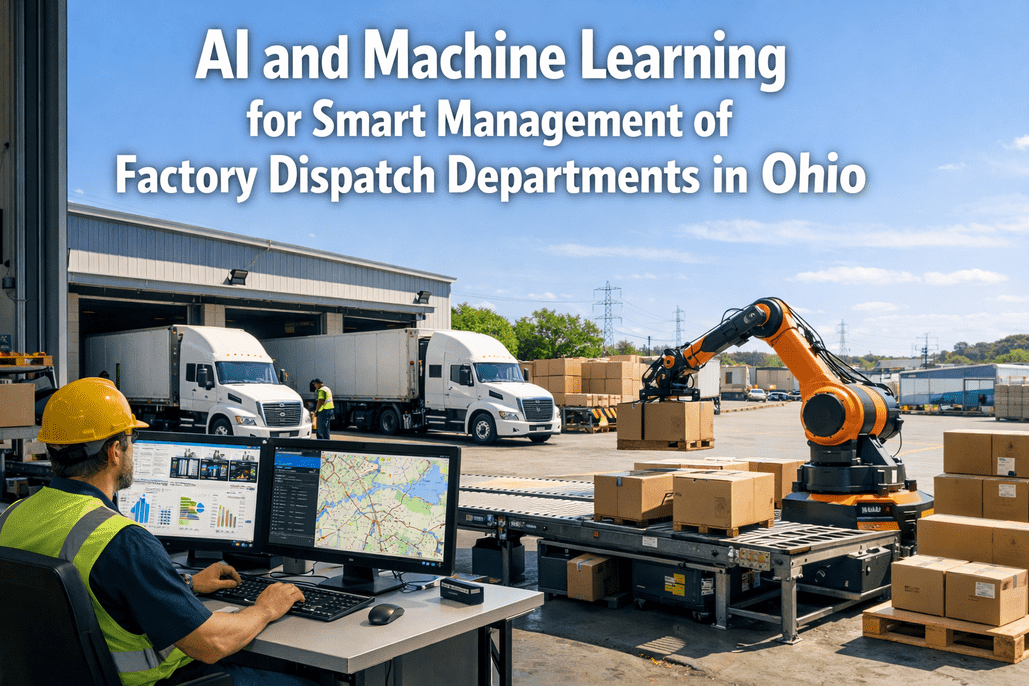
AI and Machine Learning for Smart Management of Factory Dispatch Departments in Ohio
How Ohio's largest manufacturing plants are using AI-driven gate pass management, ML-powered dispatch sequencing, and real-time material tracking to eliminate manual process failures — and what iFactory delivers in 7–14 days.
$117B
Ohio annual manufacturing output — 5th largest in the US, driving high-volume factory delivery demand
280+
Minutes of dock time lost daily at a 20-vehicle factory on manual gate passes alone
40%
Reduction in inbound delays achievable with AI-driven digital delivery workflows
7–14
Days to full iFactory deployment — no IT project, no infrastructure, no implementation fees
Ohio Manufacturing Context
Why Ohio Factory Delivery Departments Are Under Pressure to Go Digital Right Now
Ohio is not a generic manufacturing state — it is a dense, multi-sector production economy with specific pressures that make factory delivery department inefficiency disproportionately costly. Three structural forces are accelerating AI adoption in Ohio factory dispatch departments in 2025–2026.
JIT Production Pressure
Ohio Automotive: Production Lines Running on 45-Minute Inbound Windows
Ohio's automotive sector — anchored by Honda's Marysville and East Liberty plants, Ford's Cleveland Engine, and dozens of tier-1 suppliers — operates on just-in-time delivery windows where a 45-minute inbound receiving delay is enough to halt a production line. When a factory's receiving cycle runs 45–60 minutes per shipment on manual workflows, a single delayed truck can trigger production stoppages costing $10,000–$60,000 per hour. AI-driven receiving automation cuts this to under 10 minutes — and alerts production schedulers in real time when inbound materials are on site.
OSHA Compliance Enforcement
Ohio OSHA: Vehicle Inspection Enforcement Tightening Across Industrial Sites
Ohio OSHA industrial vehicle inspection requirements apply to every powered industrial truck — forklifts, pallet jacks, yard tractors — operating in a manufacturing facility. The requirement is pre-shift inspection with a documented record. Paper inspection logs are notoriously incomplete, easily backdated, and impossible to retrieve under audit pressure. Ohio OSHA citations for inadequate inspection records carry fines of $7,000–$70,000 per violation per day. AI-enforced digital inspection checklists make bypassing impossible and generate the timestamped, operator-attributed records Ohio OSHA auditors require.
Labor Market Conditions
Ohio Manufacturing: Labor Constraints Making Manual Processes Unsustainable
Ohio manufacturing faces a 29,000-person skilled labor gap projected through 2028 — the Ohio Manufacturing Association's 2025 workforce report documents persistent difficulty filling dispatch, receiving, and logistics coordination roles. When delivery department processes are manual and labor-intensive, they absorb staff capacity that Ohio factories increasingly cannot spare. AI automation of gate pass processing, dispatch sequencing, and material transfer logging eliminates the manual coordination overhead — allowing existing staff to manage higher vehicle volumes without headcount increase.
ESG & Supply Chain Traceability
Ohio's Major OEMs: Demanding Supplier Traceability Documentation
Ohio's position as a tier-1 and tier-2 automotive supplier to Ford, Honda, GM, and Stellantis means that ESG documentation and supply chain traceability requirements flowing down from OEM supplier quality programs are landing directly on Ohio factory delivery departments. Digital chain of custody from inbound receiving dock to production floor — timestamped and person-attributed — is becoming a supplier qualification requirement, not just an internal efficiency aspiration.
AI Applications in Factory Dispatch
6 Specific Ways AI and Machine Learning Are Transforming Ohio Factory Dispatch Departments
These are not theoretical AI applications. Each one addresses a specific operational failure mode that factory dispatch managers in Ohio face every shift — and each delivers measurable, documentable results within 30 days of deployment.
01
AI Gate Pass Processing — From 15 Minutes to Under 2
Traditional gate pass processing at Ohio factory sites runs 15–20 minutes per vehicle: manual driver ID check, paper log entry, phone verification to the receiving team, physical badge issue. AI-driven gate pass management eliminates every manual step. Suppliers pre-register vehicle details, driver credentials, and cargo manifest via mobile before arrival. The AI cross-references the pre-registration against the factory's open PO schedule and flags discrepancies before the vehicle reaches the gate. Gate clearance time drops to under 2 minutes. For a factory receiving 20 inbound vehicles per day, this recovers 260+ minutes of dock access time — equivalent to more than four additional dock hours daily — without adding staff.
Result: 87% gate processing time reduction · 260+ min dock time recovered daily · SB 1383-equivalent idle emission reduction
02
ML-Powered Inbound Receiving — PO Verification and Discrepancy Detection
Manual inbound receiving at Ohio manufacturing plants typically runs 45–60 minutes per shipment: paper count sheet against PO, manual discrepancy logging if the receiver notices a quantity difference, phone call to procurement, physical paper trail. Machine learning-powered receiving uses mobile barcode scanning and image capture to verify quantities against PO automatically — flagging discrepancies at the dock in real time rather than letting them surface in production three days later. Receiving cycle time drops from 45–60 minutes to under 10 minutes per shipment. The same workflow generates a digital chain of custody record — supplier, carrier, quantity, condition, timestamp — that Ohio's OEM supplier quality programs increasingly require as documentary evidence.
Result: 78% faster inbound receiving · Discrepancies caught at dock, not in production · Digital chain of custody auto-generated
03
AI Dispatch Sequencing — SLA Priority Automation with Pre-Miss Alerting
Manual dispatch sequencing in Ohio factory delivery departments operates from paper lists, whiteboard schedules, and dispatcher memory. The failure mode is well-documented: a high-priority order gets buried under routine requests, the SLA window closes, and the miss is discovered when the customer calls — not when it could still be prevented. AI dispatch sequencing replaces manual priority decisions with an algorithm that ingests every open order, its SLA deadline, vehicle availability, load constraints, and real-time capacity — generating a live priority queue with countdown timers. Any order approaching a breach triggers an escalation alert to the dispatcher and supervisor before the window closes. Dispatch error rates drop from 2–3% (manual industry average) to under 0.3%.
Result: 90% dispatch error reduction · SLA misses caught pre-breach, not post-complaint · Real-time priority queue replaces static paper list
04
Real-Time Internal Material Tracking — Eliminating the "Where Is It?" Production Stoppage
The single most expensive and most preventable production stoppage pattern in Ohio manufacturing: production raises a material unavailability flag, procurement confirms materials were received, and then a manual search begins across the receiving dock, stores, and production floor. iFactory's research across factory operations shows 30–40% of production material search time is eliminable with digital transfer records — and that the majority of "material unavailability" stoppages are locating failures, not genuine stock-outs. AI-tracked internal material transfer records every movement: dock to stores, stores to production line, production to quality inspection, with the operator ID, timestamp, and scan confirmation at each transfer point. Production teams query location in real time. The search ends. The production line restarts.
Result: 30–40% internal material search time eliminated · Production stoppages from locating failures end · Full chain of custody from dock to line
05
AI-Enforced Vehicle Inspection — Ohio OSHA Compliance on Autopilot
Ohio OSHA requires pre-shift inspection documentation for every powered industrial truck operating on a manufacturing site. On paper, drivers tick boxes — whether or not the vehicle was actually inspected. Faults go unreported, inspections get backdated, and when Ohio OSHA audits arrive, paper logs fail to produce the timestamped, person-attributed records the regulation requires. iFactory's AI inspection workflow makes bypassing impossible: each checklist item requires active confirmation on the driver's mobile app, failed items require photo documentation, and the system captures GPS location, timestamp, and operator ID for every response individually. Vehicles with failed inspection items are automatically blocked from dispatch until a verified repair work order is completed. The Ohio OSHA-compliant audit record is generated automatically — retrievable in seconds, not hours of paper search.
Result: 100% inspection record coverage · Failed vehicles auto-blocked · Ohio OSHA audit trail retrievable instantly
06
Predictive Incident Detection — From Days After Occurrence to Real-Time Escalation
In manual factory delivery departments, incidents — damaged goods at receiving, vehicle fault after departure, access breach at gate — typically surface two to four days after they occur, through complaints, missing stock, or audit discovery. By that point, the evidence chain is broken, the responsible parties are unverifiable, and the corrective action is reactive rather than preventive. iFactory's incident management layer monitors data patterns across gate pass records, inspection results, and material transfer logs in real time — flagging anomalies that indicate an incident before it is manually reported. Confirmed incidents trigger auto-escalation workflows to the appropriate supervisor, maintenance team, or security staff with a timestamped, photo-documented record that starts the audit trail at the moment of occurrence rather than days later.
Result: Incidents detected in real time, not days later · Auto-escalation with full documentation · Audit trail starts at occurrence, not discovery
See iFactory's AI Dispatch Management Running in an Ohio Manufacturing Environment
iFactory deploys in 7–14 days and immediately begins generating the gate pass timestamps, dispatch SLA records, material location data, and vehicle inspection logs that Ohio's JIT production and OSHA compliance requirements demand.
Talk to our support team about your specific facility and production environment.
Ohio Industry Sectors
How AI Delivery Department Management Applies Across Ohio's Major Manufacturing Sectors
Ohio's manufacturing base spans six distinct sectors, each with different inbound volumes, dispatch complexity levels, and compliance requirements. iFactory's platform configures to each — here is what AI delivery management delivers sector by sector.
Automotive
Honda Marysville, Ford Cleveland, Tier-1 Suppliers
JIT inbound windows of 30–60 minutes demand sub-10-minute receiving cycles. AI gate pass pre-registration and mobile PO verification deliver this consistently. OEM supplier quality programs require digital chain of custody from dock to production — iFactory generates this automatically. Ohio automotive sites typically see 87% gate time reduction and full OEM traceability records from day one.
Steel & Metals
Youngstown, Cleveland, Canton Production Sites
High-weight inbound loads, complex yard vehicle movements, and multi-shift dispatch operations with variable crew sizes. AI dispatch sequencing manages load weight constraints and shift handover queues automatically. Digital vehicle inspection with auto-block is critical for heavy yard equipment where uninspected faults create both Ohio OSHA liability and significant equipment damage risk. Incident detection is especially valuable for sites with hazardous material handling.
Aerospace & Defense
Dayton, Cincinnati Area Defense Manufacturing
Strict chain of custody requirements for sensitive components — every inbound part requires documented receipt against a specific purchase order with serial number verification. AI inbound receiving with barcode scanning and photo POD generates the component-level traceability records that ITAR, AS9100, and defense contract requirements mandate. Gate pass management with pre-registered vendor credentials satisfies site security requirements without creating inbound processing bottlenecks.
Food & Beverage
Mahoning Valley, Columbus Food Processing Plants
FSMA and Ohio Department of Agriculture receiving documentation requirements apply at the dock — every inbound food ingredient and packaging material requires a documented receipt with supplier, quantity, lot number, and condition record. Manual receiving on paper cannot reliably generate the traceability records FDA auditors require. iFactory's mobile receiving workflow captures all required fields automatically and generates the FSMA-compliant receiving record simultaneously with the operational receiving log.
Before vs. After
Ohio Factory Dispatch Department — Manual Operations vs. AI-Powered iFactory Platform
The operational gap between a paper-based Ohio factory delivery department and one running iFactory's AI platform is structural, not marginal. Every row below represents a daily compounding cost that manual operations accumulate silently across shifts.
Function
Manual / Paper Operations
iFactory AI Platform
Gate Pass
15–20 min/vehicle — paper log, phone verification, idle queue buildup
Under 2 min — pre-registered, AI cross-checked, auto-cleared
Inbound Receiving
45–60 min/shipment — manual count, paper PO match, no photo documentation
Under 10 min — mobile scan, ML PO verification, photo POD auto-generated
Dispatch SLA
Manual sequencing — 2–3% error rate, misses undetected until complaint
AI sequencing — under 0.3% errors, pre-miss alerts, live SLA countdown
Material Location
Unknown after dock entry — 30–40% search time wasted per production stoppages
Real-time location — every transfer tracked, search eliminated
Vehicle Inspection
Paper checklist — skipped, backdated, Ohio OSHA non-compliant
AI-enforced digital — timestamped, auto-block on fail, OSHA audit-ready
Incident Detection
Discovered days after occurrence — broken evidence chain, reactive response
Real-time detection — auto-escalation with timestamped documentation
Audit Records
Hours to assemble — paper logs incomplete, fragmented across binders
100% coverage — retrievable in under 60 seconds from dashboard
Deployment
Legacy systems: 6–18 months, heavy IT involvement, high upfront cost
iFactory: 7–14 days — cloud-based, mobile-first, no infrastructure project
Measurable Results
What Ohio Factories Measure Within 90 Days of iFactory Go-Live
87%
Gate Pass Time Reduction
From 15–20 minutes manual to under 2 minutes with AI pre-registration and mobile verification. A 20-vehicle facility recovers 260+ minutes of daily dock access capacity — without adding staff.
78%
Faster Inbound Receiving
Receiving cycle drops from 45–60 minutes to under 10 minutes per shipment with ML PO verification at the dock. Discrepancies caught immediately, not discovered in production.
90%
Fewer Dispatch Errors
AI dispatch sequencing reduces error rate from 2–3% (manual) to under 0.3%. SLA misses are caught before breach — not after the customer complaint arrives.
100%
Audit Trail Coverage
Every gate event, receiving transaction, material transfer, inspection result, and dispatch decision timestamped and person-attributed. Ohio OSHA and OEM supplier audit requests answered in under 60 seconds.
40%
Inbound Delay Reduction
Combined gate pass and receiving digitisation reduces total inbound processing time by 40% — directly improving JIT production schedule adherence for Ohio's automotive and aerospace facilities.
3–6 mo
Full ROI Payback
Recovered dock time, eliminated dispatch errors, reduced compliance overhead, and avoided OSHA penalty exposure combine to deliver full iFactory payback within 3–6 months of go-live.
iFactory · Ohio Factory Dispatch AI
Ohio's Manufacturing Advantage Is Built in the Factory Delivery Department. AI Is the Differentiator.
iFactory's AI-powered gate pass management, ML dispatch sequencing, real-time material tracking, and digital vehicle inspection deploy in 7–14 days across Ohio manufacturing facilities — automotive, steel, aerospace, and food processing. From day one, your delivery department generates the JIT compliance records, OSHA inspection documentation, and OEM supplier traceability data that Ohio's manufacturing environment demands. Full ROI payback in 3–6 months.
Talk to our support team about your specific facility requirements.
$117B
Ohio manufacturing output — delivery departments are the last undigitized function
7–14
Days to live iFactory deployment — no IT project required
3–6 mo
Full ROI payback from dock time recovery and error elimination
Frequently Asked Questions
AI and ML for Ohio Factory Dispatch Departments — Answered
How is "AI in a factory dispatch department" different from AI in logistics or courier delivery — what does it actually do inside a plant?
AI in a factory dispatch department operates on an entirely different problem set than AI in courier logistics or last-mile delivery. Courier AI optimises external routes between customer addresses. Factory dispatch AI optimises internal workflows — gate entry sequencing, inbound PO verification, internal vehicle routing between dock and production zones, inspection enforcement, and outbound dispatch prioritisation — all within a single manufacturing facility. Specifically: iFactory's AI cross-references pre-registered vehicle details against open PO schedules before a truck reaches the gate — flagging mismatches that a manual gate guard cannot catch in a 15-minute paper process. The ML receiving layer compares scanned inbound quantities against PO expectations and flags discrepancies at the dock rather than letting them surface in production days later. The dispatch sequencing algorithm ingests live SLA countdown data, vehicle availability, and load constraints to generate a priority queue that a human dispatcher updating a whiteboard cannot maintain at the same accuracy. None of this is courier logistics — it is factory operations intelligence applied to the delivery department.
Talk to our support team for a facility-specific walkthrough of how each AI layer applies to your operation.
Ohio OSHA requires pre-shift inspection records for powered industrial trucks. How does iFactory ensure these records actually satisfy audit requirements?
Ohio OSHA's powered industrial truck inspection requirements (29 CFR 1910.178(q)) mandate pre-shift inspection with documented defect recording and corrective action before a defective truck is returned to service. Paper checklists fail this standard in practice because they can be pre-signed, backdated, and completed without actual inspection — and the paper trail is typically assembled from multiple binders that span multiple shifts and may have gaps. iFactory's digital inspection system generates compliance with this requirement in three ways that paper cannot replicate. First, each checklist item requires individual active confirmation on the operator's mobile device — the system captures timestamp, operator ID, and GPS location per response, making pre-signing impossible. Second, failed inspection items require photo documentation uploaded from the mobile app — providing visual evidence that the defect was identified and recorded. Third, vehicles with outstanding failed items are automatically blocked from dispatch — satisfying the "removed from service until repaired" requirement with a system control rather than a supervisor relying on verbal instruction. The resulting audit trail is retrievable from iFactory's dashboard in under 60 seconds for any vehicle on any date. Ohio OSHA citations for inadequate inspection records carry fines of $7,000–$70,000 per violation per day — a single avoided citation covers years of iFactory subscription cost.
Book a demo to see the inspection compliance interface and audit dashboard.
How does ML-powered dispatch sequencing actually prevent SLA misses — what changes operationally from how Ohio factories dispatch today?
The operational change is a shift from a static priority list to a live, continuously recalculated priority queue. In a manual Ohio factory dispatch operation, the dispatcher typically starts the shift with a paper list or spreadsheet of orders sorted by expected dispatch time. As the shift progresses, urgent orders are added verbally, vehicles become unavailable, loads are delayed — and the static list becomes increasingly disconnected from reality. SLA misses happen when a high-priority order is buried under routine tasks and nobody notices the countdown until after the window closes. iFactory's ML dispatch sequencing replaces the static list with a live queue that recalculates priority continuously: every order's SLA countdown is live, vehicle availability is tracked in real time, and load constraints are factored into assignment automatically. When any order approaches a breach — at a configurable threshold, typically 30–60 minutes before the SLA deadline — an escalation alert is triggered to both the dispatcher and their supervisor. The alert fires while there is still time to act: reassign a vehicle, accelerate loading, contact the receiving party. The SLA miss is prevented, not documented. This is the core AI value proposition in factory dispatch — not just tracking what happened, but predicting what is about to go wrong and enabling intervention.
Talk to our support team about configuring SLA tiers for your specific dispatch environment.
How does iFactory deploy across multiple Ohio facilities — and can each site have different gate pass and dispatch configurations?
iFactory is built as a multi-site platform from the ground up. A single deployment can cover all Ohio manufacturing facilities under one corporate dashboard while giving each site its own configuration: separate gate pass workflows reflecting site-specific security requirements, distinct vehicle inspection checklists for different equipment types at each location, separate dispatch SLA rules calibrated to each facility's production schedule and customer contracts, and independent receiving configurations for different PO structures per site. The corporate operations layer provides unified visibility across all sites — fleet-level dashboards showing real-time gate activity, material flow, and dispatch status across every Ohio facility simultaneously. Site managers see their facility's data in detail; corporate operations sees the portfolio view. Deployment sequence for multi-site Ohio operations: the first site goes live in 7–14 days using the standard deployment process. Each additional site adds 5–10 days because the core configuration template is carried forward from the first site and adapted rather than rebuilt from scratch. The cloud-based, mobile-first architecture means there is no per-site server infrastructure, no IT department involvement beyond user provisioning, and no hardware procurement for the core platform.
Book a demo to see the multi-site dashboard and configuration interface for Ohio operations.
What is the realistic ROI calculation for an Ohio manufacturing plant deploying iFactory — what are the five components and how do they add up?
The iFactory ROI case for an Ohio manufacturing plant has five independent components that each stand on their own — the combined figure consistently delivers full payback within 3–6 months. Component 1 — Dock time recovery: a 20-vehicle/day Ohio factory processing at 15 minutes manual gate time versus 2 minutes digital recovers 260 minutes daily — at a dock labour cost of $35–$50/hour, this represents $75–$110 of recovered productive capacity per day, or $18,000–$27,000 annually. Component 2 — Dispatch error elimination: reducing dispatch errors from 2–3% to under 0.3% on a factory dispatching 100 orders daily eliminates 1.7–2.7 daily errors. At re-dispatch, SLA penalty, and management resolution costs of $200–$500 per error event, this saves $125,000–$375,000 annually. Component 3 — Production stoppage prevention: eliminating the "material unavailability" locating failure that causes production stoppages. Even one prevented stoppage per month in an Ohio automotive or steel plant — at $10,000–$60,000 per stoppage-hour — covers full annual iFactory cost. Component 4 — Ohio OSHA penalty avoidance: a single avoided Ohio OSHA citation for inadequate inspection records ($7,000–$70,000 per violation per day) covers multiple years of iFactory subscription. Component 5 — Receiving discrepancy catch rate: discrepancies caught at the dock rather than in production prevent the full cascading cost of wrong-material production runs, return freight, and supplier dispute resolution. Combined, these five streams consistently reach full payback within 3–6 months for Ohio manufacturing facilities of 50+ inbound vehicles per week.
Talk to our support team for a facility-specific ROI calculation based on your vehicle volumes, dispatch order count, and production environment.
Ohio's Factory Delivery Departments Are Running Manual Workflows in an AI-Driven Manufacturing Economy. That Changes in 14 Days.
86% of Ohio manufacturers track OEE on the production floor. Almost none track gate pass processing time, inbound receiving cycle, or dispatch SLA compliance in the delivery department. iFactory closes this gap — deploying AI gate management, ML receiving, and intelligent dispatch sequencing across your Ohio facility in 7–14 days, with full ROI payback in 3–6 months.
Talk to our support team for a facility-specific assessment before booking a demo.