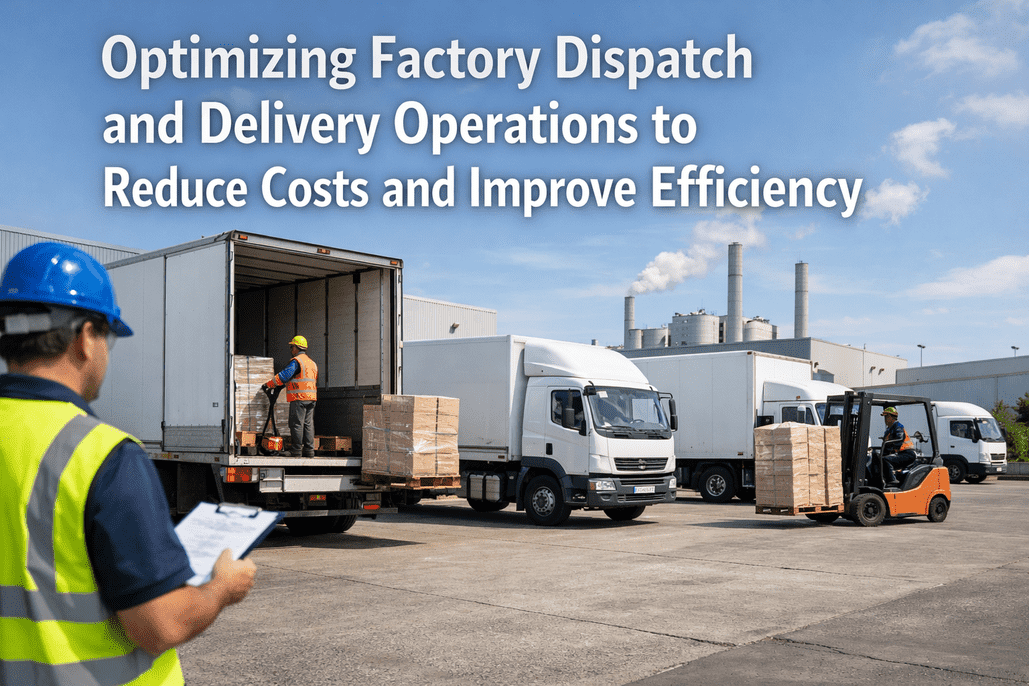
Optimizing Factory Dispatch and Delivery Operations to Reduce Costs and Improve Efficiency

By Armani Jose on March 6, 2026

optimizing-fleet-management-deliveries

A mid-size auto components manufacturer with three production lines was processing 60–80 inbound material deliveries per week on paper-based gate registers. Vehicles waited an average of 34 minutes at the gate. Returnable items dispatched without gatepass records went unrecovered — an estimated 220 missing pallets and fixtures worth $38,000 in a single year. Weighbridge disputes with suppliers triggered by manual weight entry errors delayed payment cycles by 11 days on average. Three production stoppages in one quarter were traced directly to delayed raw material unloading while dock supervisors hunted for handwritten authorization slips. After deploying iFactory's factory dispatch and delivery operations module, average gate processing time dropped to under 6 minutes. Returnable gate pass compliance reached 97%. Dock-to-floor material movement time fell 42%. And for the first time, management had a live dashboard showing every inbound, outbound, and internal movement — gatepass status, vehicle location in the yard, dock assignment, and delivery confirmation — in a single screen. Book a demo to see how iFactory transforms your factory's dispatch and delivery department.

Factory Operations  ·  High Priority Guide  ·  2026

Optimizing Factory Dispatch and Delivery Operations to Reduce Costs and Improve Efficiency

Factory dispatch and delivery is not last-mile logistics — it's the internal operations department managing every vehicle, gate pass, material movement, dock assignment, and outbound dispatch event that flows through your facility. When it works, production runs uninterrupted. When it fails, line stoppages, material losses, compliance gaps, and supplier disputes follow.

34 min
Avg gate wait time in manual paper-based factories — reduced to under 6 min with digital dispatch
42%
Reduction in dock-to-floor material movement time after iFactory deployment
97%
Returnable gate pass compliance rate — vs. under 60% on manual register systems
28%
Lower dispatch and delivery operational costs reported by iFactory-deployed manufacturing sites
What It Really Is

Factory Dispatch and Delivery: The Department Most Operations Software Ignores

Most "delivery operations" software is built for courier companies and e-commerce fleets. Factory dispatch and delivery is fundamentally different — it's the operational backbone that controls how raw materials enter your facility, how finished goods leave, how internal material moves between departments, and how every vehicle, driver, and dock asset is tracked and accounted for. It includes gate pass management, dock scheduling, weighbridge operations, inbound material authorization, outbound dispatch documentation, returnable item tracking, and vehicle movement control — all processes that directly impact production uptime, compliance, and cost.

Inbound Operations
Vendor vehicle gate entry and authorization
Material inward inspection and quality check
Weighbridge recording and dispute-proof documentation
Dock assignment and unloading schedule management
Inward gate pass generation and GRN linkage
Raw material movement from gate to store or line
Outbound Operations
Finished goods dispatch authorization and documentation
Non-returnable gate pass (NRGP) generation and approval
Packing list, invoice, and e-waybill verification at gate
Vehicle loading supervision and seal recording
Driver verification, vehicle fitness check, and exit clearance
Customer delivery confirmation and dispatch closure
Internal Movement
Inter-department material transfer with internal gate pass
Material issue from stores to production floor
WIP movement between processing stages
Scrap and rejection material movement to designated zones
Tool and fixture movement with returnable gate pass (RGP)
Returnable item tracking and recovery management
Gate and Yard Control
Vehicle entry and exit time recording with photo capture
Driver identity and vehicle registration verification
Visitor and contractor vehicle management
Yard position tracking — vehicle location within premises
Unauthorized vehicle and material exit prevention
Audit trail of all gate events with digital signatures
The Problem Landscape

6 Ways Manual Factory Dispatch Leaks Cost Every Day

Manual dispatch and gate operations feel manageable at small scale. At the volume of a production facility processing hundreds of material movements per week, the compounding losses become structural. Here are the six cost leaks that manual dispatch creates — and that digital factory dispatch systems eliminate.

01
Gate Congestion and Vendor Waiting Time
Paper-based gate registers create bottlenecks at peak inbound hours. Vendor vehicles queue for 25–45 minutes, generating detention charges and damaging supplier relationships. Gate staff manually transcribe license plates, material details, and authorization numbers — a process prone to errors that cascade into GRN discrepancies and payment holds.
Industry avg: 34-min gate wait → production material delays start here
02
Unrecovered Returnable Items
Returnable gate passes (RGP) issued for pallets, fixtures, containers, and tooling sent to job workers or vendors are tracked in spreadsheets that nobody reconciles consistently. Items dispatched under RGP that don't return within the scheduled window go unnoticed for weeks. The average factory loses 8–12% of its returnable asset inventory annually to this gap.
8–12% annual returnable asset loss in facilities with manual RGP tracking
03
Weighbridge Disputes and Documentation Errors
Manual weighbridge entry creates discrepancies between supplier invoiced weight and received weight that generate disputes lasting weeks. Without automatic weighbridge data capture integrated to the GRN, every weight discrepancy requires manual cross-referencing of paper records — consuming accounts payable and procurement team hours that should be spent on value-added activities.
Manual weight entry errors cause avg 11-day payment cycle delays in dispute-heavy sites
04
Dock Underutilization and Loading Delays
Without a dock scheduling system, vehicles queue at available docks on a first-come basis — creating peak congestion on high-volume days while docks sit idle at other times. Dock supervisors spend their shifts managing traffic instead of managing operations. A study of mid-size manufacturing facilities found dock underutilization averaging 35–40% due to uncoordinated arrival scheduling.
35–40% dock underutilization in unscheduled manufacturing facilities
05
Production Stoppages from Material Delays
When inbound material authorization, unloading supervision, and floor transfer are disconnected processes managed on paper, the handoff gaps create delays measured in hours — not minutes. Production planners have no visibility into whether a critical material is stuck at the gate, in the weighbridge queue, or at the inspection station. By the time the stoppage risk is visible, it's already a stoppage.
67% of production supervisors cite "material not at line when needed" as top disruption cause
06
Compliance Gaps and Audit Risk
Outbound dispatch documentation — packing lists, e-waybills, inspection certificates, driver authorization forms — maintained in paper files is never audit-ready. When GST audits, customer quality audits, or regulatory inspections arrive, scrambling to reconstruct dispatch records from handwritten logs consumes days of staff time and exposes gaps that carry penalty risk.
Manual dispatch records create 3–7x greater audit preparation time vs. digital systems

See iFactory's Factory Dispatch Platform in Action

iFactory's factory dispatch module covers gate pass management, dock scheduling, weighbridge integration, returnable item tracking, and outbound dispatch documentation in a single platform. Book a live demo to see your specific operation configured.

Gate Pass System

The Digital Gate Pass Framework: RGP, NRGP, and Internal Movement

Gate pass management is the control layer that governs every material movement in and out of a factory. A robust digital gate pass framework distinguishes between three fundamentally different movement types — each with its own authorization workflow, documentation requirements, and reconciliation process.

RGP — Returnable Gate Pass
Used when: Materials, fixtures, tools, containers, or equipment leave the factory premises and must return within a defined period. Common for job work, loan to vendors, or equipment sent for repair.
Material description, quantity, unit, and condition at dispatch
Authorized receiver and vendor/job worker details
Expected return date with automated alert before due date
Vehicle and driver details at dispatch and on return
Material condition check on return — comparison to dispatch state
Digital signature chain from stores, production, and gate staff
iFactory tracks 100% of RGP items with automated return-due alerts — eliminating the 8–12% annual loss rate
NRGP — Non-Returnable Gate Pass
Used when: Finished goods, scrap material, obsolete assets, or rejected items leave the factory and will not return. Represents permanent outward movement requiring full dispatch documentation.
Sales order or delivery note linkage for finished goods dispatch
Packing list, quantity, and condition verification at loading
E-waybill number and GST invoice cross-reference
Vehicle seal number recording and photo documentation
Multi-level authorization — stores, QC, dispatch, and accounts
Customer delivery confirmation loop-back via driver app or SMS
Digital NRGP closes the loop between dispatch and customer delivery — eliminating disputes over what left the factory
Internal Gate Pass
Used when: Materials move between departments, from stores to production floor, or between buildings within the same facility. Maintains internal material accountability without involving the main gate.
Issuing department and receiving department identification
Material item, batch number, and quantity authorization
Supervisor or stores-in-charge digital authorization
Delivery confirmation at receiving department
Linked to production order or work order for cost traceability
Integrated to inventory records — automatic stock debit/credit
Internal gate passes eliminate the "where is that material?" question — every movement creates a timestamped digital record
iFactory Platform

How iFactory Covers Every Layer of Factory Dispatch and Delivery Operations

iFactory's factory dispatch and delivery module is purpose-built for manufacturing and industrial operations — not adapted from a courier platform. It covers every process from vendor vehicle arrival to finished goods delivery confirmation in a single connected platform with no data gaps between stages.

Digital Gate Pass Management
Generate RGP, NRGP, and internal gate passes digitally with mobile-accessible authorization workflows. Multi-level approval chains, photo capture, and QR-code scanning eliminate paper and accelerate processing from 20+ minutes to under 5. Every gate pass is timestamped, signed, and stored with full audit trail — permanently searchable, never lost.
Dock Scheduling and Yard Management
Pre-schedule dock slots for inbound and outbound vehicles — eliminating arrival congestion and dock underutilization simultaneously. Dispatch supervisors see real-time yard status: which docks are occupied, which vehicles are queuing, and which slots are available for reallocation. Dock turns increase and detention charges drop when vehicles arrive to a pre-assigned slot.
Weighbridge Integration and Dispute Prevention
Automatic weighbridge data capture eliminates manual entry errors — weight readings link directly to inbound GRN records and supplier invoices. When gross, tare, and net weights are system-recorded with vehicle and material identification, disputes are resolved in minutes rather than days. GST and customs compliance documentation auto-populates from weighbridge records.
Returnable Item Tracking and Recovery
Every RGP item is tracked against its expected return date. Automated alerts notify the dispatch team 3–5 days before return due dates — and escalate to procurement and vendor management when items go overdue. iFactory's returnable asset register gives you a live inventory of what's out, where it is, and when it's due back — eliminating the annual 8–12% returnable loss rate.
Inbound Material Flow Tracking
Track every inbound material delivery from gate arrival through weighbridge, quality inspection, unloading, and stores receipt — with timestamps at each stage. Production planners get live visibility into where critical materials are in the receiving process — not just whether they've arrived at the gate. The result: proactive replan before a production stoppage, not reactive firefighting after one.
Outbound Dispatch Documentation and Compliance
Generate complete outbound dispatch documentation — packing list, NRGP, e-waybill reference, vehicle seal number, driver authorization, and delivery instructions — from a single dispatch order. QC sign-off, stores sign-off, and accounts clearance are all captured digitally before the vehicle can exit. Audit-ready dispatch records available on demand for customer audits, GST assessments, or management review.
Before vs. After

Factory Dispatch Operations: Manual vs. iFactory Digital Platform

The performance gap between paper-based factory dispatch and a digital platform grows with every material movement. Here's the before and after across the six processes that drive dispatch efficiency and compliance.

Process
Manual / Paper-Based
iFactory Digital Platform
Gate pass creation and approval
20–35 min per pass — handwritten forms, manual authorization routing, paper filing
Under 4 min — digital form, mobile approval, QR code at gate, auto-archived
Returnable item recovery
8–12% annual loss — spreadsheet tracking, no return-date alerts, no escalation
97%+ recovery — automated return-due alerts, vendor accountability, live RGP register
Weighbridge and GRN reconciliation
Manual entry errors trigger supplier disputes lasting 11+ days average
Automatic capture — weight linked to GRN, invoice, and supplier record instantly
Dock and yard management
First-come first-served — 35–40% dock underutilization, peak congestion unmanaged
Pre-scheduled dock slots — 90%+ utilization, no congestion, real-time yard visibility
Inbound material flow visibility
Zero visibility — production only knows material has arrived, not where in receiving process
Stage-by-stage tracking — gate → weighbridge → QC → unloading → stores, live on dashboard
Outbound dispatch compliance
Paper files — 3–7x longer audit preparation, gaps in documentation under inspection
Audit-ready in one click — all dispatch records permanently searchable with digital signatures

Stop Managing Factory Dispatch on Paper

iFactory's factory dispatch and delivery platform connects gate pass management, dock scheduling, weighbridge data, and outbound documentation in a single system. Deploy in days. See measurable results in weeks. Free to start.

Frequently Asked Questions

Detailed answers to the questions factory managers and dispatch supervisors ask when evaluating digital factory dispatch and delivery operations platforms.
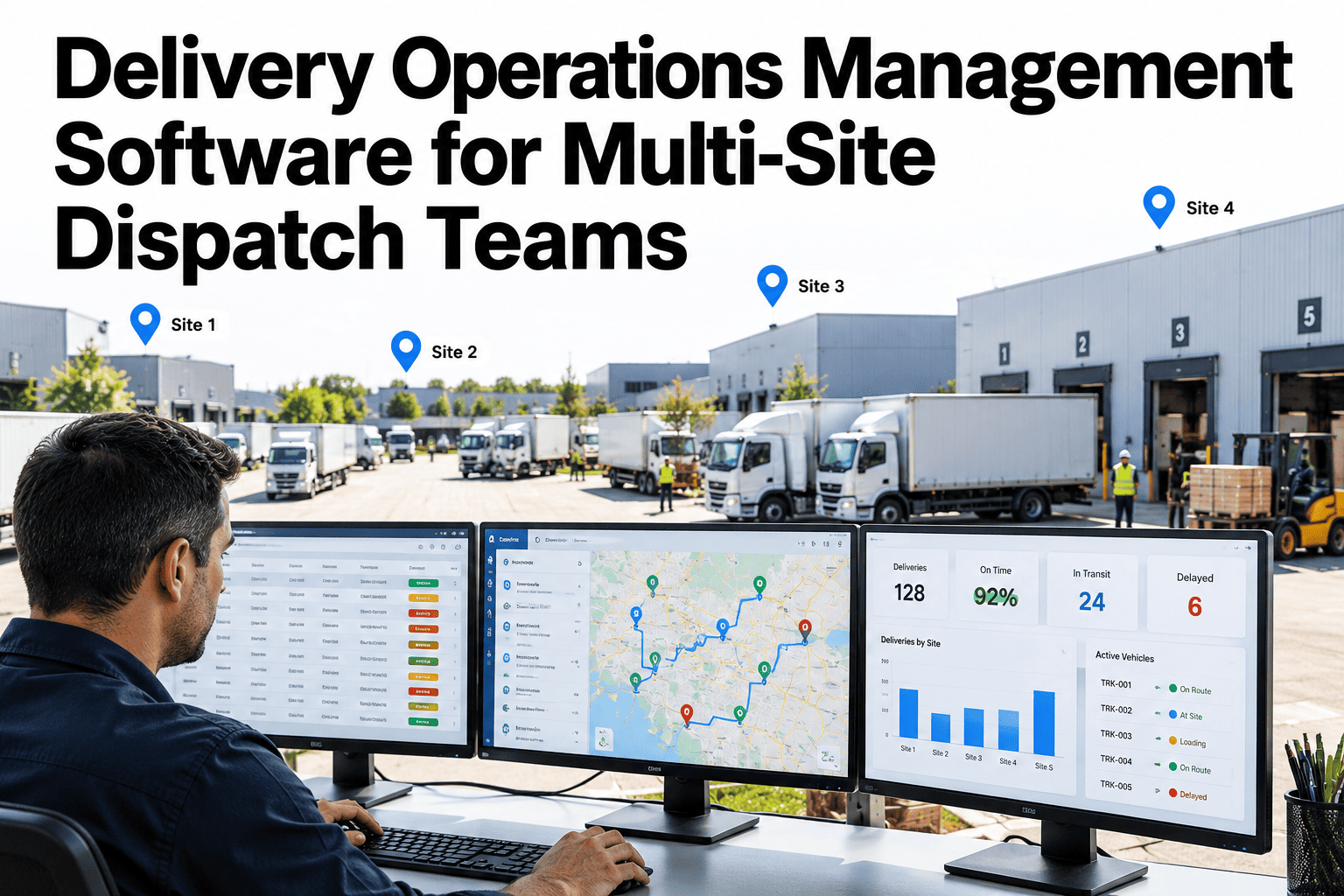
What is factory dispatch and delivery operations management — and how is it different from last-mile delivery software?
Factory dispatch and delivery operations management covers the internal processes that govern material and vehicle movement through a manufacturing or industrial facility — including gate pass generation and approval, dock scheduling, weighbridge operations, inbound material tracking, returnable item management, inter-department material transfers, and outbound finished goods dispatch documentation. This is fundamentally different from last-mile delivery software, which is built for courier companies and e-commerce fleets managing deliveries to end customers. Factory dispatch software manages the transactions that happen inside and at the boundary of your facility — vendor arrivals, internal material flows, job worker dispatches, and finished goods exits — with the compliance documentation, multi-level authorization workflows, and inventory integration that industrial operations require. iFactory's platform is purpose-built for manufacturing and industrial facilities, not adapted from a courier dispatch tool. Book a demo or talk to support to configure iFactory for your specific factory operations.
What is the difference between a Returnable Gate Pass (RGP) and a Non-Returnable Gate Pass (NRGP) — and why does the distinction matter operationally?
An RGP (Returnable Gate Pass) is issued when materials, fixtures, tools, or equipment leave your facility temporarily and must return within a defined period — typically for job work at a vendor, equipment sent for external repair, or containers loaned to a logistics partner. The critical operational requirement is tracking the return: the item was valued when it left, and it must come back in the same or better condition. When RGP tracking is manual, 8–12% of returnable assets are lost annually — through undocumented non-returns, delayed returns that become permanent losses, or condition discrepancies that go uncontested because the dispatch record is a handwritten register entry. An NRGP (Non-Returnable Gate Pass) is issued for permanent outward movements: finished goods dispatch, scrap sale, obsolete asset disposal, or sample material sent to a customer. The compliance requirement here is documentation completeness — every NRGP must link to a sales order or delivery note, carry e-waybill confirmation, and be authorized across the complete approval chain before the vehicle can exit. iFactory manages both pass types with distinct workflows, authorization chains, and tracking systems — including automated return-due alerts for RGP items and GST-linked documentation for NRGP dispatches. Book a demo to see both workflows configured for your operation.
How does dock scheduling reduce factory costs — and what results do iFactory customers typically see?
Dock scheduling replaces the first-come-first-served arrival model that dominates manual factory operations with a pre-planned arrival schedule that maximizes dock utilization and eliminates peak congestion. In unscheduled facilities, dock underutilization averages 35–40% — docks sit idle during off-peak hours while creating gridlock during peak arrival windows. Each hour a vendor vehicle waits at a factory incurs detention charges ranging from ₹500 to ₹2,000 per hour depending on vehicle type and supplier contract — costs that compound across dozens of inbound deliveries per day. iFactory's dock scheduling module pre-assigns arrival windows to each inbound delivery, sends automated notifications to vendor transporters, and provides the dispatch supervisor with a live yard view showing dock occupancy, vehicle positions, and available slots. iFactory customer data shows dock utilization improving to 88–92% after deployment, with peak-hour vehicle wait times dropping from 25–40 minutes to under 8 minutes. The vendor relationship improvement from eliminating excessive detention charges is an additional benefit that facility procurement teams consistently cite. Talk to support to discuss your facility's dock configuration requirements.
How does iFactory connect factory dispatch and delivery operations to production planning and inventory management?
The connection between dispatch operations and production planning is one of the highest-value integrations in iFactory's platform — and the one most neglected in standalone gate pass or dispatch tools. The production-dispatch connection works in three directions. First, inbound material stage tracking: iFactory tracks each inbound delivery through gate arrival, weighbridge, quality inspection, unloading, and stores receipt — giving production planners a live status of where critical materials are in the receiving process, not just whether they've arrived. When a production planner can see that a critical component is at the QC inspection stage with estimated stores receipt in 45 minutes, they can make an informed replan decision rather than waiting for a line stoppage to reveal the delay. Second, internal material movement linked to production orders: when internal gate passes for material issues from stores to the production floor link to the relevant production order or work order, cost accounting is accurate, material consumption is traceable, and production supervisors see material availability on the same screen as their work order status. Third, dispatch output linked to sales and delivery: outbound NRGP generation in iFactory links to the sales order, updating delivery status in the commercial team's records when goods physically leave the gate — not just when the sales order is "dispatched" in the ERP system, which can differ by hours or days. Book a demo to walk through the production-dispatch integration for your specific operation type.
What compliance requirements does digital factory dispatch documentation satisfy — and how does iFactory prepare factories for audits?
Factory dispatch documentation serves multiple compliance purposes simultaneously, and the audit readiness gap between paper-based and digital systems is substantial. For GST compliance, outbound dispatch documentation must link every consignment to its invoice, e-waybill, and transporter details — and be retrievable by invoice number, date, or vehicle number during a GST assessment. iFactory stores all dispatch records with these cross-references automatically, making GST audit responses a database search rather than a manual file hunt. For customer quality audits — particularly in automotive, pharma, and FMCG supply chains where customers audit their tier-1 suppliers — dispatch records must demonstrate that outbound goods passed the required QC stages with documented sign-offs. iFactory's dispatch workflow captures QC clearance, stores authorization, and accounts sign-off as digital signatures at each stage, creating an immutable dispatch audit trail per consignment. For internal management audits reviewing material losses, the RGP recovery data, weighbridge discrepancy history, and internal material movement logs in iFactory provide the evidence base that manual registers cannot. iFactory customers report audit preparation time falling from 3–5 days (paper) to under 4 hours (digital) for standard compliance assessments. Talk to support about configuring iFactory's compliance documentation for your industry's specific audit requirements.
How long does it take to deploy iFactory's factory dispatch and delivery module — and what does implementation involve?
Most factory dispatch module deployments go live within 7–14 days for standard configurations. The implementation process involves four stages. First, process mapping: iFactory's implementation team documents your current gate pass types, approval workflows, weighbridge integration requirements, and dock layout — typically a 1–2 day session. Second, system configuration: gate pass templates, approval chains, material categories, and dock schedules are configured in iFactory's platform matching your documented workflows — usually 3–5 days. Third, integration setup: weighbridge data feed, ERP linkage for GRN and sales order data, and telematics or vehicle tracking integration if applicable — timeline depends on existing system APIs but typically adds 3–7 days for standard integrations. Fourth, team training and parallel run: gate staff, dispatch supervisors, stores teams, and approvers trained on mobile and web interfaces — most facilities run digital and paper in parallel for 3–5 days before full transition. Unlike ERP implementation projects measured in months, iFactory's deployment approach is designed to be operational in the first week, with configuration refinements made based on live usage in the second and third weeks. Book a demo to discuss your facility's specific deployment timeline and integration requirements.

Share This Story, Choose Your Platform!