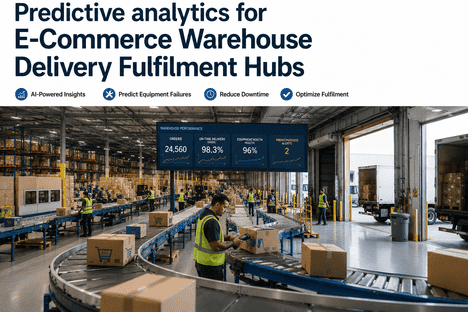
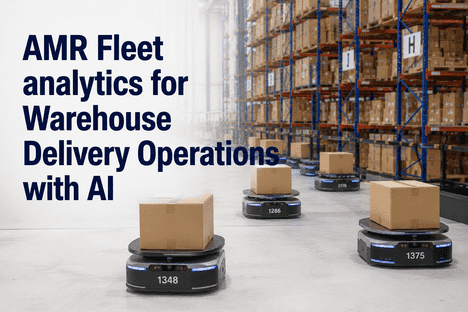
Factory yard and delivery fleets operate under a paradox: they are the department that physically moves everything that enters and exits the plant, yet they are typically the least monitored assets in the building. While production machines have condition sensors and OEE dashboards, the yard tractor, the inbound delivery truck, and the dock shunter get a paper checklist at the start of the shift — if they get anything at all. The result is predictable: vehicles fail mid-operation, dispatch gets disrupted, inbound material deliveries are delayed, and the production floor that depends on those materials stalls. According to Siemens' 2024 True Cost of Downtime report, unplanned equipment failures cost the world's 500 largest manufacturers approximately $1.4 trillion annually — and factory delivery fleet failures are among the least tracked contributors to that number. In 2026, predictive maintenance technology — IoT sensor monitoring, AI-driven failure prediction, and digital inspection enforcement — is reaching factory yard and delivery fleets with measurable results: 30–50% reductions in unplanned downtime, 25% cuts in maintenance costs, and fleet uptime numbers that paper-based inspection programs have never approached. This guide breaks down exactly how predictive maintenance works in a factory delivery department context, what data it requires, and how iFactory's platform operationalizes it from the first shift. Questions about your specific fleet? Talk to our support team directly.
iFactory · Predictive Maintenance · Factory Fleet & Delivery Department
Predictive Maintenance Is Eliminating Unplanned Downtime in Factory Delivery Fleets. Paper Inspection Logs Are the Reason Most Plants Still Experience It.
Factory yard vehicles, delivery trucks, and dock equipment generate failure signals weeks before breakdown — in engine temperature trends, vibration anomalies, and inspection defect patterns. iFactory captures this data through digital inspection enforcement, fault code integration, and real-time vehicle health monitoring — turning reactive breakdown management into planned, scheduled intervention.
50%
Reduction in unplanned downtime achievable with structured predictive maintenance programmes (McKinsey, 2024)
$1.4T
Annual cost of unplanned equipment failure for global top-500 manufacturers — fleet failures among least tracked
62%
Fewer unplanned breakdowns reported by fleets using AI-powered predictive maintenance monitoring programmes
14 days
iFactory go-live timeline — digital inspection enforcement and fleet health monitoring operational from day one
The Maintenance Data Gap
Your Production Machines Have Condition Monitoring. Your Factory Delivery Fleet Has a Paper Checklist.
Data Your Production Assets Already Generate
OEE tracked continuously — 86% of manufacturers monitor production equipment in real time
Vibration and temperature sensors on critical production machines
CMMS work order history per production asset — parts replaced, labour hours, cost
Planned preventive maintenance schedules tied to runtime hours
Fault code alerts from production line PLCs and SCADA systems
Asset condition scoring with remaining useful life indicators
Calibration and compliance records — ISO and GMP traceable
Energy consumption per asset — monitored and metered per shift
Data Your Factory Fleet Has Never Generated — Until Now
Per-vehicle inspection defect frequency — no pattern data across fleet over time
Brake, tyre, and engine condition trend by vehicle — paper checklists generate no analytics
Maintenance work order history per yard vehicle — fragmented or non-existent
Recurring defect identification — same failure on same vehicle undiscovered until breakdown
Failed inspection to work order link — defects recorded on paper, repair unverified
Block event log — vehicles with failed inspections dispatched without enforcement
Pre-use inspection completion rate per operator — no accountability data
Fleet-wide condition score — no aggregate health view across all delivery vehicles
8 Predictive Maintenance KPIs
The 8 Fleet Maintenance KPIs Predictive Monitoring Unlocks — and What the Data Delivers in a Factory Delivery Context
50%
Unplanned Downtime Reduction
Structured predictive monitoring catches developing faults before failure. Factory fleets on digital inspection programmes with work order enforcement see 30–50% reductions in breakdown events within 90 days of go-live.
Reactive: breakdown discovered at gatePredictive: failure flagged 2–4 weeks early
25%
Maintenance Cost Reduction
Replacing components at data-indicated intervals rather than at failure eliminates secondary damage, emergency labour rates, and expedited parts costs. Predictive programmes consistently reduce total maintenance spend by 18–25% versus preventive schedules.
Reactive: emergency rates, secondary damagePredictive: 25% cost reduction, planned rates
62%
Fewer Unplanned Breakdowns
52% of fleet managers using AI-powered predictive maintenance report directly reduced vehicle downtime. Fleet operations using structured digital inspection and defect-to-work-order workflows record 62% fewer unplanned breakdown events annually.
Paper checklist: 0 breakdown predictionDigital: 62% fewer unplanned events
100%
Inspection Enforcement Rate
iFactory's digital pre-use inspection checklists require completion before vehicle can be dispatched. Failed inspection items auto-block the vehicle from dispatch until a verified repair work order is closed — ending the paper-checklist bypass that most factory fleets run on unknowingly.
Paper: bypass possible, no enforcementDigital: 100% completion enforced
40%
Reduction in Reactive Maintenance Spend
Reactive maintenance costs 4–8x more per event than planned maintenance — emergency call-out rates, expedited part shipping, and towing combined. Digital inspection programmes eliminate the high-frequency low-severity events that compound into major failures when missed repeatedly.
Reactive: up to 8x cost per eventPreventive-to-predictive: 40% spend cut
30%
Spare Parts Inventory Reduction
Digital maintenance work order history reveals actual consumption patterns per vehicle per component — enabling parts procurement to order to real demand rather than safety stock guesswork. Fleets on data-driven parts management reduce spare parts inventory by 20–30% without increasing stockout risk.
Manual: overstocked or stockout riskData-driven: 30% inventory reduction
3–6 mo
Full Platform Payback Period
Prevented breakdown events, recovered dispatch uptime, reduced maintenance spend, and eliminated compliance overhead combine to deliver full platform payback within 3–6 months of go-live. iFactory deploys in 7–14 days — results visible from the first shift, not the first year.
Legacy systems: 18–24 month paybackiFactory: 3–6 months to full ROI
20–40%
Fleet Asset Life Extension
Vehicles maintained at data-indicated intervals — rather than at failure or fixed calendar schedule — extend their operational life by 20–40%. For factory yard equipment with 7–10 year replacement cycles, this represents significant CapEx deferral from structured maintenance discipline.
Paper PM: parts replaced 40% earlyPredictive: 20–40% life extension
Your factory fleet vehicles are generating failure signals every shift. iFactory captures them through digital inspection enforcement — and closes the loop automatically with work orders before breakdown occurs.
Digital pre-use inspection checklists, failed vehicle auto-block, defect-to-work-order workflow, and fleet-wide condition dashboard — live from day one in 7–14 days.
Talk to our support team about your specific fleet composition and inspection configuration.
How It Works
5 Predictive Maintenance Workflows iFactory Operationalizes in Your Factory Delivery Fleet From Go-Live
Predictive maintenance in a factory delivery department context does not require retrofitting sensors to every vehicle on day one. It starts with enforcing the data capture that should already be happening — digital inspections — and builds a failure-signal dataset from the first shift.
01
Digital Pre-Use Inspection — Defect Capture and Pattern Analysis
Every driver, operator, and security staff member completes a structured digital pre-use inspection checklist on mobile before taking a vehicle. Each checklist item — brakes, tyres, lights, fluids, steering, mirrors — generates a pass or fail record with operator attribution and timestamp. Failed items generate photo evidence and a linked maintenance notification immediately. The fleet inspection dataset builds from the first shift: by Week 4, defect frequency per vehicle and per checklist item is visible. By Month 3, recurring failure patterns — the same vehicle failing the same item repeatedly — are identifiable before the cumulative degradation results in a road breakdown. This is the foundational data layer that all predictive maintenance intelligence builds on in a factory fleet context.
Per-vehicle defect frequency
Recurring failure identification
Fleet pass rate trend
Operator compliance rate
02
Failed Vehicle Auto-Block — Enforcement That Paper Checklists Cannot Provide
When an inspection identifies a safety-critical or maintenance-flagged defect, iFactory automatically blocks the vehicle from the dispatch queue. The vehicle cannot be assigned to a dispatch order until a verified maintenance work order — with technician attribution, parts used, and completion timestamp — is created and closed against the specific defect record. This enforcement mechanism closes the gap that most factory fleet paper systems leave open: a driver notes a defect, the checklist goes in a binder, the vehicle goes on the road. On digital systems with auto-block, the defect is the trigger — not a supervisor's memory. The block event log generates the fleet-wide data point that most factory fleet managers have never seen: how many vehicles were dispatched with unresolved defect records per week before enforcement was implemented. That number is consistently higher than operations management expects.
Safety defect enforcement
Block event audit log
Dispatch compliance rate
Defect-to-repair close rate
03
Maintenance Work Order History Per Vehicle — The Foundation of Predictive Scheduling
Every maintenance work order created against a factory fleet vehicle — whether from an inspection defect flag, a driver report, or a scheduled PM event — generates a structured record: vehicle ID, defect description, technician assigned, parts used with part numbers, labour hours, cost, and completion timestamp. This work order history per vehicle is the dataset that predictive maintenance scheduling requires. By Month 2, Mean Time Between Failure (MTBF) is calculable per vehicle. By Month 6, the vehicles with the highest per-unit maintenance cost are identifiable — enabling operations management to make evidence-based fleet replacement decisions rather than judgement-based ones. For factory yard equipment with 7–10 year replacement cycles, this data directly informs CapEx forecasting with real maintenance cost curves rather than vendor-supplied depreciation tables.
MTBF per vehicle
Cost-per-vehicle trend
CapEx replacement signal
Parts consumption history
04
Telematics and OBD Fault Code Integration — Real-Time Condition Signals
For factory fleets with telematics hardware or OBD-II connectivity, iFactory ingests real-time vehicle data — engine temperature, fault codes, battery voltage, brake system pressure, and mileage — alongside the inspection and work order dataset. Fault codes flagged during operation generate automatic maintenance notifications before the vehicle completes its current run. Engine temperature anomalies during a dispatch trip generate a real-time alert to the dispatch supervisor — enabling a controlled return and planned repair rather than a roadside breakdown and emergency recovery. The combined telematics and inspection dataset is what moves a factory fleet programme from structured preventive maintenance (enforced inspection schedules) to genuine predictive maintenance (condition-signal-triggered intervention). iFactory's OBD hardware integration supports this transition without requiring vehicle replacement — existing telematics data feeds the platform via API connection.
Real-time fault code alerts
Engine health monitoring
In-trip anomaly detection
Condition-triggered work orders
05
Fleet Condition Dashboard and Compliance Reporting — Portfolio-Level Visibility
The fleet condition dashboard aggregates inspection pass rates, open defect counts, overdue work orders, blocked vehicles, and maintenance cost per vehicle into a single real-time view accessible to operations managers and plant managers across all sites. For multi-depot factory operations, each site's fleet health is visible at the site level and aggregated at the portfolio level — so a group operations director can see which depot has the highest breakdown rate, which vehicle class drives the most maintenance cost, and which site has the lowest inspection completion rate without visiting each location. Regulatory compliance documentation — DOT inspection records, OSHA safety logs, CARB yard vehicle compliance records — is auto-generated from the same operational data and retrievable in under 60 seconds for any audit event.
Fleet health dashboard
Multi-site comparison view
Compliance record auto-generation
Audit retrieval in 60 seconds
Measurable Results
What Factory Fleet Predictive Maintenance Programmes Deliver — Measured Within 90 Days of Go-Live
50%
Unplanned Downtime Cut
Structured predictive monitoring programmes consistently deliver 30–50% reductions in unplanned breakdown events. For a factory fleet of 15–20 delivery and yard vehicles, this typically prevents 8–15 breakdown events per quarter that previously disrupted dispatch schedules and inbound receiving windows.
25%
Maintenance Cost Reduced
Moving from reactive to predictive maintenance reduces total fleet maintenance spend by 18–25%. Emergency repair rates, secondary damage costs, and expedited parts premiums are eliminated when defects are caught at the inspection stage rather than at roadside breakdown.
100%
Inspection Enforcement
iFactory's auto-block enforcement ensures every vehicle completes inspection before dispatch assignment. The inspection completion rate moves from the 60–70% typical of paper-based programmes to 100% enforced digital completion — creating the continuous safety record that DOT and OSHA compliance requires.
62%
Fewer Breakdown Events
AI-powered predictive maintenance users report 62% fewer unplanned breakdown events. For factory delivery departments, each prevented breakdown event recovers an estimated 4–8 hours of dispatch capacity — the compounding benefit that reactive maintenance programmes cannot quantify because they have no baseline measurement.
30%
Parts Inventory Optimised
Work order history per vehicle enables data-driven parts procurement — reducing safety stock levels by 20–30% without increasing stockout risk. Parts for the most frequently maintained vehicles and components are ordered to actual consumption patterns, not fixed safety stock formulae.
14 days
Digital Fleet Programme Live
iFactory deploys in 7–14 days — vehicle registry upload, inspection checklist configuration, dispatch integration, and mobile app training for drivers and technicians. The predictive data layer begins accumulating from the first inspection completed. No hardware procurement. No server infrastructure. No IT project required.
Before vs. After
Factory Delivery Fleet Maintenance — Paper Operations vs. iFactory Predictive Monitoring Platform
Fleet Function
Paper-Based Operations — Zero Prediction
iFactory Predictive Monitoring
Pre-Use Inspection
Paper checklist — bypassed, not timestamped, no operator attribution, defects never linked to repair records
Digital checklist — timestamped, operator-attributed, defects auto-linked to work orders, failed vehicles auto-blocked
Defect Response
Defect noted on paper. Binder filed. Vehicle dispatched. Same defect discovered again at next breakdown event.
Defect triggers auto-block and maintenance notification. Work order created, completed, and verified before vehicle returns to fleet.
Breakdown Management
Discovered roadside or at gate. Emergency recovery. Dispatch disrupted. Inbound receiving delayed. Root cause unknown.
Defect pattern identified 2–4 weeks before failure. Planned repair during scheduled downtime. Dispatch uninterrupted.
Maintenance History
Paper work orders in binders per vehicle. No searchable record. No MTBF calculation. No cost-per-vehicle analysis possible.
Structured digital work order history per vehicle. MTBF calculable by Month 2. Cost-per-vehicle trend visible by Month 3.
Fleet Health Visibility
No fleet-wide dashboard. Condition unknown until failure or scheduled inspection. Multi-site visibility impossible.
Live fleet condition dashboard — pass rate, open defects, blocked vehicles, maintenance cost per unit, multi-depot view.
Compliance Documentation
4–8 hours manual assembly per DOT or OSHA audit. Paper inspection logs incomplete. Records fragmented across sites.
Compliance documentation auto-generated. Retrievable in under 60 seconds. Timestamped and operator-attributed per vehicle.
Telematics Integration
GPS data present but isolated. OBD fault codes generate no maintenance triggers. No connection between vehicle data and work orders.
OBD fault codes trigger automatic maintenance notifications. Telematics condition data feeds fleet health dashboard in real time.
CapEx Planning
Fleet replacement decisions based on age and gut feel. No maintenance cost curve per vehicle. CapEx guesswork, not data.
Per-vehicle cost history enables data-led replacement decisions. CapEx forecasting built on real maintenance curves, not assumptions.
iFactory · Factory Delivery Fleet & Predictive Maintenance
Your factory fleet is generating failure signals every shift. The question is whether your maintenance programme can see them before the breakdown occurs.
iFactory digitalizes every stage of factory fleet maintenance — digital pre-use inspection enforcement, defect-to-work-order automation, failed vehicle auto-block, OBD fault code integration, and fleet condition dashboard. The predictive data layer builds from the first inspection completed. Deploy in 7–14 days. No IT project. No hardware procurement.
50%Downtime reduction
62%Fewer breakdowns
100%Inspection enforcement
14 DaysTo go-live
Frequently Asked Questions
Predictive Maintenance for Factory Delivery Fleets — What Operations Leaders and Plant Managers Ask First
What is the difference between preventive and predictive maintenance for a factory delivery fleet — and which should a factory prioritize first?
Preventive maintenance follows fixed calendar or mileage schedules — service the yard tractor every 250 hours, change the delivery vehicle oil every 10,000 km — regardless of actual vehicle condition. This is an improvement over pure reactive maintenance (fixing things when they break), but it has two critical flaws: it over-maintains vehicles that are in good condition, replacing parts with 30–40% useful life remaining, and it under-maintains vehicles developing faults between scheduled intervals, which then fail unexpectedly. Predictive maintenance uses actual condition data — inspection defect patterns, fault code frequency, telematics temperature and vibration trends — to trigger maintenance when the data indicates it is needed, not when the calendar says so. For most factory delivery fleets, the right sequencing is: first, implement digital inspection enforcement to create the condition data baseline (this is where iFactory starts); second, add work order history per vehicle to build MTBF and cost-per-unit analytics; third, integrate telematics or OBD fault code data to enable real-time condition monitoring between inspection events. This phased approach delivers measurable results at each stage rather than requiring a full sensor retrofit investment before seeing any benefit. Most factory fleets achieve 30–50% unplanned downtime reduction from the digital inspection enforcement phase alone — before any telematics integration is added. For questions about the right starting point for your specific fleet,
talk to our support team.
How does iFactory's digital inspection enforcement actually prevent breakdowns — and what happens when a vehicle fails an inspection item?
iFactory's inspection enforcement works through a three-stage defect response that paper checklists structurally cannot replicate. Stage one: detection. The driver or operator completes a digital pre-use inspection checklist on mobile before the vehicle is assigned to any dispatch order or yard movement. Each checklist item — brakes, tyre condition and pressure, lights, fluid levels, steering response, mirrors, bodywork — generates a structured data record with operator attribution and timestamp. For any item marked as failed or defective, the operator captures a photo of the defect directly in the app before they can proceed. Stage two: enforcement. Any safety-critical failed inspection item automatically blocks the vehicle from the dispatch assignment queue. The vehicle cannot be assigned to a dispatch order until a maintenance work order is created against the specific defect, the repair is completed by a verified technician with parts and labour recorded, and the work order is closed with closure attribution. This auto-block enforcement is the mechanism that eliminates the most common failure mode of paper-based inspection programmes: a driver notes a defect, the paper gets filed, the vehicle goes on the road anyway because nobody sees the paper until the shift review. Stage three: pattern analytics. The failed inspection record, the work order, and the repair completion are linked as a single event chain per vehicle. After 30–60 days, the platform identifies vehicles that are failing the same inspection item repeatedly — the brake wear pattern, the tyre pressure loss rate, the oil consumption trend — before the cumulative degradation results in a roadside breakdown. This is where inspection enforcement transitions to genuine predictive maintenance: the defect pattern is the failure signal, visible 2–4 weeks before the failure event.
Book A Demo to see the inspection enforcement and defect pattern workflows in a live factory fleet environment.
Does iFactory require installing new sensors or hardware on factory fleet vehicles to deliver predictive maintenance benefits?
No. iFactory does not require any hardware installation to begin delivering predictive maintenance benefits. The digital inspection enforcement programme — pre-use checklists, defect-to-work-order automation, failed vehicle auto-block, and fleet condition dashboard — operates entirely through the mobile app on drivers' and technicians' existing smartphones or tablets. No sensors, no OBD hardware, and no vehicle modifications are required to start. The predictive data layer builds from the first digital inspection completed, using operator-reported defect data and maintenance work order history as the condition monitoring dataset. For factory fleets that want to add real-time telematics data — OBD fault codes, engine temperature, battery voltage, GPS-correlated mileage — iFactory supports OBD hardware integration for vehicles that do not have factory telematics, and API connections to existing telematics platforms (Geotab, Verizon Connect, Samsara, and others) for vehicles that already broadcast vehicle data. This means most modern commercial vehicles manufactured after 2015 — which come with factory telematics — can be integrated without any additional hardware. The recommended deployment sequence is: start with digital inspection enforcement using mobile app only (no hardware), run for 30–60 days to build the baseline dataset, then evaluate which vehicles in the fleet would benefit most from real-time telematics integration based on their inspection defect frequency and work order cost patterns. For guidance on the right integration approach for your specific fleet make and model composition,
talk to our support team.
How quickly does iFactory deploy for a factory delivery fleet — and what does the onboarding process involve for drivers, technicians, and supervisors?
iFactory goes live in 7–14 days for a standard factory fleet deployment covering digital inspection enforcement, defect-to-work-order automation, dispatch integration, and fleet condition dashboard. The deployment process runs in three phases. Days 1–3: data onboarding. This involves uploading the vehicle registry (vehicle ID, type, registration, mileage, previous service history if available), the driver and technician roster with role assignments, and the inspection checklist templates for each vehicle class in your fleet. iFactory's onboarding team handles the data migration and checklist configuration directly with your operations team. Days 4–7: configuration and training. Inspection checklists are configured per vehicle class — yard tractors, delivery vehicles, dock shunters, forklifts — with the specific items relevant to each type. Dispatch integration with your existing dispatch workflow is configured. Mobile app training for drivers and security staff takes 2–4 hours and is delivered via the app itself with guided walkthrough. Technician training on the work order creation and closure workflow takes 1–2 hours. Days 8–14: go-live and verification. Live operations commence with iFactory support monitoring data quality, checklist completion rates, and work order closure rates. Any workflow gaps are resolved during this verification phase before the full operational handover. Because iFactory is cloud-based and mobile-first, there is no server infrastructure to install, no IT department project, and no hardware procurement required for the core mobile inspection deployment. The fleet condition dashboard and analytics are live from the first inspection completed.
Book A Demo to see the deployment timeline and onboarding process for a fleet similar to yours.
What compliance documentation does iFactory generate from factory fleet inspection and maintenance records — and how does this support DOT, OSHA, and CARB audit requirements?
iFactory auto-generates four categories of compliance documentation from daily factory fleet inspection and maintenance operations — without any separate reporting step. First, pre-use inspection records: every inspection is timestamped, operator-attributed, vehicle-linked, and complete with pass/fail results per checklist item and photo evidence for failed items. This satisfies DOT pre-trip inspection record requirements and OSHA vehicle safety documentation standards. The records are retrievable by vehicle, by date range, and by operator for any audit event in under 60 seconds. Second, defect and repair records: every defect flagged in an inspection, every work order created against that defect, the technician who completed the repair, the parts used, the labour hours, and the closure timestamp are linked as a complete event chain. This satisfies DOT out-of-service repair documentation and OSHA corrective action records. Third, vehicle maintenance history: the complete work order history per vehicle — all repairs, all defects, all parts replacements — is stored chronologically and searchable by vehicle ID, defect type, or date range. This satisfies DOT vehicle maintenance log requirements and provides the continuous maintenance record that most audit scenarios require. Fourth, for California operations specifically, yard vehicle inspection records satisfy CARB in-use off-road diesel regulation requirements — the timestamped, continuous inspection log that paper-based programmes cannot produce at audit standard. For multi-site factory operations, compliance documentation is maintained site-specifically while remaining aggregated at the group level for portfolio audits.
Talk to our support team about the specific compliance documentation requirements for your facility's jurisdiction and regulatory exposure.
How does iFactory handle predictive maintenance for factory fleets operating across multiple depots or sites — and what does the multi-site fleet dashboard show?
iFactory is built as a multi-depot, multi-site platform from the ground up — a single deployment covers all factory locations in your portfolio under one dashboard with site-specific fleet configuration and access controls. For fleet managers at individual sites, the dashboard shows their site's vehicles, inspection completion rates, open defects, blocked vehicles, overdue work orders, and maintenance cost per unit in real time. For regional operations managers and group fleet directors, the portfolio-level dashboard shows all sites simultaneously: which depot has the highest breakdown rate this month, which vehicle class across the network drives the highest maintenance cost per unit, which site has the lowest inspection completion rate, and which individual vehicles across the portfolio are flagging the most recurring defects. Alert configurations are site-specific — a critical brake defect block event at Site A notifies the Site A fleet supervisor immediately, while the group operations director receives a daily digest of all active block events across the portfolio. Vehicle transfers between sites maintain their full inspection and work order history — a vehicle moved from Site A to Site B carries its complete defect and maintenance record with it, giving the receiving site's maintenance team an accurate condition picture from day one. Parts inventory management can be configured per site with inter-site transfer visibility — enabling high-frequency consumables at one site to be sourced from adjacent site stock rather than triggering an external purchase order.
Book A Demo to see multi-site fleet condition monitoring and dashboard configuration for a portfolio similar to your operation.
iFactory · Factory Fleet Predictive Maintenance
Your factory production floor has condition monitoring. Your delivery fleet and yard vehicles deserve the same intelligence.
iFactory's digital inspection enforcement, defect-to-work-order automation, OBD integration, and fleet condition dashboard deliver the predictive maintenance data layer your factory fleet has never had — live in 7–14 days, with no IT project and no hardware required to start. Book a demo to see it running in a live factory fleet environment.
50%Downtime reduction
25%Maintenance cost cut
100%Inspection enforcement
14 DaysTo go-live