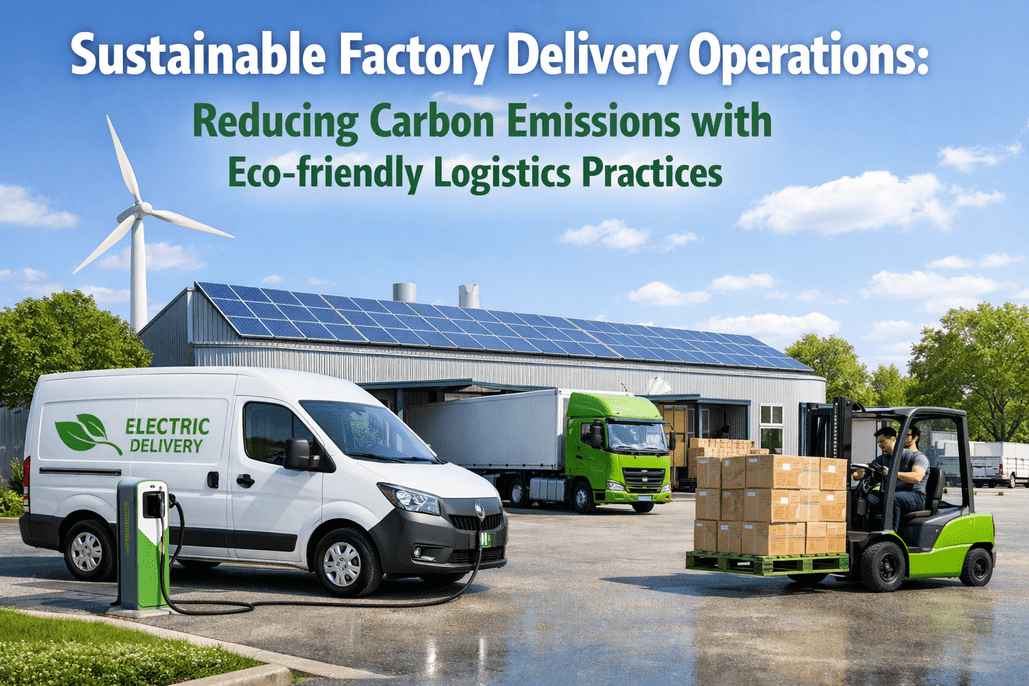
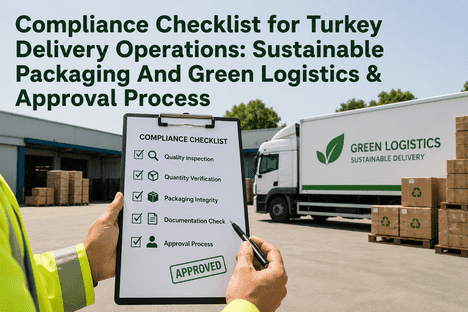
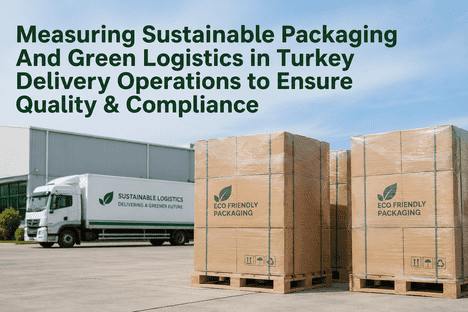
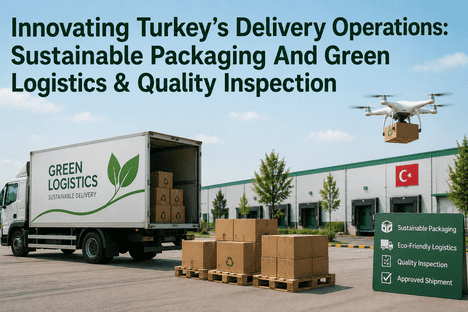
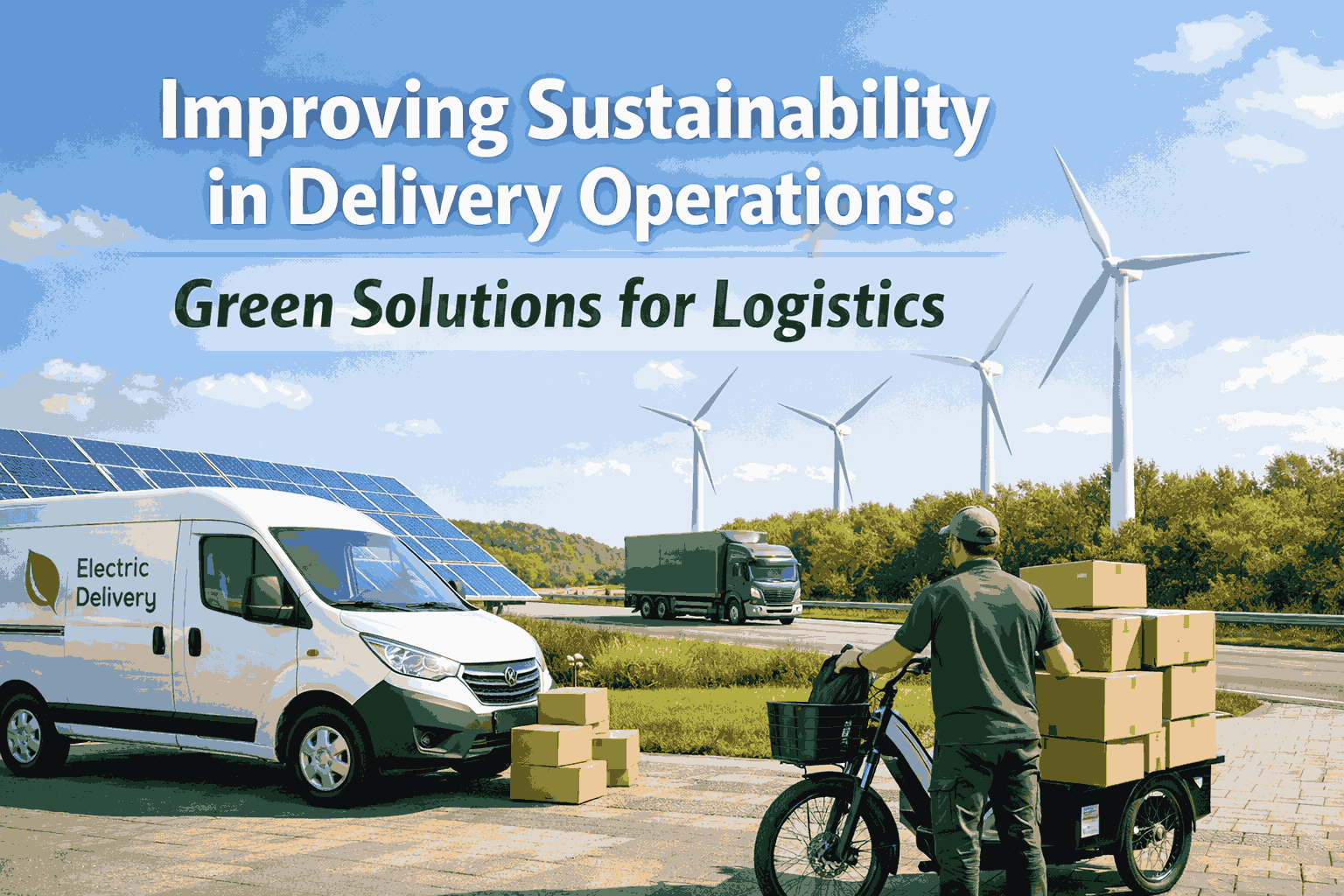
The factory delivery department — the function that controls every vehicle entering your gate, every inbound receipt, every internal material transfer, and every dispatch event — is now one of the largest sources of carbon liability for manufacturers. The logistics sector is responsible for 33% of global CO₂ emissions, and regulators in 2026 are no longer accepting pledges. They are requiring auditable, timestamped data from the operations floor. The EU Carbon Border Adjustment Mechanism (CBAM) entered its definitive period on January 1, 2026, penalizing exporters without facility-specific carbon records. The green logistics market was valued at $1.65 trillion in 2025 and is forecast to reach $3.36 trillion by 2034 — growing at 8.23% annually — because sustainability is no longer optional. For plant managers and operations leaders, this is not a CSR conversation. It is a data problem. Your factory delivery department is generating carbon-relevant events every hour of every working day — idle vehicles queued at a slow paper gate, diesel yard trucks making unnecessary repositioning runs because materials cannot be located, dispatch routes that consume more fuel than a digital SLA-priority system would assign. The question is not whether these emissions exist. The question is whether you are measuring them, managing them, and proving it. Talk to our support team if you want a compliance gap assessment for your facility.
iFactory · Factory Delivery Department Module
Your production floor has dashboards. Your delivery department deserves the same visibility.
iFactory digitizes every gate pass, inbound receipt, material transfer, vehicle inspection, dispatch event, and incident report — giving your operations team real-time visibility into the department that controls everything that enters and exits your plant. Deploy in 7–14 days. No IT project. No hardware procurement. Results visible from day one.
87%Gate pass time reduction
78%Faster inbound receiving
100%Audit trail coverage
14 DaysFull deployment
Why Your Factory Delivery Department Is the Hidden Carbon Source in 2026
Most manufacturers have invested heavily in production floor sustainability — energy monitoring, OEE tracking, predictive maintenance. Yet the delivery department — the function handling 40–80 vehicle movements per day — operates on paper logs, manual gate registers, and verbal dispatch instructions that generate zero carbon measurement data. This gap is becoming expensive.
15–20 min
Manual gate processing per vehicle
Every minute a diesel truck idles in your gate queue is a measurable emission event. A factory processing 20 vehicles/day on paper generates 300–400 minutes of idle emissions daily — with no record to contest enforcement actions.
30–40%
Production stoppages are locating failures
When materials cannot be located after dock entry, yard vehicles make repeated repositioning runs. Each run burns fuel and generates emissions. None of it is recorded. Digital internal tracking eliminates these unnecessary movements.
2–3%
Manual dispatch error rate
Every dispatch error generates a re-dispatch run — additional mileage, additional fuel, additional emissions. At 2–3% error rate on 30 daily dispatches, that is 200–300 unnecessary vehicle trips per year from dispatch errors alone.
$3.36T
Green logistics market by 2034
Manufacturers that build digital carbon data infrastructure now are ahead of the reporting and compliance curve. Those still on paper lose access to markets, credits, and customers requiring auditable sustainability records.
The 5 Eco-Friendly Practices That Start at Your Factory Gate
Sustainable factory delivery operations are not built with a single EV purchase or a recycled packaging initiative. They are built function by function, starting with the five operational workflows that generate the most carbon-relevant data every day in your delivery department.
01
Digital Gate Pass Management — Eliminate Idle Queue Emissions
Manual gate processing creates idle queues. Vehicles waiting 15–20 minutes per pass while paper forms are completed, phone calls made, and clipboards located are generating black carbon and NOx emissions at your gate — emissions that regulators can now attribute to your facility using dwell time data. Digital gate pass management eliminates the queue. Drivers pre-register before arrival. Security verifies credentials and cargo on mobile in under 2 minutes. Vehicle type — electric, diesel, hybrid — is automatically captured. Dwell time per vehicle is recorded to the second. A factory processing 20 vehicles/day recovers 280+ minutes of idle dwell time daily, eliminating the emissions that queuing generates and generating the timestamped records that prove it.
Carbon Impact
87% reduction in gate processing time → direct elimination of idle queue emissions
02
Optimized Dispatch Sequencing — Fewer Trips, Less Fuel
Manual dispatch assigns vehicles and routes based on availability and habit — not SLA priority, vehicle type, or load efficiency. The result is unnecessary trips, underloaded vehicles, and diesel runs that could have been combined or assigned to an EV unit. Digital SLA-priority dispatch sequences every outgoing vehicle by urgency tier, payload type, vehicle fuel type, and route — automatically assigning EVs to short-haul routes and consolidating loads to reduce total trip count. Every dispatch event records vehicle ID, fuel type, route mileage, and departure time — the exact data required to claim LCFS credits, support Scope 3 emissions reporting, and demonstrate route optimization to ESG auditors.
Carbon Impact
Dispatch error rate drops from 2–3% to under 0.3% → 200–300 fewer unnecessary vehicle trips per year
03
Digital Inbound Receiving — Traceable Chain of Custody
Inbound receiving is where your factory's Scope 3 emissions story begins. Every inbound shipment carries embodied carbon from its supplier, carrier, and route. Manufacturers that cannot trace inbound material from supplier to production floor cannot produce the supply chain traceability records that ESG frameworks, carbon border taxes, and supply chain transparency regulations increasingly require. Mobile inbound receiving generates a digital chain of custody record at the moment of dock arrival — linking supplier, carrier, material, quantity, and timestamp in a single timestamped entry. Photo proof of delivery is captured in seconds. PO verification is automated. Discrepancies are logged with photographic evidence. The receiving record that AB 2061, CBAM auditors, and ESG reporting platforms require is generated as a byproduct of the normal receiving workflow — without any additional step.
Carbon Impact
78% faster receiving → complete Scope 3 traceability from supplier to production floor, auto-generated
04
Yard Vehicle Inspection — Emissions Compliance at the Source
Forklifts, yard tractors, and shunters operating on diesel above their rated emission tier are a direct compliance liability under in-use off-road diesel regulations. Paper inspection checklists — incomplete, unsigned, undated — cannot satisfy the continuous compliance record requirement these regulations impose. Digital pre-use inspections take 3–5 minutes on mobile. Every inspection result is timestamped, operator-attributed, and photo-documented. Vehicles with failed emissions-relevant inspection items are automatically blocked from dispatch until a verified repair work order is completed and closed. The result is a continuous inspection log that demonstrates proactive emissions management of your yard fleet — and prevents high-emission equipment from operating without documented compliance. When an auditor requests 18 months of yard vehicle inspection records, iFactory produces them in under 60 seconds.
Carbon Impact
100% inspection coverage → non-compliant yard vehicles blocked automatically before generating emissions events
05
Internal Material Tracking — Stop Unnecessary Yard Movements
The most overlooked source of carbon emissions in a factory delivery department is not the gate — it is the yard. Materials that cannot be located after dock entry trigger repeated forklift and yard tractor movements as workers search docks, stores, and staging areas. Each search run burns diesel and generates emissions that nobody measures. Digital internal tracking logs every material transfer — dock to stores, stores to production, production to quality, quality to dispatch. Real-time location at every transfer point eliminates the search pattern entirely. The 30–40% of production stoppages attributable to material locating failures disappear. Unnecessary yard vehicle movements drop. The emissions they generated are eliminated. And the complete internal chain of custody from supplier arrival to production floor usage is documented automatically for Scope 3 reporting.
Carbon Impact
30–40% reduction in unnecessary yard movements → direct cut in internal transport emissions and fuel waste
iFactory turns your factory delivery department into a documented, measurable, audit-ready sustainability asset — in 14 days.
Every gate pass, dispatch event, inspection, and material transfer generates carbon-relevant records automatically. No separate reporting workflow. No manual assembly.
Talk to our support team for a facility-specific carbon gap review.
The Carbon Data Your Factory Delivery Department Is Not Capturing — and Should Be
Manufacturing sustainability teams have strong data on production floor energy consumption. Most have zero data on the delivery department. Here is the specific carbon-relevant data that digital factory delivery operations generate automatically — and that paper-based operations cannot produce.
Data You Cannot Produce on Paper
Per-vehicle gate dwell time — the idle emissions metric regulators now quantify
Vehicle fuel type at entry — required for fleet emissions profile and LCFS documentation
Dispatch fuel type and mileage per trip — required for Scope 3 Category 4 emissions reporting
Yard vehicle inspection logs with timestamp and operator — required for in-use diesel compliance
Inbound chain of custody from supplier to production floor — required for CBAM and supply chain transparency
Internal material movement count — cannot calculate unnecessary transport emissions without it
Gate queue length over time — the community impact metric CalEPA and EU regulators are targeting
Dispatch SLA compliance rate — cannot demonstrate route efficiency to ESG auditors without it
Data iFactory Generates Automatically
Dwell time per vehicle per gate event — timestamped, vehicle-attributed, auditor-ready
Vehicle type and fuel classification recorded at every gate entry automatically
Per-trip fuel type, route, mileage, and departure/return timestamps from dispatch records
Continuous inspection log — timestamped, person-attributed, photo-documented per vehicle per day
Digital chain of custody from supplier arrival to production floor usage, photo POD included
Every internal transfer logged — dock, stores, production, quality, dispatch — with timestamps
Gate queue trend data — vehicle volume, dwell time averages, peak hour profiling per week
SLA compliance rate, on-time dispatch rate, and error rate per period — all auto-calculated
How Sustainability Regulations Are Reaching the Factory Delivery Department in 2026
Sustainability compliance in 2026 is not limited to production floor energy use or outbound shipping emissions. Four regulatory frameworks are now creating specific documentation requirements for factory delivery department operations.
EU CBAM — Jan 2026
Carbon Border Adjustment Mechanism — Facility-Specific Records Required
CBAM entered its definitive period on January 1, 2026. Manufacturers exporting to the EU must now provide facility-specific carbon data — not industry averages — for products including steel, aluminum, cement, and chemicals. Default values are being penalized. Factories without granular operational carbon records face competitive disadvantage in European markets.
Delivery department data required: inbound material traceability, transport emissions per shipment
EU ETS — Tightening 2026
Emissions Trading System — Free Allowances Being Phased Out
EU ETS free allowances are being phased out. Carbon prices are rising. Manufacturers without verifiable emissions reduction data from every operational function — including logistics and delivery — face increasing carbon cost exposure. Documented operational improvements in gate dwell time, dispatch efficiency, and yard vehicle management are now financially relevant to ETS calculations.
Delivery department data required: gate idle data, dispatch fuel records, yard vehicle emission logs
GHG Protocol Scope 3
Scope 3 Category 4 — Upstream Transportation and Distribution
GHG Protocol Scope 3 Category 4 requires manufacturers to account for upstream transportation and distribution emissions. This includes inbound freight from suppliers and internal factory transport movements. Without per-trip vehicle data from your dispatch system and per-shipment carrier data from your receiving system, Scope 3 Category 4 reporting relies on estimates that ESG auditors and investors are increasingly rejecting.
Delivery department data required: carrier fuel type, trip mileage, inbound shipment records
LkSG / CSDD
Supply Chain Due Diligence — Traceability to Factory Gate
Germany's LkSG and the EU's Corporate Sustainability Due Diligence Directive require manufacturers to document supply chain traceability and environmental compliance from supplier to manufacturing site. The receiving dock is where this traceability obligation terminates on paper — and begins in your records. Factories without digital inbound receiving records cannot satisfy these traceability requirements under audit.
Delivery department data required: digital inbound records linking supplier, carrier, material, and timestamp
What iFactory Delivers for Sustainable Factory Delivery Operations
iFactory is purpose-built for the factory delivery department — the function that manages every gate event, every inbound receipt, every yard vehicle movement, every dispatch, and every internal material transfer. In 7–14 days, your delivery department stops being a carbon liability and becomes a documented sustainability asset.
87%
Gate Pass Time Cut
From 15–20 minutes to under 2 minutes per vehicle. 280+ minutes of idle queue emissions eliminated daily at a 20-vehicle/day factory.
78%
Faster Inbound Receiving
Mobile PO verification and photo POD cut 45–60 minute receiving to under 10 minutes — generating Scope 3 chain of custody simultaneously.
90%
Fewer Dispatch Errors
2–3% manual error rate drops to under 0.3% with SLA-priority automated sequencing — with per-trip fuel data captured for every dispatch event.
100%
Audit Trail Coverage
Every gate event, receiving transaction, inspection result, transfer, and dispatch is timestamped and retrievable in under 60 seconds for any regulatory audit.
3–6 mo
Full Payback Period
Recovered dock time, eliminated errors, compliance overhead reduction, and carbon credit documentation typically deliver full ROI within one to two quarters.
14 Days
Go-Live Timeline
Cloud-based, mobile-first deployment. No server installation, no IT project, no hardware procurement. From decision to fully operational in two weeks.
Frequently Asked Questions
Questions plant managers and sustainability leads ask when evaluating sustainable factory delivery operations — covering carbon data, regulatory obligations, and iFactory deployment.
How does digitizing a factory delivery department actually reduce carbon emissions — not just measure them?
Digital factory delivery operations reduce carbon emissions through four direct mechanisms, not just better measurement. First, eliminating idle queue emissions: digital gate pass processing cuts vehicle dwell time from 15–20 minutes to under 2 minutes — removing the idle queue that generates black carbon and NOx at your gate for every vehicle that would otherwise wait. A 20-vehicle/day factory eliminating 280+ daily minutes of idle dwell time delivers a measurable, documentable emission reduction with no additional investment beyond the software. Second, eliminating unnecessary yard movements: 30–40% of yard vehicle trips are material search runs triggered by lost location after dock entry. Digital internal tracking ends these runs — reducing diesel consumption from yard tractors and forklifts that have no records of their fuel use. Third, dispatch optimization: SLA-priority automated dispatch assigns EVs to short routes, consolidates loads to reduce trip count, and eliminates the re-dispatch runs generated by manual errors. Reducing dispatch errors from 2–3% to under 0.3% eliminates 200–300 unnecessary vehicle trips per year at a mid-size operation. Fourth, proactive yard vehicle compliance: digital inspections with automatic blocking of non-compliant vehicles prevent high-emission equipment from operating above its rated tier — a direct operational intervention, not just documentation.
Talk to our support team for a site-specific emissions reduction estimate.
What specific sustainability regulations require factory delivery department data in 2026?
Four regulatory frameworks create specific documentation requirements that reach the factory delivery department in 2026. The EU Carbon Border Adjustment Mechanism (CBAM), which entered its definitive period on January 1, 2026, requires facility-specific carbon data for products exported to Europe — penalizing manufacturers relying on default industry averages. Factories without granular inbound material traceability and transport emissions records face direct competitive disadvantage in EU markets. The EU Emissions Trading System is tightening as free allowances are phased out, making documented operational carbon reductions — including gate dwell time improvement and dispatch efficiency — financially relevant to ETS exposure calculations. GHG Protocol Scope 3 Category 4 requires upstream transportation and distribution emissions data — specifically per-trip fuel type and mileage from dispatch systems and per-shipment carrier data from receiving systems. Germany's Lieferkettensorgfaltspflichtengesetz (LkSG) and the EU Corporate Sustainability Due Diligence Directive require supply chain traceability from supplier to manufacturing site, with the receiving dock as the traceability endpoint that digital inbound records must document. Outside Europe, California's SB 1383 targets idle emissions at industrial gates, and its LCFS program credits manufacturers who can document EV and alternative fuel vehicle use per trip. The common thread across all frameworks: they require timestamped, vehicle-attributed, operation-specific data that paper-based delivery departments cannot produce.
Book a demo to see how iFactory auto-generates compliance records for each of these frameworks.
Can iFactory help with Scope 3 emissions reporting for a factory delivery department?
iFactory generates the operational data that Scope 3 emissions reporting requires for Categories 4 (upstream transportation and distribution) and 1 (purchased goods and services) directly from daily factory delivery department workflows. For Scope 3 Category 4, every dispatch event records vehicle ID, fuel type (electric, diesel, alternative fuel), assigned route, departure timestamp, and return mileage. This dataset provides the per-trip, per-vehicle fuel consumption data that GHG Protocol Category 4 calculations require — without any separate reporting step. For inbound transportation, every receiving transaction records carrier, transport mode, origin, and material weight — the inputs needed for inbound freight emissions calculations. For Scope 3 Category 1, iFactory's inbound chain of custody records link supplier and material to production floor usage — providing the traceability foundation that supply chain carbon footprint calculations require. The reporting output from iFactory's analytics dashboard can be exported in standard formats compatible with GHG Protocol reporting templates and major ESG reporting platforms. Scope 3 reporting that previously required manual data assembly across paper logs, fuel cards, and spreadsheets becomes a dashboard export.
Talk to our support team about configuring Scope 3 reporting templates for your specific reporting framework.
How quickly does iFactory deploy and what does a sustainable delivery department look like after go-live?
iFactory goes live in 7–14 days for a full factory delivery department deployment covering gate pass management, inbound receiving, yard vehicle inspection, dispatch sequencing, incident reporting, and internal material tracking simultaneously. The deployment has three phases. Days 1–3 cover data onboarding: vehicle registry, driver roster, supplier list, and PO templates are uploaded with direct support from iFactory's onboarding team. Days 4–7 cover configuration: inspection checklists, dispatch SLA rules, gate pre-registration workflows, sustainability data fields (vehicle fuel type, trip mileage, emissions tier), and user access are configured for your specific operation. Days 8–14 cover go-live and verification: live operations with iFactory support monitoring data quality and resolving any workflow gaps before full handover. After go-live, your factory delivery department operates with a real-time dashboard showing gate dwell time per vehicle, dispatch SLA compliance rate, inbound receiving time per shipment, yard vehicle inspection completion rate, and material transfer chain of custody. The sustainability data layer — gate idle metrics, dispatch fuel records, yard vehicle compliance logs — is generated automatically from these daily operations with no additional workflow required. For sustainability leads, this means Scope 3 data is captured at source, not assembled retroactively from fragmented records.
Book a demo to see the sustainability dashboard running in a live factory environment.
How does iFactory support factories outside Europe that want to use green delivery operations as a competitive advantage?
California's regulatory frameworks consistently become global standards within 3–7 years — a pattern established across emissions standards, labor regulations, and product safety rules. Factories in India, the UAE, Southeast Asia, Mexico, and the United States that build digital carbon data infrastructure from their delivery departments now are not waiting for enforcement. They are building the operational data layer that creates four measurable competitive advantages regardless of local regulation. First, major customer sustainability requirements: large manufacturers, retailers, and FMCG companies are increasingly requiring supply chain traceability documentation and Scope 3 emissions data from their suppliers. Factories with iFactory's digital delivery records can produce this documentation on demand — those on paper cannot. Second, ESG investment and financing: institutional investors and ESG-linked financing instruments increasingly require facility-level carbon data. Documented delivery department improvements in gate dwell time, dispatch efficiency, and yard vehicle compliance are concrete, auditable ESG evidence. Third, carbon credit opportunities: where carbon credit and LCFS-equivalent programs exist, per-trip fuel data from iFactory's dispatch records enables credit claims that are inaccessible to operations relying on paper logs. Fourth, insurance premium reduction: fleet and liability insurers in mature markets are beginning to offer premium discounts for documented digital inspection compliance and vehicle management records — the exact data iFactory generates automatically.
Talk to our support team about configuring iFactory for your local regulatory and customer reporting requirements.
What is the ROI of building a sustainable factory delivery department with iFactory?
The ROI calculation for sustainable factory delivery department digitization with iFactory has five components that each stand independently. Recovered dock time: a factory processing 20 vehicles/day eliminates 280+ minutes of daily idle queue time — recovering 1.5–2 full-time equivalent labor hours per day across gate and receiving operations. Annualized, this represents significant operational labor cost recovery beyond the software subscription. Dispatch optimization savings: reducing dispatch errors from 2–3% to under 0.3% eliminates re-dispatch costs, SLA penalty exposure, and management time consumed by error resolution — typically $50,000–$200,000 annually for a mid-size factory depending on shipment volume and customer contract terms. Carbon credit and LCFS revenue: where carbon credit programs apply, per-trip EV and alternative fuel documentation from iFactory's dispatch records enables credit claims worth $0.10–$0.45 per mile driven in qualifying vehicles — value that is inaccessible to operations on paper. Compliance overhead reduction: manual assembly of delivery department records for sustainability audits, CBAM submissions, or Scope 3 reporting typically consumes 4–12 hours per audit event. iFactory reduces this to a dashboard export taking under 30 minutes. Enforcement penalty avoidance: CBAM default value penalties, CARB enforcement fines reaching $37,500 per day per violation, and EU ETS exposure are all reduced by verified, auditable delivery department records. Full platform payback is typically achieved within 3–6 months of go-live when all five components are included.
Book a demo to get a custom ROI estimate based on your facility's vehicle volume and regulatory exposure.
iFactory · Factory Delivery Department Module
Sustainability starts at your factory gate. iFactory makes every event measurable, auditable, and improvable.
iFactory digitizes every gate pass, inbound receipt, material transfer, vehicle inspection, dispatch event, and incident report — giving your delivery department the same operational visibility as your production floor. Carbon data is generated automatically. Compliance records are retrievable in seconds. Idle emissions are eliminated by design. Deploy in 7–14 days. No IT project. No hardware procurement.
87%Gate Pass Reduction
100%Audit Coverage
14 DaysTo Go-Live
3–6 moFull Payback