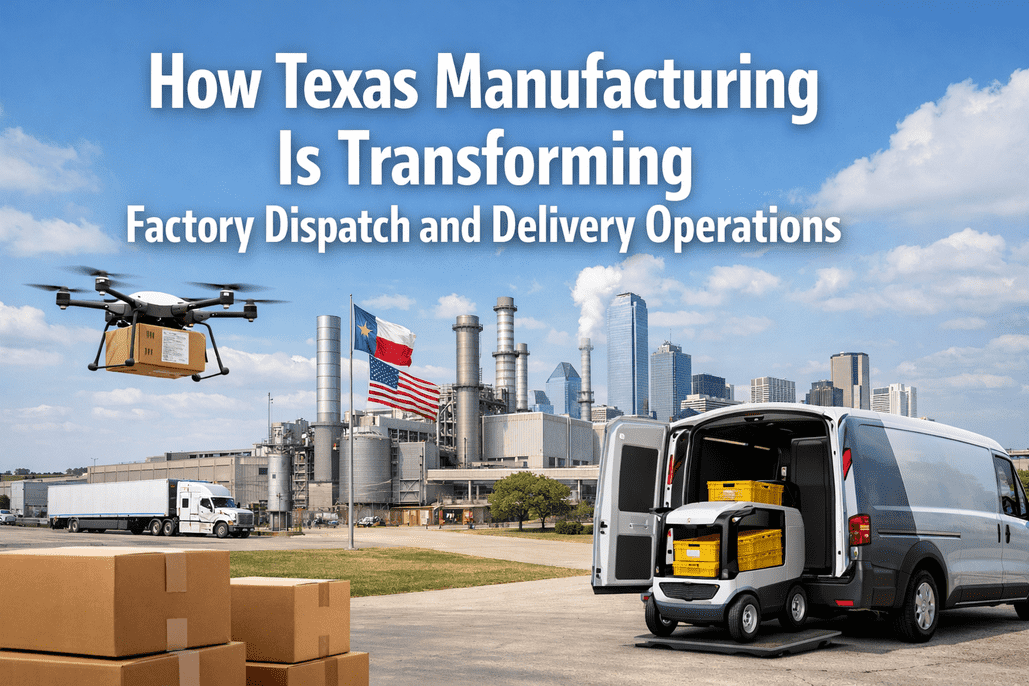
How Texas Manufacturing Is Transforming Factory Dispatch and Delivery Operations

By Garry Garfield on March 6, 2026

texas-drone-deliveries-future-logistics

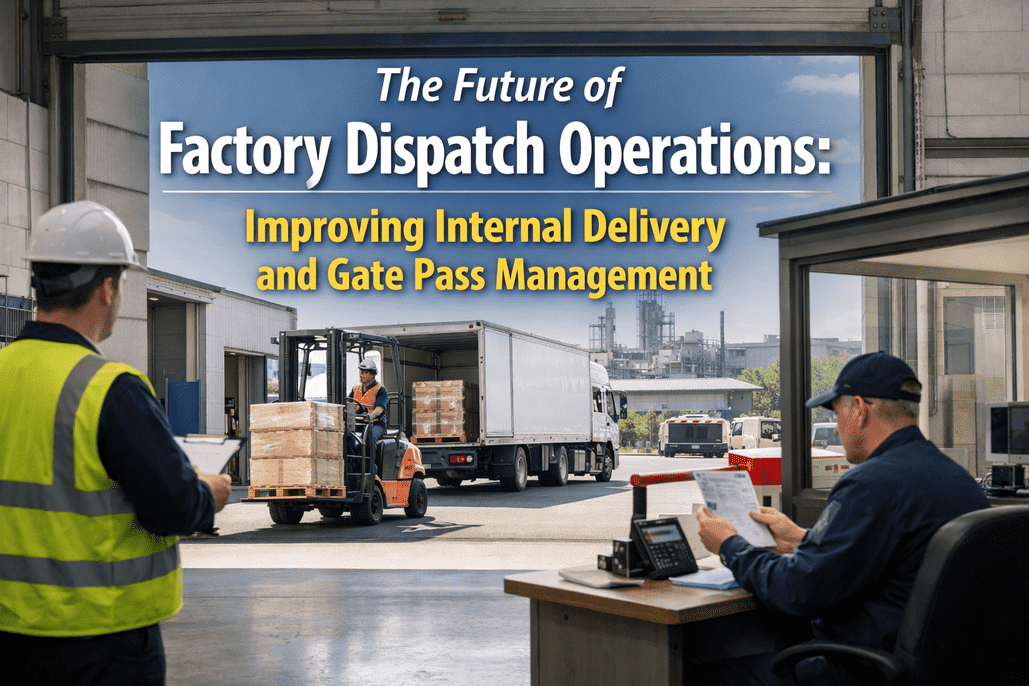
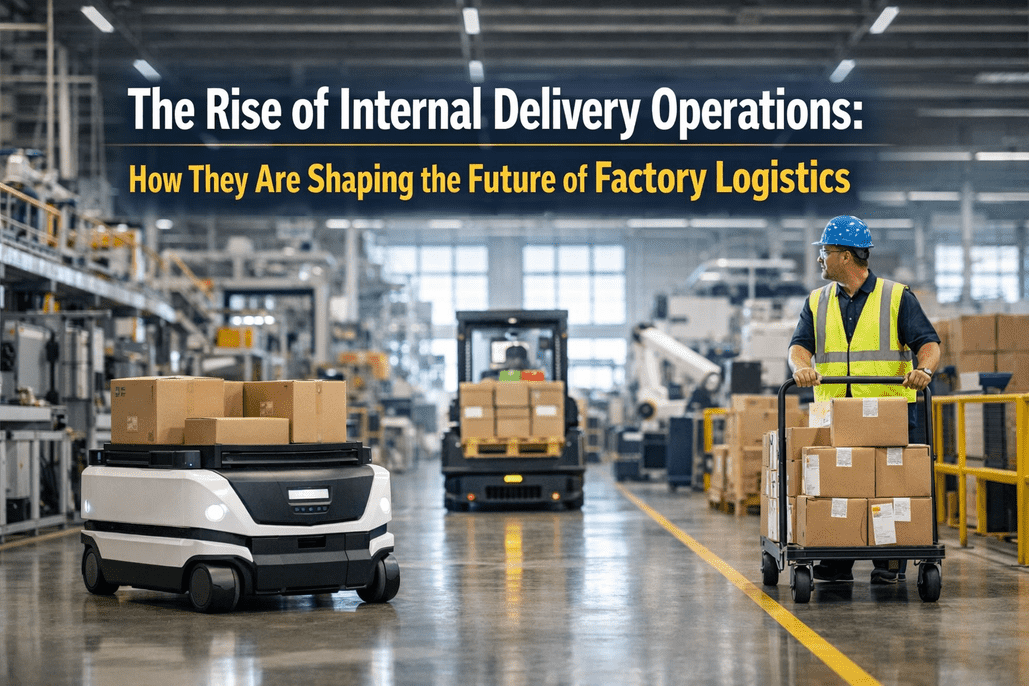
Texas is the nation's leading manufacturing state by multiple measures — over 900,000 manufacturing employees, one of every four US manufacturing jobs added since 2015, a factory production index that hit its strongest levels in three years in mid-2025, and a freight and logistics sector growing at 4.34% annually toward a projected $93B+ market. Yet behind these numbers, the operational reality inside Texas factory delivery departments tells a different story. Inbound vehicles queue at plant gates for 15–20 minutes on paper passes. Receiving staff manually match purchase orders to paper manifests. Dispatch coordinators sequence outbound loads by memory and whiteboard. Internal material stops tracking the moment it crosses the receiving dock. These are not small inefficiencies — they are the structural gap between a factory that grows profitably with Texas's manufacturing expansion and one that absorbs growth as cost. iFactory's factory delivery department platform closes this gap: digital gate pass management, mobile inbound receiving, SLA-priority dispatch sequencing, yard vehicle inspection, and internal material tracking — all in a single mobile-first system that goes live in 14 days. For questions specific to your Texas facility, talk to our support team directly.

Texas Manufacturing  ·  Factory Delivery Operations  ·  2026

How Texas Manufacturing Is Transforming Factory Dispatch and Delivery Operations

Texas has 900K+ manufacturing employees, the nation's largest border trade corridor, and one of the fastest-growing freight markets in the US. But inside most Texas factories, the delivery department is still running on paper gate passes, manual dispatch sequencing, and handwritten receiving logs — creating a compounding operational gap that digital factory delivery management closes in 14 days.

900K+
Manufacturing employees in Texas — 1 in 4 US factory jobs added since 2015 came from Texas
$93B+
Texas freight and logistics market projected size — growing at 4.34% CAGR through 2033
3.2%
Average annual Texas GDP growth rate — manufacturing and construction leading all sectors
14 days
iFactory go-live timeline — from decision to fully operational factory delivery department
The Texas Manufacturing Context

Why Texas Factory Delivery Departments Face More Operational Pressure Than Any Other State

Texas factory delivery departments do not operate in a normal logistics environment. They operate at the intersection of the nation's busiest land border, one of its fastest-growing manufacturing sectors, and a multimodal freight network that handles more cross-border trade volume than any other US state. This combination creates inbound and outbound delivery pressure that manual processes cannot absorb at scale.

Border Trade
Laredo — Busiest US Land Port of Entry
Laredo handles more trade volume than any other US land port — over $300B in annual cross-border trade with Mexico. For Texas factories receiving from Mexican manufacturing partners or shipping components south for further assembly, this means inbound delivery frequency, documentation requirements, and border delay variability that paper-based receiving departments are structurally unable to manage without errors and delays.
$300B+ annual cross-border trade · highest US land port volume
Manufacturing Growth
93,300 Net New Manufacturing Jobs Since 2015
Texas gained 93,300 net manufacturing jobs from 2015 to 2025 — more than one in four of all US manufacturing jobs added in that period. The Dallas-Fort Worth, Houston, San Antonio, and Austin-Round Rock corridors are each absorbing new factory facilities and expanding production capacity. More facilities and higher production output means more inbound vendor shipments, more outbound dispatch sequences, and more daily gate transactions requiring systematic management.
93,300 net new manufacturing jobs · DFW, Houston, SA, Austin corridors leading growth
Reshoring Wave
CHIPS Act + Nearshoring Driving New Factory Builds
Federal incentives through the CHIPS and Science Act are driving semiconductor and electronics manufacturing investment into Texas at scale — with Samsung, Texas Instruments, and multiple tier-2 suppliers expanding Texas production footprints. Simultaneously, nearshoring from Mexico is accelerating as manufacturers repatriate assembly operations previously held offshore. New factory builds and production expansions directly increase inbound delivery department load without proportional investment in delivery department management systems.
CHIPS Act investment · semiconductor + electronics expansion · nearshoring acceleration
Freight Growth
4.34% Annual Freight Market Growth Through 2033
Texas's freight and logistics industry is growing at 4.34% CAGR — driven by e-commerce demand, manufacturing expansion, and infrastructure investment including enhanced road networks and port facilities. The Port of Houston's continued expansion and the state's multimodal network mean inbound material velocity to Texas factories is accelerating year over year. Factory delivery departments that cannot process this volume faster than competitors will lose dock time, receiving accuracy, and dispatch reliability — all simultaneously.
4.34% CAGR · Port of Houston expansion · multimodal network growth
The Operational Data Gap

Where Texas Manufacturing Growth Meets Your Factory Delivery Department's Data Reality

What Texas Factory Operations Typically Track Well
Production OEE and throughput — tracked by 86% of Texas manufacturers
Maintenance work orders for production equipment and fixed plant assets
Energy consumption and utility costs for production floor operations
Outbound shipment documentation and customer proof of delivery
Employee safety training records and EHS incident documentation
Supplier qualification, vendor management, and procurement records
Finished goods inventory and warehouse location records
What Texas Factory Delivery Departments Almost Certainly Cannot Produce
Per-vehicle gate dwell time — the bottleneck creating 300–700 min of daily dock loss
Inbound vehicle arrival record with cargo manifest at time of gate entry
Digital chain of custody from supplier dock to factory production floor
Yard vehicle inspection logs with timestamps and operator attribution
Dispatch SLA compliance rate — misses invisible until customer complaint arrives
Real-time internal material location — tracking stops at the receiving dock
Incident documentation with photo evidence at time and place of occurrence
iFactory Platform — 6 Core Workflows

How iFactory Digitalizes Every Function of a Texas Factory Delivery Department

iFactory is not a last-mile delivery app or a fleet routing tool. It is a factory delivery department management system — built for the 6 operational workflows that determine whether a Texas factory's delivery department absorbs manufacturing growth profitably or loses performance to it.

87%
Gate Pass Processing Time Reduction
Drivers pre-register via mobile before arrival. Security verifies vehicle, driver credentials, and cargo manifest on mobile at the gate. Processing completes in under 2 minutes — down from 15–20 minutes on paper. Every vehicle entry generates a timestamped, person-attributed digital record. A Texas factory receiving 25 vehicles/day recovers up to 6 hours of dock time daily.
Manual: 15–20 min/vehicleDigital: under 2 min
78%
Faster Inbound Receiving Completion
Receiving staff verify inbound shipments against POs on mobile — scanning barcodes, capturing discrepancy photos, and logging exceptions in real time. Every shipment generates a digital record linking supplier, carrier, material, quantity received vs. ordered, and timestamp. Receiving errors drop from 3–7% to under 0.5% — critical for Texas factories importing from Mexico on compressed J-I-T schedules.
Manual: 45–60 min · 3–7% errorsDigital: under 10 min · under 0.5%
90%
Dispatch Error Rate Reduction
Dispatch orders are sequenced automatically by SLA priority tier, vehicle type, load capacity, and schedule constraints. Errors fall from 2–3% (manual) to under 0.3% — eliminating $50,000–$200,000 in annual SLA penalty exposure per facility. For Texas factories operating under retailer supply agreements with same-day dispatch window requirements, this is the difference between contract compliance and contract penalty.
Manual: 2–3% error rateDigital: under 0.3%
100%
Yard Vehicle Inspection — Auto-Block on Failures
Forklifts, shunters, and yard tractors complete digital pre-use inspection checklists on mobile. Failed inspection items are logged with timestamp, operator ID, and photo. Vehicles with failed inspections are automatically blocked from dispatch until a verified repair work order is completed and closed. This produces the continuous, timestamped inspection record required for OSHA compliance and fleet insurance defense — generated automatically from daily operations.
Manual: paper · incomplete · no auto-blockDigital: timestamped · failed vehicles auto-blocked
40%
Production Stoppages from Material Search Eliminated
Materials are logged at every internal transfer — dock to stores, stores to production, production to quality, quality to outbound dispatch. Most production stoppages attributed to material unavailability are locating failures, not actual stock-outs. Real-time location data eliminates 30–40% of these stoppages directly — recovering production time without capital investment. For Texas factories operating on lean JIT schedules with Mexican supply partners, this is a primary margin recovery opportunity.
Manual: no location after dock entryDigital: real-time location at every transfer
100%
Incident Documentation — Gate to Resolution
Every gate incident — vehicle damage, cargo discrepancy, security event, driver non-compliance — is captured in real time with timestamp, operator attribution, photo documentation, and resolution tracking. Auto-escalation routes unresolved incidents to supervisors within defined timeframes. The result is an irrefutable, chronological incident record from every gate event — the documentation that defends against disputed insurance claims, OSHA citations, and contractor liability disputes.
Manual: discovered days later · no photo recordDigital: real-time · photo + timestamp · auto-escalated
Texas Manufacturing Is Growing. Your Factory Delivery Department Needs to Grow With It — Not Become the Bottleneck.
Digital gate passes, mobile inbound receiving, SLA-priority dispatch, yard inspections, material tracking, and incident documentation — all in one platform. Live in 14 days. No IT project. Talk to our support team for a facility-specific assessment.
How It Works — 5 Core Workflows

How iFactory Runs a Texas Factory Delivery Department Digitally — From Gate to Production Floor

Texas factory delivery departments do not need a compliance program — they need the operational data they should already be generating digitally. iFactory captures this data as a byproduct of 5 daily workflows that replace paper-based processes without any IT infrastructure project.

01
Digital Gate Pass — Pre-Arrival Vehicle Registration to Exit Record
Drivers pre-register via mobile before arrival, submitting vehicle details, cargo manifest, and driver credentials. Security staff receive the pre-registration on their mobile device and verify against the physical vehicle at the gate — completing the full check-in process in under 2 minutes. The system records vehicle type, exact arrival and exit timestamps, cargo description, and gate dwell time per vehicle. For Texas factories managing high-frequency inbound from Laredo-routed cross-border freight, this gate record also provides the documentation foundation for customs dwell-time analysis and carrier performance tracking.
Under 2 min per vehicleDigital dwell time recordBorder freight documentation ready
02
Mobile Inbound Receiving — PO Verification, Barcode Scan, Photo POD
Receiving staff verify inbound shipments against purchase orders on mobile — scanning barcodes or QR codes, comparing received quantities against ordered quantities, photographing damaged or discrepant items, and logging receiving exceptions in real time. Every inbound shipment generates a digital record linking supplier, carrier, material description, quantity received vs. ordered, and timestamp. Discrepancy photos are attached to the shipment record automatically, creating the documentation needed to initiate supplier claims without manual evidence assembly. For Texas factories receiving from Mexican manufacturing partners on compressed JIT schedules, this means receiving errors that previously triggered hours of production-stalling phone calls are captured, documented, and escalated within minutes.
Barcode scan PO matchingPhoto discrepancy captureJIT supplier claim documentation
03
Yard Vehicle Inspection — Digital Checklists with Auto-Block
Yard tractors, forklifts, and shunters complete digital pre-use inspection checklists on mobile before each shift. Failed inspection items — fluid leaks, brake warnings, lighting failures, structural damage — are logged with timestamp, operator ID, and photo evidence. Vehicles with failed inspections are automatically blocked from dispatch until a verified repair work order is completed and closed by a qualified technician. This generates the continuous, timestamped inspection log required for OSHA compliance documentation and fleet liability defense — without any additional administrative workflow beyond the daily pre-use check that Texas regulations already require.
OSHA-ready inspection logFailed vehicle auto-blockRepair work order trigger
04
SLA-Priority Dispatch — Automated Sequencing With Per-Vehicle Records
Dispatch orders are sequenced automatically by SLA priority tier, vehicle type, load capacity, schedule constraints, and driver availability. Each dispatch event records vehicle ID, driver, assigned route, departure timestamp, expected return, and completion status. Real-time SLA alerts notify dispatch coordinators of any trip approaching a missed window before the miss occurs — not after the customer complaint arrives. For Texas factories managing outbound dispatches under retailer supply agreements with strict delivery window requirements, this automated sequencing eliminates the 2–3% manual error rate that generates $50,000–$200,000 in annual penalty exposure per mid-size facility.
SLA-priority auto-sequencingReal-time missed window alertsPer-vehicle dispatch record
05
Internal Material Transfer Tracking — Dock to Production Floor
Materials are logged at every internal transfer point — dock to stores, stores to production, production to quality hold, quality to dispatch. Each transfer generates a timestamped, person-attributed digital record. When a production supervisor asks where a specific component lot is, the answer is available in the iFactory dashboard in seconds — not after a 30-minute floor search. For Texas factories supplying automotive OEM customers (a major industry segment in San Antonio, Fort Worth, and Dallas) where production stoppages trigger immediate supplier escalations, real-time material location data is the first line of defense against customer penalty exposure.
Real-time location at every transferAutomotive OEM supplier defense30–40% stoppages eliminated
Measurable Results

What Texas Factories Measure Within 90 Days of iFactory Go-Live

87%
Gate Pass Time Reduction
From 15–20 minutes manual processing to under 2 minutes digital — across every inbound vehicle, every day. A Texas factory receiving 25 vehicles/day recovers up to 6 hours of dock time daily that previously disappeared into idle queues at the gate.
78%
Faster Inbound Receiving
Inbound receiving drops from 45–60 minutes to under 10 minutes per shipment with mobile PO scanning and photo POD. Discrepancy claims against Mexican supply partners — previously assembled manually from paper notes — are now documented and submitted within minutes of the shipment close.
90%
Fewer Dispatch Errors
Manual dispatch error rates of 2–3% drop to under 0.3% with SLA-priority automated sequencing. For Texas factories operating under automotive OEM or retailer supply agreements with financial penalty clauses, this error reduction directly eliminates $50,000–$200,000 in annual contract exposure.
100%
Incident Coverage
Every gate event, receiving transaction, inspection result, material transfer, and dispatch decision is timestamped and person-attributed in a continuous digital record. OSHA documentation, insurance claim defense, and carrier dispute evidence are retrievable in under 60 seconds — not hours of paper reconstruction.
3–6 mo
Full Payback Period
Recovered dock time, eliminated dispatch errors, receiving error reduction, and production stoppage prevention combine to deliver full platform payback within 3–6 months of go-live. iFactory deploys in 7–14 days — no heavy implementation fees, no IT infrastructure project, no hardware procurement.
14 days
Go-Live Timeline
From decision to fully operational digital factory delivery department in 7–14 days. Cloud-based deployment with mobile apps for drivers, security staff, and receiving teams. No server installation, no IT department involvement required for initial deployment. Multi-site deployment across all Texas facilities under one dashboard.
Before vs. After

Texas Factory Delivery Department — Manual Operations vs. iFactory Digital Platform

Function
Manual Operations (Current State)
iFactory Digital Platform
Gate Pass
15–20 min/vehicle · paper logs · zero dwell data · queue buildup at dock
Under 2 min · digital pre-reg · full dwell record · auto timestamp
Inbound Receiving
45–60 min/shipment · 3–7% errors · paper POD · no discrepancy photo
Under 10 min · under 0.5% errors · photo POD auto-generated
Dispatch Sequencing
Manual priority · 2–3% errors · SLA misses undetected until complaint
SLA-automated · under 0.3% · real-time missed window alerts
Yard Inspections
Paper checklists · incomplete · no auto-block on failed items
Digital checklists · timestamped · failed vehicles auto-blocked
Material Tracking
No location after dock entry · stoppages from search failures
Real-time at every transfer · 30–40% stoppages eliminated
Incident Records
Paper logs · no photo · discovered days later · no defense record
Real-time photo + timestamp · auto-escalation · audit-ready
Deployment
Legacy systems: 6–18 months · heavy IT · high upfront cost
iFactory: 7–14 days · cloud-based · no infrastructure project

Texas Manufacturing Is Growing Faster Than Manual Delivery Department Processes Can Keep Up.

iFactory digitalizes every function of your factory delivery department — gate pass management, inbound receiving, vehicle inspection, dispatch sequencing, internal material tracking, and incident documentation — and generates the operational records your plant, your customers, and your insurers require as a byproduct of daily operations. Live in 14 days. No heavy implementation fees.

Frequently Asked Questions

Texas Factory Dispatch and Delivery Operations — What Plant Managers Ask First

Have a question specific to your Texas facility or corridor? Talk to our support team for a factory-specific assessment.

What makes Texas factory delivery departments different from those in other US states — and why does that matter for how iFactory is deployed?
Texas factory delivery departments face a combination of pressures that are largely unique to the state's geography and industrial structure. First, border trade volume: Texas factories with Mexican supply partners operate under compressed JIT schedules where inbound material arrives from Laredo-routed freight with very short dock lead times — manual receiving workflows cannot match this velocity without errors. Second, automotive OEM exposure: San Antonio, Fort Worth, and Dallas factories supplying Toyota, GM, and tier-1 automotive suppliers operate under production-line supply agreements where a missed delivery or receiving error triggers immediate customer escalation. Third, multisite scale: Texas manufacturing operations frequently span multiple corridors — DFW, Houston, San Antonio, Austin — requiring a delivery department platform that manages gate, receiving, and dispatch across all sites under one dashboard. iFactory's deployment configuration for Texas-specific operations covers border freight documentation, automotive OEM SLA rules, and multi-site cross-corridor management as standard configuration options. Talk to our support team about your specific Texas facility configuration.
How does iFactory specifically help Texas factories receiving from Mexican manufacturing partners through Laredo and other border crossings?
Texas factories receiving from Mexican manufacturing partners face a specific set of inbound documentation challenges that paper-based receiving departments handle poorly. Border-routed freight from Laredo, El Paso, or McAllen arrives with customs documentation, bill of lading records, and carrier manifests that must be matched against purchase orders in real time at the receiving dock. Manual matching — comparing paper manifests against printed POs — generates a 3–7% error rate that at 20–30 inbound shipments/day creates 1–2 receiving failures daily. Each failure triggers a chain of carrier calls, customs documentation review, and production release holds that can stall production for 2–4 hours. iFactory's mobile inbound receiving module handles this directly: barcode or QR scan against the PO, quantity verification, discrepancy photo capture, and digital record generation — all completed in under 10 minutes per shipment. Discrepancy claims against Mexican supply partners are documented with photo evidence at the time of receiving, eliminating the "no evidence at time of claim" disputes that paper-based receiving consistently produces. The same receiving record also satisfies supply chain traceability documentation requirements increasingly demanded by major US retail customers and automotive OEM supply agreements. Book a demo to see the border freight receiving workflow live.
How does iFactory handle dispatch sequencing for Texas factories operating under tight retailer or automotive OEM supply window requirements?
Texas factories supplying major retailers — HEB, Walmart, Target, Amazon fulfillment centers — or automotive OEMs face outbound dispatch window requirements measured in hours, not days. Missing a delivery window with an automotive OEM customer can trigger a line-stop penalty ranging from $5,000 to $50,000 per incident depending on the supply contract. Missing a retailer delivery window generates a charge-back that erodes margin across the entire order. iFactory's SLA-priority dispatch sequencing addresses this directly: dispatch orders are ranked automatically by contractual priority tier, vehicle type, load capacity, and available departure time. Dispatchers receive real-time alerts when a scheduled dispatch is approaching a window violation — before the miss occurs, not after the penalty invoice arrives. The system also captures per-vehicle departure timestamps and return records, providing the documentation needed to contest disputed penalty claims with timestamped evidence. For Texas factories managing both retailer deliveries and automotive OEM supply in the same dispatch queue, iFactory's priority tier configuration handles mixed SLA requirements from a single dispatch dashboard. Talk to our support team about configuring dispatch SLA rules for your specific customer contracts.
How quickly can a Texas factory deploy iFactory across its delivery department — and does it require IT department involvement?
iFactory deploys in 7–14 days for a standard factory delivery department covering gate pass management, inbound receiving, yard vehicle inspection, dispatch sequencing, and internal material transfer tracking simultaneously. The deployment has three phases. Days 1–3: data onboarding — uploading vehicle registry, driver roster, supplier list, and PO templates. iFactory's onboarding team handles this directly with your operations team; no IT department involvement is required. Days 4–7: configuration and training — setting up inspection checklists, dispatch SLA rules, gate pre-registration workflows, and user access levels. Mobile app training for security staff, receiving teams, and drivers takes 2–4 hours. Days 8–14: go-live and verification — live operations with iFactory support monitoring data quality and resolving any workflow gaps in real time. Because iFactory is cloud-based and mobile-first, there is no server infrastructure to install, no hardware to procure, and no multi-month IT implementation project. For Texas manufacturers operating across multiple facilities in DFW, Houston, San Antonio, and Austin simultaneously, iFactory's multi-depot configuration can include all sites under one deployment — each with site-specific gate workflows, inspection checklists, and SLA rules, all visible from a single corporate dashboard. Book a demo to discuss your specific deployment timeline and facility count.
What is the measurable ROI for a Texas factory that digitalizes its delivery department with iFactory?
The ROI calculation for a Texas factory delivery department digitalization has five distinct components that each stand independently. Recovered dock time: a factory processing 25 vehicles/day at 15–20 minutes manual gate time recovers up to 6 hours of dock time daily by moving to under 2-minute digital processing — equivalent to 1.5–2 full-time equivalent labor hours per day across the receiving operation. Dispatch error elimination: reducing dispatch errors from 2–3% to under 0.3% eliminates SLA penalty exposure of $50,000–$200,000 annually for mid-size facilities — a figure that is even higher for Texas factories supplying automotive OEM customers with per-incident line-stop penalty clauses. Receiving error reduction: dropping receiving error rates from 3–7% to under 0.5% eliminates per-error resolution cost of $200–$800 across potentially 1–2 errors per day, and eliminates the supplier claim disputes that paper-based receiving cannot support with evidence. Production schedule adherence: eliminating 30–40% of production stoppages caused by material locating failures directly increases production output without capital investment. Incident liability protection: documented, photo-evidenced gate incidents are defensible — undocumented incidents become uncontested liability exposures that cost more than the iFactory subscription in a single settlement. Full platform payback is typically within 3–6 months of go-live when all five components are included. Talk to our support team for an ROI model specific to your facility's vehicle volume and contract exposure.
How does the CHIPS Act manufacturing investment surge in Texas affect factory delivery department requirements — and how does iFactory support new facility deployments?
The CHIPS and Science Act is driving semiconductor and electronics manufacturing investment into Texas at scale — Samsung's Taylor, Texas facility and Texas Instruments' Richardson campus expansion are among the largest manufacturing facility investments in US history. These facilities, and the tier-2 supplier facilities that follow them into the Texas market, are building factory delivery departments from scratch — making deployment decisions now that will shape their operational infrastructure for 10–15 years. A factory delivery department built on paper processes from day one will immediately face the same bottlenecks and error rates as legacy facilities — but without the institutional knowledge that legacy facilities have accumulated in managing those limitations. iFactory provides new Texas manufacturing facilities with a fully digital delivery department from go-live — meaning no paper gate pass transition, no receiving log digitization backlog, no historical dispatch record reconstruction. The platform configures around the facility's specific supplier network, SLA requirements, and vehicle fleet from the initial deployment, ensuring that operational records are audit-ready from the first day of production. For Texas facilities in ramp-up phases — where supplier relationships, receiving volumes, and dispatch schedules are evolving rapidly — iFactory's configuration can be updated in real time by facility managers without IT department involvement. Book a demo to see how iFactory configures for new facility deployments.

Your Texas Factory Delivery Department Is the Last Undigitized Function in the Plant. iFactory Changes That in 14 Days.

86% of Texas manufacturers track OEE. Almost none track gate pass processing time, inbound dwell time, or dispatch SLA compliance — the exact data that separates a factory delivery department that performs from one that costs. iFactory closes this gap with a purpose-built digital platform that deploys in 7–14 days, covers all six delivery department functions, and generates operational records automatically. Book a demo to see it running in a live Texas factory delivery environment.



Share This Story, Choose Your Platform!