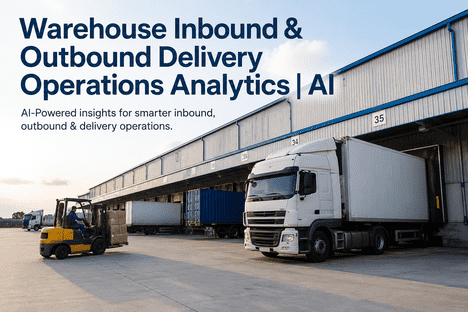
Warehouse Inbound & Outbound Delivery Operations analytics

By Arel Dixon on May 22, 2026

`warehouse-inbound-outbound-delivery-operations-analytics-ai.png`

Textile and apparel factories run on precision — and yet the warehouse delivery pipeline remains the most untracked, underdigitized function on the floor. Fabric rolls misplaced between receiving and cutting. Inbound raw material delays stalling production lines for hours. Outbound shipments dispatched in the wrong sequence, triggering SLA breaches days before anyone notices. The cost of this visibility gap in a textile manufacturing environment is not theoretical — it is measurable, recurring, and compounding every shift. AI-powered warehouse inbound and outbound delivery analytics closes this gap completely. Talk to our support team to assess where your warehouse delivery operations stand today.


Warehouse Analytics  ·  Textile & Apparel Manufacturing  ·  2025–2026

How AI-Powered Warehouse Delivery Operations Analytics Is Transforming Textile Factory Logistics

Inbound docks and outbound dispatch lanes are the lifeblood of every textile factory. Without real-time AI analytics, fabric inventory stalls, dispatch errors multiply, and SLA compliance stays a guessing game. iFactory's warehouse operations platform delivers 99%+ asset uptime — from dock to dispatch, in real time.

99%+
Warehouse asset uptime with AI-powered predictive monitoring
85%
Reduction in inbound receiving cycle time — fabric to floor in minutes
40%
Fewer production stoppages from warehouse search and location failures
14 Days
iFactory go-live timeline — warehouse analytics fully operational

The Hidden Cost

What Untracked Warehouse Delivery Operations Are Costing Your Textile Factory Every Day

From grey fabric rolls arriving at inbound docks to finished garments leaving outbound lanes — every untracked movement is a compounding operational liability. Most factory managers feel these losses. Few have the data to prove them.

2–4 hrs
Fabric location search time per shift
Greige fabric, dyed rolls, and trim inventory with no digital location record create floor-wide search delays — stalling cutting and stitching lines simultaneously.
3–5%
Inbound receiving discrepancy rate
Quantity mismatches and quality deviations on fabric and trim deliveries go unrecorded without photo documentation — surfacing only when production is already impacted.
Hours
Outbound dispatch SLA discovery lag
Garment shipment SLA breaches are typically discovered hours to days after the missed window — far too late to prevent buyer penalties or retailer chargebacks.
30%+
Production stoppages caused by warehouse failures
In textile factories, over 30% of mid-shift production stoppages trace back to warehouse delivery failures — not machine breakdowns or raw material shortages.
Days
Compliance incident discovery lag
Inbound compliance failures — wrong fabric composition, missing certifications, carrier documentation gaps — surface days after delivery under paper-based systems.
6–10 hrs
Manual audit documentation per event
Gate records, receiving logs, vehicle inspection binders, and dispatch checklists assembled manually consume 6–10 hours per audit. iFactory retrieves the same documentation in under 60 seconds.

Textile-Specific Context

Why Warehouse Delivery Analytics Hits Differently in Textile and Apparel Manufacturing

Textile factories handle the highest SKU density of any manufacturing vertical — hundreds of fabric grades, dye lots, trim specifications, and size variants moving through the same warehouse in overlapping cycles. Standard warehouse tools were not designed for this complexity.

DL
Dye Lot and Batch Integrity
Fabric rolls from different dye lots cannot be mixed in a single garment order. Without inbound lot-level tracking from dock to cutting floor, dye lot contamination causes entire production runs to be rejected by quality inspection — a direct consequence of warehouse visibility failure.
MS
Multi-SKU Inbound Complexity
A single inbound delivery to a textile factory may contain 50–200 distinct fabric and trim SKUs. Manual receiving against this volume creates systematic discrepancy blind spots — missing shortages, wrong shade codes, and certification mismatches that damage production schedule integrity.
SL
Buyer SLA Window Precision
Export-oriented textile manufacturers operate under retailer delivery windows that allow 0–48 hour tolerance. A single missequenced outbound dispatch does not just miss an SLA — it triggers chargebacks, damages buyer scorecards, and directly affects next-season order allocation from major retail buyers.
JT
Just-in-Time Trim Sequencing
Buttons, zippers, elastic, and labels for a specific style must reach the stitching line in the correct sequence and quantity — not early (no storage space) and not late (line stoppages). Warehouse delivery analytics gives operations managers real-time visibility into trim location from inbound receipt to line delivery.
CT
Certification and Compliance Traceability
GOTS, OEKO-TEX, BCI Cotton, and recycled fiber certifications must be traceable from inbound delivery documentation through production and outbound dispatch. Manual binder systems fail this requirement at audit time. iFactory captures certification documentation at the point of inbound receipt with full chain-of-custody records.
SP
Supplier Performance by Delivery
Textile factories typically manage 40–120 active fabric and trim suppliers with varying delivery reliability. Without analytics across inbound receiving events, supplier performance decisions are made on anecdote rather than data — resulting in poor sourcing choices and avoidable production risk.

The Visibility Gap

What Your Textile Factory Tracks — and What Your Warehouse Delivery Department Still Cannot See

Already Tracked With Data
Production floor machine efficiency (OEE) — tracked across all lines
Finished goods inventory by style, colour, and size in the warehouse
Quality inspection results per production batch and style
Outbound shipment tracking and proof of delivery to buyers
Employee safety training and factory EHS incident logs
Fabric consumption per style from cutting department records
Supplier qualification and vendor management records in ERP
Energy consumption data across production floor zones
Still Running Blind
Inbound fabric roll location from dock receipt to cutting floor — zero tracking
Dye lot and batch integrity across inbound receiving events
Trim and accessory location between stores and stitching lines
Gate dwell time per inbound vehicle — no data at all
Outbound dispatch SLA compliance rate — discovered only at complaint
Inbound receiving discrepancy rates by supplier and carrier
Vehicle inspection compliance records with timestamp and operator
Incident pattern data across the warehouse delivery department

What AI Analytics Covers

The 6 Core Warehouse Delivery Functions iFactory Digitizes in Your Textile Factory

AI-powered warehouse delivery analytics is not a single module — it is a connected data layer across every function your inbound and outbound operations run on daily.

01
AI-Powered Inbound Receiving Analytics
Fabric and trim deliveries verified against purchase orders on mobile — barcode scanning, dye lot capture, quantity verification, and photo documentation of discrepancies. AI flags deviation patterns by supplier and carrier. Receiving cycle drops from 60+ minutes to under 10 minutes per delivery.
85% faster receiving cycle
02
Real-Time Warehouse Location Tracking
Every fabric roll, trim batch, and accessory carton is logged at each internal transfer — dock to stores, stores to cutting, cutting to stitching. Real-time location data on mobile eliminates the search time that causes mid-shift production stoppages across cutting and stitching lines.
40% search time eliminated
03
SLA-Priority Outbound Dispatch Sequencing
Garment shipments sequenced automatically by buyer SLA priority, retailer delivery window, and vehicle capacity. AI detects departure risk before a miss occurs — alerting supervisors in real time rather than discovering breaches after buyer chargebacks have been triggered.
90% fewer dispatch errors
04
Digital Gate Pass and Dwell Analytics
Inbound fabric and outbound garment carrier vehicles pre-registered before arrival. Gate processing drops from 15–20 minutes to under 2 minutes per vehicle. Every gate event generates dwell time data — giving operations managers the visibility to eliminate dock queue bottlenecks and recover productive receiving hours.
87% faster gate processing
05
Supplier Delivery Performance AI
AI aggregates inbound receiving data across every delivery event — quantity accuracy, lead time adherence, discrepancy rate, and certification compliance — by supplier and carrier over time. Pattern analysis surfaces systemic supplier reliability issues before they affect production scheduling across styles and seasons.
Supplier-level analytics
06
Compliance and Certification Chain of Custody
GOTS, OEKO-TEX, BCI Cotton, and recycled fiber documentation captured at inbound receipt and linked to material batches through production and outbound dispatch. Audit documentation retrieved in under 60 seconds. Zero paper binder assembly required at audit time.
100% audit trail coverage

Your Textile Warehouse Is Running Blind on Inbound and Outbound Data. iFactory Gives It an AI Layer in 14 Days.
Fabric location, dispatch SLA compliance, receiving cycle speed, supplier performance analytics — all captured automatically from daily warehouse operations. No IT project. No hardware. Live in 7–14 days. Talk to our support team to see what your warehouse data gap looks like in your specific factory configuration.

How It Works

How AI Analytics Flows Through Your Textile Factory Warehouse — From First Inbound Scan to Final Dispatch

iFactory connects every warehouse movement into a single intelligent data layer — giving your operations team real-time visibility from fabric arrival to garment dispatch.

01
Pre-Arrival Gate Registration — Fabric and Trim Carriers
Fabric and trim suppliers pre-register inbound vehicles on mobile before reaching the gate. Cargo manifest, delivery note number, fabric grade, dye lot codes, and driver credentials are submitted digitally. Security receives a pre-cleared checklist — eliminating the information-gathering delay that creates dock queue buildup. Every arrival is dwell-time timestamped before the vehicle moves onto site.
Queue prevention Pre-cleared manifest Dwell time baseline
02
Inbound Receiving — Fabric, Trim, and Accessory Verification
Receiving staff scan barcodes, verify fabric quantities against PO, capture dye lot codes per roll, photograph discrepancies, and flag quality deviations — all on mobile in under 10 minutes per delivery. Chain-of-custody documentation is generated automatically from dock receipt forward. AI accumulates discrepancy data by supplier and carrier across all deliveries, surfacing performance patterns before they damage production schedules.
Dye lot capture Photo discrepancy record Supplier analytics
03
Internal Material Location — Dock to Cutting Floor
Every fabric and trim movement is logged on mobile at transfer — dock to stores, stores to cutting, cutting to stitching, stitching to finishing. Real-time location eliminates the search failures that cause mid-shift line stoppages. Operations managers see where every material batch is without phone calls or floor walks. AI flags materials that are stationary longer than expected, preventing silent bottlenecks from developing undetected.
Real-time fabric location Dwell anomaly alerts Transfer audit trail
04
Outbound Dispatch Sequencing and SLA Tracking
Garment shipments are sequenced automatically by buyer SLA tier, retailer delivery window, and vehicle load capacity. Departure timestamps are logged per vehicle. AI compares actual departures against committed SLA windows in real time — generating alerts before a miss occurs, not after. Dispatch error rates drop from 2–3% under manual operation to under 0.3% with intelligent sequencing active. Every dispatch event is permanently recorded with vehicle, operator, load, and time data.
Buyer SLA priority logic Real-time miss alerts Per-dispatch audit record
05
AI Analytics Dashboard — Warehouse Operations Intelligence
All warehouse delivery data — gate dwell times, receiving cycle speeds, inbound discrepancy rates, material location dwell, dispatch SLA compliance, and incident frequency — aggregates into a real-time AI analytics dashboard accessible to operations managers and supply chain heads. Pattern analysis surfaces systemic issues before they compound. Compliance documentation is retrievable in under 60 seconds for audit events across all warehouse delivery functions.
Cross-function analytics 60-sec audit retrieval AI pattern detection

8 Performance KPIs

What AI Warehouse Delivery Analytics Delivers in Textile Factories — Measured, Not Estimated

85%
Faster Inbound Receiving
Mobile PO verification and dye lot capture cuts fabric receiving from 60+ minutes to under 10 minutes per delivery.
Manual: 60+ minDigital: under 10 min
87%
Gate Pass Time Reduction
From 15–20 minutes manual processing to under 2 minutes digital. 20 vehicles/day recovers 280+ minutes of dock time daily.
Manual: 15–20 minDigital: under 2 min
90%
Dispatch Error Reduction
AI dispatch sequencing drops outbound errors from 2–3% to under 0.3%. Buyer SLA misses flagged in real time.
Manual: 2–3% errorsDigital: under 0.3%
40%
Search Time Eliminated
Real-time fabric and trim location tracking stops the location failures that cause cutting and stitching line stoppages mid-shift.
Manual: no location dataDigital: real-time location
100%
Audit Trail Coverage
Every gate event, material transfer, vehicle inspection, and dispatch decision — timestamped and person-attributed. Retrieved in under 60 seconds.
Manual: incomplete recordsDigital: 100% coverage
99%+
Warehouse Asset Uptime
AI-powered predictive monitoring of warehouse delivery assets keeps inbound docks and outbound dispatch lanes operational across every shift.
Reactive: 85–90% uptimeAI: 99%+ uptime
3–6 mo
Full Payback Period
Recovered dock time, eliminated dispatch errors, and compliance overhead reduction deliver full iFactory payback within 3–6 months of go-live.
Legacy: 18–24 moiFactory: 3–6 months
60 sec
Audit Documentation Retrieval
Gate records, receiving logs, certification chain-of-custody, and dispatch history — all retrievable in under 60 seconds from the iFactory audit dashboard.
Manual: 6–10 hoursDigital: under 60 sec

Before vs. After

Manual Warehouse Operations vs. iFactory AI-Powered Delivery Analytics

Scroll to view full comparison →
Warehouse Function
Manual Operations
iFactory AI Analytics
Gate Pass Processing
15–20 min per fabric carrier — paper logs, manual verification, zero dwell data, idle dock queues
Under 2 minutes — pre-arrival digital registration, mobile checklist, auto-timestamped dwell record
Fabric Receiving
60+ min per delivery — manual PO matching, no dye lot capture, no photo discrepancy documentation
Under 10 minutes — mobile scanning, dye lot capture, photo discrepancy, auto chain-of-custody
Material Location
No location after dock entry — 2–4 hour search delays per shift, cutting and stitching stoppages
Real-time mobile location at every transfer — 40% search time eliminated, stoppages prevented
Outbound Dispatch
Manual sequencing — 2–3% error rate, buyer SLA misses discovered at complaint, no priority logic
AI-priority automation — under 0.3% errors, real-time miss alerts, SLA compliance tracked live
Supplier Analytics
No performance data — discrepancy patterns invisible, sourcing decisions based on anecdote not evidence
AI aggregates discrepancy, lead time, and certification data per supplier — systemic issues flagged early
Certification Traceability
GOTS/OEKO-TEX records in paper binders — chain of custody breaks between dock and production
Certification docs captured at inbound receipt — traceable through production and outbound dispatch
Compliance Documentation
6–10 hours manual assembly per audit event — records spread across binders and spreadsheets
Under 60 seconds — all records auto-generated from daily operations, retrievable via audit dashboard
Deployment
Legacy systems: 6–18 months, IT project required, hardware procurement, high upfront cost
iFactory: 7–14 days to go-live — cloud-based, mobile-first, no IT project, no hardware required

Measurable Results

What Textile Factories Measure in the First 90 Days After iFactory Go-Live

280+
Minutes of Dock Time Recovered Daily
A textile factory receiving 20 inbound vehicles per day at 15–20 minutes manual gate processing recovers over 280 minutes of productive dock time by switching to digital. That is 4.5+ hours of previously untracked operational loss returned to the receiving schedule every single shift.
0.3%
Dispatch Error Rate — Down from 2–3%
Manual outbound sequencing in textile factories averages 2–3% dispatch error rates — generating retailer chargebacks, buyer scorecard penalties, and lost seasonal allocations. iFactory's AI dispatch sequencing reduces this to under 0.3% and surfaces every at-risk departure before the window closes.
60 sec
Audit Documentation Retrieval
Gate events, fabric receiving records, certification chain-of-custody, vehicle inspection logs, and dispatch history — all retrievable in under 60 seconds from the iFactory audit dashboard. Previously requiring 6–10 hours of manual assembly from binders and spreadsheets, now available instantly at any audit event.
100%
Chain of Custody from Dock to Dispatch
Every inbound fabric delivery, internal material transfer, and outbound garment shipment carries a complete chain of custody — timestamped, person-attributed, and immutable. Certification compliance traceability from GOTS fabric receipt to finished garment dispatch is automatic — not assembled retrospectively at audit time.
40%
Production Stoppages Eliminated
In textile factories, over 40% of mid-shift line stoppages trace to warehouse delivery failures — misplaced fabric rolls, missing trim batches, delayed inbound materials. Real-time location tracking across the entire warehouse delivery pipeline eliminates this category of stoppage entirely within the first month of go-live.
14 Days
From Decision to Fully Live
iFactory deploys in 7–14 days for a standard textile factory warehouse — covering gate management, fabric receiving, material location tracking, vehicle inspection, dispatch sequencing, and supplier analytics simultaneously. Cloud-based, mobile-first, no IT infrastructure required. Book a demo to see the deployment timeline for your specific facility.

86% of Manufacturers Track Production Floor OEE. Almost None Track Inbound Fabric Receiving Cycle Time or Outbound Dispatch SLA Compliance. iFactory Closes This Gap in 14 Days.

Your cutting floor has dashboards. Your stitching lines have data. Your warehouse delivery department deserves the same. iFactory digitizes every gate pass, fabric receipt, material transfer, vehicle inspection, and garment dispatch event — giving your operations team real-time AI analytics across the functions that control everything entering and leaving your textile factory. Deploy in 7–14 days. No IT project. No hardware procurement. Results visible from day one.


Frequently Asked Questions

AI Warehouse Delivery Analytics for Textile Factories — What Operations Leaders Ask First

How does iFactory handle dye lot and batch tracking across inbound fabric deliveries — and why does this matter for textile production?
Dye lot integrity is one of the most operationally critical challenges in textile manufacturing. Fabric rolls from different dye lots cannot be mixed within a single garment order without triggering visible shade variation that causes full production run rejection. iFactory captures dye lot codes at the point of inbound receiving — each roll is scanned and logged against the delivery note and purchase order at the dock. This creates an unbroken digital record from supplier dispatch through inbound receipt, stores location, and cutting floor delivery. When a cutting supervisor requests fabric for a specific style, the system surfaces only rolls with the correct dye lot — preventing the mixing errors that cause quality rejections downstream. Historically, dye lot discipline depended entirely on individual warehouse staff memory and paper tagging. iFactory makes it systematic and automatic. Book a demo to see dye lot tracking running on live factory data.
Our textile factory already uses an ERP for purchase orders and inventory. Why do we need a separate warehouse delivery analytics platform?
ERP systems are designed around transactions — they capture that a goods receipt note was posted, an inventory line was updated, or a purchase order was closed. They do not capture the operational reality of how those events occurred: how long the fabric carrier waited at the gate, whether dye lot codes were physically verified against the delivery note, whether the receiving discrepancy was photographed, or whether the material sat unmoved in the dock area for three hours before it was moved to stores. This gap matters because production stoppages, compliance failures, and supplier disputes all originate in the operational layer that ERP does not record. Additionally, ERP has no mobile interface designed for security staff processing gate arrivals, receiving teams scanning fabric rolls, or operations managers who need real-time warehouse location data without opening a desktop system. iFactory operates in the space between the physical warehouse and the ERP transaction — capturing the operational data that ERP was never designed to record, and integrating the results back into your ERP environment. Talk to our support team about your specific ERP environment and integration options.
How does iFactory manage outbound dispatch SLA compliance for multiple buyers with different delivery window requirements?
Textile export factories typically manage shipments for 10–50 active buyers simultaneously, each with their own delivery window tolerance, carrier preferences, and chargeback policies. iFactory's dispatch sequencing engine holds the SLA rule set for each buyer — delivery window start and end times, priority tier relative to other buyers, and acceptable departure range. When outbound garment shipments are queued for dispatch, the system ranks them automatically by buyer priority and departure urgency rather than relying on dispatcher judgment or a whiteboard queue. As actual departure time approaches, the AI compares the current dispatch queue against each buyer's window in real time — generating alerts to the operations manager when a departure is at risk before the window closes. This shifts the dispatch management posture from reactive (discovering SLA misses at customer complaint) to proactive (preventing misses before they occur). The system also maintains a permanent audit record of every dispatch event — vehicle, departure time, load, operator — which is retrievable instantly if a buyer disputes the shipment timing. Book a demo to see multi-buyer dispatch sequencing running on live data.
How does iFactory support sustainability certification traceability — GOTS, OEKO-TEX, BCI Cotton — through the warehouse delivery chain?
Sustainability certification traceability in textile manufacturing requires an unbroken chain of custody from the supplier's certification document through inbound receiving, stores, production, and outbound dispatch. Under paper-based systems, this chain consistently breaks at the inbound receiving point — certification documents are filed separately from material records, dye lot codes are not linked to certification lot numbers, and the connection between a specific fabric roll and its source certification is lost before it reaches the cutting floor. iFactory captures certification documentation at the point of inbound receipt — the receiver photographs the supplier's certificate, links it to the delivery note and specific fabric batch, and the system creates a permanent record tying that batch to its certification from dock entry forward. As the material moves through internal transfers, the certification link travels with it. At outbound dispatch, the garment shipment record carries the full certification trail from supplier origin to delivery — making buyer audit responses and social compliance documentation retrievable in under 60 seconds. For factories pursuing Tier 1 and Tier 2 traceability requirements from major retail brands, this capability is increasingly non-negotiable. Talk to our support team about certification traceability configuration for your specific compliance requirements.
What does iFactory deployment look like for a textile factory — and how does a warehouse go live in 7–14 days without an IT infrastructure project?
iFactory is cloud-based and mobile-first — no server infrastructure, no hardware procurement, and no IT department involvement required for standard deployment. The 7–14 day go-live timeline for a textile factory warehouse covers three phases. Days 1–3 involve data onboarding: uploading fabric and trim supplier lists, vehicle registry, driver roster, purchase order templates, buyer SLA rule definitions, inspection checklist configurations, and fabric grade and dye lot code structures. iFactory's onboarding team works directly with your warehouse operations team — typically requiring 4–6 hours of your team's time across the three days. Days 4–7 cover configuration and training: gate pre-registration workflows, dispatch priority tiers by buyer, internal transfer stages from dock to cutting floor, incident escalation rules, and user access levels for each role — security staff, receiving team, warehouse supervisors, and operations managers. Training for frontline staff (security, receiving, drivers) takes 2–4 hours via the mobile app and is designed for non-software users. Days 8–14 are go-live and stabilization: live operations with iFactory support monitoring data quality and confirming all warehouse delivery functions — gate management, fabric receiving, material tracking, dispatch sequencing, and supplier analytics — are running correctly before handover. Book a demo to see the deployment process and discuss your factory's specific configuration timeline.

Your Textile Factory Warehouse Is the Last Undigitized Function. iFactory Changes That in 14 Days.

Gate pass dwell time. Inbound fabric receiving cycle speed. Dispatch SLA compliance rates. Dye lot chain of custody. Internal material location. Supplier performance analytics. Certification traceability. iFactory captures all of it — automatically, from day one — and turns your warehouse delivery department from a visibility blind spot into a measurable, auditable operational asset. No IT project. No hardware. Full payback in 3–6 months. Book a demo or talk to our team about what AI warehouse analytics looks like for your specific textile factory configuration.

Share This Story, Choose Your Platform!