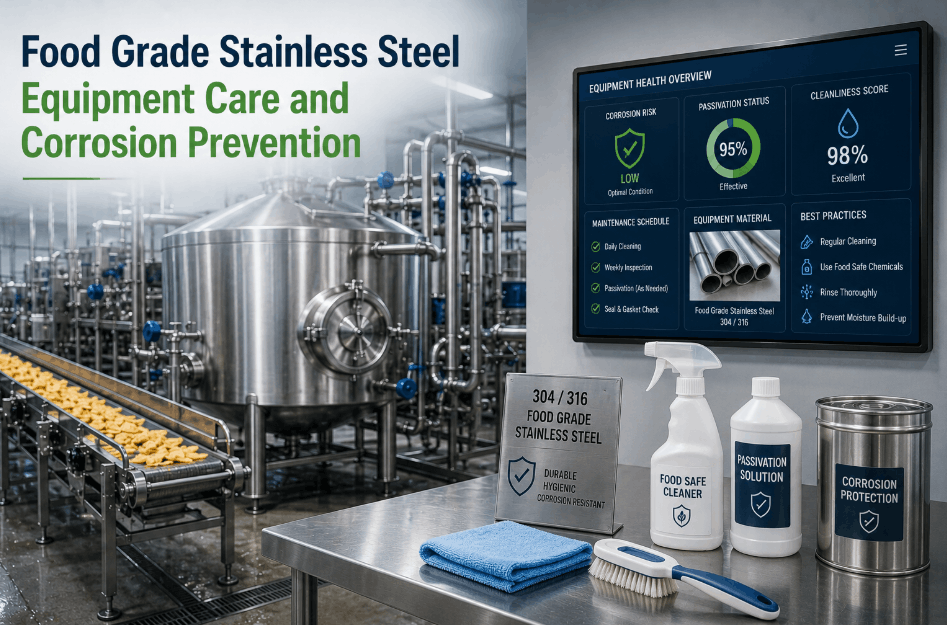
Food grade stainless steel equipment is the backbone of every compliant food processing facility — yet its long-term performance depends entirely on disciplined care protocols, proactive corrosion prevention, and AI-driven preventive analytics that most plants still overlook. From 316L stainless steel contact surfaces in dairy and beverage lines to electropolished sanitary fittings in pharmaceutical-grade food processing, corrosion, rouging, and surface finish degradation silently erode both product safety and equipment lifespan. Plants that book a demo with iFactory are discovering how AI-tracked passivation schedules and real-time corrosion monitoring can extend asset life while maintaining flawless food contact surface integrity across every production cycle.
Stop Corrosion Before It Compromises Your Food Contact Surfaces
iFactory's Mobile AI App delivers real-time passivation tracking, rouging detection, and corrosion prevention analytics — purpose-built for food processing engineers who demand surface integrity and full regulatory compliance.
Why Food Grade Stainless Steel Care Is a Compliance and Safety Priority
Stainless steel food equipment is not inherently maintenance-free. The passive chromium oxide layer that gives 304 and 316L stainless steel its corrosion resistance degrades over time through exposure to chloride-based cleaning agents, high-temperature CIP cycles, mechanical abrasion, and process chemical contact. When that passive layer breaks down, pitting corrosion, crevice corrosion, and rouging follow — introducing iron oxide contamination directly into the product stream and creating microscopic harboring points for pathogens that standard CIP cannot reach. Food equipment corrosion prevention is not just an engineering concern — it is a direct food safety and HACCP traceability issue that regulators increasingly scrutinize during audits. Plants that schedule a strategy session with iFactory routinely uncover passivation gaps and surface degradation that were completely invisible in their existing maintenance records.
Understanding Corrosion Mechanisms in Food Processing Environments
Food processing environments present a uniquely aggressive combination of corrosion triggers that interact in ways standard material datasheets do not fully capture. Understanding the primary corrosion mechanisms is the prerequisite for designing an effective food equipment surface preservation program.
Chloride Attack
Hypochlorite sanitizers and chloride-containing process water destroy the passive film at concentrations as low as 25 ppm under elevated temperatures, initiating pitting that progresses rapidly below the surface.
Crevice Corrosion
Poorly designed or worn gaskets, threaded connections, and sanitary clamp joints create oxygen-depleted micro-environments where chloride concentrates and accelerates localized attack invisible to surface inspection.
Rouging & Oxidation
Steam sterilization and high-temperature WFI systems mobilize iron oxide particles that deposit as rouge on stainless surfaces — a visible contamination risk that indicates compromised passivation and demands immediate treatment.
Stress Corrosion Cracking
Tensile stress combined with chloride environments can cause catastrophic intergranular cracking in sensitized 304 stainless — a failure mode that develops invisibly and provides no warning before fracture.
Passivation Scheduling for Food Contact Surfaces: Moving Beyond Fixed Calendars
Stainless steel passivation — the chemical treatment process that restores the chromium oxide passive film using nitric or citric acid — is the single most important preventive maintenance action in any food grade stainless steel care program. Yet most facilities still schedule passivation on fixed annual or biannual calendars, with no regard for the actual condition of the passive layer or the cumulative chemical exposure the equipment has experienced. AI-driven preventive analytics change this fundamentally by tracking passivation-relevant variables continuously — CIP chemical concentration, temperature excursions, surface exposure hours, and CIP cycle frequency — to calculate a real-time passivation index that triggers maintenance precisely when the surface needs it, not when the calendar says so. Plants that book a demo with iFactory can see exactly how passivation scheduling analytics are built for high-turnover food processing environments.
CIP Chemical Exposure Indexing
Every CIP cycle exposes stainless steel surfaces to caustic and acid chemistries that modify the passive layer. AI analytics log chemical concentration, contact temperature, and dwell time for every CIP cycle, accumulating an exposure index that directly correlates with passive film degradation rate — replacing guesswork with data-driven passivation triggers.
Temperature Excursion Tracking
High-temperature CIP cycles and steam sterilization events above 70°C significantly accelerate passive film degradation and rouging risk on 316L stainless steel surfaces. Continuous temperature logging with excursion flagging ensures that equipment subjected to abnormal thermal events receives accelerated passivation review — a critical capability absent from calendar-based programs.
Automated Passivation Compliance Records
Regulatory audits increasingly demand documented evidence that passivation was performed correctly, with verified chemical concentrations, contact times, and post-treatment rinse conductivity. AI-driven passivation tracking generates immutable digital compliance records for every treatment event — eliminating the manual log gaps that trigger FSMA and BRC audit findings.
Chloride Corrosion Prevention: The Most Overlooked Risk in Food Plant Stainless Steel Care
Chloride-induced pitting corrosion is the primary failure mechanism for stainless steel food equipment in wet processing environments — and the most difficult to detect before it causes structural damage or product contamination. Unlike surface oxidation that is visible during routine inspection, pitting initiated by chloride attack begins below the passive film and can penetrate the full wall thickness of a pipe or vessel before any external sign appears. The critical control variables — sanitizer chloride concentration, rinse water chloride content, contact temperature, and pH — interact dynamically in ways that fixed-threshold alarms cannot adequately monitor. iFactory's corrosion prevention analytics model chloride exposure risk as a continuous function of these variables, generating predictive corrosion risk scores for each equipment zone throughout the production day. Teams managing food equipment corrosion programs who book a demo consistently identify high-risk equipment zones that their existing inspection protocols had completely missed.
Process Water Chloride Monitoring
Continuous TrendingMunicipal water chloride levels fluctuate seasonally and can spike during distribution system events — introducing uncontrolled corrosion risk into CIP rinse cycles and product contact water. AI analytics track process water conductivity as a chloride proxy, alerting teams when rinse water composition exceeds safe thresholds for 316L stainless steel contact and triggering supplementary filtration or treatment protocols before surface damage occurs.
Sanitizer Concentration Control
±5 ppm AccuracyHypochlorite sanitizers must be maintained within tight concentration windows — high enough to achieve microbial kill rates required by food safety protocols, yet low enough to prevent accelerated passive film attack on stainless steel surfaces. AI-driven dosing control maintains sanitizer concentration within validated safe ranges for stainless steel, logging every CIP event with verified concentration data that feeds directly into the passivation index calculation.
Temperature-Chloride Interaction Modeling
Dynamic Risk ScoringChloride corrosion risk increases exponentially with temperature — a 10°C rise in process temperature can double the pitting initiation rate in stainless steel at equivalent chloride concentrations. iFactory's temperature-chloride interaction model calculates real-time corrosion risk scores for each equipment zone, weighting chloride exposure by temperature history to identify which assets are accumulating the fastest passive film degradation and require prioritized passivation intervention.
Stainless Steel Rouging in Food Processing: Detection, Classification, and Treatment
Rouging — the deposition of iron oxide films on stainless steel surfaces — is the most visible indicator of passive layer compromise in high-purity food processing systems. While rouging is most commonly associated with pharmaceutical water systems, it is increasingly recognized as a significant contamination and compliance risk in high-temperature dairy processing, beverage aseptic filling, and infant formula manufacturing. AI-driven analytics enable systematic rouging detection and classification before visible discoloration develops, allowing treatment interventions that preserve surface finish and prevent iron contamination of product.
Surface Finish Preservation and Electropolish Analytics for Food Equipment
The surface finish of food contact stainless steel — measured as Ra (roughness average) in micrometers — is a direct determinant of both cleanability and corrosion resistance. Sanitary standards (3-A, EHEDG, FDA) specify maximum Ra values for food contact surfaces precisely because surface roughness above threshold values creates harboring points for biofilm formation that CIP cannot penetrate. Electropolished surfaces achieving Ra ≤ 0.5 µm offer significantly superior corrosion resistance and cleanability compared to mechanically polished finishes — but electropolish integrity degrades through abrasive cleaning, mechanical damage, and chemical attack over time. iFactory's surface finish preservation analytics track the factors that accelerate electropolish degradation — abrasive CIP chemistry, high-pressure cleaning events, and mechanical contact — maintaining a surface condition score that predicts when re-electropolishing will be required before Ra values exceed sanitary compliance limits. Reliability engineers building a comprehensive food grade surface preservation program regularly choose to book a demo to see how electropolish analytics integrate with their existing maintenance management systems.
Abrasive CIP Chemistry Detection
Certain cleaning formulations — particularly high-alkalinity caustic blends with abrasive additives or incompatible chelating agents — degrade electropolished surfaces at rates far exceeding what surface inspection intervals can detect. AI analytics correlate CIP chemistry profiles with surface condition degradation models, flagging chemistry-surface incompatibilities before cumulative damage demands emergency re-treatment during production downtime.
Mechanical Damage Event Logging
Maintenance activities, equipment changeovers, and cleaning operations all introduce mechanical contact risks to food contact surfaces. AI-driven event logging captures maintenance activities correlated with surface condition changes — building a causal dataset that identifies which maintenance procedures are the primary drivers of surface finish degradation and enabling procedure modifications that preserve electropolish integrity across longer service intervals.
Ra Compliance Prediction Modeling
Rather than waiting for surface roughness measurements during scheduled inspections to reveal a compliance breach, iFactory's Ra compliance prediction models calculate the projected date at which surface finish will reach 3-A or EHEDG threshold values — based on actual chemical exposure, mechanical event history, and material-specific degradation curves. This transforms surface finish management from reactive measurement to proactive scheduling.
316L vs 304 Stainless Steel in Food Processing: Making the Right Material Analytics Decision
Material selection between 304 and 316L stainless steel in food processing equipment is one of the most consequential decisions a plant engineer makes — and one where real-world performance data consistently diverges from manufacturer specifications. The 2–3% molybdenum content in 316L provides measurably superior chloride pitting resistance in aggressive process environments, making it the preferred choice for meat and seafood processing, high-chloride dairy brine applications, and any environment where hypochlorite sanitizers are used at elevated temperatures. AI-driven preventive analytics enable facilities to build a performance database that tracks actual corrosion rates by material grade, equipment zone, and chemical exposure profile — transforming future capital investment decisions from specification-sheet comparisons into data-validated material performance analysis grounded in their specific operating conditions.
| Performance Attribute | 304 Stainless Steel | 316L Stainless Steel | AI Analytics Benefit |
|---|---|---|---|
| Chloride Pitting Resistance | Moderate (PREN 18–20) | High (PREN 24–28) | Zone-specific risk scoring by grade |
| CIP Caustic Tolerance | Good up to 70°C | Excellent up to 85°C | Temperature excursion flagging per zone |
| Passivation Frequency | Higher frequency required | Lower frequency (condition-based) | Grade-aware passivation index calculation |
| Rouging Susceptibility | Higher in steam environments | Lower with Mo stabilization | Material-specific rouging risk modeling |
| Electropolish Durability | Moderate surface stability | Superior long-term Ra retention | Differentiated Ra degradation curve tracking |
The Financial Case for AI-Driven Stainless Steel Corrosion Prevention Analytics
The economics of food grade stainless steel corrosion prevention are asymmetric in a way that makes proactive analytics investment overwhelmingly compelling. A failed passivation event that allows pitting corrosion to penetrate a product-contact vessel wall triggers not just equipment replacement costs — it triggers product recall procedures, HACCP deviation investigations, regulatory notifications, and the reputational consequences of a food safety event. AI-driven corrosion prevention analytics convert these catastrophic tail-risk events into manageable, predictable maintenance interventions that occur on schedule, on budget, and with full digital documentation. The platform ROI is typically realized within 90–150 production days through the combined effect of eliminated emergency repairs, extended asset service intervals, reduced passivation chemical consumption, and audit-ready compliance documentation that eliminates third-party inspection costs.
Condition-based scheduling eliminates unnecessary treatments, reducing chemical consumption and labor without compromising surface protection.
AI models identify passive layer degradation signatures weeks before visual inspection or threshold alarms would detect a deviation.
Automated passivation, rouging treatment, and surface condition records eliminate manual compliance documentation gaps.
Typical payback period through combined savings in emergency repairs, compliance costs, and extended equipment service life.
Food Grade Stainless Steel Care — Frequently Asked Questions
How often should food grade stainless steel equipment be passivated?
Passivation frequency should be condition-based, not calendar-based — high-chloride or high-temperature CIP environments typically need treatment every 3–6 months, while lower-exposure equipment can hold integrity for 12–18 months. iFactory's AI passivation indexing calculates the exact right interval from your actual chemical exposure data; book a demo to see how it works for your line.
What is the difference between Class I, II, and III rouging in food equipment?
Class I is a superficial, loosely adherent iron oxide deposit removable with citric acid; Class II is a tightly bonded in-situ oxidation film requiring stronger derouging chemistry; Class III involves deep pitting that may need electropolishing before the surface returns to food contact service. AI analytics catch rouging onset at Class I — book a demo to see early detection in action.
Can AI analytics integrate with our existing CIP control system for stainless steel monitoring?
Yes — iFactory ingests CIP chemistry concentration, temperature, flow rate, and dwell time via standard protocols (Modbus, OPC-UA, Profibus) without replacing existing automation infrastructure. Every CIP cycle feeds directly into the passivation index and corrosion risk models. Book a demo to walk through your current CIP setup with our engineers.
What sensors are required to implement stainless steel corrosion prevention analytics?
Most plants already have the core infrastructure — CIP temperature transmitters, conductivity probes, and flow meters. Where gaps exist, iFactory recommends targeted additions of inline pH sensors and wireless temperature nodes integrated via washdown-rated IoT gateways. Book a demo and we'll map sensor gaps against your existing equipment.
How does electropolish analytics help maintain 3-A and EHEDG surface finish compliance?
iFactory models cumulative Ra degradation from abrasive CIP chemistry, mechanical contact events, and thermal cycling — generating predictive alerts before surface finish breaches 3-A or EHEDG limits. Maintenance teams get scheduled re-electropolishing windows instead of emergency shutdowns. Book a demo to see Ra compliance prediction for your equipment.
Is 316L stainless steel always preferable to 304 in food processing applications?
316L's molybdenum content gives it superior chloride pitting resistance, making it the right choice for meat brining, dairy CIP with hypochlorite sanitizers, and high-temperature wet environments — while 304 remains adequate and cost-effective in low-chloride, low-temperature zones. AI material performance analytics build a facility-specific corrosion database to validate these decisions; book a demo to see data-driven grade selection in practice.
Ready to Build a Smarter Stainless Steel Care Program?
iFactory's AI-driven preventive analytics platform delivers real-time corrosion risk scoring, condition-based passivation scheduling, and audit-ready surface compliance documentation — built for food processing engineers who demand measurable ROI and zero food safety compromise.