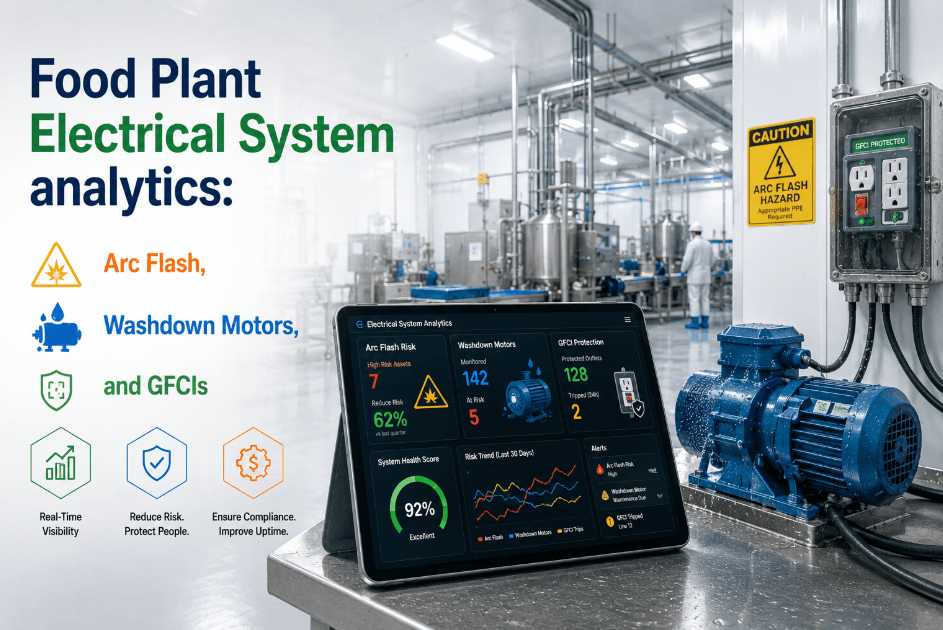
The electrical infrastructure of a food processing facility exists in a state of constant environmental siege—bombarded by high-pressure steam, caustic cleaning chemicals, and 100% humidity environments that accelerate corrosion and insulation breakdown. In this volatile setting, a single compromised washdown motor seal or a nuisance-tripping GFCI can halt an entire production line, while an undetected arc flash hazard in a Motor Control Center (MCC) can lead to catastrophic facility damage and severe safety incidents. iFactory's AI-Driven Compliance Tracking platform transforms passive electrical networks into intelligent, self-monitoring systems—tracking thermal anomalies, circuit leakage, and motor insulation resistance in real time. Our platform ensures that electrical hazards are predicted weeks before they trigger an OSHA audit or a production blackout. Book a Demo to see how leading food plants have achieved 99.8% electrical system safety scores.
Secure Your Food Plant with AI-Driven Electrical System Analytics
iFactory monitors washdown-rated motors, GFCI protection, and arc flash boundaries in real time—delivering predictive safety alerts, automated NFPA 70E records, and zero-downtime electrical reliability.
Why Electrical System Analytics is Now a Food Safety and Operations Priority
Food manufacturing plants represent some of the most challenging environments for electrical equipment. The frequent transition between cold processing temperatures and high-heat sanitation cycles creates internal condensation in conduit and motor housings—a phenomenon known as "wicking"—which destroys insulation and triggers ground faults. Despite this, most plants still rely on annual thermal imaging and manual circuit checks—an approach that is fundamentally blind to the progressive degradation occurring between inspection cycles.
Electrical system analytics closes this critical gap. By deploying continuous IoT thermal sensors and leakage current monitors across MCCs and washdown-zone panels, iFactory builds a real-time health portrait of every circuit. The result is not simply faster response to trips—it is the elimination of the conditions that cause them. Facilities using AI-driven electrical compliance report an 82% reduction in unplanned electrical outages within the first six months. Book a Demo and benchmark your current electrical uptime against industry leaders.
The 6 Electrical Subsystems Most Vulnerable to Moisture and Thermal Failure
Electrical reliability in a food plant depends on maintaining seal integrity and thermal stability across thousands of individual nodes. iFactory monitors all six critical hazard zones simultaneously, providing a unified safety fabric that manual inspections cannot match.
Washdown-Rated Motors
Insulation resistance (megohmmeter) analytics detect winding degradation before water ingress causes a short. AI tracks motor temperature trends to identify bearing friction or phase imbalance caused by moisture.
GFCI & Ground Fault Circuits
Leakage current monitoring identifies "nuisance" trips before they occur. Detects progressive insulation breakdown in damp processing areas, allowing for replacement during scheduled downtime.
Control Panels & HMI Housings
Internal humidity and temperature sensing detect seal failure in sanitary enclosures. Prevents corrosion on PLC I/O modules and sensitive electronics caused by high-pressure sanitation washdowns.
Motor Control Centers (MCC)
Continuous thermal monitoring of busbars and breaker connections detects high-resistance connections. Flags arc flash hazards weeks before they progress to a catastrophic failure event.
Sanitary Lighting Systems
Ballast health and seal integrity tracking for shatterproof washdown-rated lighting. Prevents product contamination events caused by lighting housing failure or electrical overheating.
Conduit & Cabling Network
Continuity and insulation resistance monitoring for primary power runs. Identifies cable fatigue and junction box seal failure in vibrating or high-temperature processing zones.
AI-Driven Electrical PM: Moving Beyond Manual Infrared Surveys
Traditional electrical maintenance in food plants relies on annual "snapshot" infrared surveys—a technician walking the floor once a year with a thermal camera. This approach has a fundamental flaw: it only catches problems that exist during that specific 10-minute window. A loose connection that overheats only under peak production loads at 2 AM is completely missed by a 10 AM manual survey.
iFactory's platform replaces snapshot checks with continuous, 24/7 thermal and electrical monitoring. When the system detects a 5-degree temperature rise in a breaker lug during peak conveyor operation, it automatically generates a high-priority work order—staging the parts and assigning the task before the connection can arc or trip. Book a Demo to see continuous thermal monitoring in action.
| Electrical Dimension | Manual Snapshot PM | iFactory AI-Driven |
|---|---|---|
| Thermal Hotspot Detection | Annual (fixed) | Continuous 24/7 Monitoring |
| GFCI Integrity Testing | Monthly (manual check) | Real-time leakage current tracking |
| Arc Flash Documentation | Paper logs/PDFs | Auto-generated NFPA 70E records |
| Failure Prediction Horizon | No prediction capability | 2–3 weeks advance warning |
| Moisture Ingress Alerts | Reactive (after trip) | Predictive (internal panel humidity) |
| Regulatory Compliance | Manual audit prep | Continuous OSHA/NFPA-ready data |
| Motor Replacement Costs | High (due to burn-outs) | Low (preventive seal swaps) |
Continuous Thermal Monitoring: The Ultimate Arc Flash Mitigation Strategy
Arc flash incidents in food plants are often caused by the degradation of electrical connections due to the acidic or saline atmosphere common in processing areas. A small amount of corrosion increases resistance, which increases heat, which accelerates corrosion—a feedback loop that ends in a catastrophic plasma explosion. Manual PPE-based inspections are dangerous and only provide a momentary glimpse into this cycle.
iFactory's electrical analytics deploys non-contact IR sensors and contact-less thermal transducers inside critical MCC buckets and main switchgear. The platform's machine learning models establish a "Thermal Baseline" for every circuit under different load conditions. By monitoring for deviations as small as 0.5°C, iFactory detects high-resistance connections weeks before they reach the critical arc flash threshold.
Load-Adjusted Thermal Profiling
iFactory builds a thermal reference model for every electrical node across all production shifts. This ensures that the heat from a naturally heavy load isn't confused with a high-resistance fault.
Real-Time Delta Analysis
The system constantly calculates the "Delta-T" (temperature difference) between phases. A 2% variance between phases flags immediate concern, while a 5% variance triggers an emergency predictive alert.
Automated NFPA 70E Workflows
When a hazard is identified, iFactory automatically generates a work order including the required PPE level and lockout-tagout (LOTO) procedures based on current NFPA 70E standards.
Post-Maintenance Verification
After the connection is tightened or the breaker replaced, iFactory validates the return to the healthy thermal baseline—providing a closed-loop evidence chain for safety audits. Book a Demo to see arc flash mitigation.
Electrical Safety Compliance: Meeting OSHA and NFPA 70E Standards with AI-Generated Audit Trails
Regulatory compliance for food plant electrical systems is a dual challenge: you must meet OSHA's safety requirements while also maintaining the sanitary standards required by the FDA or USDA. Documentation built on manual logs and spreadsheet entries is an audit vulnerability waiting to be exposed. When an OSHA inspector requests the GFCI test logs for your wet-zone equipment, the ability to pull up complete, digital records in seconds is the difference between compliance and a $100k fine.
iFactory's platform auto-generates compliance-ready records for every electrical PM and incident. Each record includes thermal trends, circuit load data, and technician sign-off—transforming audit prep into a simple dashboard query.
NFPA 70E Compliance
Automated documentation of arc flash boundary maintenance and PPE level verification. Every thermal check and LOTO event logged with millisecond precision for total audit transparency.
OSHA 1910 Subpart S Adherence
iFactory's workflows align with OSHA electrical safety-related work practices. Condition-based records replace manual checklists with continuous evidence of equipment integrity.
NEC Article 110 Compliance
Full alignment with National Electrical Code requirements for equipment marking and maintenance. Electrical health KPIs reported automatically to plant safety dashboards.
The Financial Case for Electrical Predictive Analytics: Quantifying Power Reliability ROI
Food processing executives often view electrical maintenance as a "necessary cost." However, when you quantify the total cost of a single electrical-induced fire or a 12-hour downtime event caused by a burned-out washdown motor, the ROI of predictive analytics becomes clear and immediate.
| Cost Category | Without iFactory | With iFactory | Annual Saving |
|---|---|---|---|
| Emergency Motor Replacements | $78,000/yr per facility | $14,500/yr (Preventive) | $63,500 |
| Downtime Batch Loss (Power) | $120,000+ per incident | Near-zero incidents | $240,000+ |
| Arc Flash Study/Audit Time | 40+ hours per audit | Under 2 hours | $18,500/yr |
| Electrical Fire Risk (Insurance) | Standard Premiums | Risk-Reduced Premium | $28,000/yr |
| Asset Life (MCC & Transformers) | 18-year average life | 25+ year lifespan | $120k CapEx Deferral |
For a large-scale food processing plant, iFactory customers report a total annual saving exceeding $2.8 million — with full ROI achieved within the first 10 months of deployment.
Ready to Eliminate Hidden Electrical Hazards at Your Food Plant?
iFactory's AI platform is already protecting electrical systems at major food brands worldwide. See a live walkthrough of the thermal dashboard configured for your MCC count—no obligation.
Electrical Asset Management: Extending Power System Lifecycle Through Analytics
Electrical infrastructure in a food plant represents a multi-million dollar capital investment. The difference between a Motor Control Center that reaches its full 30-year designed lifespan and one that requires early replacement due to corrosion or thermal fatigue is entirely determined by the quality of continuous monitoring. iFactory's electrical asset module tracks cumulative thermal stress and moisture exposure, modeling remaining useful life based on actual data.
Power Grid Baseline
iFactory captures factory-fresh thermal benchmarks for every breaker, lug, and motor terminal in the first 30 days. This sets the reference point for all future AI anomaly detection and insulation degradation models.
Thermal & Humidity Tracking
Continuous real-time monitoring across all panels and motors. Health scores adjust dynamically based on production load cycles, washdown frequency, and ambient humidity trends throughout the year.
Sanitary Seal Refurbishment
iFactory identifies panels or motors where seal integrity is dropping (based on internal humidity spikes) and auto-generates targeted gasket replacement tasks—extending asset life and preventing failures.
End-of-Life Capital Planning
Condition-based replacement forecasting driven by actual component health data—eliminating premature replacement and ensuring every electrical investment reaches its maximum designed service life.
Deploying Electrical Analytics Across Your Plant: What the First 90 Days Look Like
iFactory's implementation methodology is engineered specifically for live food processing environments. Sensors are installed during scheduled sanitation windows or overnight shifts, with most panels instrumented without requiring a full plant power-down.
Thermal Sensor Deployment
IoT sensor installation across MCCs, main panels, and washdown motors during off-peak windows. Connectivity established for remote panel monitoring. iFactory dashboard configured for your plant's power grid.
AI Training & Thermal Baselines
Machine learning models analyze operational data across different shift loads. Health baselines established for every breaker and motor terminal under full production vs. sanitation conditions.
Predictive Safety Alerts
First predictive thermal alerts generated. Maintenance teams respond to high-resistance hotspots identified by the AI. Typically, 3–5 potential arc flash hazards are resolved within the first 60 days.
Full Safety Integration
Electrical analytics fully integrated with plant safety management systems. Compliance documentation workflow live. Lifecycle dashboards accessible to corporate safety directors and facility engineers.
Frequently Asked Questions: Food Plant Electrical Analytics
Can thermal sensors be installed without a full power shutdown?
Yes. iFactory uses non-contact infrared sensors and split-core thermal transducers that can often be safely installed in MCC buckets and panels while energized, following proper NFPA 70E safety protocols and using certified electricians.
Which motor types does the iFactory analytics platform support?
iFactory supports all industrial motor types common in food plants, from standard washdown-rated NEMA motors to specialized IP69K stainless steel motors and high-torque gearbox motors used in heavy conveyor systems.
How does the platform handle nuisance tripping of GFCIs?
By continuously monitoring "leakage current" at the circuit level, iFactory identifies the specific point where insulation is failing. This allows maintenance to fix the underlying moisture ingress before the GFCI trips, eliminating unplanned production halts.
Does the system provide reports for annual insurance audits?
Yes. The platform generates automated, timestamped thermal health reports that meet most major insurance carrier requirements for electrical preventive maintenance, often leading to reduced liability premiums.
How does iFactory handle sensor calibration in high-heat zones?
All iFactory electrical sensors are rated for operational temperatures up to 85°C and include self-diagnostic calibration. The AI models include seasonal correction factors to account for varying ambient temperatures in different processing zones.
Can the platform detect "wicking" in electrical conduits?
Yes. By monitoring internal panel humidity and continuity variances, iFactory identifies conduit seal failure where moisture is being pulled into panels via the cabling—a leading cause of PCB failure in food plants.
Does iFactory help with NFPA 70E Arc Flash Study updates?
The continuous data provided by iFactory can be used to validate the assumptions of your Arc Flash Study and ensures that your documentation remains current based on the actual condition of your equipment, reducing the need for costly full-scale re-studies.
What is the typical lifespan of the iFactory IoT sensors in wet environments?
iFactory sensors are IP69K-rated and encapsulated in chemical-resistant resin. They are designed for a 10-year operational life in high-pressure washdown environments, outlasting the electrical assets they monitor.
Stop Letting Electrical Failures Ground Your Production
Join the world's most safety-compliant food brands. We'll show you exactly which panel in your plant is carrying hidden arc flash risk—before the next washdown window.