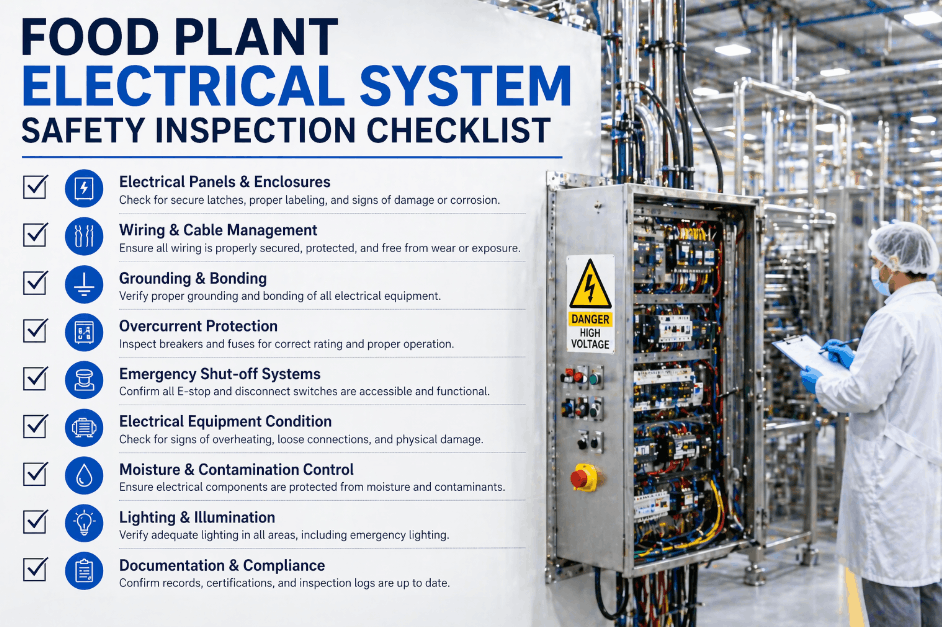
Food Plant Electrical System Safety Inspection Checklist

By Josh Turley on April 24, 2026

food-plant-electrical-system-safety-inspection-checklist

Food processing environments combine high-voltage electrical systems with aggressive washdown chemicals, condensation, steam, and continuous wet-floor conditions — creating one of the most demanding electrical safety challenges in any industrial sector. A single unguarded terminal strip, an uncalibrated GFCI, or a missing arc flash label can expose personnel to electrocution, trigger an NFPA 70E citation, or shut down your production line for days. A structured, documented food plant electrical system safety inspection checklist is the foundation of every compliant, zero-incident facility. Book a Demo to see how iFactory's preventive analytics platform digitizes your electrical inspection records and keeps your team NFPA 70E audit-ready every single day.

PREVENTIVE ANALYTICS NFPA 70E COMPLIANCE ELECTRICAL SAFETY

Eliminate Electrical Safety Gaps Across Your Food Plant with AI-Driven Inspections

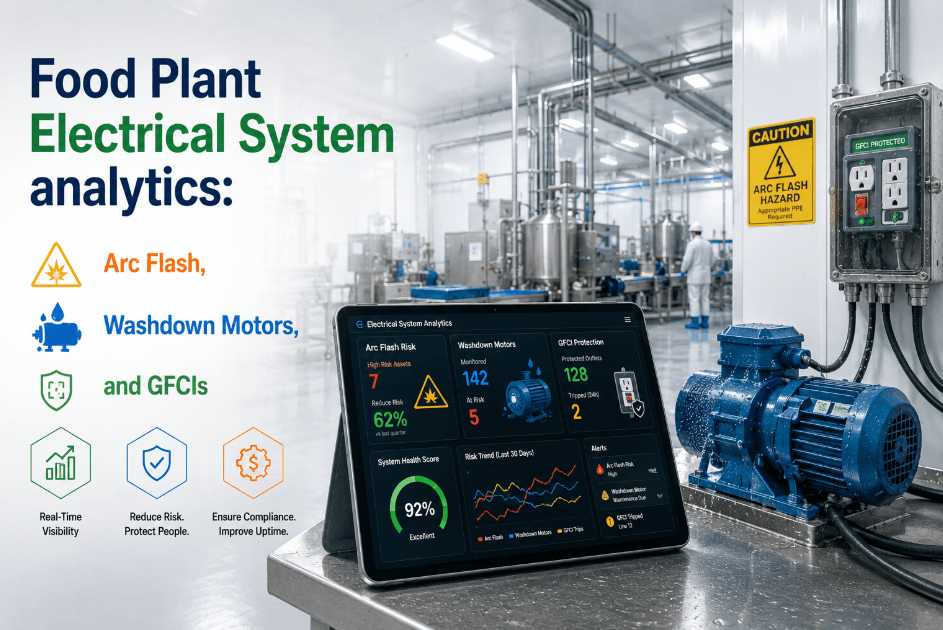
iFactory tracks every GFCI test date, arc flash label currency, motor PM interval, and washdown-rated equipment certification across your facility — delivering real-time compliance dashboards and audit-ready documentation for your next NFPA 70E or insurance review.

Why Food Plant Electrical Inspections Demand a Dedicated Checklist

NFPA 70E & OSHA 1910.303 Compliance Obligations

Food manufacturing facilities are subject to NFPA 70E Standard for Electrical Safety in the Workplace, OSHA 29 CFR 1910.303 general electrical standards, and the National Electrical Code (NEC). Non-compliance with arc flash boundary labeling, qualified worker requirements, or lockout/tagout procedures can result in OSHA Serious or Willful citations exceeding $15,625 per violation. Book a Demo to automate your NFPA 70E compliance calendar and eliminate missed inspection windows.

Unique Electrical Hazards in Food Processing Environments

Unlike standard industrial facilities, food plants operate with continuous wet washdown cycles, steam from cooking and sanitation, conductive cleaning chemicals, and refrigerated spaces with condensation. These conditions accelerate insulation degradation, cause corrosion inside enclosures, and dramatically increase ground fault and arc flash risk. Standard commercial electrical inspection protocols are insufficient — food plant electrical checks must account for IP69K ratings, NSF-compliant enclosures, and washdown-duty motor specifications at every inspection point.

1. Washdown-Rated Equipment & IP Enclosure Verification
2. GFCI Testing & Ground Fault Protection
3. Arc Flash Labels & Hazard Boundary Compliance
4. Motor & Variable Frequency Drive (VFD) Inspection
5. Electrical Panel & Distribution System Health
6. NFPA 70E PPE Compliance & Qualified Worker Readiness
7. Conduit, Cable & Junction Box Integrity
8. Preventive Maintenance Records & Compliance Documentation
GET STARTED TRANSFORM YOUR COMPLIANCE

Digitize Your Food Plant Electrical Safety Program Today

Join leading food manufacturers standardizing GFCI test records, arc flash label audits, motor PM intervals, and NFPA 70E documentation — all in one real-time compliance platform powered by iFactory's preventive analytics engine.

Benefits of Digital Electrical Safety Management in Food Plants

OSHA & NFPA 70E Audit Readiness

Timestamped digital electrical inspection records satisfy OSHA 1910.303 and NFPA 70E documentation requirements, dramatically reducing citation risk during unannounced OSHA inspections or FM Global property audits targeting food manufacturing facilities.

Automated PM & Calibration Reminders

iFactory automatically tracks GFCI test due dates, glove dielectric re-test windows, megger inspection schedules, and thermal imaging cycles — sending escalating alerts before any deadline lapses so no inspection falls through the cracks.

Deficiency-to-Work-Order Automation

Any failed checklist item instantly generates a high-priority corrective maintenance work order and notifies your electrical supervisor — eliminating the paper-trail gap that allows critical arc flash or ground fault deficiencies to remain unresolved for weeks.

Mobile-First Panel & Motor Patrols

Electricians log running amperage, VFD temperatures, and enclosure condition directly from their smartphones at each inspection point — replacing paper patrol logs with GPS-tagged, tamper-proof digital records accessible during any audit or insurance review.

Multi-Facility Compliance Dashboard

Monitor electrical safety compliance scores, open deficiencies, overdue arc flash study revalidations, and PPE inventory status across every plant in your food manufacturing portfolio from a single centralized command center.

Insurance & EPA Documentation Support

Immutable, cloud-stored electrical inspection records provide verified proof of diligence for FM Global, HSB, and other food industry insurers — supporting property premium reductions and accelerating claims resolution after any electrical incident.

Food Plant Electrical Safety FAQs

1. What electrical standard applies to food manufacturing facilities?
Food manufacturing facilities are subject to OSHA 29 CFR 1910.303 through 1910.399 (general industry electrical standards), the National Electrical Code (NFPA 70), and NFPA 70E (Standard for Electrical Safety in the Workplace). Facilities with specific wet-process or classified hazardous locations may also be subject to NEC Article 547 (agricultural buildings) or Article 430 (motor circuits) requirements depending on the process type and equipment installed.
2. How often must GFCI outlets be tested in a food plant?
OSHA and NFPA 70E do not specify a universal GFCI test frequency, but GFCI manufacturers and the NEC Handbook recommend monthly testing of all GFCI receptacles in wet and damp locations. In food processing environments subject to daily washdown, many facilities adopt a weekly visual inspection and monthly trip-test cycle. All test events must be documented with location ID, date, technician name, and pass/fail result to satisfy OSHA 1910.303 documentation requirements during inspections.
3. How often must arc flash studies be updated in a food plant?
NFPA 70E recommends reviewing and updating Arc Flash Hazard Analysis at intervals not exceeding 5 years, or whenever a significant modification to the electrical distribution system occurs — including utility transformer changes, new large motor installations, added VFDs, or main breaker replacements. Outdated arc flash labels that do not reflect current system conditions provide no worker protection and represent the same NFPA 70E violation risk as missing labels entirely.
4. What IP rating is required for electrical equipment in food washdown areas?
For high-pressure washdown zones in food processing facilities, IP69K is the recommended minimum ingress protection rating per IEC 60529. IP69K certifies protection against close-range, high-pressure, high-temperature water jets used in food sanitation. NEMA 4X stainless steel enclosures are the NEMA equivalent standard used in North American food plant electrical installations. Equipment carrying only IP65 or IP67 ratings is generally insufficient for direct washdown exposure.
5. What PPE is required for working on energized electrical equipment in a food plant?
Per NFPA 70E, PPE requirements are determined by the incident energy level at the point of work, expressed in cal/cm². At minimum, workers must wear voltage-rated rubber gloves with leather protectors, arc-rated face shields or arc flash hoods, and arc-rated clothing with the arc rating (AR) at or above the incident energy on the equipment label. For PPE Category 1 tasks (up to 4 cal/cm²), a minimum arc rating of 4 cal/cm² is required. All rubber insulating gloves must be dielectric-tested every 6 months per ASTM D120.
6. Can digital records satisfy NFPA 70E and OSHA electrical documentation requirements?
Yes. OSHA and NFPA 70E specify that electrical safety records must be accurate, complete, and retrievable — they do not mandate paper format. Digital records with tamper-evident timestamps, electronic technician sign-off, and cloud backup are increasingly accepted by OSHA compliance officers and insurance auditors as superior to paper systems because they provide searchable corrective action histories, prevent record falsification, and remain accessible even if the physical facility is compromised during an electrical incident or emergency event.
PREVENTIVE ANALYTICS ZERO-FINDING INSPECTIONS

Achieve Zero-Finding Electrical Inspections Across Your Food Manufacturing Portfolio

Standardize your GFCI records, track arc flash study revalidation dates, manage VFD PM schedules, and generate corrective work orders automatically — all inside iFactory's food plant compliance platform.


Share This Story, Choose Your Platform!