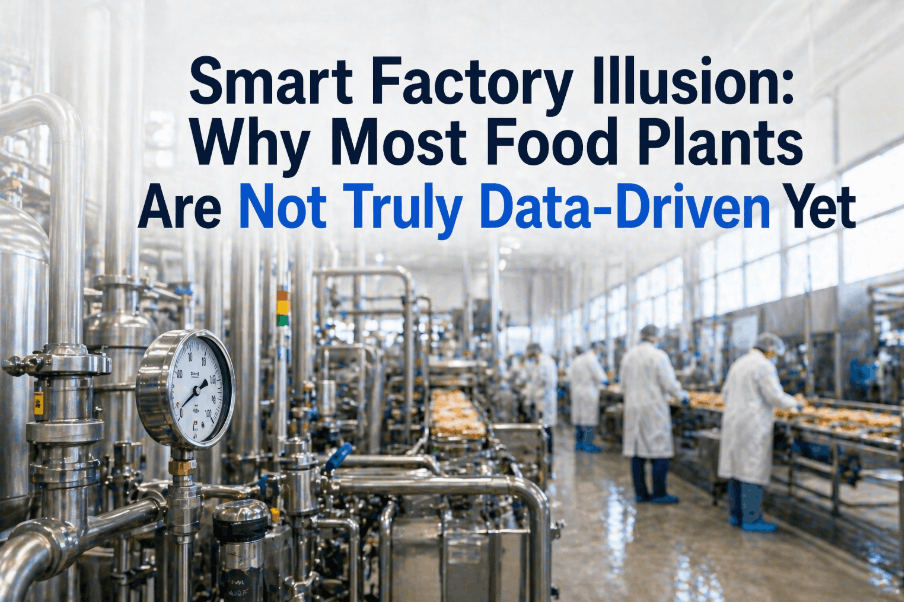
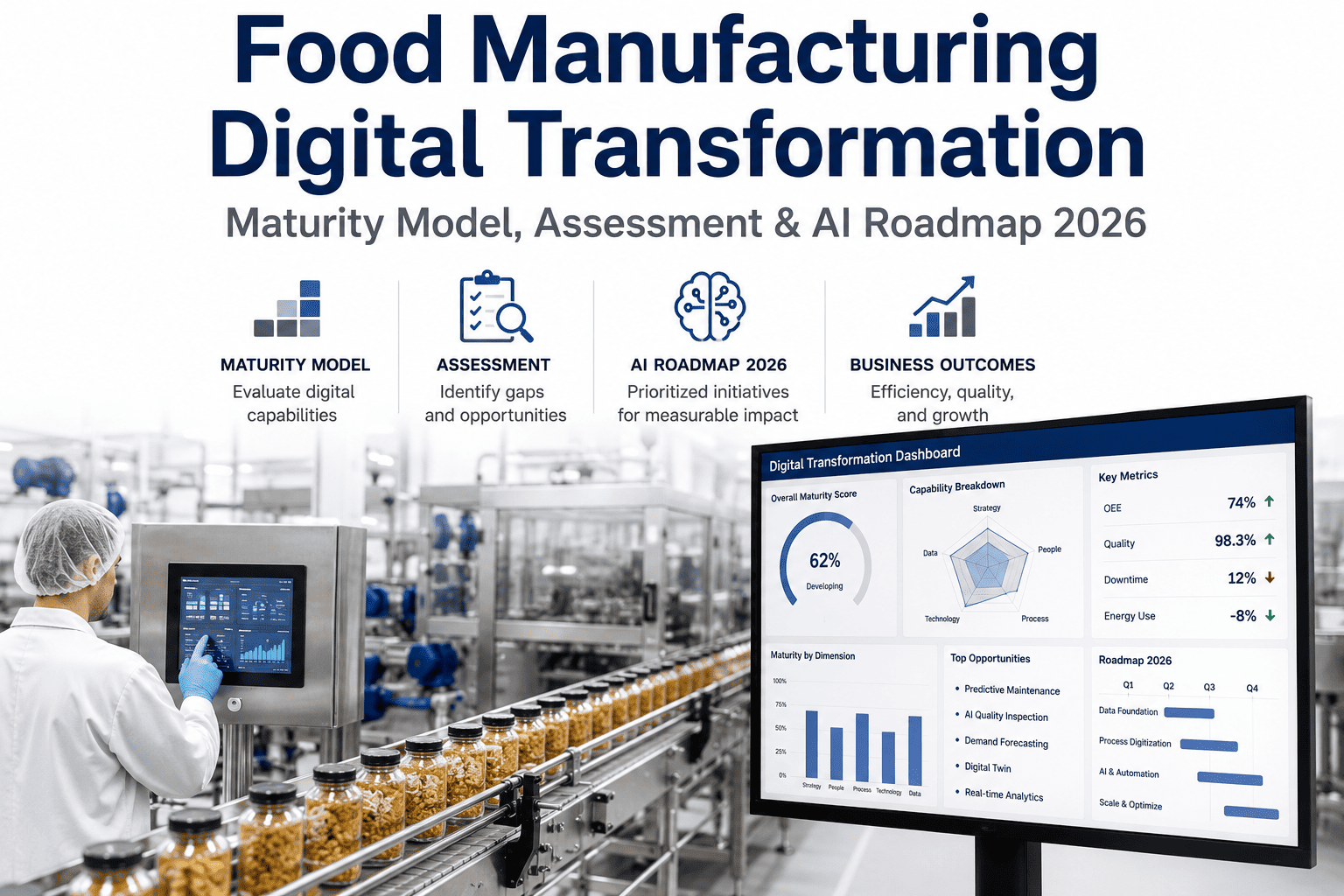
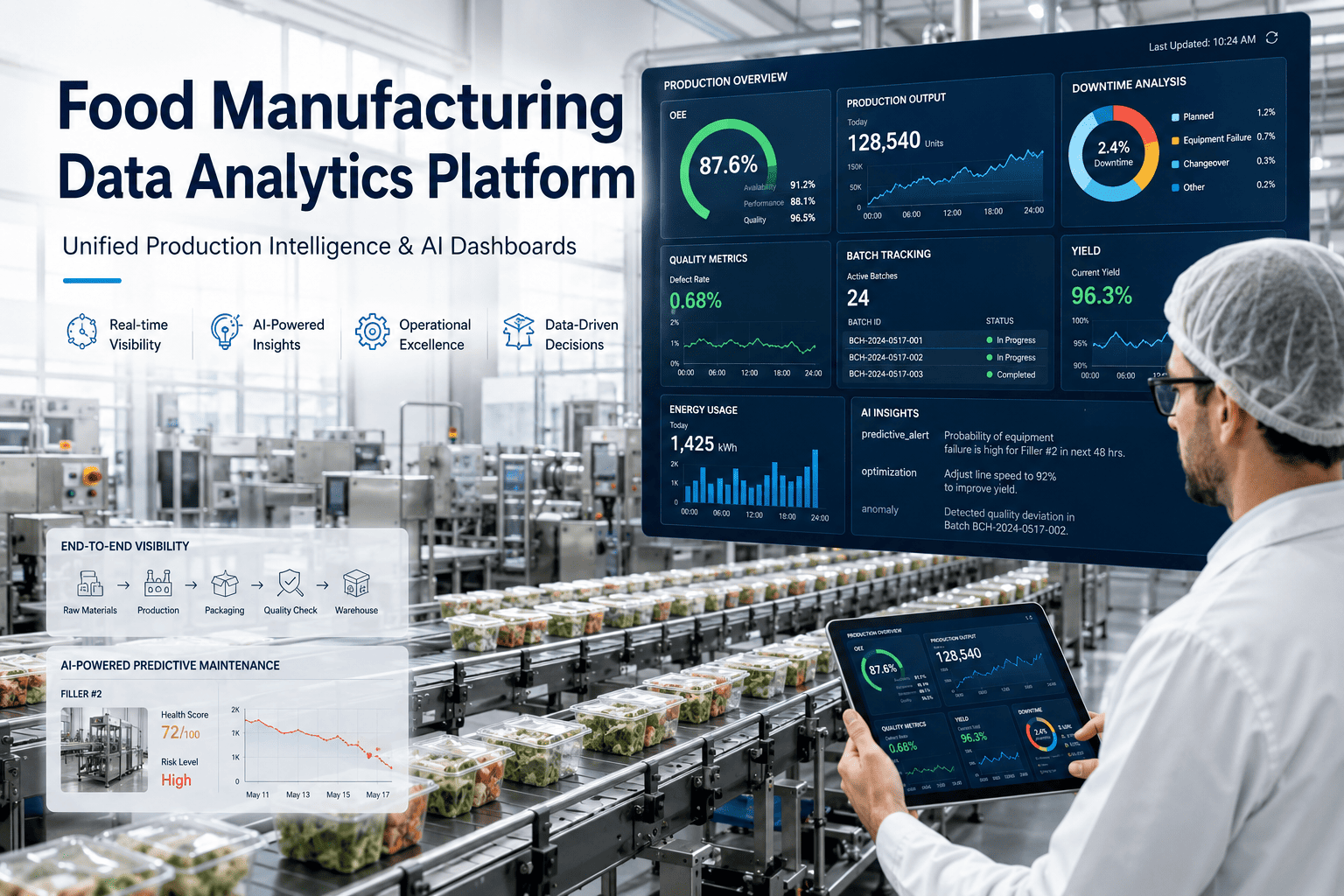
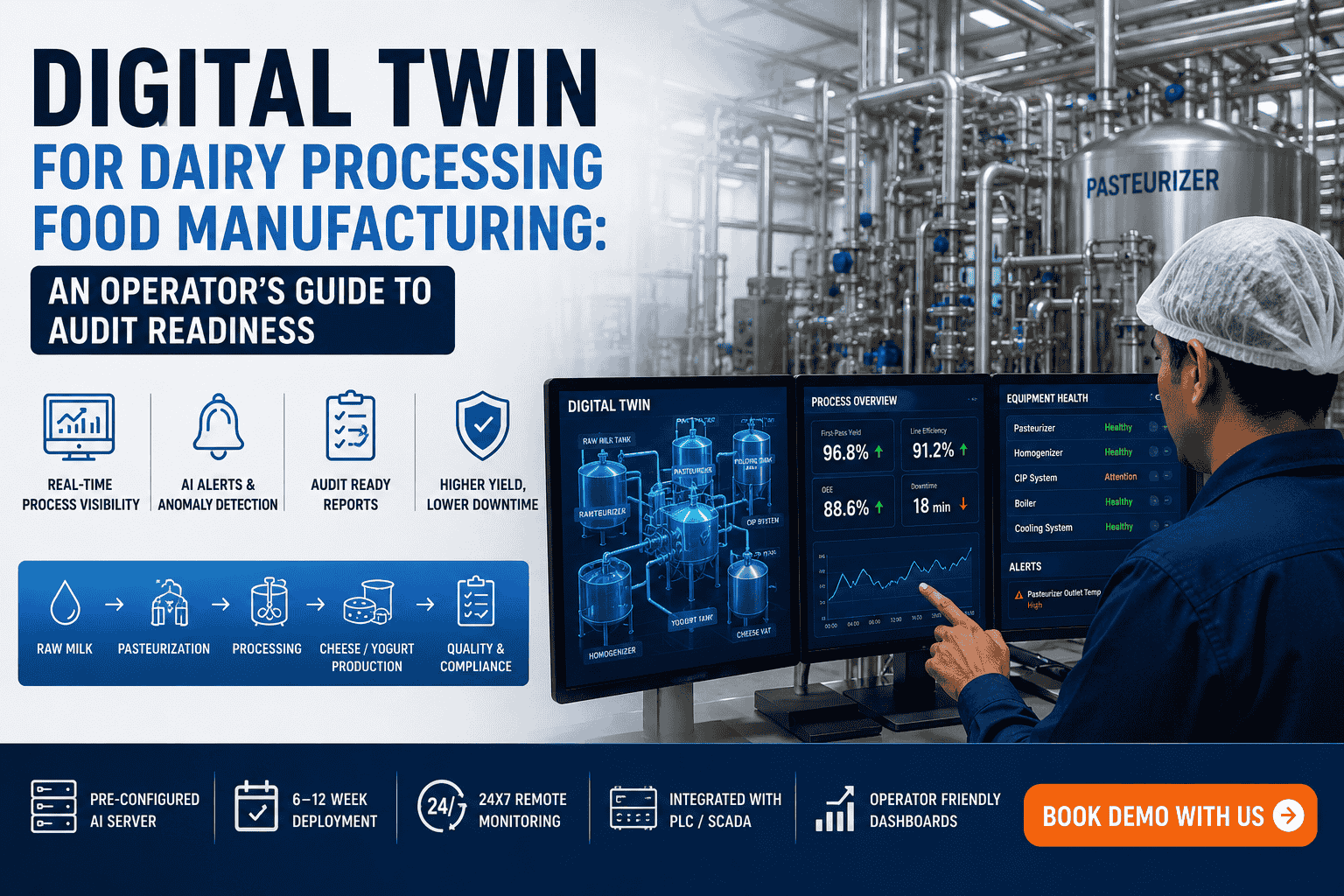
The smart factory label has become one of the most overused terms in food manufacturing today. Sensors on the floor, dashboards on the wall, and a cloud subscription in the budget — many plant managers believe these investments signal a completed digital transformation. The reality is far more sobering. Most food manufacturing facilities operating under the smart factory banner in 2026 are running sophisticated-looking technology on top of fundamentally fragmented, unreliable data infrastructure. The gap between the illusion of intelligence and genuine data-driven food plant operations is not just a maturity issue — it is an operational liability. Understanding where your facility truly stands on the AI readiness and digital transformation spectrum is the first step toward closing that gap. Book a demo to assess your plant's real data maturity today.
SMART FACTORY · DATA MATURITY · AI READINESS
Is Your Food Plant Truly Data-Driven — Or Operating Under a Smart Factory Illusion?
iFactory delivers genuine manufacturing intelligence — unified data, real-time visibility, and AI-powered analytics that transform food plants from technology-adopters into true data-driven operations ready for Industry 4.0.
The Smart Factory Gap — What Food Plants Think They Have vs. What They Actually Have
A 2026 industry assessment of mid-to-large food manufacturing operations found that over 74% of plants that self-identified as "smart factories" could not produce a complete, real-time view of production performance across a single shift without manual data compilation. They had sensors. They had dashboards. They had IoT devices collecting temperature, throughput, and equipment status. But the data lived in disconnected pockets — ERP systems that couldn't talk to MES platforms, quality databases isolated from production scheduling, and maintenance records existing entirely outside the analytics ecosystem.
This is the smart factory illusion in its most common form: technology investment without data integration, producing the appearance of intelligence without the substance of it. True data-driven manufacturing requires not just data collection but data unification, contextual correlation, and decision-ready analytics delivered at the moment and location where operational choices are made.
74%
of self-identified smart factories cannot generate real-time cross-functional performance visibility
6.3
average disconnected systems in food plants claiming digital transformation completion
82%
of operational decisions in "smart" food plants still rely on manual data pulls or tribal knowledge
4.2x
productivity gain gap between truly data-driven plants and those operating under the smart factory illusion
Maturity Assessment
The Five Stages of Smart Factory Maturity in Food Manufacturing — Where Does Your Plant Actually Sit?
Genuine AI readiness and Industry 4.0 transformation in food manufacturing follows a predictable maturity curve. Most facilities believe they are further along this curve than they actually are. Honest assessment against these five stages is the foundation of any meaningful digital transformation strategy. You can book a demo to benchmark your facility against these maturity levels with iFactory's diagnostic tools.
01
Data Collection Without Integration
The plant has invested in sensors, PLCs, and monitoring devices. Data is being collected at various points across the operation. However, data exists in separate systems with no automated flow between them. Reports are generated manually by pulling from multiple sources. Most food plants that believe they are "digital" are operating at this stage — mistaking data capture for data intelligence.
Where most food plants actually are
02
Connected Data With Reactive Visibility
Core operational systems are integrated into a unified data platform. Production, quality, and inventory data flows automatically. Management can view real-time dashboards without manual compilation. Alerts notify teams of deviations after they occur. This is the first genuine step toward a data-driven operation — but decisions are still largely reactive rather than predictive.
Foundation for true smart factory operations
03
Contextual Analytics With Cross-Functional Correlation
The platform correlates data across functions — linking equipment performance to quality outcomes, supplier inputs to production deviations, environmental conditions to yield rates. Analytics move beyond reporting to insight generation. Root cause analysis that previously required days of manual investigation is completed in minutes. The plant begins making data-informed decisions at the operational level, not just the management level.
Where Industry 4.0 benefits become measurable
04
Predictive Analytics With Proactive Intervention
Machine learning models trained on unified operational data begin identifying patterns that precede quality failures, equipment breakdowns, and yield losses — before the event occurs. Predictive analytics maturity at this stage means the plant is preventing problems rather than responding to them. Maintenance is scheduled based on actual performance degradation signals, not calendar intervals. Quality holds are triggered by pattern recognition, not failed test results.
True AI-driven manufacturing intelligence
05
Autonomous Optimization With Continuous Learning
The highest level of smart factory analytics maturity. The platform not only predicts issues but autonomously adjusts process parameters, schedules, and resource allocation to optimize outcomes in real time. Models continuously update based on new operational data. The facility operates as a genuinely self-improving system with human oversight focused on strategic decisions rather than operational firefighting. This is the frontier that leading food manufacturers are actively working toward in 2026.
The genuine smart factory destination
Root Causes
Why Food Plants Overestimate Their Digital Transformation Progress
The persistent gap between perceived and actual data-driven manufacturing maturity in food plants is not primarily a technology problem. It is a measurement problem combined with a definition problem. Facilities invest in technology and declare transformation complete — without ever defining what transformation actually looks like in operational terms. Understanding the specific misconceptions that create this gap is essential for any food manufacturer serious about genuine Industry 4.0 readiness. Many plants that reach out to book a demo with iFactory discover during the assessment that their current technology stack is Stage 1 despite years of investment.
Technology Investment Confused With Capability
Budget spent on IoT devices, cloud platforms, and enterprise software is often equated with achieved capability. In reality, technology without integration and adoption delivers sensors generating data that nobody uses and dashboards that nobody trusts. The investment creates the appearance of a smart factory without the operational reality of one.
Dashboard Proliferation Without Decision Support
Most food plants have more dashboards than they did five years ago. But dashboards that require interpretation, context knowledge, and manual cross-referencing to be meaningful are not analytics — they are electronic versions of paper reports. True manufacturing intelligence software delivers decision-ready insights at the point of action, not raw data visualization requiring expert interpretation.
Data Quality Assumptions That Don't Hold
Sophisticated analytics built on poor-quality data produce sophisticated-looking wrong answers. Many food plants discover during genuine maturity assessments that the data flowing into their analytics platforms is incomplete, inconsistently timestamped, or manually entered with error rates that make the outputs unreliable. AI readiness requires data quality infrastructure, not just analytical tools sitting on top of dirty data.
Pilot Project Permanence
Successful proof-of-concept projects on a single production line or within a single function get declared as facility-wide transformation achievements. The operational impact of a pilot that covered 8% of the facility's processes is real but limited — yet it becomes the justification for declaring digital maturity complete. True enterprise analytics platform deployment requires scaled integration across all critical processes, not isolated successes.
Vendor Certification as Capability Proxy
Implementation of a certified ERP, MES, or cloud platform is frequently positioned — by both vendors and internal champions — as achieving digital transformation. Software implementation and software utilization are entirely different achievements. Most food manufacturers use a fraction of the analytical capability available in their existing platforms because data integration, change management, and workflow redesign were not part of the deployment scope.
Operational Data Visibility Gaps
A plant can have excellent financial reporting and supply chain visibility while being completely blind to real-time operational data visibility on the production floor. When shift supervisors cannot answer basic questions about current OEE, active quality holds, or equipment status without making phone calls or checking clipboards, the smart factory infrastructure has failed at its most fundamental purpose regardless of what the board-level dashboards show.
Impact Analysis
The Real Cost of Operating Under the Smart Factory Illusion
The financial and operational cost of the gap between perceived and actual data-driven maturity in food manufacturing is measurable and substantial. These are the specific performance deficits that food plants operating under the smart factory illusion consistently experience — costs that are often invisible because there is no baseline measurement to compare against.
Smart Factory Illusion — Performance Gap Analysis 2026
Strategic Framework
Building Genuine Data-Driven Capability in Food Manufacturing — What Industry 4.0 Readiness Actually Requires
Closing the gap between smart factory appearance and smart factory reality requires a structured capability-building approach that addresses data infrastructure, process integration, and organizational adoption simultaneously. These are the foundational capabilities that genuinely data-driven food manufacturing operations have built — and that facilities still operating under the illusion have not yet addressed. Food plants serious about genuine transformation can book a demo with iFactory to begin building this foundation today.
01
Unified Data Architecture as the Foundation
Every analytical capability built on top of fragmented data infrastructure will eventually fail or mislead. The foundation of genuine smart factory analytics is a unified data layer that aggregates production, quality, equipment, supplier, and environmental data into a single source of truth with consistent identifiers, timestamps, and data quality validation. This is not about replacing existing systems — it is about creating a connected layer above them that makes their data collectively useful for the first time. Without this foundation, every analytics investment produces isolated insights rather than operational intelligence.
02
Process-Level Instrumentation Across All Critical Functions
True operational data visibility in food manufacturing means having reliable, automated data capture at every critical process point — not just the ones that were easy to instrument first. This includes manual processes that are frequently excluded from digital transformation projects because they are "too complex" to automate. Mixed-mode data environments that combine IoT sensor data with structured manual entry, vision systems, and third-party data feeds are the reality of mature food plant analytics architectures. Partial instrumentation produces partial visibility — and partial visibility still produces blind spots that drive operational decisions based on assumption rather than data.
03
Contextual Intelligence Over Raw Data Reporting
The transition from data reporting to manufacturing intelligence happens when analytics platforms begin delivering contextualized insight rather than raw metric visualization. A temperature reading is data. A temperature reading correlated with equipment age, recent maintenance history, ambient conditions, and the specific product being processed is intelligence. Food plants that reach genuine Stage 3 maturity have configured their analytics environments to automatically surface these contextual correlations — transforming what would have required expert analysis into standard operational output accessible to every shift supervisor and production manager.
04
AI Readiness Assessment Before AI Deployment
The majority of food plants that attempt to deploy
predictive analytics and AI maturity capabilities without first achieving Stage 2 data integration discover that their models are unreliable because the training data is incomplete, inconsistent, or biased by data collection gaps. A genuine
AI readiness assessment evaluates data completeness, quality, and coverage across all operational domains before committing to predictive model development — preventing the most expensive version of the smart factory illusion, where AI is deployed but trusted by nobody because its outputs regularly contradict what experienced operators know to be true. Facilities that
book a demo with iFactory receive a complimentary data readiness evaluation as part of the onboarding process.
05
Adoption Architecture — Getting Decisions Made From Data
The final and most frequently neglected component of genuine digital transformation in food manufacturing is adoption architecture — the systematic design of how analytics outputs reach decision-makers at the moment and location where decisions are made. Analytics platforms that require users to log in, navigate to the relevant view, interpret the visualization, and then act on it will not be used consistently under production pressure. Mature data-driven manufacturing operations deliver push-based insights to the right person at the right moment, integrated into the operational workflows they already use — rather than requiring behavior change to access a separate analytics system.
Industry Reality Check
A mid-sized protein processing facility in the Midwest had invested over $2.4 million in smart factory technology over three years — IoT sensors on every production line, a cloud-based analytics platform, and an upgraded MES. During an independent maturity assessment, evaluators discovered that 71% of operational decisions at the shift level were still being made based on supervisor experience rather than system data, primarily because the analytics platform required 4–6 minutes to load relevant dashboards under production network conditions. The data was being collected. The platform was running. But the intelligence was not reaching the decisions that mattered. After deploying iFactory's unified analytics architecture with push-based floor-level insight delivery, the same facility reduced unplanned downtime by 61% and improved OEE by 22 points within the first production quarter — without purchasing a single additional sensor. The technology was never the gap. The intelligence architecture was.
Book a demo to see how iFactory delivers decision-ready intelligence at the floor level.
Transformation Roadmap
From Smart Factory Illusion to Genuine Data-Driven Operations — A 90-Day Acceleration Plan
The transition from illusory to genuine smart factory maturity does not require replacing existing technology investments. It requires a structured integration and intelligence layer that makes current technology collectively useful for the first time. This 90-day acceleration framework delivers measurable maturity progression for food plants at any current stage of their digital transformation journey.
1
Days 1–15: Honest Maturity Assessment and Data Ecosystem Mapping
Conduct a structured audit of every data system currently in operation — not the systems that appear in the technology investment register, but the systems that operations teams actually use to make decisions. Map data flows, identify manual handoffs, and document where operational decisions are being made without reliable data support. The output of this phase is an honest current-state assessment and a prioritized integration roadmap based on operational impact rather than technology architecture preferences.
Outcome: Clear picture of actual vs. perceived maturity with quantified gap analysis
2
Days 16–45: Unified Data Foundation Deployment
Deploy the centralized data integration layer connecting highest-priority operational systems — production, quality, and equipment monitoring as the standard starting configuration. Establish data quality validation rules, consistent identifiers across systems, and automated data flow monitoring. Configure the first generation of cross-functional analytics covering the operational decisions that currently rely most heavily on manual data compilation. This phase moves the facility from Stage 1 to Stage 2 maturity with measurable impact on analytical reliability and decision speed.
Outcome: Reliable real-time visibility across core operational functions without manual compilation
3
Days 46–75: Contextual Intelligence and Process Optimization Analytics
Activate cross-functional correlation analytics that surface the relationships between operational variables — equipment performance and quality outcomes, ingredient variability and yield rates, environmental conditions and process stability. Configure automated root cause analysis workflows for the most frequent and highest-cost operational deviations. Deploy adoption-optimized insight delivery that pushes relevant intelligence to decision-makers within their existing operational workflows rather than requiring separate platform navigation. This phase advances the facility to Stage 3 maturity with measurable improvement in decision speed and process optimization outcomes.
Outcome: Data-driven root cause resolution in minutes, not days — across all critical operational functions
4
Days 76–90: Predictive Analytics Activation and Continuous Improvement Infrastructure
With a reliable unified data foundation established and validated over the first 75 days, activate predictive analytics models for the highest-impact operational domains — equipment failure prediction, quality deviation early warning, and yield optimization pattern recognition. Configure performance benchmarking against the baseline established during the assessment phase to produce quantified ROI documentation. Establish continuous improvement governance that ensures the analytics environment evolves with operational changes rather than becoming a static snapshot that loses relevance over time.
Outcome: Stage 4 predictive capability with documented, measurable ROI and continuous maturity progression infrastructure
GENUINE AI READINESS · 90-DAY TRANSFORMATION
Stop Investing in Smart Factory Appearances — Build Genuine Data-Driven Capability
iFactory's unified manufacturing intelligence platform closes the gap between smart factory illusion and operational reality — delivering genuine data integration, AI-powered analytics, and decision-ready intelligence that transforms how food plants perform, compete, and grow.
Frequently Asked Questions — Smart Factory Maturity and AI Readiness in Food Manufacturing
What is the smart factory illusion in food manufacturing?
It is the gap between investing in technology (IoT, dashboards) and achieving genuine operational intelligence. Most plants have data capture but lack the integration and architecture needed for real-time, data-driven decisions.
How do I assess my food plant's actual AI maturity level?
Evaluate five dimensions: data quality, system integration, analytics adoption, decision speed, and model trust. Most facilities discover their actual maturity is 1-2 stages below their self-assessed level.
Why do food plants overestimate their digital transformation progress?
Plants often mistake software implementation for capability. They allow successful pilots to proxy for facility-wide transformation without defining what "data-driven" actually means for their specific operational workflows.
What does genuine Industry 4.0 readiness look like for a food manufacturer?
It requires unified data, real-time cross-functional visibility, automated root cause analysis, and predictive models that floor teams trust. It is a state of operational capability, not a technology installation event.
Can a food plant advance from Stage 1 to Stage 3 maturity without replacing existing systems?
Yes. Modern intelligence platforms create a unified layer above existing ERP and MES systems via APIs. You can achieve Stage 3 maturity by integrating the data you already have, without replacing current infrastructure.
What ROI can food manufacturers expect from closing the smart factory maturity gap?
Manufacturers typically see 20% OEE gains, 70% downtime reduction, and 90% less compliance burden. Most platforms deliver full ROI within 6-12 months as predictive accuracy compounds over time.
Achieve Genuine Smart Factory Status in 2026
iFactory — Manufacturing Intelligence That Closes the Digital Transformation Gap
Most food plants are not as data-driven as they believe. iFactory's unified analytics platform delivers the integration, intelligence, and adoption architecture that transforms smart factory investments into genuine operational capability — measurable in OEE, quality performance, and competitive advantage from day one.
Honest AI maturity assessment with quantified gap analysis and prioritized roadmap
Unified data integration across all critical operational systems without replacing existing infrastructure
Real-time cross-functional visibility delivered at the moment and location of operational decisions
Predictive analytics models for equipment, quality, and yield optimization built on validated data
Push-based intelligence delivery integrated into existing operational workflows
90-day transformation framework with measurable maturity milestones and documented ROI