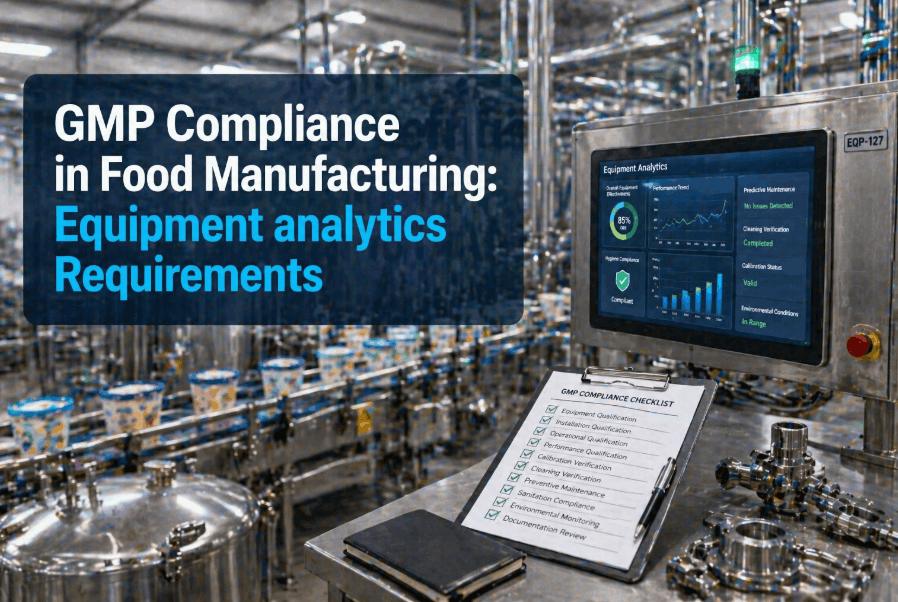
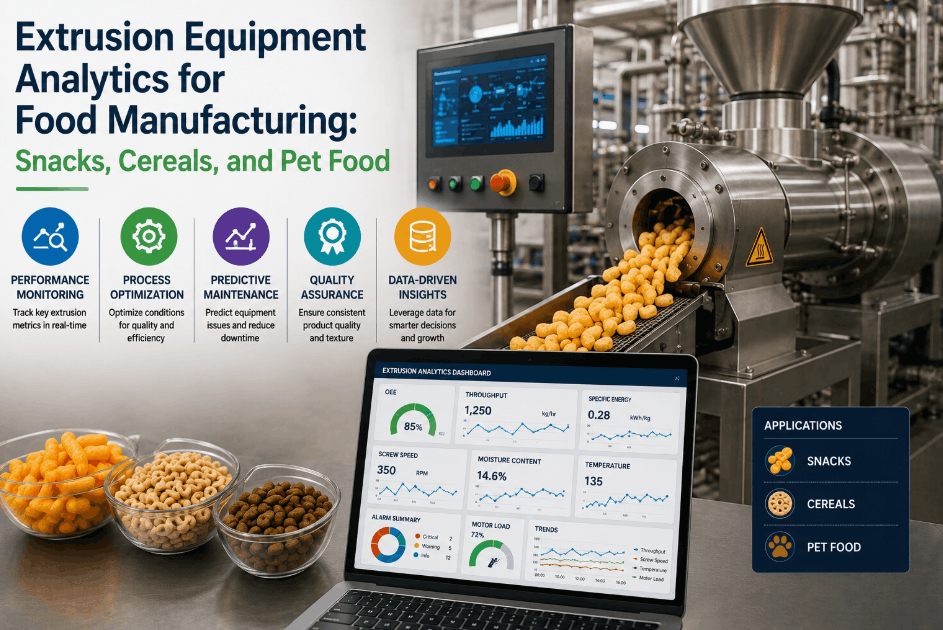
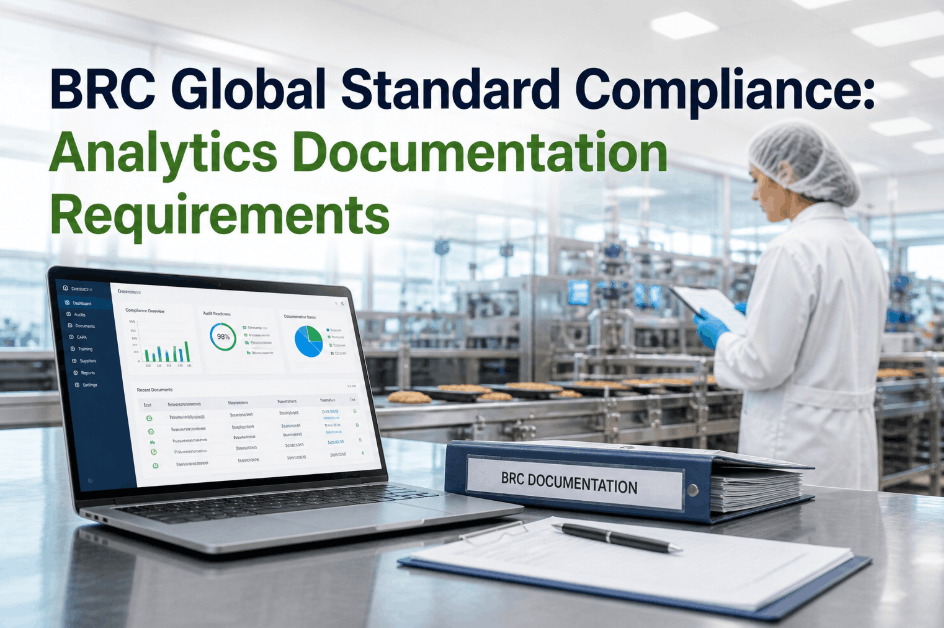
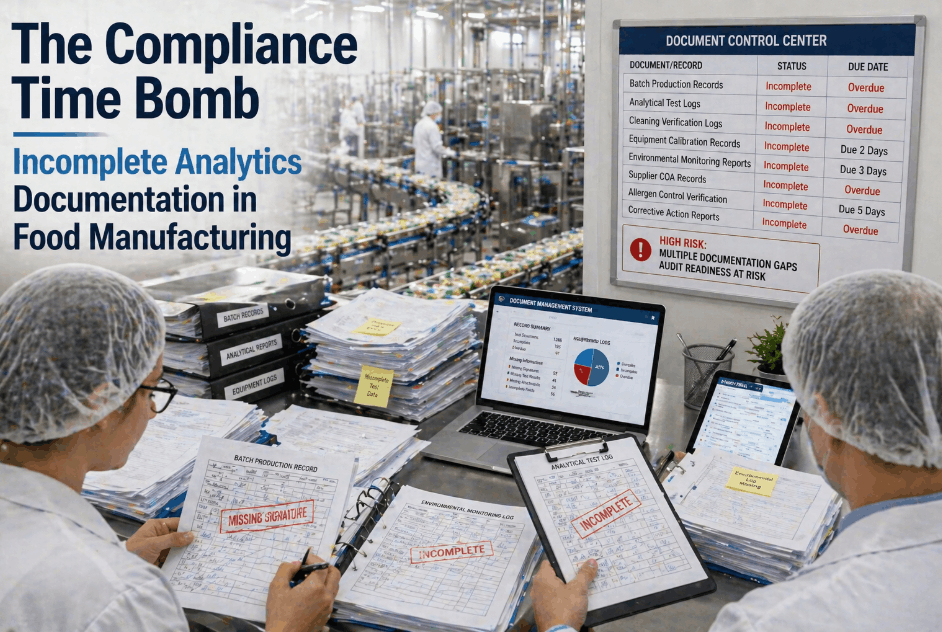
GMP compliance in food manufacturing is no longer a checkbox exercise — it is a real-time operational discipline that determines whether your facility passes an FDA CGMP audit or faces a Form 483 citation that halts production. Equipment analytics sits at the center of every good manufacturing practice requirement that touches calibration records, sanitation logs, and preventive maintenance documentation. As regulatory scrutiny of food plant operations intensifies under 21 CFR Part 110 and FSMA's preventive controls framework, compliance managers who rely on disconnected spreadsheets or manual record-keeping systems face an increasingly unsustainable compliance burden. If your GMP documentation process still depends on paper logs and end-of-shift data entry, Book a Demo to see how AI-driven equipment analytics eliminates your audit risk entirely.
GMP COMPLIANCE · FOOD MANUFACTURING · EQUIPMENT ANALYTICS
Achieve Audit-Ready GMP Compliance Across Every Asset in Your Food Plant
Give your compliance managers real-time calibration records, automated CGMP documentation, and AI-driven equipment analytics built for food manufacturing regulatory requirements.
Why GMP Compliance in Food Manufacturing Demands Real-Time Equipment Analytics
Good manufacturing practices establish the baseline standard for every process, material, personnel activity, and piece of equipment that touches food product. Under 21 CFR Parts 110 and 117, FDA inspectors evaluate not just whether procedures exist but whether your facility can demonstrate contemporaneous, traceable compliance evidence for every regulated event. Equipment calibration records, cleaning verification logs, and corrective maintenance documentation must be accurate, timestamped, and immediately retrievable — reflecting actual operational conditions, not reconstructed data entered hours after the fact.
Core CGMP Equipment Requirements: What Compliance Managers Must Document
The FDA's current good manufacturing practice regulations — codified across 21 CFR Part 110 and Part 117 for FSMA preventive controls — establish specific equipment analytics requirements that compliance managers must translate into documented, verifiable operational records. Compliance managers looking to close documentation gaps before their next FDA inspection can Book a Demo to review how iFactory maps to each CGMP equipment requirement category.
01
Equipment Design and Construction Standards
CGMP regulations require that food contact surfaces are constructed of nontoxic, non-absorbent materials that can withstand repeated cleaning and sanitizing. Equipment analytics platforms must capture asset specifications, material certifications, and design compliance records to provide complete GMP documentation coverage.
02
Calibration Record Keeping Requirements
Temperature sensors, pressure gauges, flow meters, and checkweighers used in critical control points must carry current calibration certificates traceable to NIST standards. GMP calibration requirements demand that out-of-tolerance findings trigger corrective action records and that calibration history is retained for a minimum of two years.
03
Cleaning and Sanitization Documentation
Every cleaning and sanitization event must be documented with chemical concentrations, contact times, water temperatures, and verification method results. Documentation gaps in this category are among the top five FDA Form 483 citation drivers in food plants under FSMA preventive controls requirements.
04
Preventive Maintenance Documentation Under GMP
GMP compliance requires that equipment maintenance schedules are documented, followed, and verifiable. Food plants must demonstrate that PM tasks were completed on schedule, deviations were captured and justified, and maintenance activities do not introduce contamination risk into food contact environments.
05
Corrective Action Records for Equipment Failures
When equipment deviates from GMP specifications, the corrective action must be documented with root cause analysis, immediate containment, and verification of effectiveness. GMP analytics documentation must link the deviation event, the corrective action record, and the return-to-service sign-off in a single traceable workflow.
06
Supplier and Parts Qualification Records
Food-grade lubricants, replacement gaskets, and cleaning chemicals used in GMP environments must come from qualified suppliers with documentation confirming food-safe formulations. Equipment analytics systems that track parts consumption at the work order level create a natural repository for supplier qualification records.
GMP Food Plant Audit Readiness: The Documentation Gap That Gets Facilities Cited
FDA food plant inspections under FSMA have shifted from procedure-review audits to evidence-based inspections. An inspector arriving at your facility today will request your actual calibration records for the past 12 months, corrective maintenance logs for equipment at critical control points, and cleaning verification data for the prior 90 days. If those records exist in paper form or with gaps between when events occurred and when they were documented, you have created a compliance finding before the inspector reaches the production floor. Compliance managers can Book a Demo to walk through a live audit readiness assessment using iFactory's GMP analytics platform.
67%
Of FDA food plant Form 483 citations involve documentation gaps in equipment maintenance or calibration records
3.4×
Higher corrective action closure rate for facilities using digital GMP equipment analytics vs. paper-based systems
91%
Calibration record completeness on first retrieval with AI-driven documentation vs. 58% in manual CMMS environments
40%
Reduction in pre-inspection documentation preparation time when GMP analytics records are captured in real time
AI-Driven GMP Compliance: How Automation Transforms Equipment Analytics
Artificial intelligence is reshaping how food manufacturers approach GMP compliance documentation — not by replacing human judgment but by eliminating the administrative burden that prevents compliance managers from applying their expertise where it matters most. AI-driven platforms automate calibration scheduling and record capture, corrective action routing and closure tracking, and regulatory report generation for FDA inspection readiness — all without manual intervention. To see this workflow in a live food plant environment, Book a Demo with iFactory's GMP compliance team.
GMP Calibration Requirements: Building a Traceable Calibration Program
Calibration management is the single most technically demanding component of GMP equipment compliance. The FDA's expectation is that calibration is performed on a documented schedule, by qualified personnel, using reference standards traceable to NIST, and that any out-of-tolerance finding triggers an impact assessment covering every product batch produced since the last successful calibration.
| Instrument Type |
GMP Calibration Frequency |
Traceability Requirement |
Out-of-Tolerance Action |
Retention Period |
| Temperature Sensors (CCP) |
Monthly or per batch frequency |
NIST-traceable reference thermometer |
Product hold + root cause + batch impact assessment |
Minimum 2 years |
| Pressure Gauges (Retort / CIP) |
Quarterly or per process validation |
Dead weight tester or calibrated reference gauge |
Maintenance work order + process review |
Minimum 2 years |
| Checkweighers / Fill Weight |
Start of each production shift |
Certified reference weights (Class F or better) |
Line stop + weight verification + records correction |
Minimum 1 year |
| pH Meters (Acidified Foods) |
Prior to each use with 2-point calibration |
NIST-traceable buffer solutions with certificate |
Product quarantine + re-test + disposition record |
Minimum 3 years (21 CFR 114) |
| Metal Detectors / X-Ray |
Hourly sensitivity verification |
Certified test wands per equipment spec |
Line stop + product segregation + service call |
Minimum 2 years |
| Flow Meters (CIP Chemistry) |
Semi-annually or per SOP trigger |
Calibrated master meter or volumetric reference |
CIP validation review + sanitation risk assessment |
Minimum 2 years |
GMP Record Keeping Best Practices for Food Manufacturing Compliance Managers
The FDA's standard for GMP record keeping has three dimensions compliance managers must address simultaneously: completeness, contemporaneity, and retrievability. Digital GMP analytics documentation systems address all three by design — mobile capture ensures contemporaneous records, mandatory field completion enforces completeness, and cloud-based storage delivers instant retrievability during any FDA inspection.
Best Practice
Contemporaneous Capture at the Point of Activity
GMP records must reflect what actually happened, when it happened. Mobile work order platforms that require technicians to close records at the asset create the contemporaneous documentation standard that FDA inspectors expect. Retroactive record entry is a common source of data integrity findings during inspections.
Best Practice
Mandatory Field Completion Logic
GMP documentation completeness is best enforced at the system level, not through supervisor review. Digital platforms that prevent work order closure without mandatory fields — failure mode code, corrective action description, approver sign-off — eliminate the blank-field citations that appear regularly in food plant FDA inspection reports.
Best Practice
Electronic Signature and Approval Workflows
21 CFR Part 11 electronic records requirements apply to food manufacturers using digital GMP documentation systems. Compliant platforms must support user-specific electronic signatures with audit trail timestamps, ensuring every approval is attributed to a specific individual and preserved as an immutable record.
Best Practice
Cross-Referenced Equipment Histories
GMP auditors routinely request the complete maintenance and calibration history for a specific asset. Equipment analytics platforms that maintain asset-level history linking every calibration event, corrective action, and PM completion allow compliance managers to respond to these requests in seconds rather than hours.
Integrating GMP Equipment Analytics with FSMA Preventive Controls Documentation
FSMA's preventive controls for human food rule requires that food manufacturers establish, implement, and verify preventive controls for each identified hazard in the food safety plan. GMP calibration records, PM completion data, and corrective maintenance documentation must flow into FSMA verification activities — quarterly preventive control reviews, annual reanalyses, and supplier verification records — in a traceable, auditable format that AI-driven GMP analytics platforms deliver by design. Compliance managers ready to close the gap between FSMA requirements and current documentation practices can Book a Demo to see how iFactory unifies GMP and FSMA compliance in a single platform.
Transform Your Food Plant's GMP Compliance with AI-Driven Equipment Analytics
Give your compliance managers real-time calibration records, automated CGMP documentation, and audit-ready GMP analytics — all in one platform built specifically for food manufacturing.
Frequently Asked Questions: GMP Compliance in Food Manufacturing
What are the primary GMP equipment analytics requirements under 21 CFR Part 117?
21 CFR Part 117 requires equipment to be adequately maintained, properly designed, and documented to prevent contamination. Analytics requirements include calibration records, maintenance schedules, sanitation documentation, and corrective action records — all retained as contemporaneous records retrievable during FDA inspection.
How does AI-driven GMP compliance differ from traditional CMMS-based documentation?
Traditional CMMS platforms handle scheduling and work orders but lack regulatory compliance logic. AI-driven GMP platforms add automatic routing, mandatory field enforcement, electronic signatures, and FSMA verification report generation — eliminating manual data extraction and spreadsheet reconciliation for compliance managers.
What GMP calibration records must be retained and for how long?
FSMA requires calibration records at critical control points to be retained for a minimum of two years; low-acid canned food operations under 21 CFR Part 113 require three years. All records must be available for FDA review within 24 hours of a written request.
How do digital GMP analytics platforms handle multi-site food manufacturing compliance?
Multi-site platforms give corporate compliance managers centralized visibility across all facilities — enabling cross-site calibration benchmarking, standardized documentation templates, and unified audit report generation to identify and close GMP gaps network-wide.
Can GMP equipment analytics platforms integrate with existing ERP or food safety management systems?
Yes. Modern platforms integrate with SAP S/4HANA, Oracle EAM, and Microsoft Dynamics via REST API and OData connectors. Calibration certificates, maintenance records, and corrective action documentation sync bidirectionally — eliminating duplicate data entry between maintenance and quality management systems.
What is the most common GMP compliance documentation failure in FDA food plant inspections?
The most common failure is incomplete or retroactive record entry — where documentation reflects when records were entered rather than when the activity occurred. Digital GMP platforms resolve this by requiring mobile capture at the point of activity with automatic, unalterable timestamps.
READY TO ELIMINATE YOUR AUDIT RISK?
Start Your GMP Compliance Transformation Today
iFactory's AI-driven GMP equipment analytics platform gives food manufacturing compliance managers complete audit-ready documentation — from calibration records to FSMA preventive control verification — in one unified system.