Artificial intelligence is fundamentally changing how food manufacturers detect and prevent equipment failure. Traditional reactive and calendar-based maintenance models leave plant directors blind to the subtle mechanical degradation that occurs deep inside rotating assets—degradation that builds silently until it triggers catastrophic, costly downtime. AI-powered anomaly detection software now gives reliability engineers the ability to identify hidden failure patterns in food production lines weeks before a physical breakdown occurs, transforming the way the industry manages asset health, operational risk, and production continuity. If your facility is still operating without a predictive intelligence layer, Book a Demo to see how AI fault detection can be deployed across your production environment in weeks.
Why Hidden Equipment Failure Patterns Devastate Food Production Lines
In food manufacturing, unplanned downtime is not simply an operational inconvenience—it is a compounding financial event. A single unexpected failure on a high-speed filling line or a primary processing pump can cost facilities between $50,000 and $250,000 per hour when factoring in lost product, emergency labor, expedited parts, and customer penalties. The core problem is that most of these failures are not sudden. They are the result of slow-developing failure patterns—microscopic mechanical changes in bearing surfaces, gradual gearbox misalignment, and early-stage motor winding degradation—that conventional maintenance programs simply cannot detect.
Condition monitoring systems powered by AI change this dynamic entirely. By continuously analyzing high-resolution vibration signatures, thermal gradients, and motor current draw against a trained baseline, machine learning models can identify statistical anomalies that are invisible to human inspectors and unreachable by periodic manual checks. This is the foundation of modern reliability engineering software: not responding to failure, but predicting and preventing it with data-driven precision.
Bearing Degradation Signatures
AI models track the specific frequency signatures of early-stage inner and outer race defects in rolling element bearings—detecting sub-millimeter wear patterns weeks before they escalate into catastrophic seizure events on critical conveyor and pump assets.
Detection window: 4–8 weeks earlyMechanical Misalignment Drift
Rotational misalignment between motor shafts and driven components generates a characteristic 2x harmonic in vibration spectra. Pattern recognition software identifies this signature before it causes accelerated bearing wear, seal failure, and coupling destruction.
Detection window: 2–6 weeks earlyRotor Imbalance Accumulation
In food processing environments, product buildup and blade erosion on fans and centrifuges causes progressive rotor imbalance. AI anomaly detection software tracks 1x vibration amplitude trends over time, flagging imbalance accumulation before it damages shaft bearings.
Detection window: 1–4 weeks earlyGearbox Tooth Wear Patterns
Gear mesh frequencies and their harmonics carry precise diagnostic information about tooth wear, lubrication breakdown, and pitch errors inside gearboxes. Industrial analytics platforms trained on food manufacturing failure data extract these patterns from raw vibration waveforms with exceptional accuracy.
Detection window: 3–10 weeks earlyThe Mechanics of AI Anomaly Detection in Industrial Equipment Monitoring
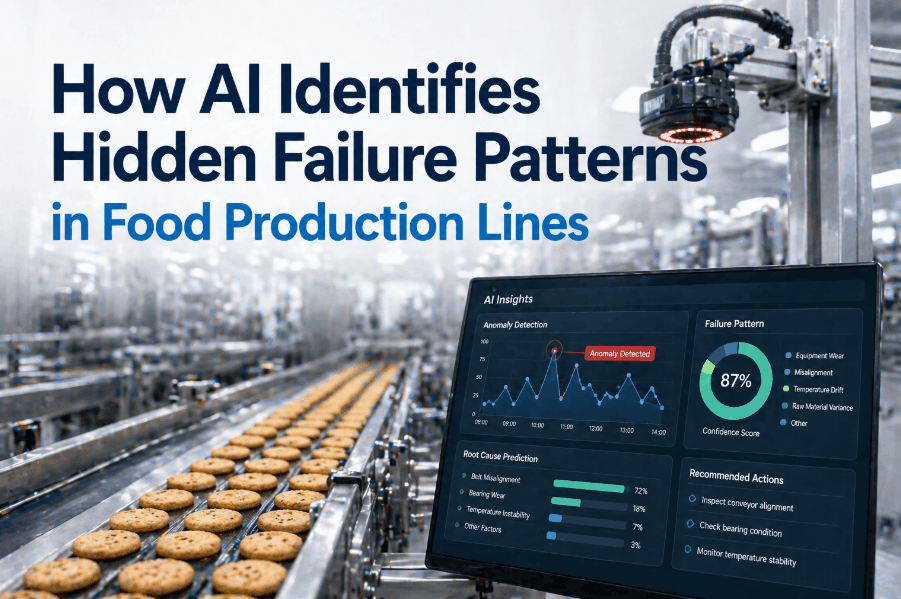
Understanding how predictive maintenance software detects hidden failure patterns requires a look at the underlying AI architecture. Unlike rule-based threshold systems that simply trigger alarms when a vibration reading exceeds a fixed limit, modern AI fault detection platforms use multi-layer machine learning models that learn the normal operational fingerprint of each individual asset and detect statistically significant deviations—even when overall vibration levels remain within conventional alarm limits. This distinction is what separates genuine predictive intelligence from simple monitoring systems.
From Raw Sensor Data to Actionable Failure Intelligence
The process begins at the sensor level. High-frequency vibration sensors—sampling at rates between 10kHz and 100kHz—capture the full mechanical signature of rotating assets. This raw data is then processed through a digital signal processing pipeline that performs Fast Fourier Transform (FFT) analysis, converting time-domain waveforms into frequency spectra where individual failure modes appear as distinct peaks. The AI engine then applies trained neural network models to these spectral maps, comparing current readings against the asset's historical baseline to calculate an anomaly score in real time. Facilities that want to see this process applied to their own equipment can Book a Demo and receive a live walkthrough of their asset data within 48 hours of sensor deployment.
High-Frequency Data Acquisition
Wireless MEMS vibration sensors capture sub-millisecond mechanical data across all axes from motors, pumps, gearboxes, and conveyors—transmitting continuously to the edge computing gateway without interrupting production.
Edge-Level Signal Processing
The edge gateway performs real-time FFT analysis, extracting frequency-domain features including gear mesh frequencies, bearing defect frequencies, and sub-synchronous components before transmitting compressed feature vectors to the cloud AI engine.
AI Anomaly Scoring and Pattern Recognition
Machine learning models—trained on millions of food manufacturing failure events—score each asset's current spectral signature against its established healthy baseline, producing a continuously updated Asset Health Index that reflects the true mechanical condition of each component.
Predictive Alert and Work Order Generation
When the anomaly score exceeds a statistically calibrated threshold, the platform automatically generates a predictive maintenance work order—including a diagnostic summary, estimated time-to-failure, and recommended corrective action—pushed directly to your CMMS or mobile maintenance team.
Critical Asset Failure Modes AI Detects in Food Manufacturing Environments
Food production environments present unique challenges for condition monitoring systems. Washdown cycles, temperature fluctuations, product contamination, and variable loading profiles all influence the mechanical behavior of rotating assets. AI fault detection models trained specifically on food industry data are calibrated to distinguish genuine failure signatures from process-induced vibration variations—dramatically reducing false alarms while maintaining maximum detection sensitivity for true mechanical degradation events.
| Asset Type | Primary Failure Mode | AI Detection Method | Typical Early Warning Window | Consequence if Missed |
|---|---|---|---|---|
| Processing Pumps | Cavitation & Impeller Wear | Sub-synchronous vibration + acoustic emission analysis | 3–6 weeks | Catastrophic seal failure, product contamination |
| Conveyor Drive Motors | Bearing Fatigue & Winding Degradation | BPFI/BPFO frequency tracking + thermal trending | 4–8 weeks | Full line stoppage, emergency motor replacement |
| Filling Line Gearboxes | Gear Tooth Wear & Lubrication Breakdown | Gear mesh frequency harmonic analysis | 6–12 weeks | Gearbox seizure, multi-day production loss |
| Centrifuges & Separators | Rotor Imbalance & Bowl Wear | 1x amplitude trending + phase analysis | 2–5 weeks | Structural damage, safety incident risk |
| Packaging Machines | Cam & Follower Wear | High-frequency envelope analysis + pattern deviation scoring | 3–7 weeks | Product quality defects, regulatory non-compliance |
| Refrigeration Compressors | Valve Wear & Refrigerant Leak Onset | Pressure wave analysis + current signature monitoring | 5–10 weeks | Cold chain failure, entire batch loss |
Quantifying the Financial Value of AI-Driven Equipment Failure Prediction
For plant directors and finance teams evaluating predictive maintenance software, the business case must be built on concrete, measurable returns—not theoretical capabilities. The financial value of AI fault detection is generated across three distinct layers: immediate downtime avoidance, sustained throughput improvement, and long-term capital rationalization. Facilities that have deployed industrial IoT monitoring platforms with AI anomaly detection consistently report transformative improvements across all three layers within the first 12 months of operation.
Average reduction in unplanned production stoppages achieved by detecting and resolving hidden failure patterns before they escalate to asset failure events.
Overall Equipment Effectiveness improvement driven by eliminating chronic micro-stoppages, slow-running equipment, and extended recovery times after unplanned events.
Reduction in total maintenance expenditure by eliminating emergency repair premiums, overnight freight costs, and the waste of unnecessary preventive component replacements.
Average critical asset lifecycle extension achieved by identifying and correcting mechanical stressors early, before they cause irreversible internal component damage.
Why One Prevented Failure Justifies the Entire Platform Investment
The most compelling financial argument for AI-driven production line monitoring software is the "single-event ROI" calculation. For high-volume food manufacturers, a single undetected gearbox failure on a primary processing line—factoring in 16–24 hours of lost production, emergency parts procurement, overtime labor, product disposal, and customer penalty clauses—frequently costs between $150,000 and $600,000 in a single event. The total cost of deploying a predictive intelligence platform across an entire facility is typically $50,000–$200,000. The math is unambiguous: one prevented catastrophic failure pays for the entire system. Reliability engineers at facilities ready to build this business case can Book a Demo to receive a facility-specific ROI projection based on your equipment inventory and production volume.
Deploying AI Condition Monitoring Systems Without Disrupting Production Operations
One of the most common concerns plant directors raise about deploying industrial analytics platforms is the fear of complex, disruptive implementation processes that interfere with production schedules. Modern AI-powered asset performance management solutions address this directly through non-intrusive, wireless-first deployment architectures that can be fully operational on a facility's most critical assets within 48 to 72 hours—without stopping a single production line or requiring integration with existing PLC or SCADA systems as a prerequisite.
Wireless Sensor Deployment
Industrial-grade wireless vibration, temperature, and current sensors are mounted directly to asset housings using magnetic or adhesive mounts—a process that takes 15–30 minutes per asset and requires no electrical work, no production stoppage, and no modification to existing equipment.
Duration: 48–72 hoursAI Baseline Learning Period
The AI engine automatically learns the normal operational signature of each asset across all operating modes and load conditions during a 2–4 week learning period, establishing the statistical baseline against which all future anomaly detection is calibrated for maximum accuracy and minimal false alarms.
Duration: 2–4 weeksActive Predictive Intelligence
Once the baseline is established, the platform enters active predictive mode—continuously monitoring all assets, scoring anomalies in real time, and generating prioritized work orders automatically. The system continues to refine its failure prediction accuracy as it accumulates more operational data over time.
Ongoing · Self-improvingReal-World Applications of AI Pattern Recognition in Food Production Reliability
The value of manufacturing intelligence software is best understood through the specific operational scenarios it resolves. These are not edge cases—they are the daily reliability challenges that maintenance and operations teams in food manufacturing confront every production shift. Pattern recognition software transforms each of these scenarios from unpredictable crises into manageable, scheduled maintenance activities. Plant directors who want to see how these scenarios apply to their own asset inventory can Book a Demo for a live review of their production environment with our reliability engineers.
Separator Bowl Imbalance Detection
AI vibration analytics continuously tracks the rotational balance of high-speed centrifugal separators operating at 6,000–9,000 RPM. Early detection of progressive bowl imbalance—caused by product scale buildup—enables planned maintenance interventions that prevent catastrophic bowl failures and the associated safety risks, production losses, and multi-day repair downtime.
Key metric: Rotor imbalance trendingFilling Valve Wear Pattern Recognition
High-speed filling machines cycle thousands of times per hour, and the gradual wear of filling valve actuators creates subtle but detectable changes in the acoustic and vibration signature of each cycle. AI anomaly detection identifies these wear patterns before they cause fill volume variability, product quality failures, and the batch-level disposition decisions that devastate margin.
Key metric: Cycle-to-cycle pattern deviationConveyor Drive Gearbox Health Monitoring
Baking and snack production lines rely on complex networks of conveyor systems where a single gearbox failure can stop an entire production sequence. Condition-based monitoring using AI gear mesh frequency analysis detects lubrication breakdown and early tooth wear—enabling maintenance teams to replace gearbox components during planned downtime windows rather than emergency stoppages.
Key metric: Gear mesh harmonic amplitudeHow AI Failure Pattern Detection Serves Every Level of the Food Manufacturing Organization
Deploying operational risk management technology in a food manufacturing environment requires alignment across multiple stakeholders—each of whom has different priorities, success metrics, and concerns. The strategic advantage of AI-powered predictive maintenance software is that it generates value simultaneously for every stakeholder group, converting a technical reliability investment into an enterprise-wide business performance improvement. Plant directors seeking to align their leadership teams around a data-driven reliability strategy can Book a Demo to see how the platform addresses each stakeholder's specific concerns with live data.
Zero-Surprise Production Scheduling
Real-time asset health dashboards give operations leadership complete visibility into the mechanical condition of every critical production asset—enabling confident production scheduling, accurate customer commitments, and capital allocation decisions that are grounded in actual equipment data rather than maintenance team estimates.
Condition-Based Work Order Prioritization
AI-generated predictive alerts replace reactive work orders with structured, prioritized maintenance schedules that are driven by actual equipment condition—not calendars. Maintenance teams shift from emergency firefighting to planned precision work, reducing overtime, technician burnout, and the cognitive burden of constantly triaging competing urgent repairs across the facility.
Total Cost of Ownership Transparency
Detailed asset health history and failure prediction data give finance teams the ability to build accurate total cost of ownership models for every critical asset—quantifying the true economic case for repair versus replacement, optimizing spare parts inventory levels, and creating data-backed justifications for capital expenditure decisions that the entire leadership team can support.
AI Anomaly Detection & Predictive Maintenance — Frequently Asked Questions
How accurate is AI fault detection compared to manual vibration analysis?
AI-powered anomaly detection platforms trained on large food manufacturing datasets consistently achieve detection accuracy above 95% for major rotating equipment failure modes—outperforming periodic manual vibration analysis by detecting failures weeks earlier and eliminating the variability introduced by different analyst skill levels and inconsistent measurement intervals.
Can AI condition monitoring work on legacy equipment without existing sensors or PLCs?
Yes. Modern industrial IoT monitoring platforms are explicitly designed for mixed-age production environments. Wireless MEMS vibration sensors can be added to any rotating asset regardless of age, manufacturer, or communication capability—bringing full AI condition monitoring to 30-year-old motors and gearboxes alongside modern automated lines with no modifications required.
How long does it take for the AI model to start detecting failure patterns accurately?
Basic anomaly scoring begins within 48 hours of sensor deployment. Full predictive accuracy—where the AI model has learned the normal operational envelope of each asset across all load conditions and production modes—is typically achieved within 3 to 6 weeks of continuous data collection, after which detection reliability compounds as the model accumulates more failure event data.
What is the difference between anomaly detection and traditional vibration threshold alarms?
Traditional threshold alarms trigger only when a vibration level exceeds a fixed absolute limit—which typically means the asset is already in an advanced failure state. AI anomaly detection identifies statistically significant deviations from each asset's individual normal baseline, enabling detection of genuine failure patterns at vibration levels that remain well below any conventional alarm threshold, providing weeks of additional response time.
Does the platform integrate with SAP PM, Maximo, or other CMMS systems?
Full CMMS integration is a core platform capability. Predictive work orders—including failure diagnosis, severity rating, and recommended corrective action—can be automatically pushed to SAP Plant Maintenance, IBM Maximo, UpKeep, MP2, and other major CMMS platforms, ensuring that AI-generated insights immediately result in actionable maintenance tasks without manual data entry or workflow delays.
How does AI failure detection support food safety and regulatory compliance?
Continuous, timestamped asset health records generated by AI condition monitoring platforms provide auditable documentation of equipment performance and maintenance actions that directly supports FDA, FSMA, and BRC compliance requirements. High-fidelity mechanical health records demonstrate proactive risk management and due diligence during regulatory inspections and customer audits—reducing both compliance risk and insurance liability exposure.