In 2026, food manufacturers relying on legacy systems face a critical inflection point — aging PLCs, siloed SCADA data, and disconnected ERP records generate enormous operational data volumes that traditional monitoring tools were never designed to interpret. Building a predictive analytics AI layer on top of existing systems in food manufacturing bridges that gap without requiring a full infrastructure overhaul. By adding an intelligent integration layer above your current asset stack, you unlock real-time condition monitoring, failure prediction, and cross-system data fusion that transforms raw plant-floor data into competitive operational intelligence. If you're ready to see this in action, book a demo and explore how AI integration fits your existing architecture.
Add Predictive AI to Your Existing Food Manufacturing Systems
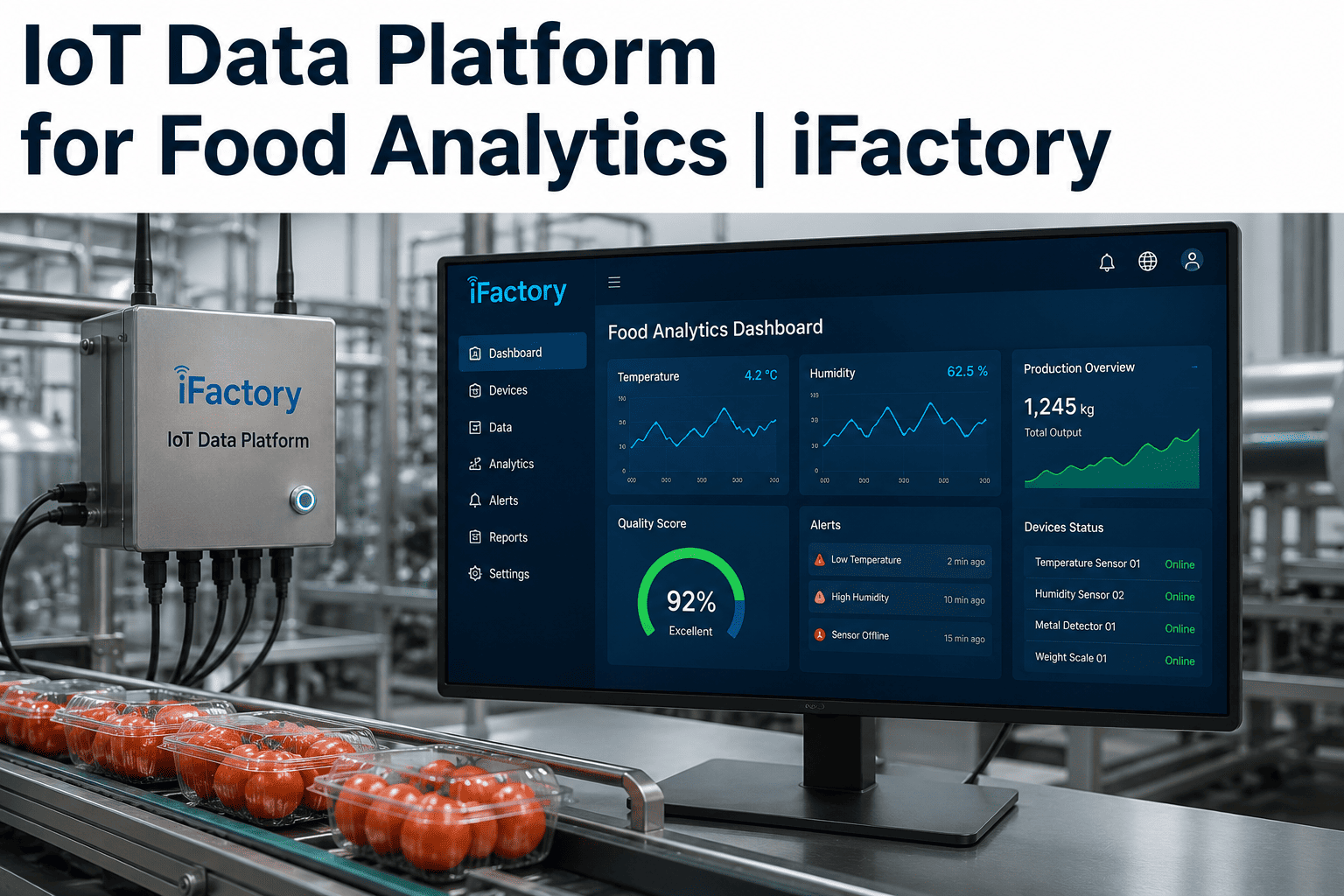
iFactory's AI integration platform overlays your current SCADA, ERP, and PLC infrastructure with real-time predictive analytics, asset health scoring, and automated compliance documentation — no rip-and-replace required.
Why Food Manufacturers Need a Predictive Analytics AI Layer Now
Food processing operations are caught between two realities: the machines running their lines were installed a decade ago, and the competitive and regulatory expectations placed on those lines belong firmly to 2026. Older filling systems, conveyors, heat tunnels, and packaging equipment were designed around fixed-interval maintenance schedules — schedules that have no way of knowing a bearing is developing an inner race defect or that a sealer's heating element is losing thermal consistency two weeks before a quality deviation occurs. A predictive analytics software layer solves this without requiring facilities to abandon functional infrastructure by sitting above existing control systems and reading their output streams, applying machine learning models trained on equipment-specific failure signatures to score asset health in real time. Food manufacturers exploring this approach can book a demo to see exactly how the overlay architecture connects to their specific equipment mix.
What "Overlaying" an AI Layer Actually Means in Practice
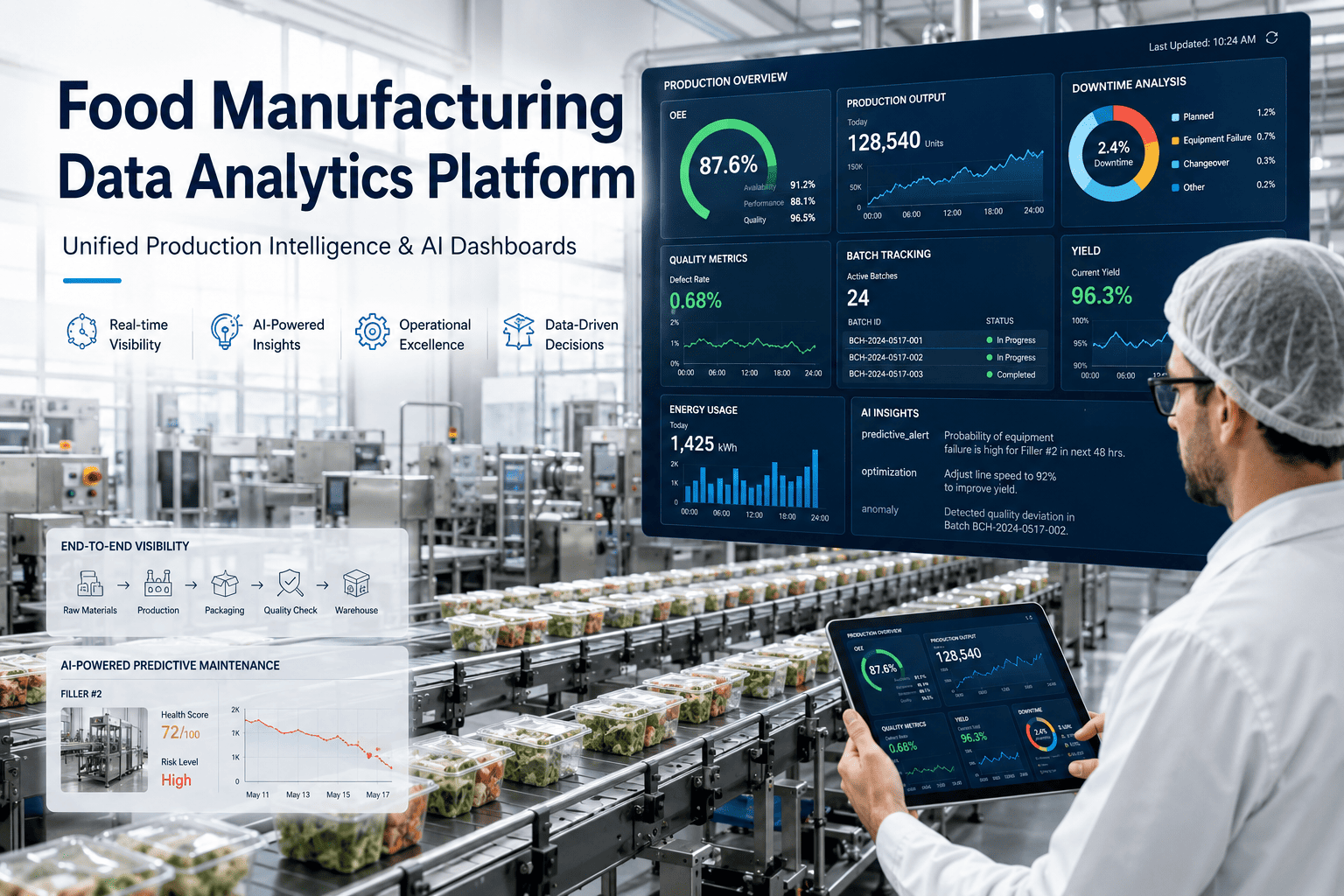
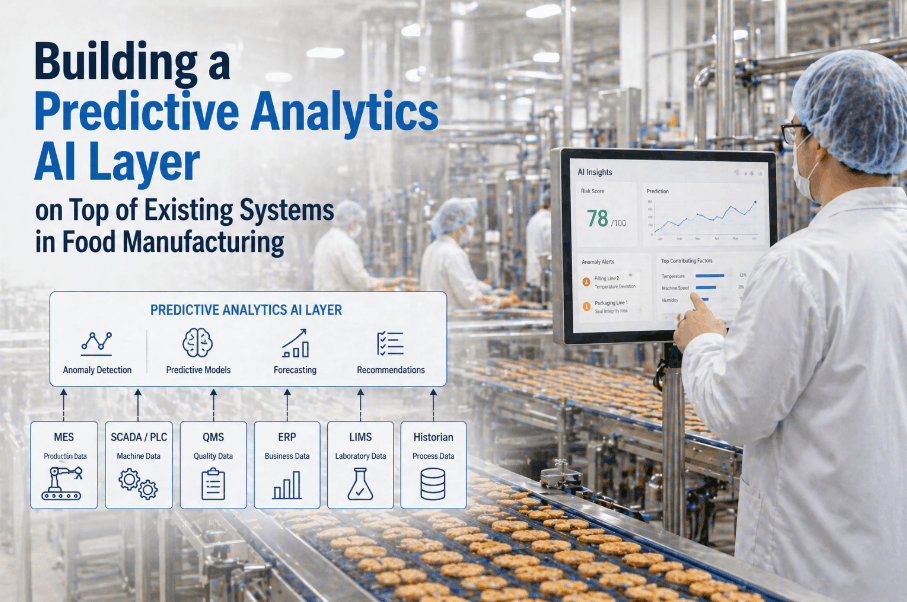
The concept of an AI integration platform overlay is often misunderstood as another software installation on top of an already complex stack. In practice, a well-designed predictive AI overlay connects to existing data outputs — OPC-UA tags from PLCs, historian feeds from SCADA systems, batch records from MES platforms, and maintenance logs from ERP systems — through lightweight edge connectors that require no modifications to the source systems. The AI layer aggregates these disparate data streams into a unified operational data model, applies anomaly detection and failure prediction algorithms, and surfaces actionable alerts to maintenance, quality, and operations teams through a single manufacturing intelligence dashboard. Teams do not manage the source systems differently; they simply gain a layer of intelligence that interprets their existing data in ways those source systems were never designed to deliver. Facilities wanting to understand how this connector architecture maps to their current infrastructure can book a demo for a live integration walkthrough.
Unified Manufacturing Data Integration
Edge connectors pull real-time data from OPC-UA, Modbus, MQTT, and proprietary historian protocols simultaneously — normalizing signals from equipment across different vintages and vendors into a single operational data model without requiring PLC reprogramming or SCADA modification.
Equipment-Specific Failure Prediction Models
Machine learning models are trained on the specific operational signatures of each asset class — fillers, sealers, conveyors, heat exchangers, compressors — learning the vibration, thermal, electrical, and process patterns that distinguish healthy operation from developing fault states weeks before failure events.
Severity-Scored Predictive Maintenance Alerts
Rather than binary alarm thresholds, the AI layer scores asset health continuously on a 0–100 scale, tracking trend velocity and projecting failure timelines so maintenance teams can prioritize interventions by consequence severity, remaining useful life, and scheduled production windows.
Automated FSMA and HACCP Documentation Generation
Every equipment health event, process deviation alert, and maintenance response is automatically timestamped and archived in structured regulatory records — continuously generating the FSMA Preventive Controls documentation, HACCP verification logs, and corrective action records that food safety audits require.
Critical Integration Points: Where the AI Layer Connects to Existing Systems
Effective legacy system integration for predictive analytics in food manufacturing requires connecting the AI layer at multiple system tiers simultaneously — a single integration point captures only a fraction of the operational intelligence available across the plant floor. The most valuable AI deployments fuse data from equipment sensors, control systems, quality databases, and maintenance platforms into a correlated operational picture that no single source system can provide independently. Food manufacturing operations teams investigating integration scope can book a demo for a live integration mapping session against their current system architecture.
Real-Time Process Data Fusion and Anomaly Detection
SCADA historians contain decades of process trend data that most facilities have never analyzed beyond manual review. The AI layer ingests historian feeds continuously, applying unsupervised anomaly detection to identify process behavior deviations that precede equipment failures or product quality events — turning archival process data into a live early-warning system.
Maintenance History Correlation with Predictive Health Scores
Connecting the AI layer to ERP and CMMS work order history allows failure prediction models to incorporate actual maintenance event data — learning how specific interventions affect equipment health trajectories and improving future prediction accuracy while simultaneously auto-generating work orders when asset health scoring triggers predefined maintenance thresholds.
Equipment Health to Product Quality Correlation Analytics
Integrating the AI layer with LIMS and SPC quality databases enables bidirectional intelligence — correlating equipment health score trajectories with product specification deviation histories to identify which equipment degradation patterns drive which quality outcomes, creating a process optimization software capability that scheduled maintenance programs cannot replicate.
Supplemental Sensor Deployment for Unmonitored Asset Classes
For equipment not currently wired to SCADA or historian systems, non-invasive IIoT sensors add vibration, temperature, current draw, and acoustic monitoring at the edge — feeding the AI layer the raw signal data needed to build health models for asset classes that were previously invisible to operational analytics programs.
AI Layer vs. Traditional Monitoring: Food Manufacturing Performance Comparison
The operational case for adding a predictive analytics software overlay is most clearly framed against the limitations of the legacy monitoring approaches it replaces — the comparison below shows performance differences across the dimensions that matter most for food manufacturing reliability, food safety compliance, and maintenance cost efficiency.
| Operational Dimension | Legacy / Scheduled Monitoring | AI Predictive Analytics Layer | Operational Impact |
|---|---|---|---|
| Failure Detection Timing | At breakdown or fixed inspection interval | Days to weeks before failure event | Eliminates production-stopping unplanned outages |
| Data Source Coverage | Single-system siloed view | Cross-system fused operational model | Root cause identification across equipment and process layers |
| Legacy System Compatibility | Requires costly system upgrades | Non-invasive overlay on existing systems | Full analytics capability without infrastructure replacement |
| Compliance Documentation | Manual records, paper logs | Automated digital audit trail generation | Continuous FDA and FSMA audit readiness |
| Quality Correlation | Retrospective batch review | Real-time equipment-to-quality correlation | Quality deviations prevented before product is affected |
| Maintenance Trigger | Calendar schedule or failure event | Condition-based asset health threshold | Right-time maintenance eliminates premature and emergency cost |
| Multi-Site Visibility | Site-by-site manual reporting | Enterprise-wide asset performance dashboard | Benchmark performance across facilities in real time |
Deployment Roadmap: Implementing a Predictive AI Layer in a Food Plant
The most common barrier to deploying an industrial IoT platform overlay in food manufacturing is not technical complexity — it is deployment sequencing. Facilities that attempt full-plant integration in a single project phase consistently face integration delays, change management challenges, and extended time-to-value periods. Phased deployment models that begin with highest-consequence assets and expand coverage as initial ROI is validated have consistently outperformed big-bang implementations across every measured performance dimension. Facilities ready to build their deployment roadmap can book a demo to review a phased integration plan tailored to their specific asset mix and system architecture.
System Discovery and Priority Asset Integration
Integration connectors are mapped to existing SCADA historian feeds, PLC data outputs, and ERP maintenance records. Non-invasive sensors are deployed on highest-consequence assets during scheduled downtime windows. AI models begin ingesting baseline operational data for the priority asset tier with no production interruption required.
Model Calibration and Alert Workflow Deployment
Machine learning models establish equipment-specific health baselines across full production cycles, including product changeovers and seasonal raw material variation. Alert severity scoring is calibrated to each asset's actual operating profile. Maintenance team workflows are connected to AI-generated work order triggers for seamless CMMS integration.
Coverage Expansion and Continuous Intelligence Improvement
AI models continuously improve prediction accuracy as equipment history accumulates. Monitoring coverage expands to secondary asset tiers, quality system integrations deepen, and enterprise-wide benchmarking becomes available as multi-site deployments come online — building toward full enterprise analytics platform capability across the manufacturing network.
Common Challenges Food Manufacturers Face Without Predictive AI — and How the AI Layer Solves Them
Most food manufacturing facilities are not struggling because they lack data — they are struggling because the data they already generate is fragmented across systems that never talk to each other. Maintenance teams work from one platform, quality teams from another, and production supervisors from a third, with no unified view of how equipment health, process variation, and product quality outcomes connect. This operational fragmentation is the root cause behind most recurring downtime events, quality escapes, and compliance documentation gaps that food plants experience year after year. Understanding how an AI integration layer directly addresses each of these challenges is the clearest path to building the internal business case for investment. Operations leaders ready to map these challenges to their own facility can book a demo and review a gap analysis tailored to their current operational architecture.
Recurring Unplanned Downtime Despite Regular Scheduled Maintenance
Scheduled maintenance intervals are designed around average failure rates, not the actual condition of individual assets operating under specific load, temperature, and throughput profiles. Equipment that is degrading faster than the schedule anticipates fails between service windows — and no amount of increasing maintenance frequency eliminates this gap without condition-based monitoring. The AI layer detects degradation in real time, replacing schedule-driven replacement with data-driven intervention that eliminates the category of failures that scheduled maintenance structurally cannot prevent.
Quality Deviations Traced Back to Equipment Degradation After the Fact
When a filling line produces out-of-spec product weights or a heat tunnel delivers inconsistent seal integrity, quality teams investigate the equipment after the deviation has already occurred and product has already been affected. The AI layer inverts this sequence by correlating equipment health score trajectories with historical quality deviation events — identifying the equipment conditions that predictably precede quality failures so that corrective action happens before product specification is breached, not after batch disposition decisions have already been made.
FDA and FSMA Audit Preparation Consuming Weeks of Manual Documentation Work
Regulatory audit preparation in food manufacturing plants typically triggers weeks of manual record compilation — pulling maintenance logs from CMMS, CCP records from quality systems, and corrective action documentation from email threads and paper binders. The AI layer eliminates this preparation burden by generating structured, timestamped, audit-ready documentation continuously — so that when an FDA inspector or third-party SQF auditor arrives, the complete compliance record is already assembled and searchable, not assembled under time pressure.
No Visibility into Equipment Performance Trends Across Multiple Production Sites
Food manufacturers operating more than one facility face an additional challenge that single-site operations do not: the inability to compare asset performance, maintenance cost patterns, and reliability outcomes across plants in a consistent, real-time way. Each site runs its own SCADA system, its own CMMS, and its own maintenance culture — making enterprise-level performance benchmarking practically impossible without manual data extraction and spreadsheet consolidation. The AI layer creates a unified enterprise asset performance management view that surfaces cross-site reliability benchmarks, identifies best-practice facilities, and flags underperforming sites before their reliability gaps become financial events.
Digital Transformation in Food Manufacturing: The Compounding Returns of AI Integration
Digital transformation in manufacturing is not a single-event initiative — it is a compounding capability-building process where each layer of integration makes the next layer more valuable. Year one of a predictive AI overlay delivers immediate unplanned downtime reduction and compliance documentation improvement. Year two surfaces the equipment-to-quality correlations that enable systemic process optimization. Year three and beyond unlocks the enterprise benchmarking and cross-facility reliability engineering insights that turn operational analytics into a genuine competitive advantage. Food manufacturers who delay AI integration are not just missing short-term efficiency gains — they are deferring the baseline capability accumulation that longer-term operational leadership requires. Operations teams ready to begin that journey can book a demo and see the full platform in action with a live integration demonstration.
Ready to Add Predictive AI Intelligence to Your Existing Systems?
iFactory's manufacturing intelligence platform overlays your current SCADA, ERP, PLC, and IIoT infrastructure with real-time predictive analytics, automated compliance documentation, and cross-system operational intelligence — delivering measurable ROI from your first priority asset tier without replacing a single existing system.
Frequently Asked Questions: Predictive Analytics AI Layer for Food Manufacturing
Can a predictive AI layer connect to our existing SCADA and historian systems without modification?
Yes. Modern AI integration platforms use standard industrial protocols — OPC-UA, Modbus, MQTT, and proprietary historian APIs — to read existing data outputs without requiring any changes to source system configurations, PLC programming, or SCADA architecture. The overlay model is specifically designed for non-invasive deployment on production infrastructure.
How long does it take to see predictive maintenance alerts after initial AI layer deployment?
Priority asset monitoring typically produces calibrated predictive alerts within 4–8 weeks of initial deployment, following a baseline modeling period during which AI models learn each asset's normal operational signatures across full production cycles. Alert accuracy improves continuously as equipment history accumulates over subsequent months.
What food manufacturing systems does the AI overlay integrate with most commonly?
The most common integration points include SCADA historian systems, ERP maintenance modules (SAP PM, Oracle, Infor), CMMS platforms (Maximo, eMaint), LIMS quality databases, and direct PLC data feeds via OPC-UA. Supplemental IIoT sensor layers are added for equipment not currently wired to existing control systems.
Does adding a predictive AI layer help with FSMA Preventive Controls compliance documentation?
Yes. AI platforms automatically generate equipment maintenance records, process deviation logs, corrective action documentation, and verification records that map directly to FSMA Preventive Controls requirements — eliminating manual record entry while creating a continuous, audit-ready documentation trail for FDA inspections and third-party food safety certification audits.
What ROI can food manufacturers expect from a predictive analytics AI overlay investment?
ROI is driven by unplanned downtime elimination, emergency maintenance cost reduction, extended equipment service life, product quality improvement from equipment-to-quality correlation analytics, and avoided food safety events. For mid-to-large food processing facilities, preventing two to three unplanned line stoppages per quarter typically covers full platform investment within the first twelve months.