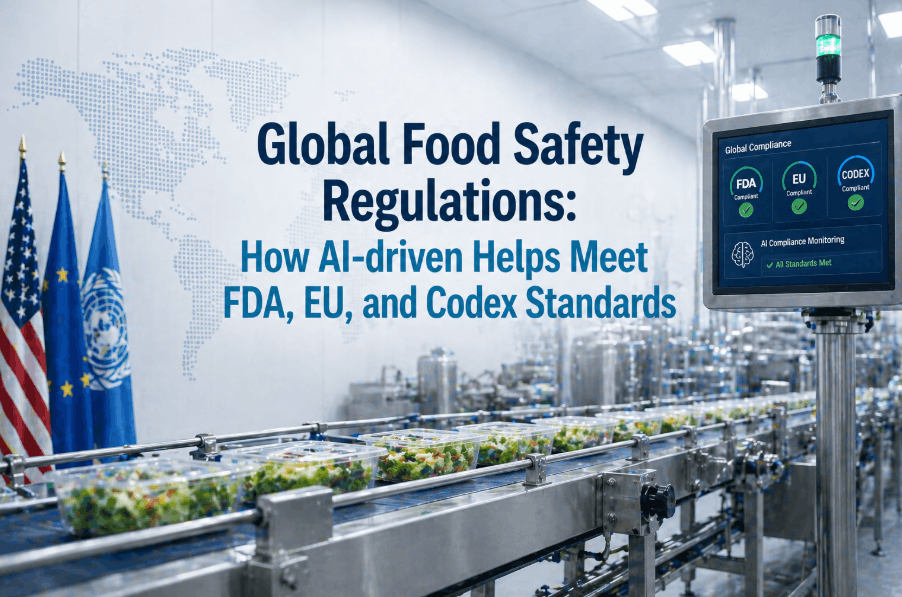
Global food safety regulations have never been more complex — or more consequential. In 2026, food manufacturers exporting across multiple markets must simultaneously satisfy FDA FSMA requirements, EU Regulation 852/2004 hygiene mandates, and Codex Alimentarius international food standards, each with distinct documentation obligations, hazard analysis frameworks, and audit expectations. The compliance gap between these jurisdictions is where recalls happen, export licenses are revoked, and market access disappears overnight. AI-driven compliance platforms are now enabling QA and Regulatory Directors to manage multi-jurisdictional food safety requirements from a single operational intelligence layer — reducing audit preparation time by up to 60 percent and closing the documentation gaps that regulators identify most frequently. To see how AI-driven global compliance works across FDA, EU, and Codex frameworks in a live food manufacturing environment, Book a Demo with the iFactory team today.
Understanding Global Food Safety Regulations in 2026
Why Multi-Jurisdictional Compliance Is the Defining Challenge for Food Exporters
The international food trade system operates under a patchwork of regulatory frameworks that share common scientific foundations — hazard analysis, preventive controls, traceability — but diverge significantly in implementation requirements, documentation formats, and enforcement approaches. A food manufacturer exporting packaged goods from Southeast Asia to the United States, the European Union, and markets governed by Codex Alimentarius standards must maintain compliance with three distinct regulatory architectures simultaneously, each of which carries its own inspection regime, labeling requirements, and recall protocol obligations. Understanding where these frameworks align and where they conflict is the starting point for building a compliance system that does not collapse under multi-market audit pressure.
FDA Food Safety Regulations: FSMA Requirements for Global Exporters
How the Food Safety Modernization Act Shapes International Food Compliance Obligations
The U.S. Food Safety Modernization Act represents the most significant restructuring of American food safety law since the 1930s — and its extraterritorial reach makes it the single most consequential regulatory framework for any food manufacturer exporting to the United States market. FSMA's Preventive Controls for Human Food rule requires foreign facilities to implement a written Food Safety Plan that identifies hazards, establishes preventive controls, defines monitoring procedures, and documents corrective actions. The Foreign Supplier Verification Program (FSVP) extends FDA oversight to importers who must verify that foreign suppliers produce food at a standard equivalent to U.S. safety requirements. For QA directors managing FDA food regulations compliance, the documentation burden is substantial: FSMA requires that records be maintained for two to three years and made available to FDA within 24 hours of a request. AI-driven compliance systems that auto-generate FSMA-aligned documentation from production and quality data dramatically reduce this administrative burden — and food manufacturers looking to understand how this works in practice can Book a Demo to review a live FSMA documentation workflow.
EU Food Safety Regulations: Navigating the European Regulatory Framework
EU Regulation 852/2004 and the Hygiene Package Requirements for Food Manufacturers
European Union food safety law operates through a comprehensive regulatory architecture known as the Hygiene Package, anchored by EU Regulation 852/2004 on the hygiene of foodstuffs. This framework establishes Hazard Analysis and Critical Control Points (HACCP) as a mandatory legal obligation for all food business operators — not a voluntary best practice — and requires documented prerequisite programs, HACCP plans, and verification procedures maintained with sufficient detail to satisfy European Food Safety Authority (EFSA) oversight and national competent authority inspections. The EU food safety framework is further layered with Regulation 853/2004 for animal-origin products, Regulation 854/2004 for official controls, and a cascade of specific directives governing contaminants, additives, labeling, and traceability. Food exporters entering the EU market must also comply with General Food Law Regulation 178/2002, which establishes the one-step-back, one-step-forward traceability requirement that enables rapid market withdrawal when safety incidents occur. The complexity of maintaining continuous alignment with this regulatory ecosystem — while simultaneously managing FDA FSMA obligations — is precisely the operational challenge that AI-driven international food compliance platforms are designed to solve.
Codex Alimentarius: The International Food Standards Framework
How Codex Food Standards Underpin Global Food Export Compliance
The Codex Alimentarius Commission, jointly administered by the Food and Agriculture Organization (FAO) and the World Health Organization (WHO), develops the international food standards, guidelines, and codes of practice that form the scientific and technical reference point for food safety regulation in 187 member countries. While Codex standards are not directly legally binding in the way that FDA regulations or EU directives are, they carry enormous practical weight: the World Trade Organization's Agreement on Sanitary and Phytosanitary Measures (SPS Agreement) explicitly identifies Codex standards as the international benchmark against which national food safety measures are evaluated in trade disputes. For food exporters, this means that Codex Alimentarius compliance effectively functions as the baseline that grants presumptive legitimacy to food safety claims across markets that have adopted Codex standards into their domestic regulatory frameworks — which includes the majority of emerging market export destinations in Asia, Africa, Latin America, and the Middle East. QA Directors building multi-jurisdictional compliance programs can Book a Demo to review how AI-driven platforms map Codex general principles to operational control documentation.
FDA vs. EU vs. Codex: A Regulatory Comparison for Food Safety Directors
Key Differences and Alignment Points Across International Food Compliance Frameworks
Understanding the structural differences between these three regulatory frameworks is essential for QA and Regulatory Directors designing compliance management systems that satisfy all three without creating redundant documentation burdens or dangerous compliance gaps. The table below maps the most operationally significant comparison points across FDA FSMA, EU Regulation 852/2004, and Codex Alimentarius General Principles of Food Hygiene.
| Compliance Dimension | FDA FSMA (U.S.) | EU Regulation 852/2004 | Codex Alimentarius |
|---|---|---|---|
| Hazard Analysis Framework | Preventive Controls — written Food Safety Plan required | HACCP — mandatory legal obligation with documented plan | HACCP — foundational guideline (CAC/RCP 1-1969) |
| Legal Binding Status | Legally enforceable U.S. federal law | EU Regulation — directly applicable in member states | Reference standard; adopted into national law by member states |
| Traceability Requirement | Product traceability under Food Safety Plan records | One step back / one step forward (Reg. 178/2002) | General traceability principles; no specific chain requirement |
| Record Retention Period | 2–3 years; available within 24 hours on request | Varies by product; typically 2–5 years | Recommended best practice; market-specific requirements apply |
| Foreign Supplier Oversight | FSVP — importer verification required | Official controls at point of entry; importer responsibility | Export certification guidelines under specific commodity standards |
| Allergen Labeling | FASTER Act — 9 major allergens | EU 1169/2011 — 14 allergen categories | General standard for labelling of prepackaged foods (CODEX STAN 1) |
| Inspection Authority | FDA — federal inspection right; mandatory foreign facility registration | National competent authorities; RASFF alert system | No direct inspection authority; national bodies enforce adopted standards |
How AI-Driven Platforms Solve Multi-Jurisdictional Food Safety Compliance
Mapping Regulatory Requirements to Operational Controls With AI Compliance Intelligence
The fundamental operational challenge of managing simultaneous FDA FSMA, EU food safety, and Codex Alimentarius compliance is not a knowledge problem — QA Directors typically understand what each framework requires. It is a systems problem: the documentation, monitoring, verification, and reporting workflows required by three distinct regulatory frameworks generate a compliance administration burden that human teams cannot sustain without introducing documentation gaps, version control failures, and response lag times that regulators identify during audits. AI-driven global compliance platforms address this challenge by creating a unified data layer that captures production quality events, equipment condition data, and process control records once — and then automatically generates the jurisdiction-specific documentation formats required by each regulatory framework. Food manufacturers ready to evaluate this approach for their specific multi-market compliance architecture can Book a Demo and see a live mapping of their regulatory obligations to AI-generated compliance outputs.
Building a Global Food Safety Compliance Program: Implementation Roadmap
A Phased Approach to Multi-Jurisdictional Food Regulatory Compliance
Constructing a compliance management system that simultaneously satisfies FDA FSMA, EU food safety regulations, and Codex Alimentarius requirements is a structured organizational undertaking — not a software deployment exercise. The roadmap below reflects the implementation sequence that QA and Regulatory Directors have used most successfully to build durable multi-jurisdictional compliance programs without disrupting ongoing production and export operations. Regulatory Directors who want to accelerate this timeline through AI-powered compliance support can Book a Demo for a live compliance architecture review with the iFactory engineering team.
Common Global Food Safety Compliance Failures and How to Prevent Them
The Four Regulatory Risk Patterns That Expose Food Exporters to Market Access Loss
The majority of food export compliance failures that result in FDA import alerts, EU border rejections, or market withdrawal notices are not caused by fundamental food safety failures. They are caused by documentation and systems failures that are entirely preventable — and that AI-driven compliance platforms are specifically designed to eliminate. Understanding these failure patterns before they materialize in your operation is the most valuable risk management investment a QA or Regulatory Director can make.
Frequently Asked Questions
What are the key differences between FDA FSMA and EU food safety regulations?
FDA FSMA requires a written Food Safety Plan under 21 CFR Part 117 with preventive controls and FSVP obligations for importers. EU Regulation 852/2004 mandates a legally binding HACCP plan with documented prerequisite programs and one-step traceability under Regulation 178/2002. Both share a hazard analysis foundation but differ significantly in documentation structure, allergen labeling, and inspection authority.
Is Codex Alimentarius legally binding for food exporters?
Codex Alimentarius standards are not directly legally binding, but the WTO SPS Agreement designates them as the international benchmark for evaluating national food safety measures in trade disputes. Most developing market export destinations have incorporated Codex standards into domestic law, making compliance effectively mandatory for market access.
How many allergens must be declared under FDA vs. EU labeling requirements?
The FDA FASTER Act requires declaration of 9 major allergens, while EU Regulation 1169/2011 mandates 14 allergen categories — adding celery, lupin, mustard, sulphites, and molluscs beyond the overlapping FDA list. Food exporters serving both markets must maintain separate jurisdiction-specific labeling formats.
What records does FDA require food manufacturers to maintain under FSMA?
FDA requires retention of Food Safety Plan records, hazard analysis documentation, preventive control monitoring, corrective actions, and supply chain program records for a minimum of two years. All records must be made available to FDA within 24 hours of a written request, making real-time digital record management essential.
How does AI-driven compliance help with multi-jurisdictional food safety management?
AI compliance platforms capture production and quality data once, then auto-generate jurisdiction-specific documentation for FDA FSMA, EU 852/2004, and Codex standards simultaneously. They provide real-time gap analysis, automate traceability records, and deliver audit-ready reporting packages — eliminating the manual overhead of parallel compliance administration.
What is the EU RASFF system and why does it matter for food exporters?
RASFF is the European Commission's rapid alert mechanism for food safety risks identified in the EU market. When a RASFF alert is triggered, manufacturers must execute immediate traceability-based market withdrawal under EU Regulation 178/2002 — delays in response or traceability gaps result in escalating enforcement actions and potential suspension of EU market access.