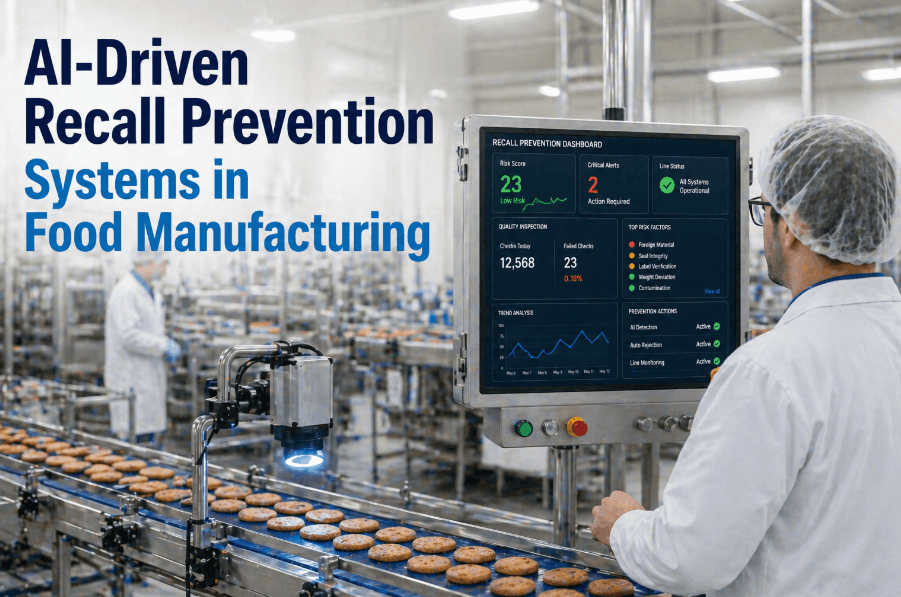
Food recalls cost the U.S. food industry an estimated $10 billion annually — and behind every recall is a window of time where AI-driven recall prevention systems could have intervened. The convergence of machine learning, real-time contamination detection, and predictive food safety analytics is fundamentally changing how food manufacturers manage risk. In 2026, leading manufacturers are not reacting to recalls — they are preventing them through food safety software that identifies failure patterns weeks before a product ever reaches a consumer. Book a demo to see how AI recall prevention works in a real food manufacturing environment.
AI RECALL PREVENTION · FOOD SAFETY COMPLIANCE · PREDICTIVE ANALYTICS
Stop Recalls Before They Start — AI-Powered Food Safety Intelligence
iFactory's AI-driven recall prevention platform delivers real-time contamination detection, automated compliance management, and predictive risk analytics — purpose-built for food manufacturers who cannot afford reactive quality control.
Why Traditional Recall Management Software Is No Longer Sufficient
Conventional recall management software was designed for a different era of food manufacturing — one where the primary goal was documenting and executing a recall after the problem had already occurred. In 2026, a single finished product may contain ingredients from dozens of suppliers, distributed through channels that touch millions of consumers within 72 hours of production. AI-driven recall prevention systems reframe the entire approach by combining predictive analytics for food safety, continuous supplier monitoring, and machine learning-based anomaly detection to intervene at the earliest possible point — when correction is still cheap, contained, and confidential. Book a demo to benchmark your current recall risk exposure against AI-prevention benchmarks.
$10B
annual cost of food recalls to the U.S. food industry
83%
of recalls involve failure points detectable by AI before distribution
6.2x
higher cost to manage a recall vs. preventing it with predictive systems
91%
reduction in recall scope when AI detection triggers early intervention
Core Capabilities
How AI-Driven Recall Prevention Systems Work in Food Manufacturing
Understanding the technical architecture of AI food safety platforms is essential for evaluating which systems deliver genuine prevention capability versus those that simply automate existing reactive workflows. Effective recall prevention AI operates across four interdependent capability layers — each building on the other to produce early warning intelligence that eliminates distribution-scale recall events.
01
Real-Time Contamination Detection and Pattern Recognition
AI models trained on historical production data establish dynamic baselines for every critical control point — temperature, pH, moisture, microbial indicators, and equipment performance metrics. When current readings begin trending toward historical failure patterns, the system triggers alerts before the deviation crosses a critical threshold. This predictive window — often 15 to 90 minutes ahead of an actual quality failure — is what separates AI prevention from reactive detection.
Prevention window: 15–90 minutes before quality failure threshold
02
Supplier Quality Management and Incoming Material Risk Scoring
Advanced supplier quality management software with AI capabilities continuously analyzes supplier performance data, certificate of analysis trends, third-party audit results, and industry alert databases to generate dynamic risk scores for every active supplier. High-risk scores trigger enhanced incoming inspection protocols automatically, without requiring manual review of compliance documentation or waiting for a lab result to come back positive.
Risk scored across 40+ supplier performance dimensions
03
Digital Traceability Platform for Sub-Lot Recall Precision
AI-powered traceability platforms maintain granular lineage records linking every unit of finished product to specific ingredient lots, equipment states, process parameters, operator shifts, and environmental conditions at the moment of production. When AI detection identifies a potential contamination event, the system immediately calculates the exact scope of affected product — often reducing the volume subject to hold by 60 to 80 percent compared to lot-level tracing systems.
Sub-lot precision reduces recall scope by up to 80%
04
Compliance Automation and Regulatory Documentation
Food safety compliance software with AI automation eliminates the manual documentation burden that makes regulatory readiness a perpetual challenge. Automated HACCP monitoring, real-time FSMA recordkeeping, SQF and BRC evidence generation, and continuous environmental monitoring documentation are generated as production occurs — not assembled manually before an audit. The complete compliance record is available instantly, with full chain-of-custody integrity that withstands regulatory scrutiny.
Audit-ready documentation generated automatically during production
Risk Intelligence
Predictive Analytics for Food Safety — Moving From Reactive to Preventive Risk Management
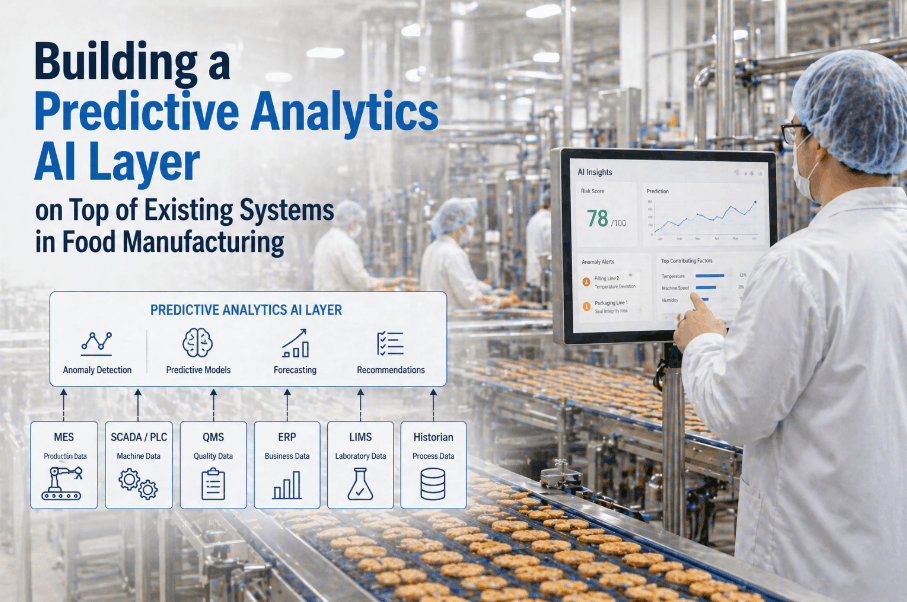
Predictive analytics for food safety represents the most significant operational shift available to food manufacturers in 2026. Every recall that reaches consumers was preceded by detectable signals — in ingredient variability, equipment degradation, environmental condition drift, or process parameter deviation — that an AI model with sufficient historical data can learn to recognize. Operational risk analytics platforms that integrate with existing ERP, MES, and quality systems deliver dramatically better predictive performance than standalone AI tools that cannot access the full operational data context. Book a demo to assess your current data architecture's AI readiness for predictive food safety deployment.
The Four Predictive Models That Prevent the Most Recalls
Microbial Growth Prediction Models
By correlating temperature excursion data, humidity readings, and historical contamination event records, AI models can predict environments where pathogen growth risk is elevated — triggering enhanced sanitation protocols and hold procedures before contamination reaches detectable levels in finished product testing.
Allergen Cross-Contact Risk Models
AI models that track line scheduling, cleaning validation outcomes, and historical allergen test results can identify changeover sequences and sanitation gaps that present elevated cross-contact risk — and automatically flag scheduling conflicts before production begins.
Foreign Material Detection Prediction
Predictive maintenance models integrated with manufacturing quality control systems can identify equipment degradation trajectories that historically precede foreign material contamination events — scheduling intervention before material failure occurs during production.
Label and Formulation Compliance Risk
AI monitoring of ingredient procurement data against approved formulations and labeling specifications provides continuous compliance verification that manual label review processes cannot achieve at production speed — preventing undeclared ingredient recalls before they reach distribution.
Performance Comparison
AI Recall Prevention vs. Traditional Quality Management — 2026 Performance Data
The performance difference between AI-powered food recall prevention and traditional quality management software is now large enough to represent a material competitive and compliance disadvantage for manufacturers operating without it. The following comparison reflects documented outcomes from food manufacturers operating both approaches across equivalent production environments.
AI Recall Prevention vs. Traditional QMS — Performance Gap Analysis 2026
Implementation Strategy
Building an AI-Driven Food Safety Platform — What Successful Implementation Requires
The most common reason AI food safety implementations underperform is not the technology — it is the data infrastructure beneath it. Successful AI recall prevention follows a structured sequencing: data infrastructure consolidation first, model training second, and adoption architecture third. Skipping the foundation phase is the single most predictable cause of failed food safety AI projects. Book a demo with iFactory to receive a complimentary data readiness assessment before beginning any AI recall prevention deployment.
Five Implementation Pillars for AI Recall Prevention Success
01
Unified Quality and Production Data Architecture
The first implementation requirement is a unified data layer that connects quality management records, production process data, equipment performance metrics, environmental monitoring logs, and supplier COA data into a single analyzable dataset — creating the connective layer above existing systems that makes their data collectively useful for machine learning model training and real-time inference.
02
Critical Control Point Instrumentation Coverage
Effective contamination detection systems require automated data capture at every critical control point — not just the ones that were convenient to instrument first. Partial instrumentation creates blind spots that AI models learn to work around rather than monitor. A comprehensive instrumentation audit identifying manual data entry gaps is a prerequisite for reliable AI food safety model deployment.
03
Historical Failure Data Labeling and Model Training
Predictive models learn what precedes quality failures by analyzing historical events. This requires systematically labeling historical quality records — identifying not just what failed, but the process conditions present in the 24 to 72 hours before the failure was detected. The depth and quality of this historical dataset directly determines model prediction accuracy.
04
Alert Calibration to Prevent Operator Fatigue
Alert calibration requires iterative tuning of detection thresholds against actual quality outcomes, reducing false positive rates to levels where every alert receives genuine operational attention. This calibration phase typically requires 60 to 90 days of supervised operation before alert reliability reaches production-grade confidence.
05
Compliance Workflow Integration and Regulatory Documentation Automation
The most resilient implementations integrate compliance documentation generation directly into the production workflow — so HACCP records, environmental monitoring logs, and corrective action documentation are generated automatically as events occur. This integration is what enables the 90% reduction in audit preparation time that mature AI food safety platforms deliver.
Regulatory Alignment
AI Recall Prevention and FSMA Compliance — How Automation Meets Regulatory Requirements
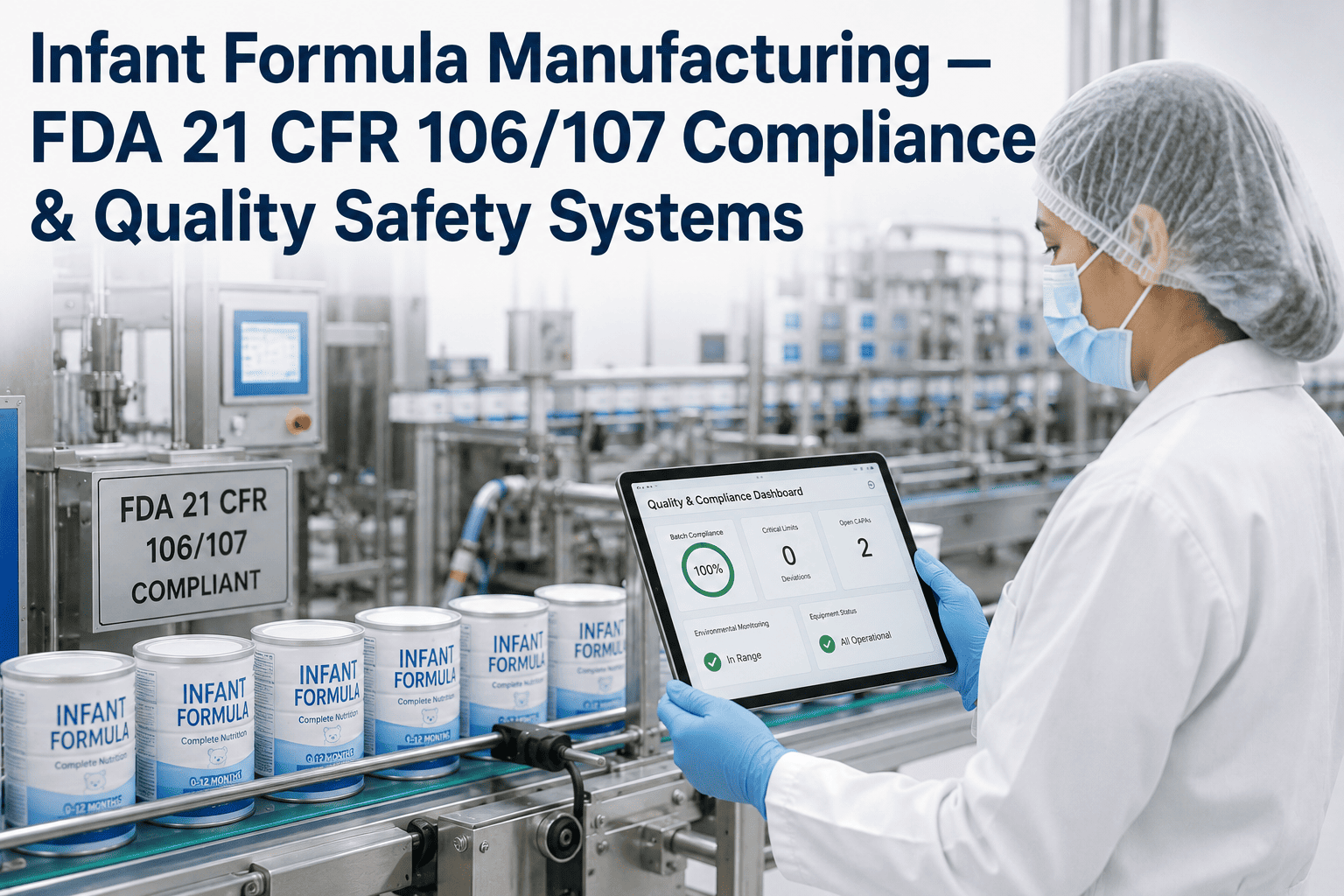
The FDA's Food Safety Modernization Act established a preventive controls framework that is philosophically aligned with AI-driven recall prevention — but most food manufacturers are still fulfilling FSMA requirements through manual processes not designed for the data volume and speed that modern supply chains require. AI platforms deliver measurable compliance improvement across HARPC, Supply Chain Program supplier verification, Environmental Monitoring Program documentation, and the Traceability Rule's critical tracking event records. Book a demo to see how iFactory's compliance automation maps directly to your specific FSMA obligations.
Real-World Result
A ready-to-eat protein manufacturer experienced three voluntary recalls in 18 months, each traced to shared Listeria environmental precursors. After deploying iFactory's AI food safety platform, automated alerts identified the recurring humidity and temperature pattern correlated with every historical positive hit — delivering 26 consecutive months without a positive environmental test or a single recall event.
ROI Framework
The Financial Case for AI-Driven Food Recall Prevention Investment
Food manufacturers evaluating recall management software upgrades frequently underestimate the true cost of the status quo. The visible costs of a recall — product destruction, logistics, and regulatory penalties — are typically only 20 to 30 percent of the total financial impact. Brand damage, lost retail shelf space, and the internal operational cost of recall execution multiply the actual cost to 3 to 5 times the direct expenses most finance teams model in initial assessments. An AI prevention platform that reduces annual recall probability from 18% to 4% generates expected value protection of $2.2 to $2.5 million annually before any operational efficiency gains are counted. Book a demo to run a custom ROI projection for your specific facility profile and recall risk exposure.
Direct Recall Cost Avoided
$8M–$32M
Per Class I recall event avoided through AI early detection and containment
Quality Hold Waste Reduction
55–70%
Smaller affected scope through sub-lot traceability precision
Compliance Labor Savings
$180K–$420K
Annual reduction in manual compliance documentation and audit preparation labor
Typical Platform Payback
4–8 Months
Time to full ROI recovery including implementation costs for mid-sized manufacturers
Frequently Asked Questions
AI Food Safety and Recall Prevention — Common Questions from Food Manufacturers
How does AI-driven recall prevention differ from traditional food safety software?
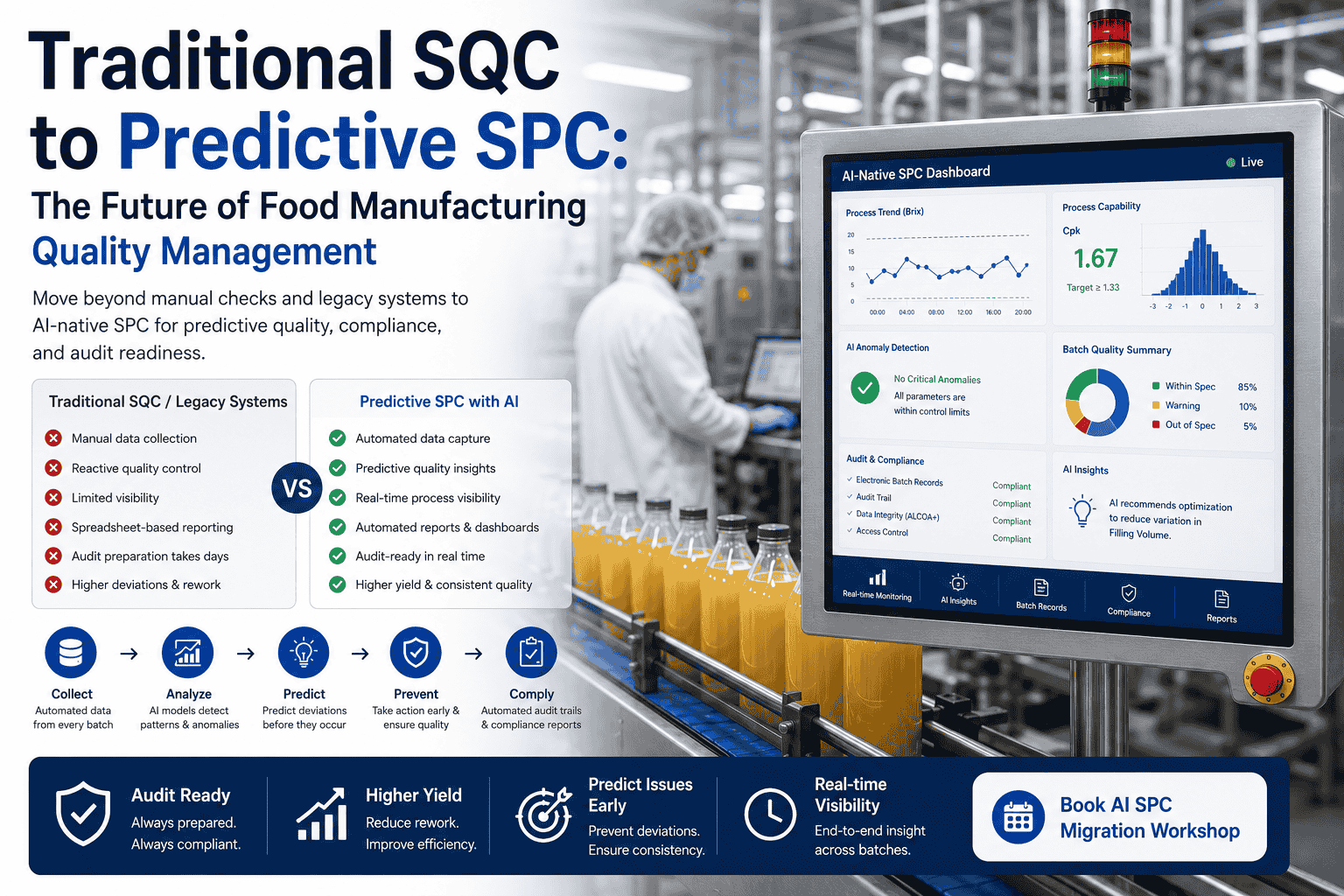
Traditional food safety software documents compliance and manages recall execution after a problem is identified. AI-driven recall prevention systems analyze real-time production data against historical failure patterns to identify and intervene before quality failures reach distribution scale — shifting quality management from reactive to preventive.
What data does an AI food safety platform need to generate reliable predictions?
Effective predictive models require historical quality event records, production process parameters, environmental monitoring data, equipment performance history, and supplier quality data — all contextually linked. Minimum viable training datasets typically require 18 to 24 months of historical production data with documented quality events.
Can AI recall prevention software integrate with existing ERP and quality management systems?
Yes. Modern AI food safety platforms operate as an integration layer above existing ERP, MES, and QMS systems via API connectivity — rather than replacing them. This approach preserves existing infrastructure investments while gaining AI prevention capabilities on top of the data those systems already collect.
How long does it take for AI food safety models to become accurate enough for operational use?
Initial model deployment using historical training data typically achieves 70 to 80% prediction accuracy within the first production quarter. Models improve continuously as new production data is incorporated, with most implementations reaching 90%+ accuracy within 6 to 9 months of live operation.
Does AI recall prevention software support FSMA and SQF compliance documentation?
Leading AI food safety platforms automate FSMA preventive controls recordkeeping, HARPC documentation, supplier verification records, and SQF/BRC evidence generation as production occurs — eliminating the manual compilation that creates documentation gaps and audit preparation burdens.
What ROI can food manufacturers expect from AI recall prevention investment?
Manufacturers typically see 80% fewer annual recall events, 55–70% quality hold waste reduction, and $180K–$420K in annual compliance labor savings. Most platforms deliver full ROI within 4 to 8 months as predictive accuracy compounds over time.
AI FOOD SAFETY · RECALL PREVENTION · COMPLIANCE AUTOMATION
Ready to Move From Recall Response to Recall Prevention?
iFactory's AI-driven food safety platform delivers the contamination detection, predictive analytics, and compliance automation that transforms food manufacturers from reactive to preventive — with measurable ROI from the first production quarter.