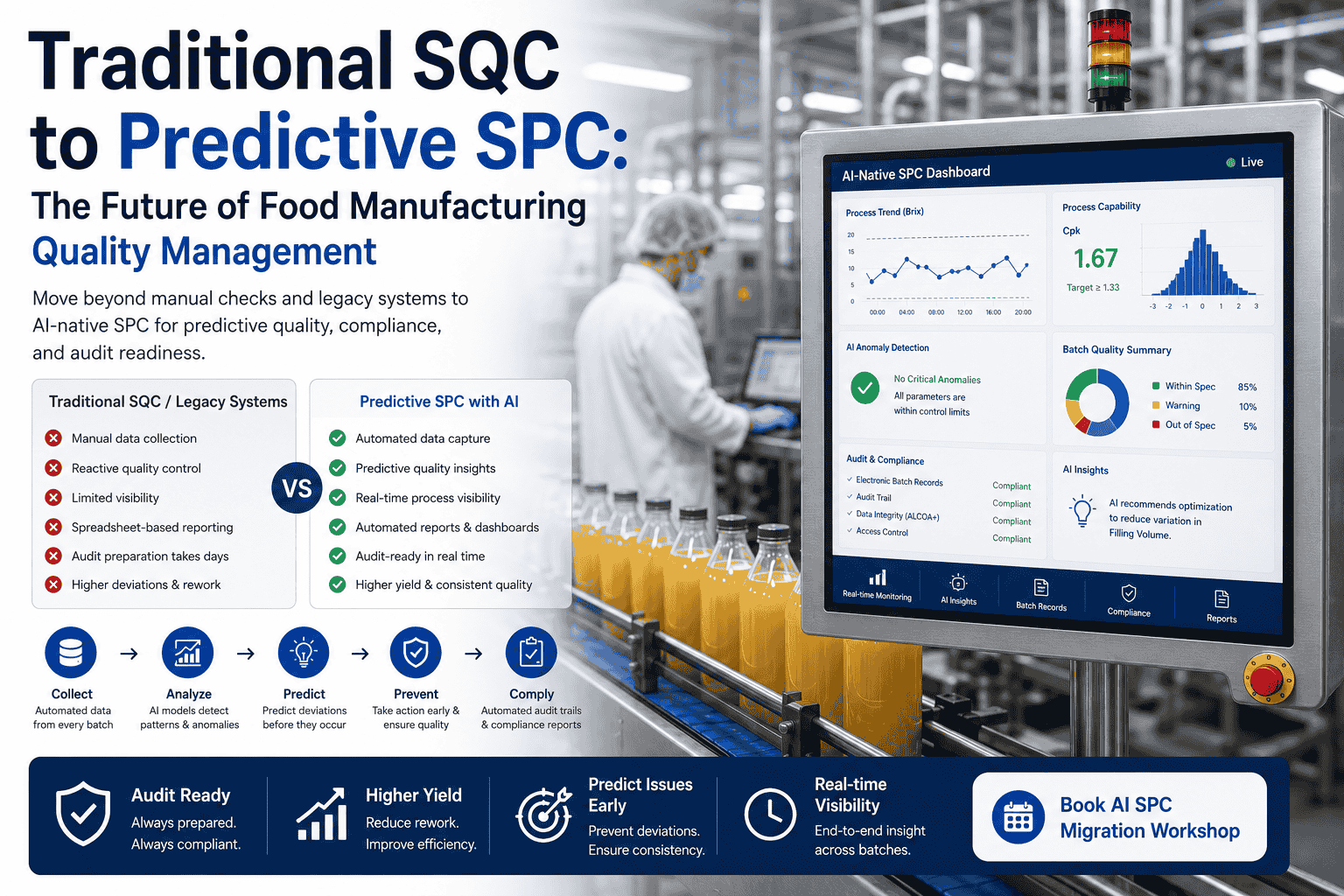
Traditional SQC monitors outputs—checking finished products after they're produced to see if they passed or failed. It answers the question "did we make good product?" but never "are we about to make bad product?" In food manufacturing, where batch variability, allergen segregation, and sanitation cycles create process conditions that shift constantly, that backward-looking model guarantees you'll always discover problems too late to prevent them. Predictive SPC flips the model: it monitors process inputs in real time, detects multivariate drift patterns that single-variable charts miss, and predicts quality exceedances before they produce a single defective unit. Book a demo to see how iFactory's AI-native SPC transforms reactive quality control into predictive process intelligence.
SPC Evolution
From Reactive SQC to Predictive SPC
Three eras of quality intelligence — and why food manufacturers are leaping to the third
Era 1
Traditional SQC
Inspect outputs after production
Finds defects — can't prevent them
Era 2
Real-Time SPC
Monitor process inputs live
Detects drift — but static limits miss context
Era 3
Predictive SPC
Predict quality before production
AI learns, adapts, and prevents — continuously
SQC vs SPC vs Predictive SPC: What's Actually Different
These terms get used interchangeably in food manufacturing—but they describe fundamentally different quality philosophies. Understanding the distinction is the first step to understanding why your current system can't deliver the process stability you need.
Dimension
Traditional SQC
Real-Time SPC
Predictive SPC
What it monitors
Finished product outputs
Process inputs in real time
Process inputs + multivariate patterns
When it detects
After defects are produced
When limits are breached
Before limits are reached
Control limits
Static spec limits
Fixed statistical limits
Adaptive limits that learn from conditions
Root cause
Manual investigation
Manual with better data
Automated — AI correlates in seconds
Variables analyzed
One at a time
One at a time, faster
Hundreds simultaneously
Learning
None — same rules forever
Minimal — manual recalculation
Continuous — improves every shift
Still running traditional SQC or static SPC? Book a live demo to see the difference predictive SPC makes on your actual process data.
Why Traditional SQC Fails Food Manufacturing Specifically
Food manufacturing has characteristics that make traditional SQC structurally inadequate—not just slow. Batch-to-batch variability, allergen segregation, sanitation-driven process restarts, and seasonal ingredient variation create conditions that fixed-limit quality systems cannot model.
Every Batch Is a New Process
Ingredient moisture, protein content, fat percentage, and microbial load vary between supplier lots and between seasons. Static control limits set for one material lot produce false alarms on the next. Traditional SQC treats every batch identically—predictive SPC adjusts expectations for each batch's actual input properties.
Sanitation Resets Process Baselines
Every CIP (Clean-in-Place) cycle resets equipment conditions—temperatures stabilize differently, seals seat differently, and the first 15–30 minutes of post-sanitation production behave differently than steady-state. SQC doesn't account for this. Predictive SPC learns post-CIP behavior patterns and adjusts limits accordingly.
Single-Variable Charts Miss Interactions
A temperature reading within spec and a humidity reading within spec can still produce defects when their combined effect exceeds tolerance. Traditional SQC monitors each variable in isolation. Predictive SPC analyzes hundreds of variables simultaneously, detecting multivariate interaction patterns that single-variable charts structurally cannot see.
See Predictive SPC on Your Process Parameters
In a 30-minute workshop, we'll show you how predictive SPC detects drift patterns, adapts to your batch variability, and identifies multivariate interactions your current SQC system misses.
What Predictive SPC Delivers for Process Stability
Predictive SPC doesn't just chart faster—it fundamentally changes what your quality system can see, predict, and prevent. Here are the four capabilities that drive measurable process stability improvements in food manufacturing.
Detection
Multivariate Pattern Recognition
AI analyzes hundreds of process variables simultaneously—temperature, pressure, humidity, speed, material properties, equipment state—detecting interaction patterns that single-variable control charts miss entirely.
100s of variables analyzed simultaneously vs. one at a time
Prediction
Pre-Breach Drift Alerting
Instead of alerting when a limit is breached, predictive SPC identifies trending patterns 15–30 minutes before exceedance occurs—giving operators time to correct before a single defective unit is produced.
15–30 min early warning before spec exceedance
Adaptation
Self-Learning Control Limits
Control limits adjust automatically for material lot variations, post-CIP restarts, seasonal ingredient changes, and equipment wear. The system continuously refines its understanding of what "good" looks like for the current operating context.
Zero false alarms from seasonal or lot-to-lot variation
Intelligence
Cause-Linked Process Alerts
When drift is detected, AI doesn't just flag the deviation—it links it to the most probable upstream cause: worn sealing die, temperature excursion, supplier batch variability, or newly installed equipment performing outside calibration.
Seconds to root cause vs. hours of manual investigation
Want to see how adaptive SPC handles your specific batch variability? Schedule a predictive SPC demo on your representative dairy, bakery, or beverage processes.
Expert Perspective
"Traditional SPC monitors one variable at a time and flags breaches after they happen. AI-powered SPC analyzes hundreds of variables simultaneously, detects multivariate patterns that single-variable charts miss, and predicts process shifts before they breach control limits. The gap between these two approaches isn't incremental—it's generational."
— AI-Enhanced SPC Best Practice
18%
yield improvement reported within 3 months of AI SPC deployment
Cpk 1.33+
process capability maintained continuously with adaptive limits
50+
measurements per shift is where manual SQC becomes unreliable
Ready to move beyond traditional SQC? Request a demo and see self-learning SPC running on representative F&B processes.
Conclusion: From Inspecting Outputs to Predicting Outcomes
The evolution from SQC to predictive SPC isn't a technology upgrade—it's a philosophy change. SQC asks "did we make good product?" after the fact. SPC asks "is the process stable?" in real time. Predictive SPC asks "will the process stay stable over the next 4–24 hours—and if not, what should we change now?" For food manufacturers dealing with batch variability, CIP resets, allergen changeovers, and seasonal ingredient shifts, the ability to predict and prevent quality exceedances rather than detect and react to them is the difference between world-class process stability and perpetual firefighting. The technology exists today, the migration path is proven, and the ROI compounds with every shift as the AI learns your specific processes.
Transition to Predictive SPC for Your Food Operations
In a 30-minute workshop, we'll assess your current SQC/SPC maturity, show predictive SPC on your process parameters, and map the migration path to self-learning quality intelligence.
Frequently Asked Questions
What is the difference between SQC and SPC?
SQC (Statistical Quality Control) monitors finished product outputs—inspecting products after production to determine if they meet specifications. SPC (Statistical Process Control) monitors process inputs in real time—tracking the variables that create quality (temperature, pressure, speed, material properties) to detect drift before defects are produced. In practice, SQC tells you what happened; SPC tells you what's happening. Predictive SPC tells you what's about to happen.
Book a demo to see the difference on your process data.
Why can't traditional SPC handle food manufacturing variability?
Traditional SPC uses fixed control limits calculated from historical data. In food manufacturing, conditions change constantly: ingredient properties vary by supplier lot and season, CIP cycles reset equipment baselines, allergen changeovers alter process dynamics, and ambient conditions shift through the day. Fixed limits either trigger false alarms when conditions change normally or miss real drift when the baseline has shifted. Predictive SPC solves this with adaptive limits that learn and adjust to current operating context automatically.
What is multivariate SPC and why does it matter?
Traditional SPC monitors one variable at a time on separate control charts. Multivariate SPC analyzes hundreds of variables simultaneously, detecting interaction patterns that single-variable charts cannot see. For example, temperature and humidity both within individual spec limits can still produce defects when their combined effect exceeds tolerance. AI-powered multivariate SPC identifies these interaction patterns automatically—a capability that is structurally impossible with traditional one-variable-at-a-time charting.
How quickly does predictive SPC detect process drift?
Predictive SPC typically detects trending patterns 15–30 minutes before a control limit is breached—giving operators time to intervene before defective product is produced. Traditional SPC only alerts after the breach, by which point defective units are already in the pipeline. The early warning comes from AI's ability to detect subtle pattern changes across multiple variables simultaneously, identifying drift signatures that haven't yet manifested as single-variable exceedances.
Does predictive SPC replace our existing quality management system?
No—predictive SPC layers on top of your existing quality infrastructure. Your SAP QM, MES, or quality management system continues handling compliance documentation, audit trails, and regulatory reporting. Predictive SPC adds the real-time intelligence layer: adaptive control charts, multivariate pattern detection, automated root-cause analysis, and predictive alerts. Quality results flow back into your existing system for documentation. The migration is additive, not replacement.