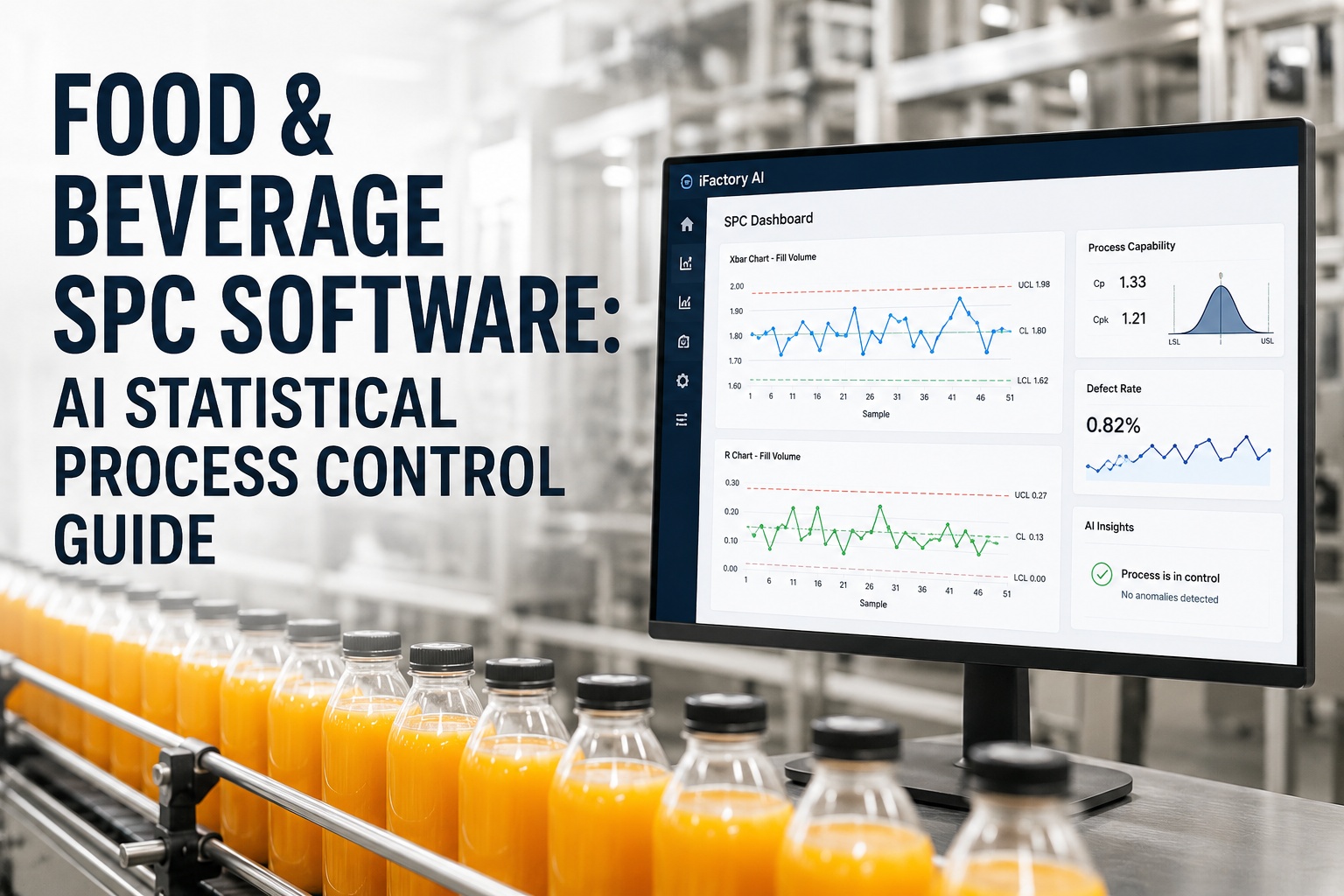
In food and beverage, process variation isn't just a quality metric — it's the line between a profitable run and a recall, between hitting target fill weight and giving away free product on every unit. Most plants still catch problems the expensive way: at end-of-line inspection, after the money is already spent on off-spec product. Statistical process control flips that, moving from detection to prevention — but only if it runs fast enough to matter. Manual SPC sampling a few readings an hour can't see a filler head drifting 0.8% low between checks, and it certainly can't predict a seal-integrity failure before it happens. This guide explains how modern food and beverage SPC software works, why AI-native SPC catches drift before it becomes scrap or a safety event, and how iFactory replaces legacy SAP MII and SAP DMC systems with continuous, on-premise quality intelligence built for HACCP, FSMA, SQF, and BRCGS.
Food & Beverage SPC Software: The AI Statistical Process Control Guide
Real-time control charts on fill weight, seal integrity, temperature, and CCPs — with continuous Cp/Cpk, AI drift prediction, and audit-ready HACCP/FSMA/SQF/BRCGS records. Catch a drifting filler head or a narrowing seal before it becomes giveaway, scrap, or a hold. On-premise so your data stays in the plant — a modern SAP MII and DMC alternative, live in 6–12 weeks.
Why SPC Beats End-of-Line Inspection in Food
The reason is structural, and it follows what Deming called the reaction chain: reduce variation, and fewer defects, less rework, lower cost, and more capacity all follow. End-of-line inspection only tells you good-or-bad after the money is already spent on the product. SPC tells you the process is drifting while you can still steer it — and in food and beverage, "drift" usually means one of three costly things: product safety risk, regulatory exposure, or quiet margin leaking out as overfill giveaway.
The Three Things That Drift in Food & Beverage
Food SPC isn't generic — the high-cost, high-risk variables are specific to the process. Modern SPC software puts the right chart on each one, so the drift is caught early in the way that matters for that variable.
Fill weight & giveaway
Fill-weight SPC monitors mean drift and variance per filler head. CUSUM charts flag a 0.8% low-drift before it ever exits the tolerance band — protecting both compliance and the margin lost to overfill giveaway.
Seal integrity
X-bar charts on seal width catch the gradual narrowing that precedes a seal-integrity failure — before a leaker reaches finished goods or a customer, and before a quality hold stops the line.
Temperature & CCPs
Continuous monitoring of cook, pasteurization, and cold-chain temperatures against HACCP critical control points — with automatic, time-stamped records replacing periodic manual logs.
Want to see which of your processes are leaking margin or risk to drift right now? Book a 30-minute demo and iFactory's quality engineers will run rolling SPC on your own fill-weight, seal, or temperature data and show where capability is slipping. Sessions available this week.
The Manual-Sampling Gap — and How AI Closes It
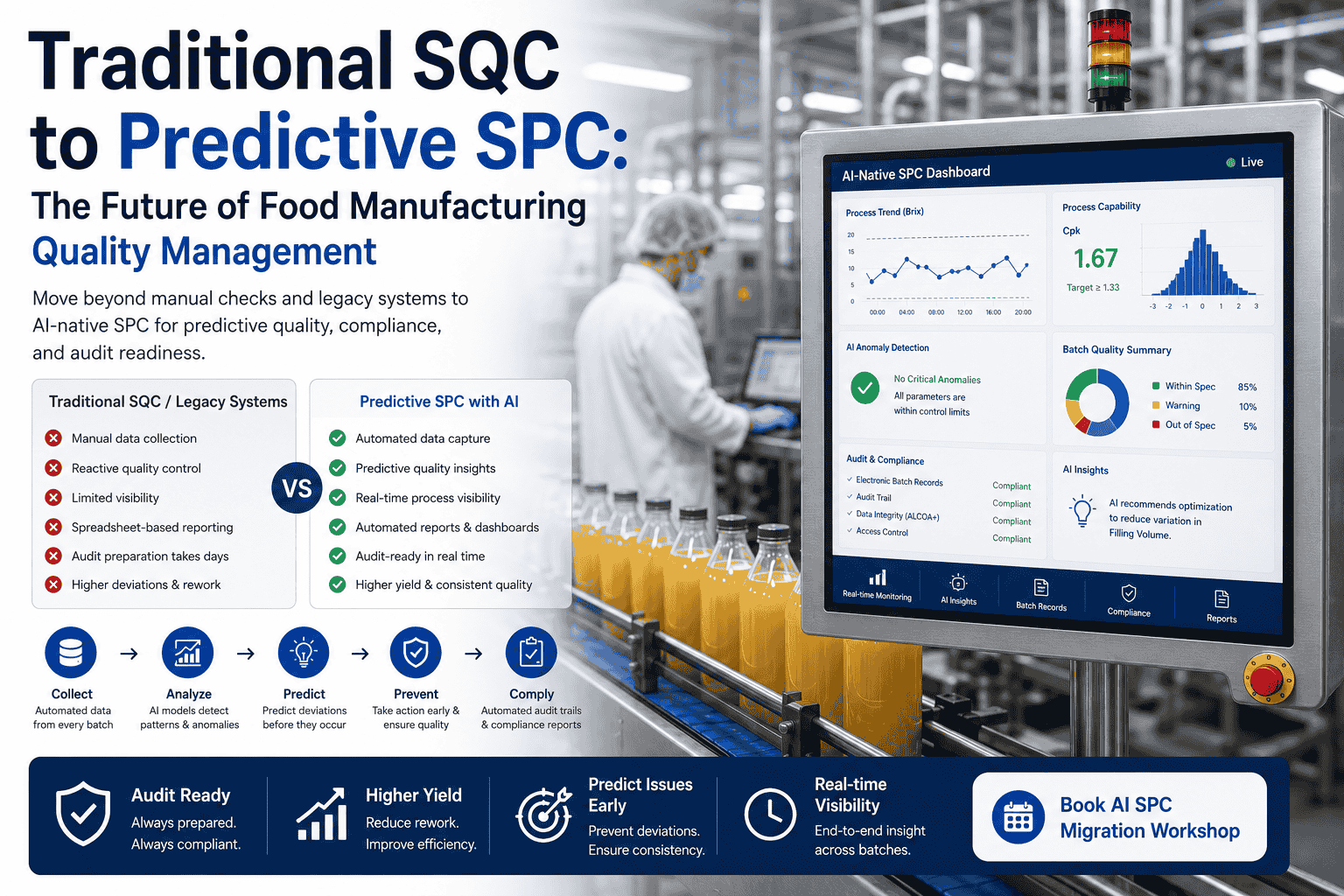
The math behind SPC hasn't changed in 95 years; what fails is the sampling cadence. A manual program grabs 5–10 readings an hour while a filler runs thousands of containers — so a head drifting low between checks is invisible until a scheduled sample or a customer complaint surfaces it. AI-native SPC updates control charts continuously from sensor data, detecting drift before it crosses a limit and predicting failures weeks ahead.
The manual program catches the low-drift only at or past the lower spec limit — after underweight product has shipped or overfill has been quietly given away for hours. Continuous AI monitoring sees the same 0.8% drift while the head is still in-spec, alerts within seconds, and lets the operator trim the filler before a single off-spec container leaves the line.
What Modern Food & Beverage SPC Software Includes
Live control charts
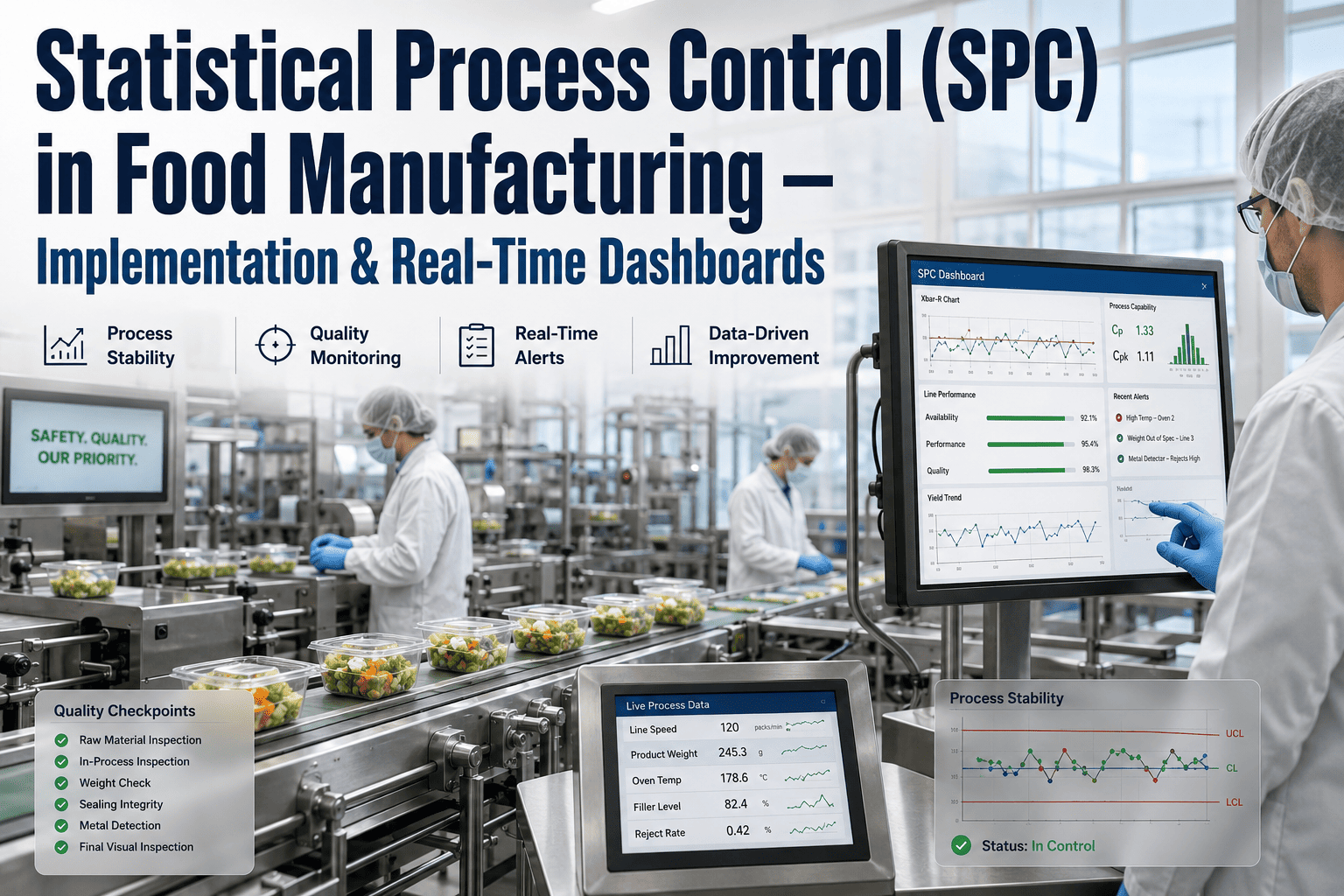
X-bar/R, I-MR, and CUSUM updating in real time from fillers, sealers, and sensors — not scheduled studies.
Rolling Cp/Cpk
Capability trended sample-by-sample, turning "we think it's fine" into documented evidence for FDA, HACCP, and GFSI.
AI drift prediction
ML on SPC plus equipment and environment data predicts filler, sealer, and process failures 2–8 weeks ahead.
CCP monitoring
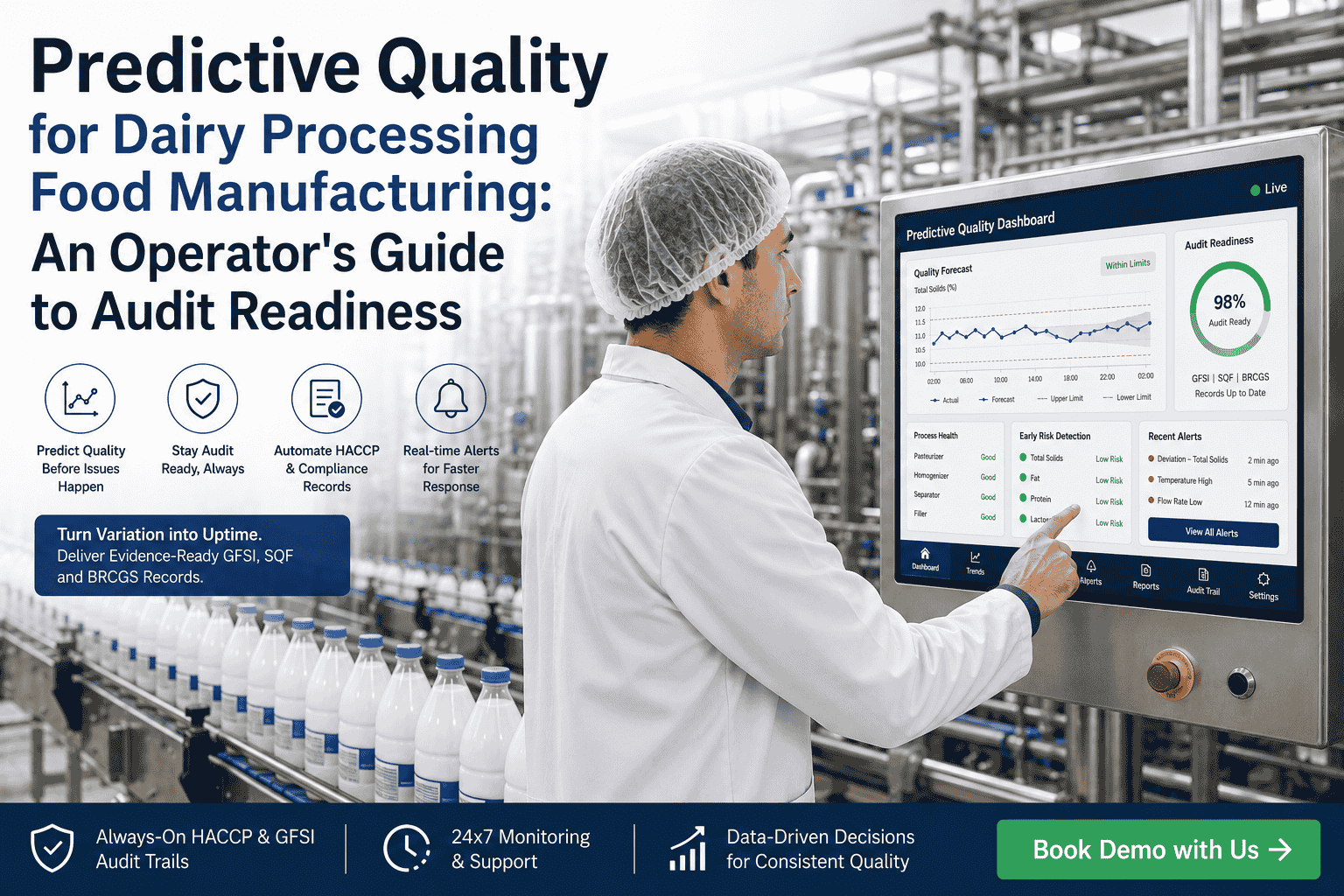
Continuous, time-stamped logging of temperature and contamination control points — HACCP CCPs verified automatically.
Audit-ready records
Electronic records, signed Cpk studies, and full ingredient genealogy for FSMA, SQF, BRCGS, and FSSC 22000.
Line integration
Connects to checkweighers, fillers, sealers, X-ray/metal detectors, PLCs, and gauges; syncs to MES and ERP.
Not sure which charts and compliance records your SQF or BRCGS audit needs? Ask iFactory Support with your product types and certification scheme, and the team will map the exact SPC outputs and audit evidence you need — typically a response within 3 business days.
The Hidden Cost: Overfill Giveaway
Food plants obsess over underfill because it's a compliance risk — but overfill is a silent, continuous margin drain. Every gram given away above target, multiplied across millions of units, is profit handed to customers for free. Tight fill-weight SPC lets a plant safely move its target closer to the spec line, recovering giveaway without risking underweight non-conformance.
Curious how much giveaway your fill lines could recover? Schedule a demo and iFactory will estimate recoverable margin from your current fill-weight variation and target offset — a sized projection built during the session. Slots open this week.
Replacing SAP MII and SAP DMC
Many food and beverage plants run quality through SAP MII or are weighing SAP DMC for the digital-manufacturing layer. Both are heavy to maintain and were built to move and display data, not to predict. iFactory connects to your fillers, checkweighers, sealers, and sensors directly, adds the AI prediction layer SAP never had, and syncs results back to SAP or MES — so you modernize the quality layer without an enterprise-wide rip-and-replace or an 18-month pilot.
iFactory On-Premise Appliance The default — food-safety data stays in the plant
- Pre-configured NVIDIA AI server — racked, loaded, ready.
- Continuous edge monitoring — keeps pace with line speed.
- Air-gap capable — recipe and quality data never leave.
- Runs through WAN outages — CCP logging never stops.
iFactory Cloud For multi-plant and co-packer networks
- Fully managed — no on-site hardware to maintain.
- Same SPC engine — rolling Cpk, CUSUM, AI prediction.
- Cross-plant benchmarking — compare capability site to site.
- Fastest start — first plant live in 2–4 weeks.
In food, drift costs three ways: safety, compliance, and giveaway.
End-of-line inspection catches problems after the spend. AI-native SPC catches a drifting filler or a narrowing seal while you can still steer — protecting safety, proving compliance, and recovering giveaway margin. iFactory delivers real-time control charts, rolling Cpk, CUSUM, and 2–8 week drift prediction on a pre-configured on-premise appliance, replacing SAP MII and DMC. Live in 6–12 weeks, ROI proven on one line first.
Frequently Asked Questions
Why is SPC better than end-of-line inspection in food?
Inspection tells you good-or-bad after the product is already made and the money spent. SPC monitors the process while it's running, so drift is caught while you can still correct it — following Deming's reaction chain: less variation leads to fewer defects, lower cost, and more capacity. In food specifically, that means catching a low-drifting filler or a narrowing seal before it becomes an underfill, a leaker, or a safety hold.
How does SPC help with fill-weight giveaway?
Overfill is a silent margin drain — every gram above target, across millions of units, is profit given away. Tight fill-weight SPC, using CUSUM charts per filler head to catch drift as small as 0.8% before it exits tolerance, lets a plant safely move its target closer to the legal minimum. That recovers giveaway without risking underweight non-conformance. iFactory can estimate your recoverable margin during a demo.
Does it support HACCP, FSMA, SQF, and BRCGS?
Yes. iFactory ships audit-ready for the schemes that matter in food and beverage — HACCP CCP monitoring, FSMA Preventive Controls, SQF, BRCGS, and FSSC 22000. It provides continuous time-stamped CCP records, signed Cpk capability studies, and full ingredient genealogy, collapsing audit prep from manual assembly to review. Contact iFactory Support for a mapping of exactly which records your certification scheme requires.
How is AI SPC different from traditional SPC?
Traditional SPC is reactive — it flags a problem after a control limit is breached, often from sparse manual samples. AI-powered SPC is predictive and continuous: it updates charts in real time from sensor data and uses machine learning on SPC plus equipment and environment signals to forecast failures 2–8 weeks ahead. Across food and FMCG, teams report around 40% reduction in process variance after adopting it.
Is this a replacement for SAP MII or SAP DMC?
It replaces the SPC and quality-intelligence layer while connecting directly to your existing line equipment. SAP MII and DMC move and display data; iFactory connects to the same fillers, checkweighers, sealers, and sensors, adds predictive analytics SAP never had, and syncs results back to SAP or MES — no enterprise-wide rip-and-replace. A demo is the fastest way to see the integration; schedule one here.
How do I book a demo or get an SPC assessment?
Two routes. For a live walkthrough on your own line data, schedule a 30-minute demo — it covers fill-weight CUSUM, seal and CCP charts, rolling Cpk, AI drift prediction, and a sized giveaway-recovery estimate. For a written capability or compliance check, contact iFactory Support and expect a response within about 3 business days. No obligation either way.
Steer the process while it's still in-spec.
The 2026 food and beverage SPC baseline is continuous, AI-native, on-premise: real-time fill-weight, seal, and CCP charts, rolling Cpk, and 2–8 week drift prediction — replacing SAP MII and DMC without touching your line equipment. Live in 6–12 weeks, ROI proven on one line first. The next step is a 30-minute demo against your own process data. Sessions available this week.