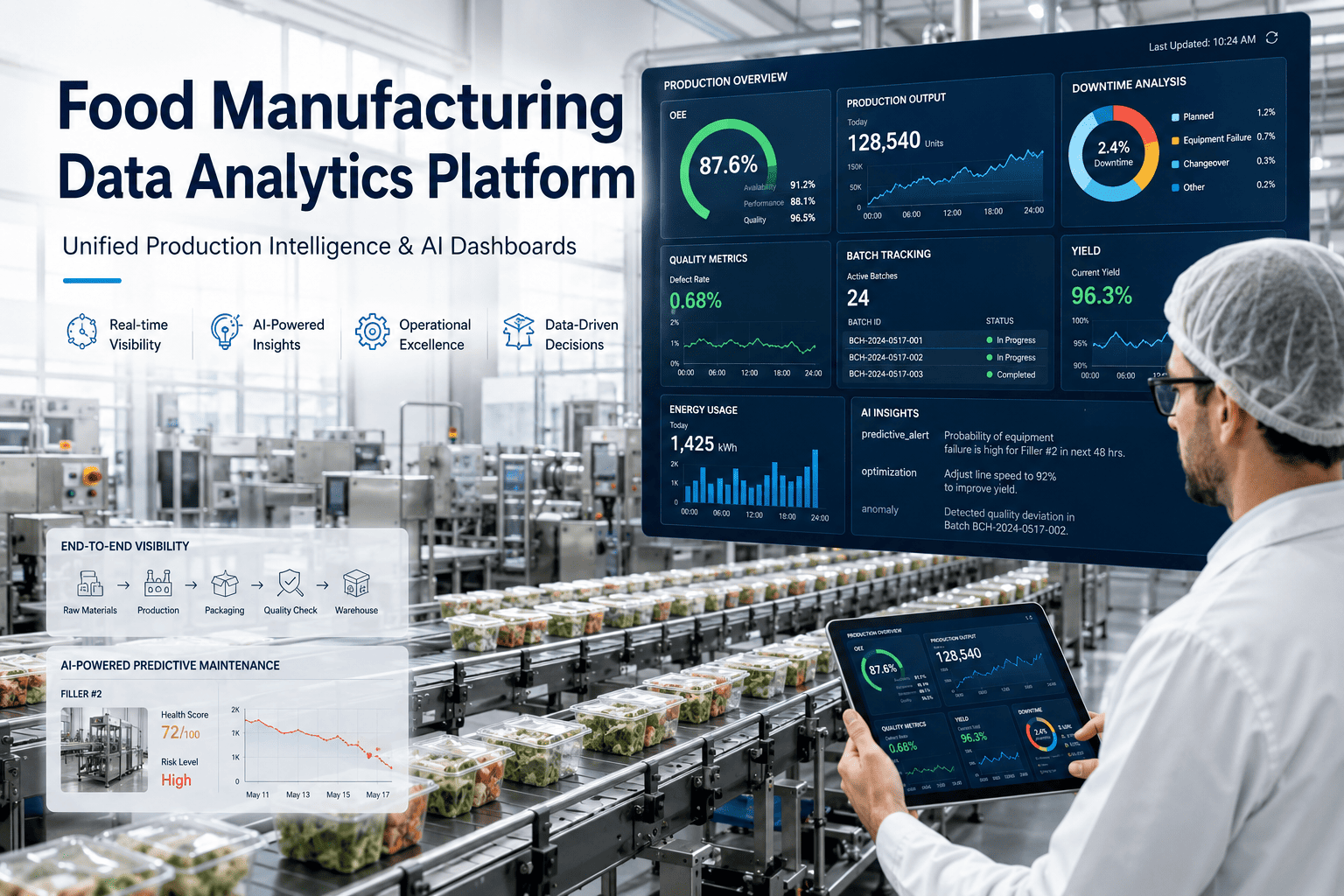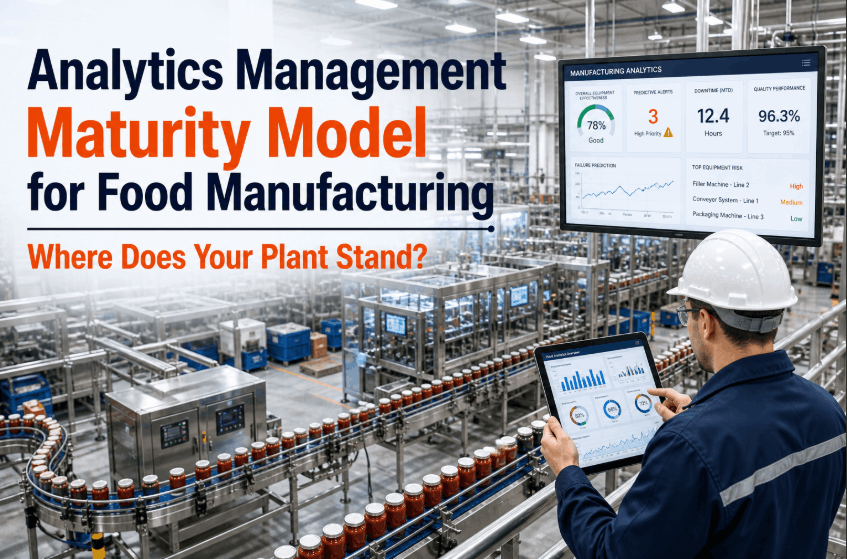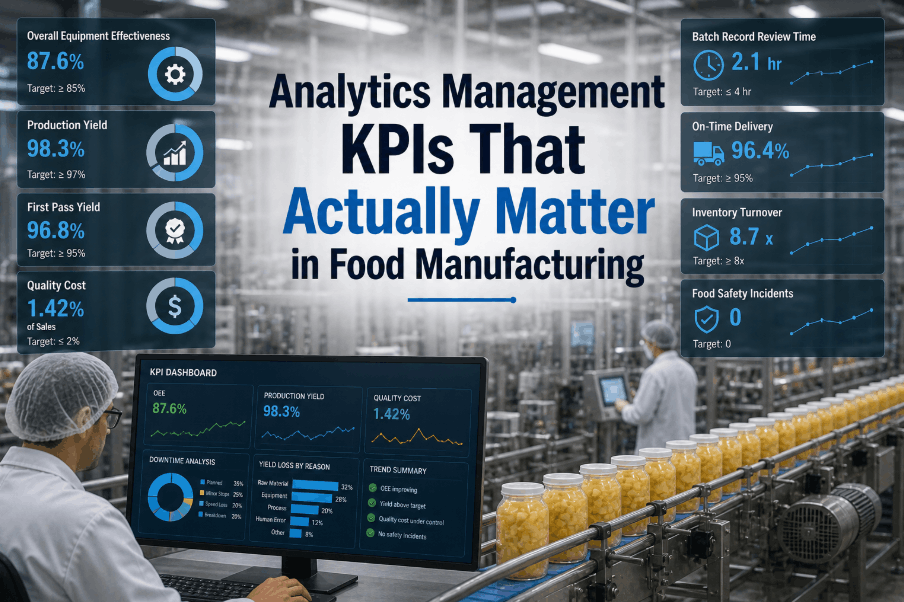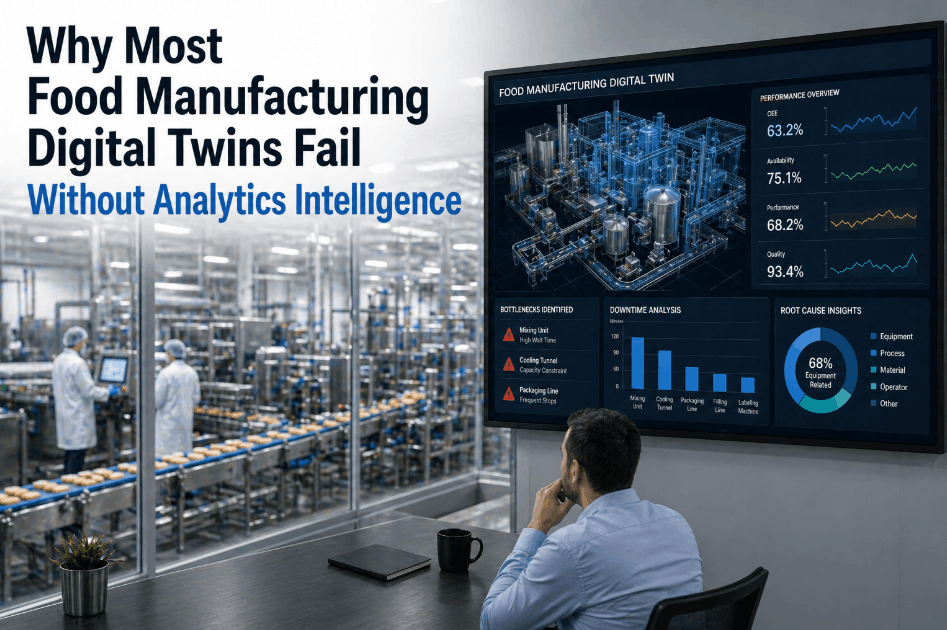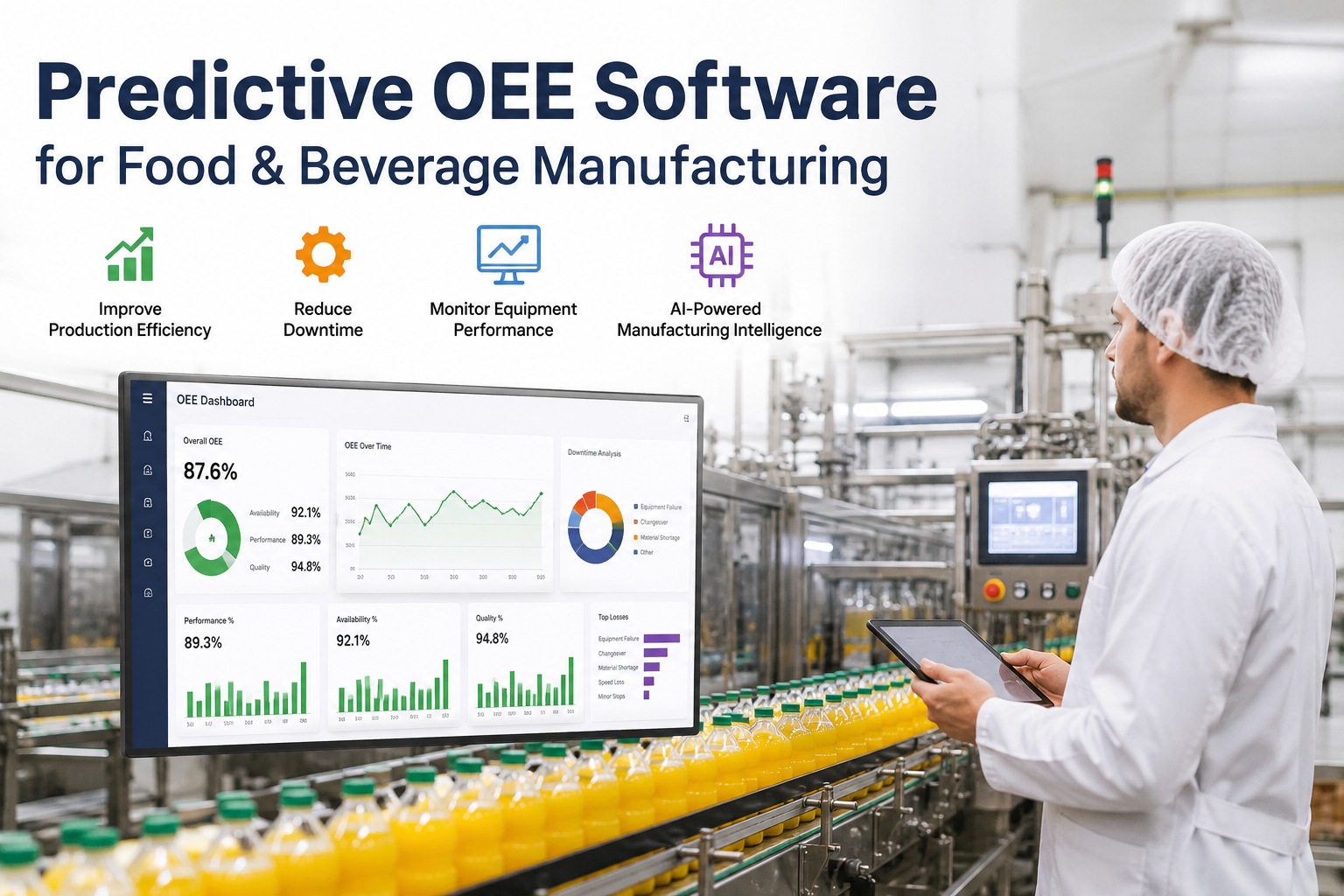
Most food and beverage plants believe their OEE is higher than it is. When TeepTrak first measures food lines, the real number lands at 45–60% — typically 15 to 20 points below what management estimated. The gap is hidden losses: micro-stoppages on a 1,200-bottle-a-minute line every few minutes, CIP overruns, changeover rejects, and speed sag from material variation — losses that vanish between manual reports faster than an operator can log them. Predictive OEE software changes the picture twice over: first by capturing every loss automatically, then by forecasting the next shift's OEE so teams fix problems before the score drops. This guide explains how predictive OEE software works for food and beverage, the Six Big Losses in food-specific terms, the path from a 50% baseline to world-class, and how iFactory replaces legacy SAP MII with on-premise AI manufacturing intelligence.
Predictive OEE Software for Food & Beverage Manufacturing
Real-time Availability × Performance × Quality, automatic Six Big Losses categorization, and AI that predicts the next shift's OEE — so micro-stops, CIP overruns, and changeover losses get fixed before they cost throughput. GMP-compliant capture, on-premise so your data stays in the plant. A modern SAP MII alternative, live in 6–12 weeks.
OEE in 30 Seconds — and Why Food Is Different
OEE is one number built from three factors multiplied together: Availability (is the line running when it should be?), Performance (is it running at rated speed?), and Quality (are the units good first time?). The trap is that a respectable-looking 60% can hide very different problems — and in food, the losses cluster in places generic OEE tools handle poorly: mandatory CIP cleaning, allergen changeovers, and relentless high-speed micro-stops.
The Six Big Losses — in Food & Beverage Terms
Every point of OEE you lose traces to one of six causes from the TPM framework. Predictive OEE software automatically categorizes every lost minute into the right bucket — so teams stop arguing about why the line was down and start fixing it. Here's how each loss actually shows up on a food or beverage line.
1 · Breakdowns
Unplanned stoppages — filler valve seizures, cartoner servo failures. Most visible, not always the largest.
2 · Changeover & CIP
SKU and allergen format changes plus Clean-in-Place. CIP alone can eat 15–25% of shift time in dairy and beverage.
3 · Micro-stops
Label misfeeds, cap jams, bottle tip-overs under 5 min. Cumulatively 30+ minutes a shift that manual reports miss.
4 · Speed loss
Running below rated speed from material quality variation or worn equipment — the quietest performance drain.
5 · Start-up rejects
Off-spec product right after a changeover or CIP, before the process stabilizes — a pure quality loss.
6 · Production rejects
Scrap and rework during steady-state running — underfills, seal failures, contamination rejections.
Want to see which of the six losses is quietly costing you the most throughput? Book a 30-minute demo and iFactory will break down your real Six Big Losses by line and SKU on your own data — one micro-stop category alone has recovered $380K for a single plant. Sessions available this week.
The Micro-Stop Problem — Why Manual Reporting Fails
The number-one hidden loss on high-speed food and beverage lines is the micro-stop: a 20–90 second stoppage that happens every few minutes. Each one is too short to log by hand, so they evaporate from manual reports — yet they cumulatively account for 30-plus minutes of lost time per shift and often 20%+ of all performance loss. Automated second-by-second capture is the only way to see them.
The manual log catches the two stoppages long enough to notice; the other eighteen disappear. AI-driven capture records every one second-by-second, maps each to the right loss bucket, and surfaces the pattern — which SKU, which shift, which machine — so the root cause gets fixed instead of re-occurring every few minutes.
From Reactive to Predictive — How OEE Software Earns Its Name
"Predictive" is the difference between logging losses and preventing them. Reactive OEE tells you yesterday's score. Predictive OEE forecasts the next shift's number, schedules maintenance into CIP and sanitation windows before a breakdown, and correlates equipment condition to in-line defect rates. The benefit compounds: AI models learn your specific equipment behavior, and unplanned downtime keeps falling month over month.
Curious where your lines sit on this curve and what the next 10 points are worth? Send your line list and current OEE estimate to iFactory Support and the team will return a sized improvement projection by loss category — typically within 3 business days, no obligation.
What Predictive OEE Software Includes
Real-time A×P×Q
Live OEE per line, SKU, and shift, computed continuously with automatic Six Big Losses categorization.
Second-by-second capture
Auto-capture from PLCs, IoT sensors, SCADA, and vision — catching micro-stops manual logs never see.
Predictive forecasting
AI predicts the next shift's OEE and the next failure, scheduling maintenance into CIP and sanitation breaks.
Auto work orders
OEE-degrading conditions auto-create work orders with parts and SOP attached — closing the maintenance loop.
GMP audit trail
Every event logged with user, timestamp, and task record — aligned to SQF, BRCGS, FDA, GMP, and ISO 9001.
Hygienic integration
Non-intrusive clip-on current sensors — no food-contact-surface modification, no contamination traps.
Not sure how to instrument your lines without violating hygiene rules? Schedule a demo and iFactory will walk through GMP-compliant, non-intrusive sensor installation for your specific equipment — plus the data it unlocks. Slots open this week.
Replacing SAP MII — On-Premise or Cloud
Many food and beverage plants run production intelligence through SAP MII, which was built to move and display data rather than predict it. iFactory connects to the same PLCs, sensors, and SCADA directly, adds the AI forecasting layer SAP never had, and syncs results back to SAP or MES — so you modernize without an enterprise-wide rip-and-replace. On-premise is the default for food, keeping recipe and production data in the plant.
iFactory On-Premise Appliance The food default — data stays in the plant
- Pre-configured NVIDIA AI server — racked, loaded, ready.
- Second-by-second edge capture — keeps pace with high-speed lines.
- Air-gap capable — recipe and production data never leave.
- Runs through WAN outages — OEE tracking never goes dark.
iFactory Cloud For multi-plant and co-packer networks
- Fully managed — no on-site hardware to maintain.
- Same OEE engine — A×P×Q, Six Big Losses, AI prediction.
- Cross-plant benchmarking — compare OEE line to line, site to site.
- Fastest start — first plant live in 2–4 weeks.
Your real OEE is probably 15 points below your guess. Predictive software finds them.
The hidden losses — micro-stops, CIP overruns, changeover rejects — are exactly the ones manual reporting can't see. iFactory captures every loss second-by-second, categorizes it by the Six Big Losses, and predicts the next shift's OEE so the fix happens first. On a pre-configured on-premise appliance replacing SAP MII, live in 6–12 weeks, with payback often inside 6 months.
Frequently Asked Questions
What's a good OEE for food and beverage?
World-class OEE in food and beverage is generally 75–85%, which accounts for the inherent cleaning and changeover requirements food production carries. First measurements in food plants typically land at 45–60% — often 15 to 20 points below management estimates — because hidden micro-stop and CIP losses don't show up in manual reports. Optimized lines with predictive OEE can push into the 88–96% range.
What makes OEE "predictive" rather than just real-time?
Real-time OEE tells you the current score; predictive OEE forecasts the next shift's number and the next likely failure, then schedules maintenance into CIP and sanitation windows before a breakdown happens. AI models learn your specific equipment behavior, so the benefit compounds — unplanned downtime keeps falling from around month four onward as the models mature.
Why are micro-stops such a big deal in food lines?
On a high-speed line running 1,200 bottles a minute, micro-stops — label misfeeds, cap jams, tip-overs — happen every few minutes and last 20–90 seconds each. They're too short to log manually, so they vanish from reports, yet they cumulatively account for 30+ minutes per shift and often 20%+ of performance loss. Only automated second-by-second capture makes them visible.
How does it handle CIP and changeover time?
CIP and changeover are planned events that can consume 15–25% of shift time in dairy and beverage, so they must be tracked separately from unplanned losses or they distort OEE. iFactory records CIP and changeover precisely, optimizes their sequencing, and schedules predictive maintenance into those windows — turning mandatory downtime into useful maintenance time.
Is this a replacement for SAP MII?
It replaces the production-intelligence and OEE layer while connecting directly to your existing equipment. SAP MII moves and displays data; iFactory connects to the same PLCs, sensors, and SCADA, adds AI prediction SAP never had, and syncs results back to SAP or MES — no enterprise-wide rip-and-replace. A demo is the fastest way to see the integration; schedule one here.
How do I book a demo or get an OEE assessment?
Two routes. For a live walkthrough on your own line data, schedule a 30-minute demo — it covers real-time A×P×Q, your Six Big Losses breakdown, predictive forecasting, and a sized improvement projection. For a written assessment, contact iFactory Support with your line list and current OEE and expect a response within about 3 business days. No obligation either way.
Stop logging losses. Start predicting them.
The 2026 food and beverage OEE baseline is predictive, automatic, on-premise: real-time A×P×Q, Six Big Losses categorization, second-by-second micro-stop capture, and next-shift forecasting — replacing SAP MII without touching your line equipment. Live in 6–12 weeks, payback often inside 6 months. The next step is a 30-minute demo against your own production data. Sessions available this week.