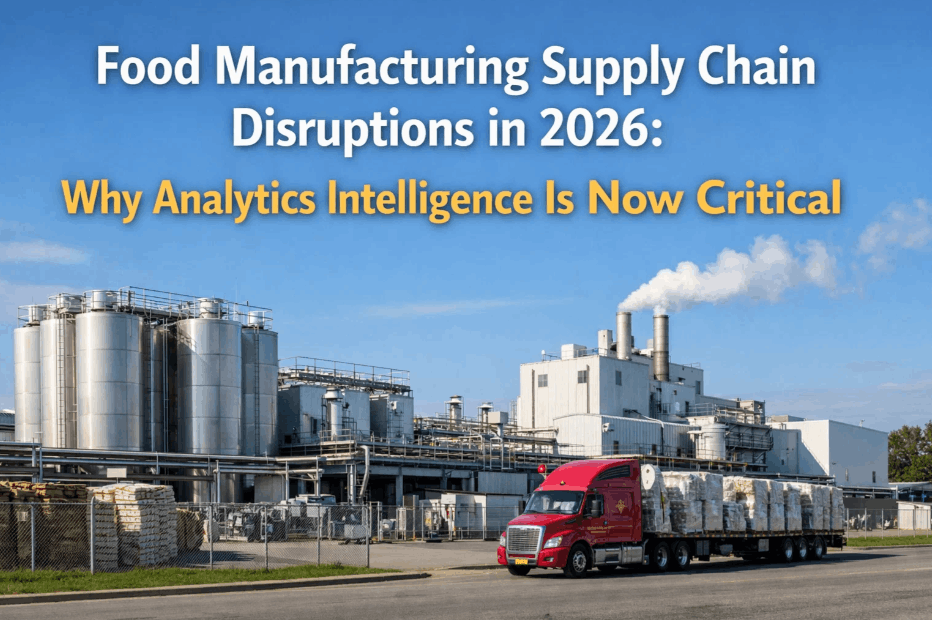
Food manufacturing supply chain disruptions have surged to record levels in 2026, threatening production continuity, regulatory compliance, and profitability across the global food processing industry. From raw material shortages and logistics failures to equipment downtime and geopolitical instability, food plants are navigating a landscape of compounding operational risks unlike any seen in the past decade. For food manufacturers still relying on reactive maintenance strategies and manual production monitoring, the cost of unplanned disruptions is now simply too high to ignore — and Book a Demo to see how AI-driven analytics intelligence is transforming plant resilience in real time.
AI-DRIVEN PLATFORM
·
SUPPLY CHAIN ANALYTICS
·
GFSI AUDIT READY
Achieve Zero Supply Chain Disruptions with AI-Driven Analytics Intelligence
iFactory monitors every critical production asset, supplier risk signal, and CCP compliance event in your facility — delivering real-time disruption alerts, predictive maintenance scheduling, and complete audit-ready documentation before your next SQF, BRC, or FSSC 22000 inspection.
The State of Food Manufacturing Supply Chain Risk in 2026
The food manufacturing sector entered 2026 facing an unprecedented convergence of supply chain pressures. Global ingredient shortages, escalating energy costs, port congestion, and post-pandemic supplier instability have combined with stricter GFSI compliance requirements to create a high-risk operational environment. According to industry tracking data, unplanned production stoppages in food processing facilities increased by over 34% between 2023 and 2025, with equipment failure cited as the leading internal contributor to line downtime.
For plant managers and operations directors, the central challenge is no longer simply managing disruption when it occurs — it is predicting and preventing it. The food manufacturers gaining competitive advantage in 2026 are those deploying analytics intelligence platforms that deliver real-time visibility across every critical asset, process variable, and supply node in their production environment. Traditional ERP systems and paper-based maintenance logs simply cannot provide the signal depth needed to identify emerging failure risks before they cascade into full production shutdowns.
34%
Increase in unplanned production stoppages in food plants since 2023
$2.4M
Average annual cost of equipment-driven downtime per mid-size food facility
68%
Of food manufacturers report inadequate real-time visibility into supply chain risk
95%
Reduction in audit preparation time with AI-driven compliance documentation
Root Cause Analysis
Why Food Manufacturing Supply Chain Disruptions Are Getting Worse
Understanding what is driving the acceleration of supply chain risk in 2026 is essential before any meaningful resilience strategy can be built. Food manufacturers are dealing with disruptions at three distinct layers simultaneously: upstream supplier volatility, internal production instability, and downstream logistics fragility. Each layer compounds the others — a supplier delay that extends production run times places additional wear stress on aging equipment, which then increases the probability of mid-run failures that delay outbound shipment schedules.
At the plant floor level, equipment reliability has emerged as the single most controllable variable in the supply chain risk equation. Unlike geopolitical instability or shipping delays, internal asset performance is something food manufacturers can directly influence through intelligent monitoring, predictive maintenance scheduling, and Book a Demo to understand how AI analytics platforms deliver that control at scale.
01
Aging Production Equipment
The average age of food processing equipment in North American and European facilities has increased significantly since 2020 as capital expenditure was deferred during pandemic-era budget constraints. Older assets operating without intelligent monitoring are significantly more prone to undetected degradation and sudden failure events.
02
Reactive Maintenance Culture
An estimated 70% of food manufacturing facilities still operate predominantly on reactive or time-based maintenance schedules. Without real-time condition monitoring data, maintenance teams cannot distinguish between assets in stable operation and those exhibiting early-stage failure signals — until breakdown occurs.
03
Supplier Concentration Risk
Post-pandemic supply chain consolidation has increased single-source dependency for key ingredients and packaging materials across the food industry. When a concentrated supplier experiences disruption, food manufacturers with no digital supply network visibility face extended production reformulation lead times with no early warning capability.
04
Skills Gap and Workforce Volatility
High turnover rates among skilled maintenance technicians and production operators have accelerated knowledge loss in food plants. Without digital documentation systems capturing equipment history, maintenance patterns, and operational procedures, facilities lose institutional knowledge with every personnel change — increasing the risk of critical error during disruption response.
05
Compliance Pressure During Disruption
GFSI certification requirements — SQF, BRC, and FSSC 22000 — do not relax during supply chain disruptions. Food manufacturers dealing with production volatility face simultaneous pressure to maintain documented CCP monitoring, corrective action trails, and calibration records even when plants are operating outside normal parameters.
06
Digital Visibility Deficit
Most food facilities lack unified real-time dashboards connecting equipment performance data, production KPIs, and supply chain status. Without integrated operational risk management software, plant leadership makes critical production decisions based on lagging indicators rather than live intelligence — consistently arriving too late to prevent disruption escalation.
Analytics Intelligence Platform
How AI-Driven Analytics Intelligence Addresses Food Manufacturing Supply Chain Risk
The emergence of industrial IoT analytics and AI-powered asset performance management platforms has fundamentally changed what is possible in food manufacturing operational risk management. Where legacy monitoring systems generated raw data streams that required manual interpretation, modern analytics intelligence platforms translate equipment sensor data, production performance metrics, and maintenance history into actionable predictions — delivering early warning signals before disruption events materialize.
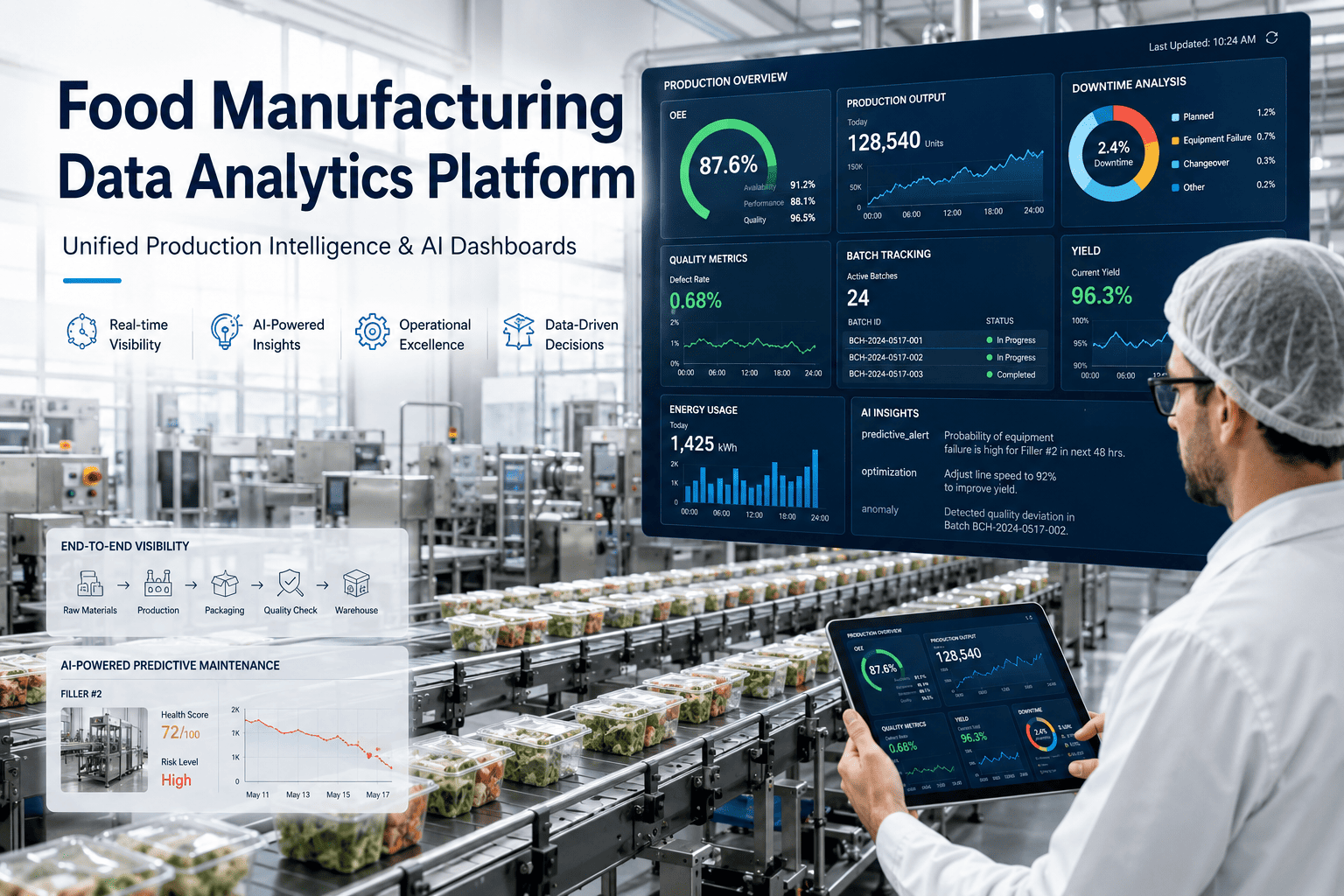
iFactory's analytics intelligence platform is purpose-built for food manufacturing environments, integrating real-time production monitoring, predictive maintenance scheduling, CCP compliance documentation, and supply chain risk visibility into a single operational intelligence layer. Food manufacturers can Book a Demo to see exactly how the platform maps to their specific production environment and risk profile.
01
Real-Time Equipment Performance Monitoring
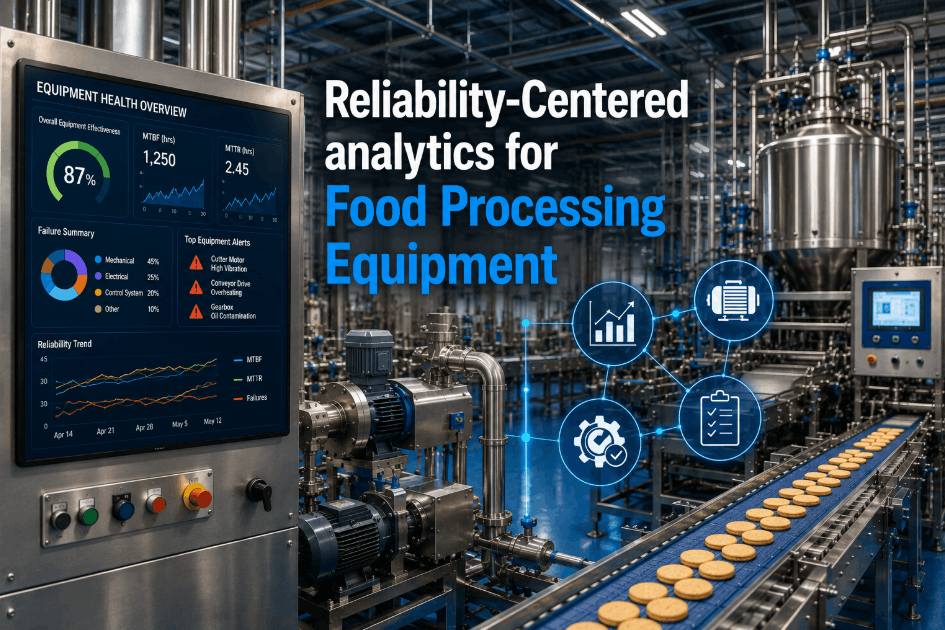
AI-driven continuous monitoring of critical production assets — filling machines, pasteurizers, conveyors, detection systems, packaging lines — generates live performance data that enables maintenance teams to identify developing failures days or weeks before breakdown. Vibration anomalies, temperature drift, pressure deviations, and cycle time degradation are all captured and analyzed in real time, converting equipment health from a mystery into a measurable, manageable variable.
02
Predictive Maintenance Scheduling for Production Continuity
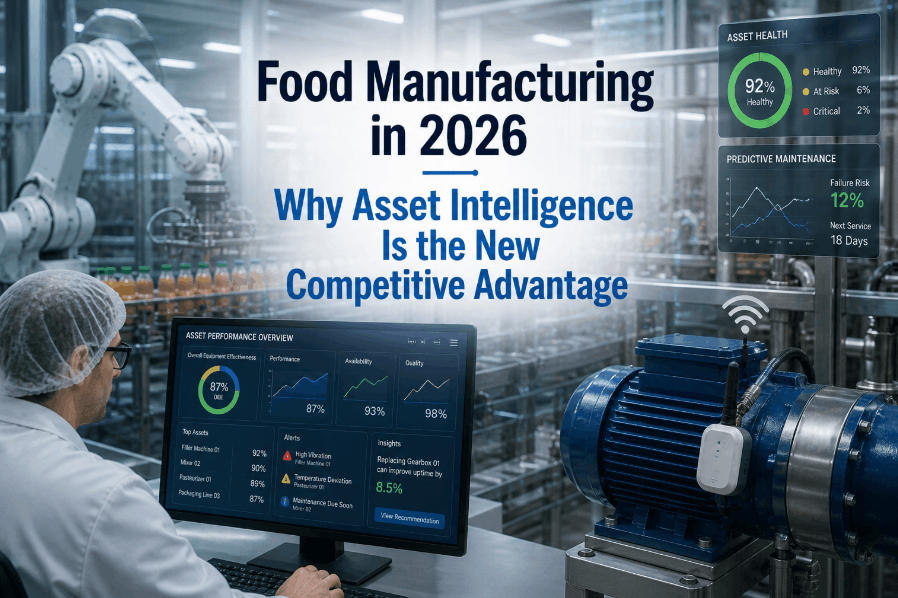
Traditional time-based preventive maintenance schedules are blunt instruments — they replace components that still have useful life remaining while missing developing failures that fall between scheduled service intervals. AI-driven predictive maintenance uses condition monitoring data and machine learning algorithms to generate optimized maintenance schedules based on actual asset health — reducing unnecessary maintenance downtime while eliminating unplanned failure events that disrupt production continuity planning.
03
Digital Twin Analytics for Production Scenario Planning
Digital twin technology creates virtual replicas of production lines that allow food manufacturers to simulate the impact of supply chain disruptions before they occur. If a key ingredient supplier reports a two-week delay, digital twin analytics can model the production schedule impact, identify alternative formulation options, and quantify the downstream effect on finished goods inventory and customer commitments — enabling proactive decision-making rather than reactive crisis management.
04
Automated CCP Compliance Documentation During Disruption
Supply chain disruptions create heightened compliance risk as production schedules are compressed and normal procedures are accelerated. AI-driven compliance automation ensures that metal detector challenge tests, pasteurization temperature records, allergen control verifications, and corrective action documentation are captured continuously — regardless of whether the plant is operating at normal capacity or in disruption-response mode. Audit readiness is maintained even when operations are under maximum pressure.
05
Supply Chain Visibility and Supplier Risk Scoring
Integrated supply chain risk analytics aggregate supplier performance data, lead time variability, geographic concentration risk, and alternative sourcing options into a unified risk dashboard. Plant managers gain visibility into which suppliers represent the highest disruption probability, enabling proactive inventory buffering, dual-sourcing decisions, and procurement schedule adjustments before supply gaps translate into production stoppages. Learn how this capability works by arranging to
Book a Demo with the iFactory team.
Operational Risk Management: Reactive vs. AI-Driven Analytics Intelligence
Food manufacturers that have deployed analytics intelligence platforms report measurable improvements across every operational risk dimension compared to facilities still relying on traditional reactive management approaches.
Supply Chain Resilience Comparison: Traditional vs. AI-Driven Food Manufacturing
Implementation Strategy
Building a Plant Resilience Strategy with Analytics Intelligence in 2026
Deploying an analytics intelligence platform is not a multi-year transformation project — it is a phased deployment that delivers measurable value within weeks. The most resilient food manufacturers in 2026 are those that connected their highest-risk production assets first, generating immediate visibility into the equipment most likely to cause supply chain disruption, then expanded coverage systematically across their plant operations. Any food manufacturer serious about operational risk management can Book a Demo and be generating real-time production intelligence within 30 days.
1
Asset Risk Assessment and Prioritization
Begin with a structured assessment of your production assets ranked by their criticality to supply chain continuity. Which equipment failures would cause the longest production stoppage? Which assets have the poorest maintenance history? Which CCPs carry the highest compliance risk if monitoring is interrupted? This risk ranking determines the sequence of IoT sensor deployment and analytics platform integration — maximizing the resilience impact of every implementation dollar.
Outcome: Risk-prioritized deployment roadmap
2
IoT Connectivity and Real-Time Data Capture
Industrial IoT sensors connect directly to existing production equipment — capturing vibration, temperature, pressure, current draw, and cycle rate data continuously. For equipment without direct sensor interfaces, operator-facing digital forms replace paper logs and enforce complete data capture before submission. The iFactory platform ingests this data stream and begins building the equipment performance baseline needed for accurate predictive analytics within the first days of operation.
Outcome: Live production monitoring from day one
3
Predictive Analytics Model Training and Alerting
AI machine learning models are trained on your specific equipment performance data — identifying the unique signatures that precede failure events on your production assets. As the model accumulates operational history, predictive accuracy improves continuously. Automated alert thresholds are configured to notify maintenance teams, plant managers, and supply chain planners when equipment health indicators cross into elevated risk territory — enabling intervention before production is affected.
Outcome: Early failure warning with plant-specific precision
4
Supply Chain Intelligence Integration and Scenario Modeling
Connect supplier performance data, inventory levels, and logistics KPIs to the analytics platform — creating a unified operational risk dashboard that spans both internal production and external supply chain variables. Configure disruption scenario models that automatically calculate the production impact of defined supply chain events, enabling proactive response planning rather than emergency reaction. Plant leadership gains the decision-support intelligence needed to manage supply chain risk with strategic precision.
Outcome: End-to-end supply chain risk visibility
Industry Insight
What Leading Food Manufacturers Are Doing Differently in 2026
The food manufacturers achieving the strongest operational resilience outcomes in 2026 share a common set of strategic commitments that distinguish them from facilities still managing production risk with legacy tools. These are not theoretical best practices — they are documented operational patterns emerging from the food plants with the lowest unplanned downtime rates, the fastest supply chain disruption recovery times, and the cleanest GFSI audit records.
They Treat Equipment Health as a Supply Chain Variable
Leading food manufacturers have stopped treating internal equipment reliability as a separate concern from supply chain risk management. They understand that a single critical asset failure can disrupt outbound shipment commitments just as severely as a supplier delay — and they monitor both through integrated real-time dashboards that give operations leadership unified visibility across internal and external risk factors.
They Invest in Predictive, Not Just Preventive, Maintenance
Time-based preventive maintenance schedules are being systematically replaced with AI-driven predictive maintenance programs that use actual condition monitoring data to schedule interventions at the optimal point — before failure, but not before it is necessary. This shift produces measurable improvements in both equipment availability and maintenance cost efficiency, directly strengthening production continuity planning capabilities.
They Automate Compliance Documentation at Every Risk Level
GFSI certification schemes require the same documentation rigor during supply chain disruption as during normal operations. Food manufacturers that automate CCP monitoring records, corrective action workflows, and calibration histories eliminate the compliance gap risk that manual documentation creates during high-pressure production periods — maintaining audit readiness regardless of operational conditions.
They Use Data to Make Production Decisions, Not Intuition
The shift from intuition-driven to data-driven production management is the defining operational change in high-performing food plants in 2026. When supply chain disruption forces a rapid production schedule change, facilities with real-time analytics intelligence can model the equipment stress implications of accelerated run rates, identify which assets are most vulnerable under the new schedule, and preemptively stage maintenance interventions — avoiding the secondary equipment failures that compound initial disruption impact.
Frequently Asked Questions
How quickly can analytics intelligence reduce unplanned downtime?
Most food plants see measurable downtime reduction within 60–90 days of deployment. Facilities report 60–85% fewer unplanned equipment failures within the first 12 months as AI predictive models accumulate plant-specific operational data.
Does it work for smaller food manufacturing facilities?
Yes. The platform scales from single-site facilities to multi-plant enterprises. Smaller manufacturers often benefit most, as they lack in-house data science resources to manually analyze equipment performance trends across shifts.
Can it integrate with existing ERP or CMMS systems?
iFactory integrates with existing ERP, CMMS, and MES systems through standard API connectivity — layering real-time predictive analytics on top of current infrastructure without replacing existing technology investments.
How does it support GFSI compliance during disruptions?
AI-driven compliance automation captures CCP monitoring records, calibration events, and corrective action documentation continuously — even during operational disruptions — keeping audit records complete for BRC, SQF, and FSSC 22000.
What is the ROI timeline for deployment?
Food manufacturers typically achieve positive ROI within 6–9 months, driven by reductions in emergency repair costs, unplanned downtime, and compliance-related audit findings across production facilities.
How is predictive different from preventive maintenance?
Predictive maintenance uses real-time condition data and AI pattern recognition to intervene at the right moment — before failure occurs. Preventive maintenance runs on fixed schedules, missing failures between intervals and replacing parts with life remaining.
Build Your Disruption-Proof Production Environment
iFactory — AI Analytics Intelligence for Food Manufacturing Supply Chain Resilience
Food manufacturing supply chain disruptions in 2026 are not going away — they are becoming more frequent, more complex, and more costly. The food manufacturers that will lead their categories through this environment are those investing now in analytics intelligence platforms that deliver real-time equipment monitoring, predictive maintenance scheduling, supply chain risk visibility, and automated compliance documentation as a single integrated capability.
Real-time production monitoring across all critical assets
AI predictive maintenance to eliminate unplanned downtime
Supply chain risk scoring with early disruption alerts
Digital twin analytics for production scenario planning
Automated CCP compliance documentation under any operating condition
Audit-ready reporting for SQF, BRC, and FSSC 22000