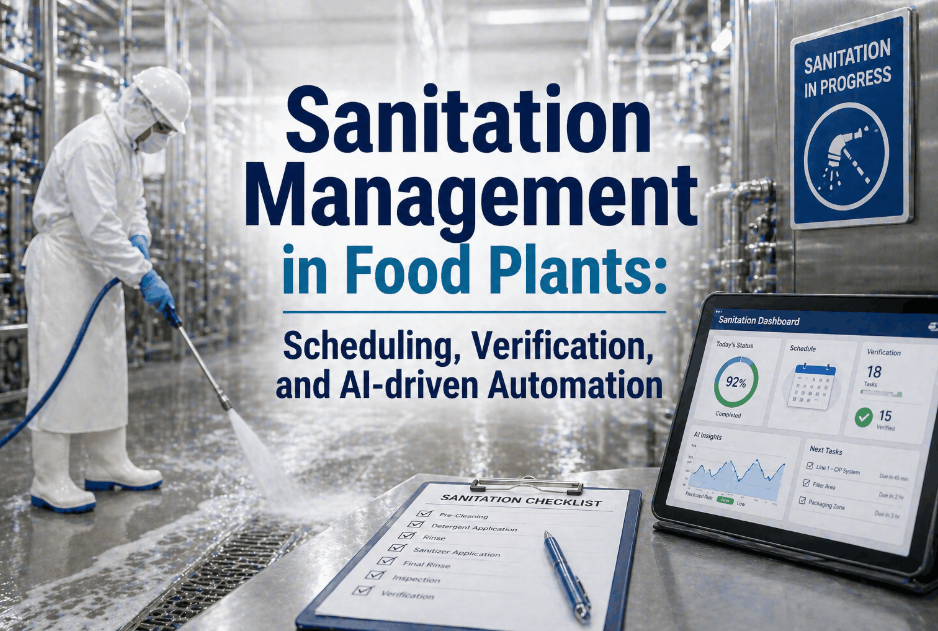
Food plant sanitation management is no longer a clipboard-and-checklist operation — in 2026, leading food manufacturers are deploying AI-driven sanitation scheduling, real-time verification, and automated SSOP compliance documentation to eliminate audit risk, protect brand integrity, and meet the ever-tightening demands of FSMA, SQF, and BRC certification. When a single sanitation failure can trigger a recall costing millions of dollars and irreparable consumer trust damage, the cost of reactive sanitation management is simply too high. Sanitation supervisors operating across multi-line, multi-shift environments need a smarter system — one that thinks ahead, flags gaps before they become violations, and produces audit-ready records automatically. To see how AI-powered sanitation management works inside a live food plant environment, Book a Demo with the iFactory team today.
Why Traditional Sanitation Scheduling Fails Modern Food Manufacturers
The Hidden Risk of Manual Master Sanitation Schedules
Most food manufacturing facilities still manage their master sanitation schedule through a combination of paper logs, shared spreadsheets, and individual supervisor memory — a system that creates invisible compliance gaps that only surface during audits or, worse, during a foodborne illness investigation. Static cleaning frequencies cannot adapt to production intensity changes, allergen crossover events, or equipment condition shifts that demand immediate sanitation intervention. In environments running multiple shifts across dozens of lines, the gap between what the sanitation schedule prescribes and what was actually executed and verified becomes a documented liability. Sanitation supervisors ready to close that gap can Book a Demo and see how AI-driven scheduling eliminates compliance blind spots from day one.
Core Components of an Effective Food Plant Sanitation Program
Building a Sanitation Architecture That Satisfies FSMA and GFSI Auditors
A compliant food plant sanitation program is not a single process — it is a layered architecture of interconnected procedures, schedules, verifications, and corrective action records that must function reliably across every production day, every shift change, and every equipment configuration. The five operational pillars below form the structural foundation that separates audit-ready sanitation programs from those that generate warning letters and hold events. Sanitation supervisors evaluating a technology upgrade can Book a Demo and walk through how each pillar is managed inside the iFactory platform.
AI-Driven Sanitation Automation: What Changes and What It Delivers
How Machine Learning Transforms Sanitation Scheduling and Verification
The fundamental shift that AI-driven sanitation automation introduces is the transition from time-based cleaning schedules to condition-responsive sanitation intelligence — where cleaning frequency, intensity, and scope are continuously recalibrated based on production data, environmental monitoring results, and equipment condition signals. This is not incremental improvement over existing digital checklists. It is a structural change in how food plants manage the relationship between sanitation actions and food safety risk, and it is the capability that separates facilities achieving 98-plus percent pre-op pass rates from those managing a persistent cycle of inspection findings.
Sanitation Management Platform Comparison: Manual vs. Digital vs. AI-Driven
Evaluating Food Plant Sanitation Software for FSMA and GFSI Compliance
The capability comparison below maps the critical performance dimensions that food safety auditors, FSMA compliance officers, and SQF practitioners evaluate when assessing the maturity of a facility sanitation program. Understanding where your current system sits in this framework is the starting point for identifying your highest-priority compliance investment. Sanitation supervisors seeking a platform assessment against their current program can Book a Demo for a live gap analysis with the iFactory food safety engineering team.
| Sanitation Management Capability | Paper / Manual | Digital Checklist | AI-Driven Platform |
|---|---|---|---|
| Master Sanitation Schedule Logic | Static Calendar | Fixed Digital Forms | Dynamic AI-Adjusted |
| Pre-Operational Verification Records | Paper Sign-Off | Digital Checkbox | Photo + ATP + Timestamp |
| CIP Cycle Validation | Manual Chart Review | Partial Integration | Automated Parameter Cert. |
| SSOP Deviation Documentation | Ad Hoc Paper Notes | Manual Digital Entry | Auto-Triggered CAPA Workflow |
| Environmental Monitoring Response | Not Integrated | Manual Update | Auto-Schedule Intensification |
| Audit Report Preparation | Manual Compilation | Semi-Automated Export | On-Demand Auto-Generation |
| Multi-Shift Accountability | Not Tracked | Basic Sign-Off Log | Individual + Escalation Tracking |
| Chemical Concentration Verification | Not Available | Manual Entry Only | Automated Dosing Validation |
SSOP Compliance in Food Manufacturing: What Auditors Actually Look For
Closing the Documentation Gap That Triggers FDA Warning Letters
Understanding what SSOP compliance auditors prioritize during facility assessments reveals exactly why paper-based and basic digital systems consistently fail under scrutiny — and why the facilities achieving zero-finding audits have universally moved to automated sanitation documentation platforms. The six audit dimensions below represent the most frequently cited documentation deficiencies in FDA 483 observation reports and GFSI audit findings across food manufacturing categories.
Measuring the ROI of AI-Driven Sanitation Management
Financial Outcomes Delivered by Automated Food Plant Sanitation Programs
Building Your Digital Sanitation Program: A Practical Implementation Roadmap
How Food Plants Deploy AI Sanitation Management Without Disrupting Production
The most frequent concern sanitation supervisors raise when evaluating AI-driven sanitation platforms is deployment complexity — specifically, how a new digital system integrates with existing sanitation crew workflows, validated CIP programs, and established SSOP documentation without creating a transition period that introduces new compliance risk. Purpose-built food plant sanitation platforms are designed with this exact constraint in mind: deployment follows a phased activation model that delivers compliance value at each stage rather than requiring a complete program overhaul before any benefit is realized. To see a deployment timeline mapped to your specific facility configuration, Book a Demo and speak with the iFactory food safety implementation team directly.
Frequently Asked Questions
What is a master sanitation schedule in food manufacturing?
A master sanitation schedule (MSS) defines the cleaning frequency, method, responsible personnel, and verification requirements for every surface, equipment unit, and zone in a food facility. AI-driven platforms maintain dynamic MSS logic that automatically adjusts cleaning frequencies based on production volume, environmental monitoring outcomes, and equipment condition data — replacing static calendars with responsive sanitation intelligence.
How does AI-driven sanitation scheduling improve FSMA compliance?
AI sanitation platforms generate automated, timestamped records for every scheduled task, deviation, corrective action, and verification activity — creating the complete documentation chain that FSMA Preventive Controls requires. The system closes the gap between what the sanitation program prescribes and what was actually executed, which is the core documentation deficiency that generates FDA 483 observations.
What is the difference between pre-operational and operational sanitation?
Pre-operational sanitation verifies that all food-contact surfaces are clean and sanitized before production begins each shift. Operational sanitation manages contamination risk during active production through scheduled mid-shift cleaning, equipment wipe-downs, drip management, and allergen changeover procedures. Both require documented verification records to satisfy SSOP compliance requirements.
What CIP data does an AI sanitation platform capture and validate?
AI-integrated CIP management captures temperature profile, chemical concentration curve, flow rate, cycle duration, and final rinse conductivity for every cleaning cycle — validating completion against programmatic parameters and generating a tamper-proof digital cycle certificate that replaces paper CIP logs with an auditable electronic record tied to each individual production run.
How does automated SSOP documentation reduce audit preparation time?
AI-driven sanitation platforms generate on-demand compliance reports, deviation logs, and corrective action summaries directly from captured operational data — eliminating the manual compilation process that typically requires 14 to 22 hours of supervisor time per audit cycle. Auditors receive a structured, complete evidence package that demonstrates systematic program execution rather than ad hoc record assembly.
Can AI sanitation management integrate with existing food safety software?
Yes. Purpose-built food plant sanitation platforms integrate with existing ERP, CMMS, and food safety management systems through standard protocols — adding AI-driven scheduling and automated verification without replacing validated system configurations. Most integrations are completed without production interruption, with full platform activation typically achieved within 10 to 14 weeks.
How does digital sanitation management handle allergen changeover documentation?
AI sanitation platforms enforce mandatory allergen changeover verification workflows — requiring photographic evidence, ATP swab results, and authorized sign-off before production release — and automatically flag any attempt to start a new product run without a completed allergen clearance record. This creates an auditable, traceable allergen management chain that eliminates the documentation gaps most commonly associated with allergen-related recalls.
What ROI can food manufacturers expect from AI sanitation automation?
Documented deployments consistently show 38 to 45 percent reduction in pre-operational sanitation failures, 62 to 78 percent decrease in SSOP documentation deficiencies at third-party audits, and 29 to 41 percent reduction in sanitation-related production hold and rework events — with most facilities achieving full platform payback within the first two audit cycles.