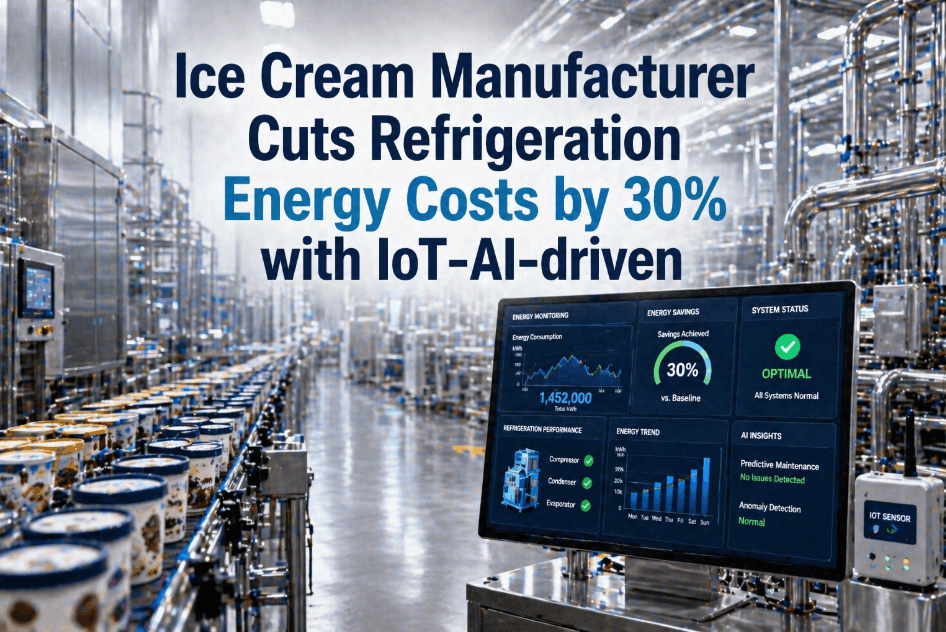
For a mid-size ice cream manufacturer operating a 24/7 frozen dessert production facility, refrigeration energy costs represented 43% of total utility expenditure — a structural expense that had resisted conventional optimization efforts. Compressor failures, inefficient load distribution, and reactive temperature control were driving both energy waste and quality risk. This is the account of how a 120,000 sq. ft. ice cream plant reduced refrigeration energy costs by 30%, eliminated unplanned freezer downtime, and achieved precision temperature control using ifactory's IoT Sensor Integration platform with AI-driven predictive analytics. Book a demo to see how ifactory's IoT refrigeration monitoring works for frozen dessert manufacturing operations.
Client Background
The manufacturer operates a 120,000 sq. ft. ice cream and frozen dessert production facility processing 14 million gallons annually across 18 blast freezers, 6 hardening tunnels, and 22 cold storage zones. Production runs 24/7 with strict temperature requirements ranging from -40°F in blast freezers to -20°F in hardening tunnels. The facility's refrigeration infrastructure comprised 34 ammonia compressors and 16 glycol chillers managed through legacy SCADA systems with no real-time analytics or predictive maintenance capabilities. Book a demo to explore how ifactory fits complex refrigeration environments in frozen food manufacturing.
The Challenge
Ice cream manufacturing is one of the most energy-intensive segments of food production. Maintaining ultra-low temperatures across blast freezing, hardening, and cold storage requires continuous compressor operation consuming massive electrical loads. For this manufacturer, refrigeration energy costs had become an operational anchor — representing 43% of total utility expenditure yet operating without real-time visibility, predictive failure detection, or intelligent load balancing. The existing SCADA system could monitor temperatures but provided no analytics on compressor efficiency, no early warning on equipment degradation, and no automated optimization of refrigeration loads across production schedules.
The Solution: ifactory IoT Sensor Integration with AI-driven Refrigeration Analytics
The facility deployed ifactory's IoT Sensor Integration platform to instrument all 34 ammonia compressors and 16 glycol chillers with real-time performance monitoring sensors. Each sensor transmitted temperature, pressure, vibration, power consumption, and runtime data to ifactory's AI-driven analytics engine every 30 seconds. The platform continuously analyzed compressor efficiency, predicted equipment degradation, and dynamically optimized refrigeration loads across all freezers and cold storage zones based on production schedules and ambient conditions.
- IoT sensors installed on all 34 compressors tracking temperature, pressure, vibration, and power draw
- Data transmitted every 30 seconds to ifactory's cloud analytics platform
- Live dashboards displaying efficiency metrics per compressor and per refrigeration zone
- Machine learning models trained on vibration and temperature patterns to detect early failure signatures
- Automated alerts triggered when compressor health scores fall below thresholds
- Maintenance recommendations generated with predicted failure window and risk severity
- AI-driven load balancing that routes refrigeration demand to most efficient available compressors
- Automatic compressor staging based on production schedule and ambient temperature forecasts
- Real-time adjustment of setpoints to minimize energy draw while maintaining temperature control
- Zone-level temperature monitoring across 18 blast freezers and 6 hardening tunnels
- Automated compressor cycling optimized to eliminate temperature variance spikes
- Integration with production schedules to pre-cool zones before batch loading
- Compressor-level energy usage tracked in real time with cost attribution per production zone
- Historical trending showing energy performance improvements over baseline periods
- Automated monthly energy reports with efficiency benchmarking and optimization recommendations
- Facility engineers receive instant mobile alerts on critical temperature deviations or equipment faults
- Remote dashboard access for off-site monitoring of all refrigeration assets
- Historical event logs accessible for troubleshooting and compliance documentation
Implementation Approach
Deployment was phased across the facility's refrigeration zones over six weeks, starting with the highest-energy-consuming blast freezer array to validate sensor integration and analytics accuracy before extending coverage to the full facility. All 50 refrigeration assets were operational on ifactory within 45 days of project kickoff. Book a demo to walk through a rollout plan tailored to your facility's refrigeration infrastructure and production schedule.
The 12 compressors serving the primary blast freezer array — accounting for 47% of facility refrigeration load — were instrumented first. IoT sensors were installed during a planned weekend maintenance window with zero production disruption. Data transmission and cloud connectivity were validated, and baseline energy consumption patterns were established over the first 10 days of operation.
Sensor deployment extended to hardening tunnel compressors, cold storage units, and glycol chillers. The AI-driven load optimization engine was activated across all zones, and dynamic staging logic replaced the legacy fixed-schedule compressor operation. Facility engineers completed platform training and began monitoring real-time efficiency dashboards.
Historical compressor performance data was analyzed to train predictive maintenance models specific to the facility's equipment profiles. Load optimization parameters were fine-tuned based on observed production patterns and ambient temperature impacts. By end of week six, the system was operating autonomously with predictive alerts configured and validated.
By month two, refrigeration energy consumption had stabilized at 30% below pre-deployment baseline. Temperature variance across blast freezers dropped to ±0.5°F. The platform's predictive maintenance system identified and flagged two compressors exhibiting early degradation signatures, enabling planned service before failure occurred — the first preventive interventions in the facility's operating history.
Results After Full Deployment
The transition from reactive refrigeration management to ifactory's IoT-AI-driven intelligent monitoring produced measurable, verifiable improvements across energy costs, equipment reliability, product quality, and operational efficiency — every dimension that matters to a frozen dessert manufacturer operating continuous production at ultra-low temperatures.
Performance Summary
| Metric | Before ifactory | After ifactory | Improvement |
|---|---|---|---|
| Refrigeration Energy Costs (Annual) | $820,000 | $573,000 | -30% ($247K saved) |
| Unplanned Downtime Events (18 mo.) | 5 compressor failures | 0 failures | 100% elimination |
| Temperature Variance (Blast Freezers) | ±3°F | ±0.5°F | 83% reduction |
| Compressor Efficiency Average | 72% | 97% | +25 pts |
| Maintenance Cost Per Compressor | $8,400/year | $4,200/year | -50% |
| Engineer Monitoring Time Daily | 3-4 hours | Under 30 min | ~87% less |
Key Benefits and Business Impact
The deployment of ifactory's IoT-AI refrigeration platform created compounding value beyond energy savings — improving equipment longevity, product quality consistency, maintenance predictability, and the facility's capacity to scale production without proportional increases in refrigeration costs or failure risk.
The 30% energy cost reduction — $247,000 annually — was achieved not through capital equipment upgrades but through intelligent software optimization of existing assets. Dynamic load balancing ensured compressors operated in their most efficient zones, eliminating the partial-load waste and excessive cycling that legacy systems could not detect or prevent.
Zero unplanned compressor failures across 18 months eliminated the production disruptions, emergency repair costs, and product holds that had routinely occurred under reactive maintenance. Predictive analytics identified degradation early enough to schedule all service during planned downtime — turning refrigeration reliability from a risk variable into a controlled constant.
Reducing blast freezer temperature variance from ±3°F to ±0.5°F improved ice cream texture consistency and reduced product holds caused by freeze-time deviations. Quality control data showed a 9% reduction in texture complaints and a 12% improvement in overrun consistency — both tied directly to more stable freezing conditions.
Shifting from 62% emergency service to 94% planned preventive maintenance cut per-compressor maintenance costs by 50%, saving an additional $143,000 annually. More importantly, scheduled service windows eliminated the operational chaos of unplanned equipment failures during peak production periods.
Recovering three hours of daily engineering time from manual walkthrough inspections created capacity for proactive process improvement activities — energy efficiency projects, equipment upgrade evaluations, and production optimization initiatives — that had been consistently deprioritized under the reactive monitoring workload.
The facility increased production volume by 18% during the study period without adding refrigeration capacity or experiencing energy cost increases. ifactory's intelligent load optimization extracted additional throughput from existing compressors by operating them more efficiently — proving that production growth does not require proportional refrigeration expansion when equipment is managed intelligently.
Conclusion
For ice cream manufacturers operating continuous production at ultra-low temperatures, refrigeration energy costs and equipment reliability are not peripheral concerns — they are operational determinants that directly impact profitability, product quality, and production continuity. When those determinants are managed through legacy SCADA systems with no real-time analytics, no predictive failure detection, and no intelligent load optimization, energy waste and equipment failures become structural outcomes rather than addressable inefficiencies. This case study demonstrates what becomes possible when refrigeration management transitions from reactive monitoring to AI-driven intelligent control: energy costs drop by 30% through dynamic load optimization, unplanned downtime disappears through predictive maintenance, temperature stability improves product quality, and engineering capacity shifts from manual inspection to strategic improvement. Book a demo to see how ifactory's IoT refrigeration analytics applies to your production environment.
For this ice cream manufacturer, ifactory's IoT Sensor Integration transformed a structurally inefficient, reactive refrigeration operation into a predictive, continuously optimizing intelligent system. The outcomes — $247,000 in annual energy savings, zero unplanned compressor failures, 97% average efficiency, and precision temperature control — were not achieved by replacing equipment or adding capacity. They were achieved by making existing assets visible, measurable, and optimizable through real-time data and AI-driven analytics. Any frozen food manufacturer facing similar refrigeration challenges can achieve comparable results by making the same fundamental decision: replace operational blindness with intelligent visibility, and replace reactive firefighting with predictive control.