-what-food-manufacturers-must-do-now.png)
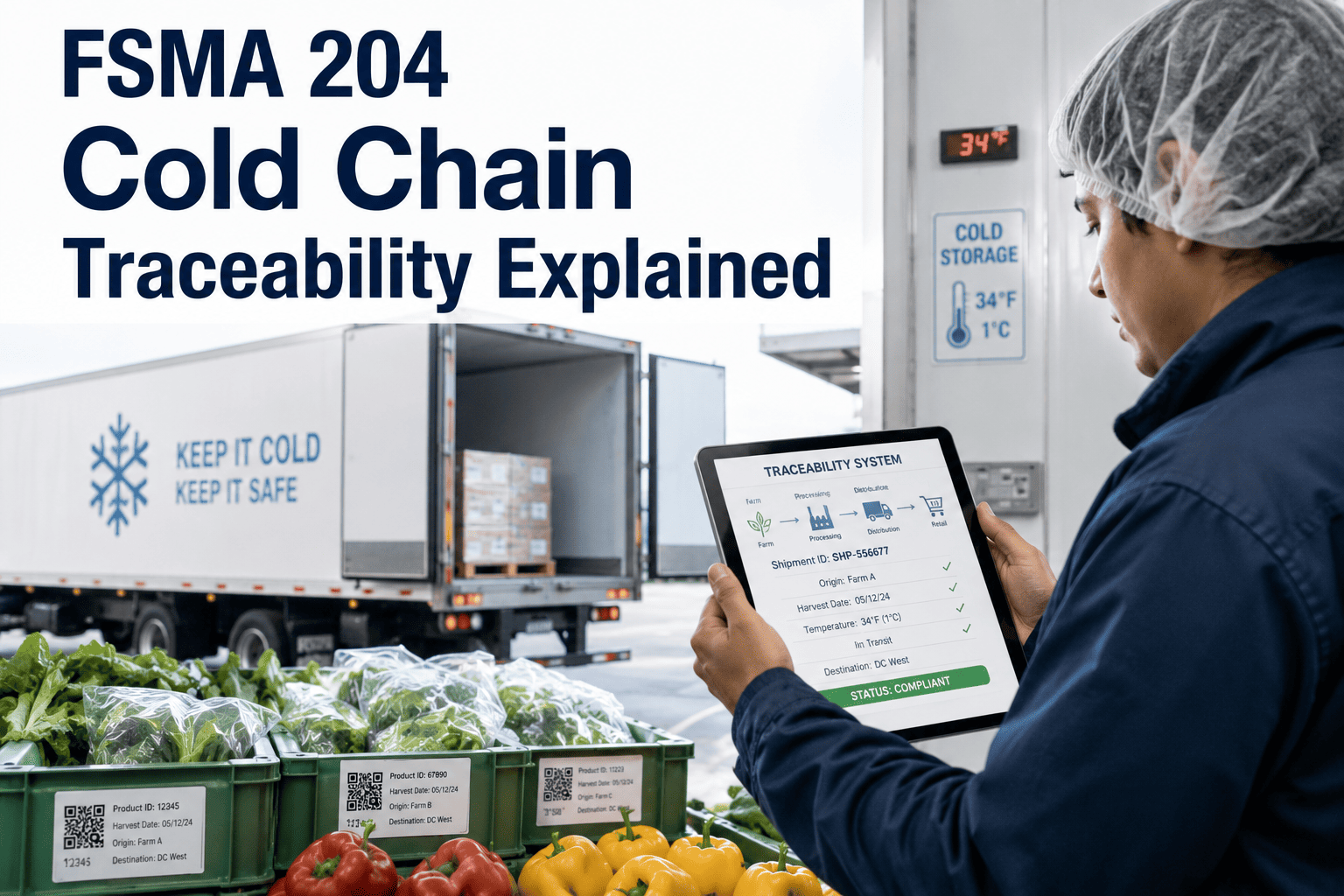
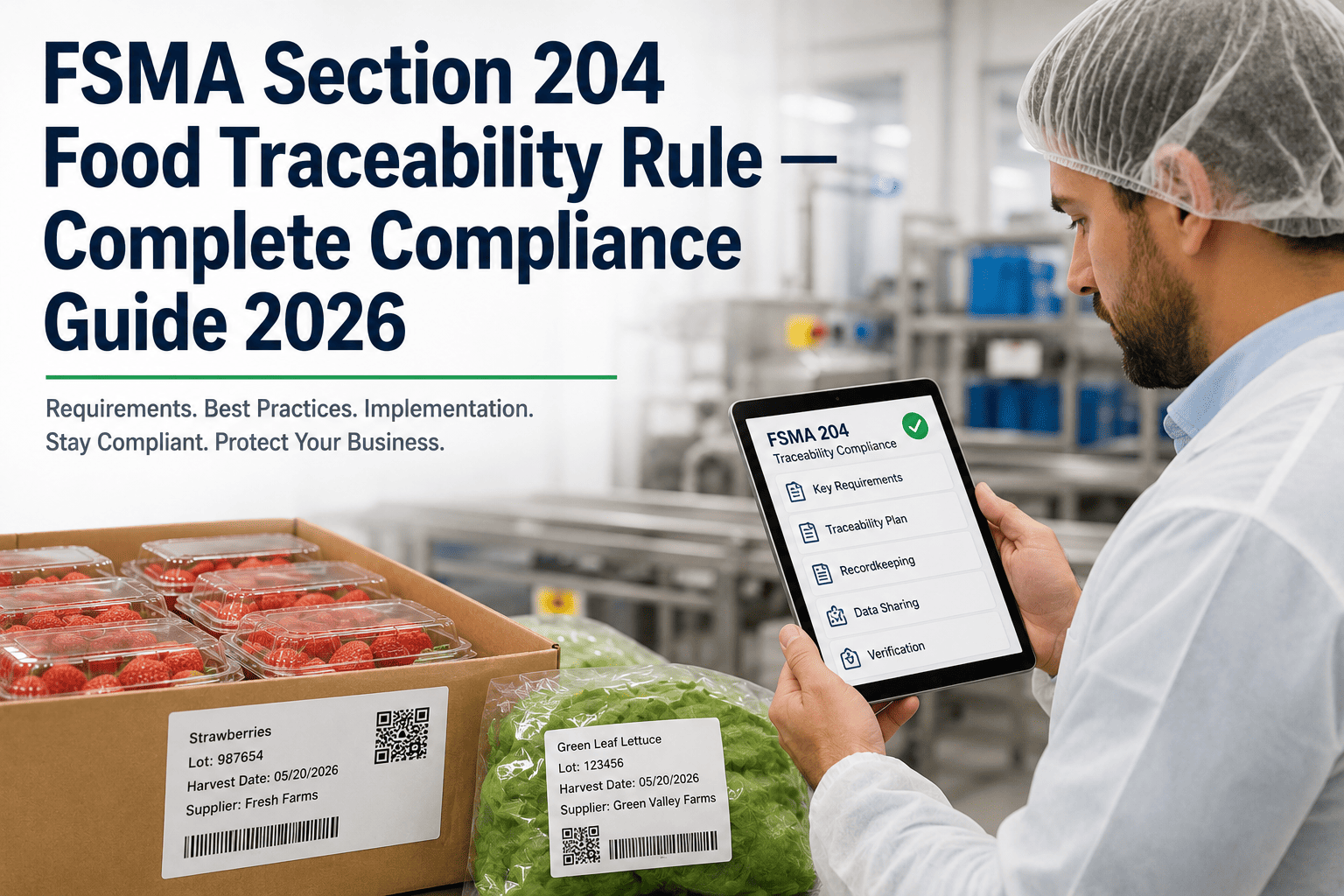
The FDA Food Traceability Rule under FSMA Section 204 is the most significant regulatory shift in food supply chain management in decades. Effective January 20, 2026, this rule mandates that food manufacturers, processors, and distributors handling foods on the Food Traceability List (FTL) maintain detailed traceability records — down to the lot level — and produce them to regulators within 24 hours upon request. For Regulatory and Quality Directors, the compliance window is no longer approaching. It is here. Understanding your obligations around Key Data Elements (KDEs), Critical Tracking Events (CTEs), and electronic record retention is not optional — it is the operational baseline for continued market access.
What Is the FDA Food Traceability Rule (FSMA Section 204)?
The FDA Food Traceability Rule, codified under Section 204 of the Food Safety Modernization Act, establishes a new traceability recordkeeping framework for high-risk foods. Unlike prior FDA guidance, Section 204 is not voluntary. It defines a mandatory, standardized approach to tracking food through the supply chain — from farm or first processor through to the final point of sale or service. The rule introduces a structured vocabulary of traceability obligations built around two foundational concepts: Critical Tracking Events and Key Data Elements. Every food manufacturer covered by the rule must understand these two constructs in operational, not just regulatory, terms.
The Food Traceability List — the scope document for Section 204 compliance — covers categories including leafy greens, shell eggs, nut butters, soft cheeses, ready-to-eat deli salads, fresh herbs, melons, peppers, sprouts, tomatoes, cucumbers, tropical tree fruits, and fresh-cut fruits and vegetables. If your facility handles any of these commodities at any point in the supply chain, Section 204 applies to your operations.
Understanding CTEs: Critical Tracking Events in Food Manufacturing
Critical Tracking Events are the defined moments in the food supply chain where traceability records must be created and maintained. The FDA has identified a structured set of CTEs that apply across different supply chain roles. For food manufacturers and processors, the most operationally significant CTEs are:
Harvesting (for farms and initial harvesters)
The point at which a raw agricultural commodity covered by the FTL is harvested. Required KDEs include the commodity, variety, quantity, unit of measure, harvest date, harvest location, and reference to the traceability lot code assigned.
Cooling (for initial packers and processors)
The initial cooling step applied to a raw agricultural commodity after harvest. A new traceability lot code must be assigned if none was assigned at harvest. Required KDEs include the commodity, lot code, quantity, cooling date, and location.
Initial Packing
The first packing of a raw agricultural commodity into a container. This CTE is the most common compliance trigger for food manufacturers who receive bulk product and pack into consumer or wholesale units. The traceability lot code assigned at packing must follow the product through all subsequent transactions.
First Land-Based Receiving
The first point at which a food is received on land from a fishing vessel. Applies specifically to seafood products on the FTL. KDEs include vessel name, fishing trip dates, port of landing, and quantity.
Shipping and Receiving (throughout supply chain)
Every ship and receive transaction for FTL foods must be documented with traceability lot codes, quantity, unit of measure, and location identifiers. This applies to every entity in the supply chain — manufacturers, distributors, and retailers included. Book a demo to see how automated shipping/receiving capture works in iFactory's traceability platform.
Key Data Elements (KDEs): What Your Records Must Capture
Key Data Elements are the specific data points that must be recorded at each Critical Tracking Event. The FDA has defined both required KDEs — which must always be captured — and reference document KDEs, which link traceability records to shipping documents, invoices, or other business records. The practical compliance challenge for most food manufacturers is not knowing what KDEs are required; it is building operational systems that capture them consistently, accurately, and in a format that can be produced to the FDA within 24 hours. Book a demo to see how iFactory maps KDE capture to your existing production line and ERP workflows.
| CTE | Required KDEs | Traceability Lot Code Required? | Who Must Record |
|---|---|---|---|
| Harvesting | Commodity, variety, quantity, unit of measure, harvest date, harvest location, geo-coordinates | Yes — Assign at harvest | Farms, initial harvesters |
| Cooling | Commodity, lot code, quantity, cooling date and location | Yes — Assign if not at harvest | Initial coolers, packers |
| Initial Packing | Commodity, lot code, quantity, packing date, packing location, reference document | Yes — Assign at packing | Initial packers, food manufacturers |
| Transformation | Input lot codes, output lot codes, commodity, quantity, transformation date and location | Yes — New TLC for output | Processors, manufacturers |
| Shipping | TLC, quantity, unit of measure, ship date, location, receiver identity | Yes — Pass through TLC | All covered entities |
| Receiving | TLC, quantity, receive date, location, supplier identity, reference document | Yes — Record TLC from supplier | All covered entities |
FDA Food Traceability Record Retention Requirements
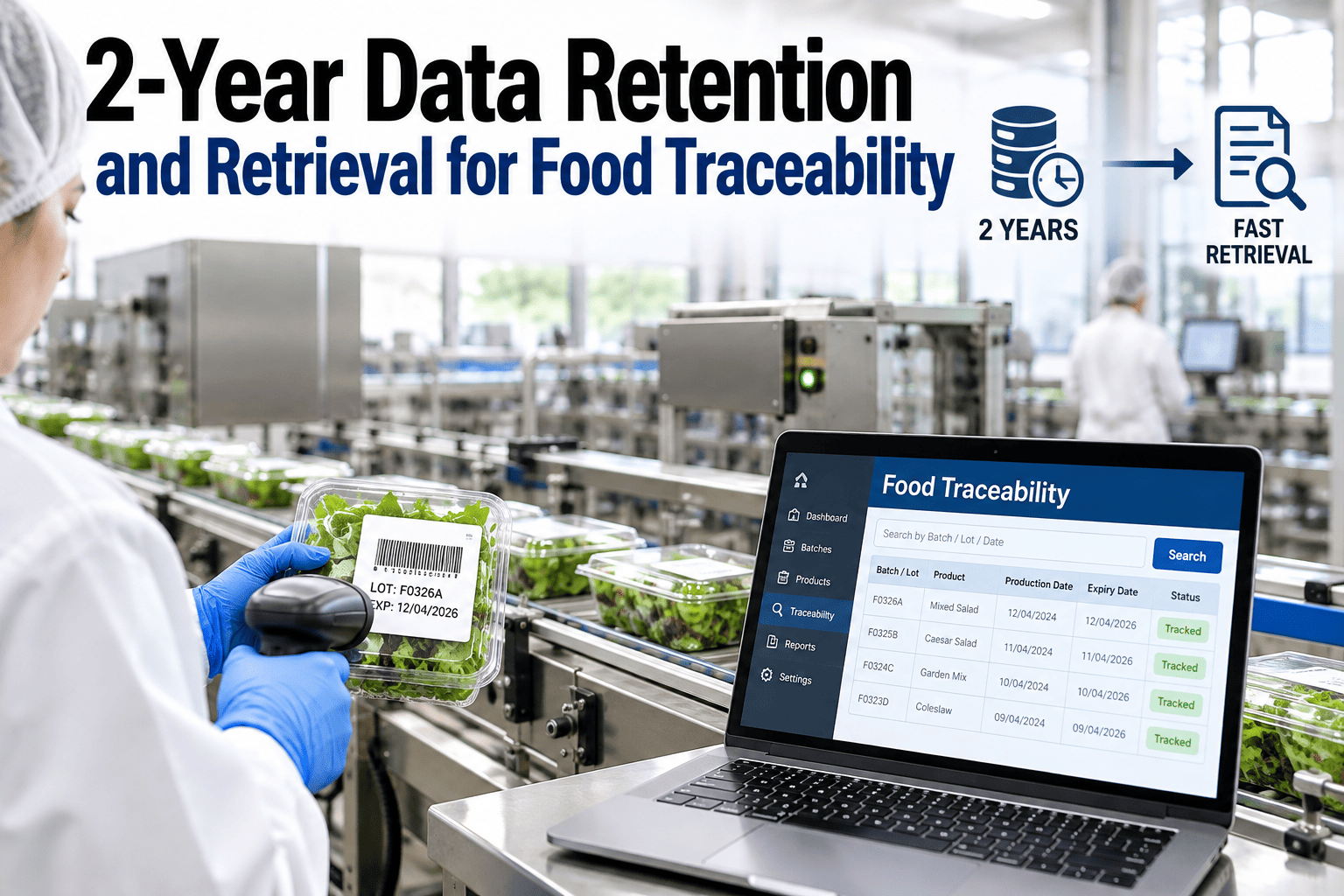
Section 204 requires covered entities to retain traceability records for a minimum of two years from the date the record was created. Records must be maintained in a format that is retrievable and producible to the FDA within 24 hours of a written request. This 24-hour production requirement is the compliance standard that exposes the most significant operational gaps in food manufacturers who rely on paper-based or siloed digital recordkeeping systems.
The rule does not mandate electronic records — paper records are technically permissible — but the 24-hour production window makes paper-only systems extremely high-risk in practice. A manufacturer with 18 months of paper lot records across multiple shifts, SKUs, and receiving docks cannot realistically produce a complete and accurate traceability chain for a specific lot within 24 hours without digital infrastructure. Book a demo to see how iFactory's traceability system structures record retention to meet FDA's 24-hour production standard.
If the FDA submits a written request for traceability records related to a specific lot or shipment, your facility must produce all relevant KDE records across every applicable CTE within 24 hours. This means your system must be able to: (1) identify all lot codes associated with the request, (2) retrieve all CTEs and KDEs linked to those lots, (3) trace backward to supplier records and forward to customer shipments, and (4) compile and transmit these records in a readable format. For facilities processing hundreds of lots per week, manual compilation within 24 hours is not operationally viable without a purpose-built traceability system.
The Transformation CTE: The Most Complex Compliance Challenge for Food Processors
For food manufacturers who transform raw ingredients into processed or value-added products, the Transformation CTE introduces the most complex traceability requirement in Section 204. Transformation is defined as any process that changes a food's form, including cutting, cooking, mixing, or packaging. At the point of transformation, manufacturers must record all input traceability lot codes, create new output traceability lot codes for the transformed product, and document the linkage between inputs and outputs with sufficient specificity to support a traceback investigation.
This linkage requirement — connecting input lot codes to output lot codes through the transformation event — is what makes lot-level traceability in food manufacturing fundamentally different from simply labeling finished goods. It requires that your production management system captures lot information at the point of ingredient usage, not just at intake or outbound shipping. Book a demo to see how iFactory handles transformation lot linkage across multi-ingredient food production workflows.
AI-Driven Traceability for FSMA 204 Compliance: How Technology Closes the Gap
Manual and spreadsheet-based traceability systems fail FSMA Section 204 compliance on three fronts: they cannot capture KDEs in real time at the point of the CTE, they cannot reliably link input lot codes to output lot codes through transformation events, and they cannot produce complete traceability chains within the 24-hour FDA record access window. AI-driven food traceability platforms address each of these failure points through automated data capture, intelligent lot linkage, and on-demand record compilation. Book a demo to see iFactory's AI-driven traceability module in action across a live food manufacturing scenario.
Automated KDE Capture at CTEs
Integrated with production line sensors, barcode scanners, and ERP systems, AI-driven platforms capture Key Data Elements automatically at each Critical Tracking Event — eliminating manual data entry delays and transcription errors that create compliance gaps.
Lot-Level Linkage Through Transformation
Intelligent lot tracking engines automatically link input ingredient lot codes to output product lot codes through transformation events — maintaining the traceability chain integrity required for FDA traceback investigations without manual bill-of-materials mapping.
24-Hour Record Compilation
On-demand traceability reports compile complete KDE histories across all CTEs for any lot code — in minutes, not days. Records are formatted to FDA standards and can be transmitted electronically, ensuring 24-hour production compliance regardless of incident volume.
Recall Simulation and Audit Readiness
Built-in recall simulation tools allow Quality Directors to run mock traceback exercises, identifying traceability chain gaps before an FDA audit or actual recall event. Audit-ready record libraries reduce response preparation time from weeks to hours.
FSMA 204 Compliance Gaps: Where Food Manufacturers Are Most at Risk
Based on industry analysis of food manufacturer traceability readiness assessments, the following compliance gaps appear most frequently in facilities approaching their Section 204 deadline.
Section 204 Compliance Exemptions: Who Is Excluded
Not all food businesses are subject to FSMA Section 204 requirements. The rule provides exemptions for very small businesses (defined as those with average annual monetary value of food sales of $1 million or less, adjusted for inflation), farms that are not otherwise covered under produce safety regulations for the specific commodity, and restaurant and retail food establishments for food they sell directly to consumers. However, food manufacturers supplying retail, foodservice, or wholesale channels with FTL commodities do not qualify for these exemptions and are fully subject to Section 204 requirements.
Building a FSMA 204 Compliance Roadmap: A Step-by-Step Approach for Quality Directors
For Regulatory and Quality Directors leading their organization's Section 204 implementation, the compliance roadmap has five operational phases. Each phase has a defined output that feeds into the next, creating a structured pathway from current-state assessment to audit-ready operation.
Scope Determination: Map Your FTL Commodity Exposure
Audit every ingredient, raw material, and finished good handled at your facility against the FDA Food Traceability List. Document which commodities trigger Section 204 obligations and at which point in your process (receiving, production, transformation, shipping) each CTE applies. Output: a facility-specific CTE map and commodity scope document.
KDE Gap Analysis: Assess Current Data Capture Against Requirements
For each in-scope CTE, compare the KDEs your current systems capture against the KDEs required by Section 204. Identify fields that are missing, captured inconsistently, or recorded in formats that cannot be produced within 24 hours. Output: a KDE gap register with severity classifications and system assignments.
Traceability Lot Code System Design
Design a traceability lot code structure that meets FDA requirements: unique identification, linkage to KDE records, and passthrough capability across supply chain transactions. Integrate lot code assignment into production workflows at each applicable CTE. Output: a documented TLC schema and assignment procedure for each CTE.
Technology Platform Selection and Integration
Select and deploy a traceability technology platform capable of automated KDE capture, transformation lot linkage, 24-hour record production, and supplier data integration. Integrate with existing ERP, WMS, MES, and production systems to eliminate manual data re-entry. Output: a deployed traceability system with validated data flows across all applicable CTEs.
Mock Traceback Exercise and Audit Readiness Validation
Conduct a minimum of two mock traceback exercises — one forward trace from a raw material lot to all finished goods produced, and one backward trace from a customer shipment to all input ingredients. Time the record production against the 24-hour requirement. Document gaps and close them before audit. Output: validated audit-readiness certification with mock traceback results on file.
Frequently Asked Questions: FDA Food Traceability Rule (FSMA Section 204)
What is the FDA Food Traceability Rule and who does it apply to?
FSMA Section 204 requires food manufacturers, processors, and distributors handling FTL commodities to maintain lot-level traceability records at every Critical Tracking Event. It applies to the full supply chain — farms through retailers — with limited exemptions for very small businesses and direct-to-consumer operations.
What is a traceability lot code under FSMA Section 204?
A traceability lot code (TLC) is a unique identifier assigned to a food at a defined CTE — harvesting, packing, or transformation — and linked to all required KDEs. It must accompany the product through every subsequent supply chain transaction to maintain an unbroken traceability chain.
How long does it take to implement a FSMA 204-compliant traceability system?
Most mid-size food manufacturers achieve full compliance in 8–14 weeks, covering ERP integration, CTE mapping, lot code schema design, and mock traceback validation. Facilities with existing digital records can compress this timeline significantly.
What happens if a food manufacturer cannot produce traceability records within 24 hours?
Failure to meet the 24-hour record production window is a Section 204 recordkeeping violation, exposing your facility to FDA warning letters, inspections, and import alerts. In active foodborne illness investigations, the consequences are substantially more severe.
Does FSMA Section 204 require electronic records?
Electronic records are not explicitly mandated, but the 24-hour FDA production requirement makes paper-only systems operationally unviable for most facilities. AI-driven traceability platforms are the most reliable path to meeting the production standard consistently.
Which foods are on the FDA Food Traceability List?
The FTL covers leafy greens, shell eggs, nut butters, soft cheeses, ready-to-eat deli salads, fresh herbs, melons, peppers, sprouts, tomatoes, cucumbers, tropical tree fruits, fresh-cut produce, and certain seafood. The FDA may revise the list periodically, so ongoing monitoring is recommended.