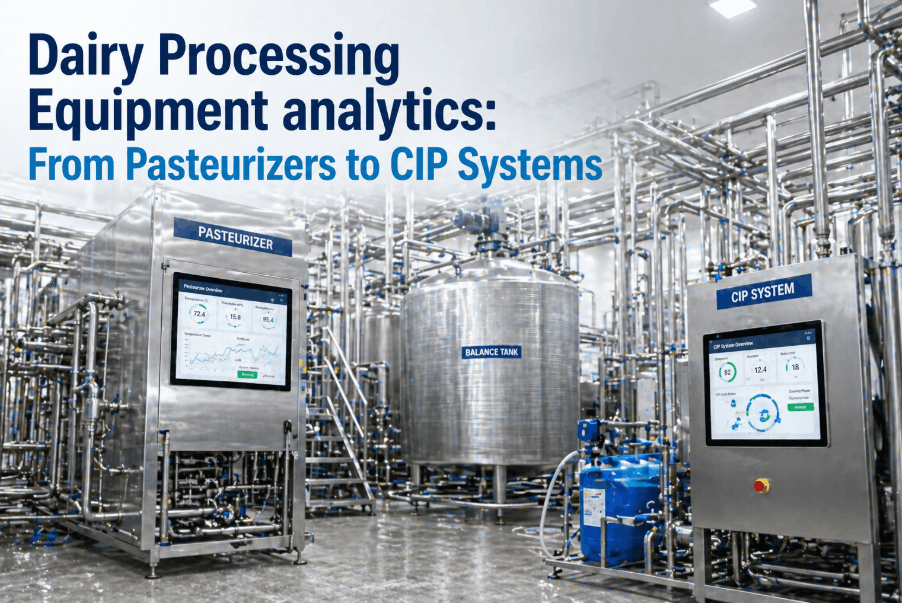
Dairy processing equipment analytics is redefining how dairy plant engineers monitor, maintain, and optimize every asset on the floor — from HTST pasteurizers and UHT systems to CIP skids, homogenizers, separators, and membrane filtration units. As PMO requirements and 3-A Sanitary Standards grow more rigorous, real-time equipment intelligence is no longer optional. Engineers who adopt predictive analytics for dairy plant equipment today are compressing failure windows, extending asset life, and eliminating unplanned downtime across fluid milk, cheese, yogurt, and UHT beverage lines. Book a Demo to see live dairy equipment analytics dashboards running across pasteurization, CIP, and separation systems.
AI-Powered Dairy Equipment Analytics — From Pasteurizer to CIP
iFactory delivers predictive maintenance, real-time quality monitoring, and CIP performance analytics built specifically for dairy plant engineers managing HTST, UHT, homogenizer, separator, and membrane filtration systems under PMO and 3-A compliance.
Why Dairy Processing Equipment Analytics Is Now a Core Engineering Priority
Dairy plant equipment failure follows detectable degradation patterns that sensor-driven analytics can identify 24 to 72 hours before failure. Gasket wear on HTST flow diversion valves, fouling accumulation inside UHT heat exchangers, vibration signature drift in separator bowl assemblies, and CIP conductivity variance are all measurable and predictable when the right analytics infrastructure is in place. PMO-required pasteurization records, calibration intervals, and CIP log documentation demand data fidelity that paper-based systems cannot sustain at scale — analytics platforms make compliance always audit-ready.
HTST Pasteurizer Analytics: Monitoring the Most Compliance-Critical Dairy Asset
High-Temperature Short-Time pasteurizer systems are the regulatory linchpin of every fluid milk operation. PMO compliance requires continuous monitoring of holding tube outlet temperature, flow diversion valve position confirmation, and differential pressure across the regeneration sections. By trending temperature variance against seasonal raw milk inlet temperature, dairy plant engineers identify heat exchanger fouling rates before product temperature control degrades to the point of diversion. Book a Demo to see how HTST analytics captures fouling index, diversion event history, and temperature controller drift in a single compliance dashboard.
Flow Diversion Valve Performance Monitoring
Continuous valve position confirmation, actuation cycle counting, and response time trending detect pneumatic actuator degradation before valve failure causes a regulatory-reportable pasteurization break — eliminating reactive disassembly and PMO incident documentation.
Fouling Index Trending and CIP Trigger Optimization
Regeneration efficiency calculations derived from inlet and outlet temperature differentials expose fouling accumulation rates — enabling data-driven CIP scheduling that extends run intervals without sacrificing heat transfer performance or product temperature compliance margins.
Residence Time Verification and Flow Rate Analytics
Flow meter data integrated with product viscosity monitoring verifies minimum holding time requirements are met across the full product range — from skim milk to heavy cream — generating continuous PMO compliance records without manual calculation.
Multi-Point Temperature Recorder Drift Detection
Automated comparison of regulatory temperature recorder outputs against calibrated reference sensors detects thermocouple drift between calibration intervals — flagging out-of-tolerance conditions before they produce PMO non-conformances or product loss events.
UHT System Analytics: Sustaining Sterility Assurance Across Indirect and Direct Systems
Ultra-High Temperature processing systems demand analytics across five critical dimensions: thermal profile uniformity, fouling rate in heating zones, aseptic valve integrity, homogenizer temperature verification, and sterile tank pressure differential. For indirect UHT systems, analytics platforms trending differential pressure across each heat exchanger section give dairy plant engineers a predictive fouling index that replaces time-based CIP scheduling with run-based scheduling tied to actual thermal performance. Dairy engineers can Book a Demo to review UHT thermal profile dashboards and aseptic system integrity monitoring in production environments.
Aseptic Valve and Sterile Barrier Integrity Analytics
Continuous position monitoring and leak detection across aseptic valve clusters — combined with sterile condensate conductivity trending — detect sterile barrier breaches before contamination risk escalates to product loss or regulatory-reportable sterilization failure events.
Differential Pressure Fouling Index for UHT Heat Exchangers
Section-by-section differential pressure trending across pre-heating, final heating, and cooling zones isolates fouling location and rate — enabling targeted CIP chemical selection and contact time optimization that restores full thermal capacity without excessive cleaning cycle duration.
Steam Pressure and Quality Analytics for Direct UHT Systems
Steam pressure variance and quality monitoring at the injection or infusion point ensures direct UHT systems maintain consistent lethal rate calculations — preventing both under-processing risk and excessive thermal damage to heat-sensitive dairy proteins and vitamins.
F-Value and Lethality Rate Continuous Calculation
Real-time F-value integration across the full UHT thermal profile provides continuous sterility assurance documentation — replacing manual lethality calculations with automated records that satisfy regulatory authorities and retail customer audit requirements simultaneously.
CIP System Analytics: Maximizing Clean-in-Place Effectiveness and Chemical Efficiency
Effective dairy CIP system analytics monitors caustic concentration, return conductivity and temperature, flow velocity at every circuit branch, spray device coverage, total organic carbon in return streams, and chemical consumption per shift. Trending return conductivity profiles across repeated cycles for the same circuit exposes gradual soiling load increases — giving dairy plant engineers both 3-A Sanitary Standards compliance documentation and the operational intelligence to optimize CIP chemical spend without sacrificing microbiological performance.
Homogenizer Analytics: Protecting Pressure and Valve Performance in High-Fat Applications
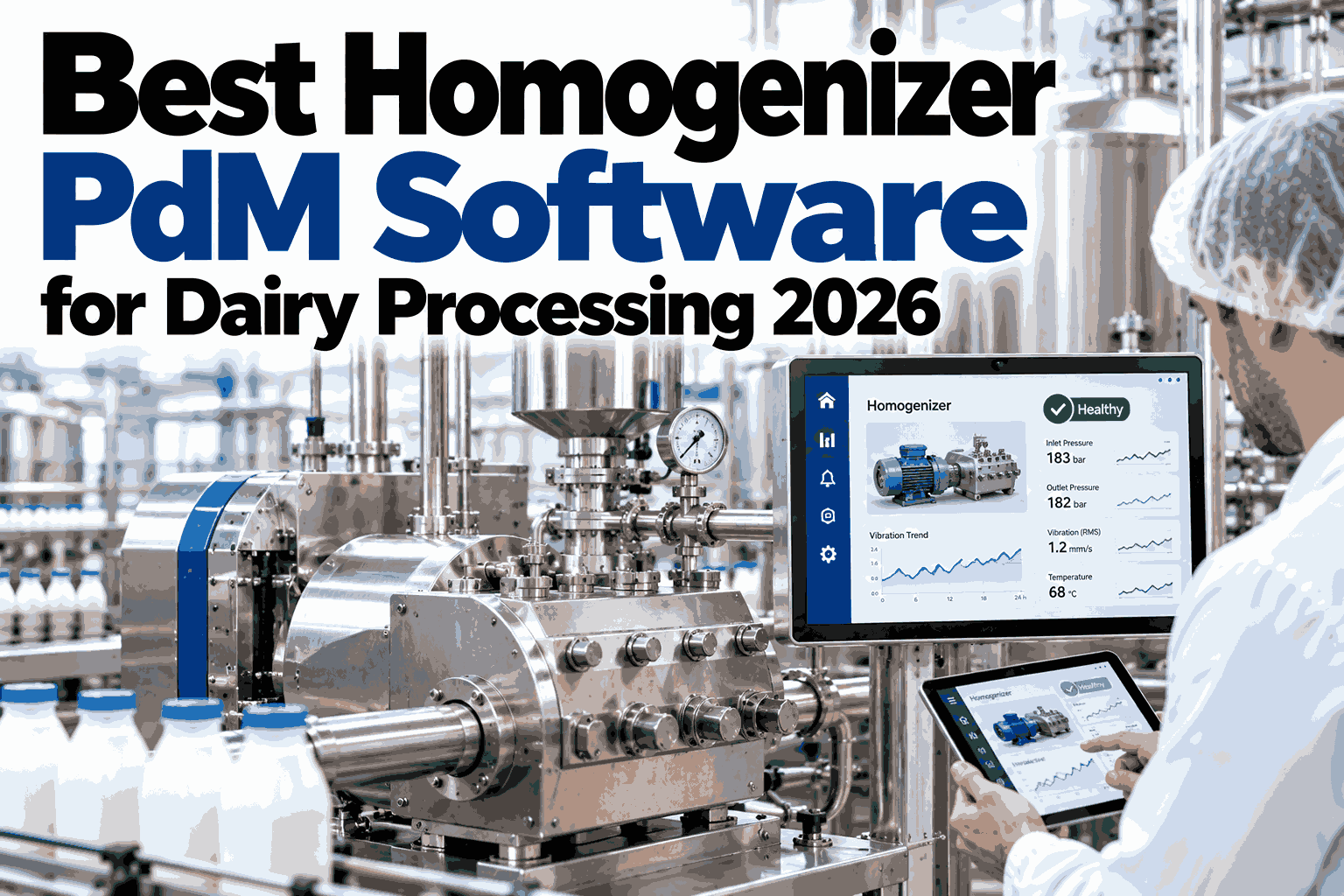
Two-stage homogenizers operating at 2,500 to 4,000 PSI experience predictable wear patterns in homogenizing valves, valve seats, and plunger packing seals that acoustic emission monitoring and pressure variance analytics detect long before catastrophic seal failure. For high-fat applications — cream lines, ice cream mix, cream cheese — analytics platforms correlating valve seat wear rate with fat content and throughput volume give maintenance teams a remaining useful life model for scheduled replacement during CIP windows. Dairy plant engineers can Book a Demo to explore homogenizer condition monitoring dashboards with acoustic emission and pressure variance trending.
Separator Analytics: Vibration, Balance, and Efficiency Monitoring for Centrifugal Systems
Centrifugal separators operating at 4,000 to 7,000 RPM are among the highest-consequence mechanical assets in dairy processing — bowl balance directly impacts bearing life and cream fat standardization accuracy. Analytics platforms with continuous vibration FFT processing detect bowl imbalance onset 8 to 24 hours before automatic shutdown thresholds are reached, converting unplanned production stops into planned maintenance windows and eliminating the safety risk of bowl failure at operating speed.
Dairy Equipment Analytics Technology Comparison: Reactive vs. Predictive Maintenance
The performance gap between reactive and predictive maintenance strategies in dairy processing is measurable across every key operational metric. Manufacturers who have transitioned to predictive dairy equipment analytics report compounding advantages in uptime, compliance documentation quality, and maintenance labor efficiency that reactive programs cannot approach.
| Equipment System | Reactive Maintenance Approach | Predictive Analytics Approach | Operational Benefit |
|---|---|---|---|
| HTST Pasteurizer | Scheduled valve rebuild at fixed intervals | Actuation cycle count and response time trending | Eliminates premature rebuilds and unplanned diversion events |
| UHT System | Fixed-interval CIP scheduling regardless of fouling state | Differential pressure fouling index drives CIP timing | Extends run length 15–30% without compliance risk |
| CIP System | Fixed chemical concentration targets regardless of soil load | Return conductivity and TOC-based chemical optimization | Reduces chemical consumption 20–35% per cleaning cycle |
| Homogenizer | Emergency valve rebuild after seal failure and product loss | Acoustic emission and pressure variance predict valve wear | Schedules valve replacement during CIP, eliminating production loss |
| Centrifugal Separator | Vibration shutdown triggers unplanned maintenance stop | FFT vibration trending detects imbalance 8–24 hours early | Converts unplanned stops to planned maintenance windows |
| Membrane Filtration | Flux decline forces emergency cleaning or membrane replacement | Transmembrane pressure trending predicts cleaning need | Extends membrane life 40–60% with optimized CIP timing |
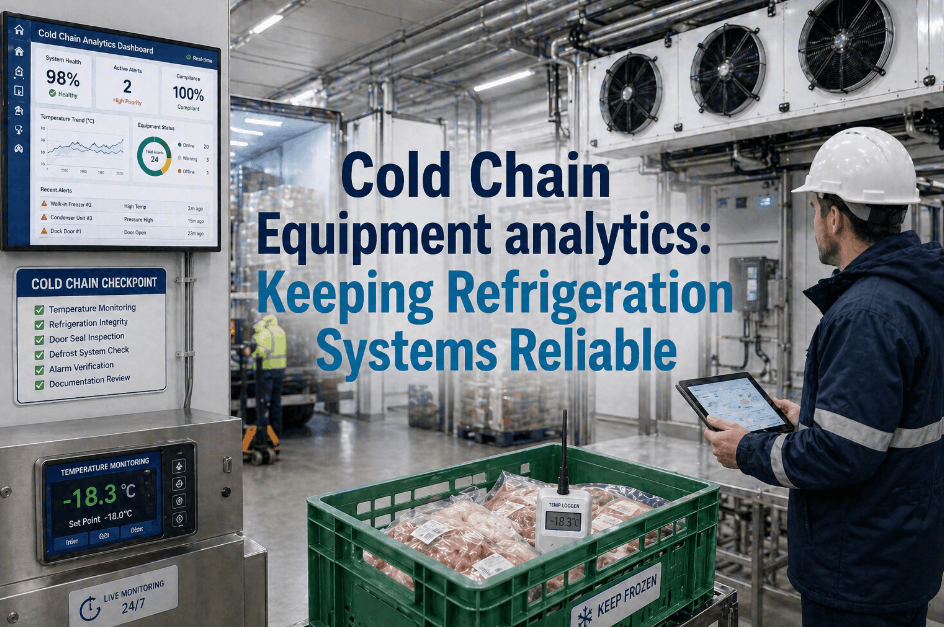
| Refrigeration System | Evaporator coil icing forces manual defrost cycle intervention | Suction pressure and superheat trending predict icing onset | Maintains cold storage temperature compliance without product risk |
Membrane Filtration Analytics: MF, UF, NF, and RO System Performance Monitoring
Membrane filtration analytics — covering MF, UF, NF, and RO systems — focuses on transmembrane pressure trending, normalized permeate flux calculation corrected for temperature and concentration, rejection rate monitoring, and chemical enhanced backwash effectiveness. For UF systems processing whey, analytics platforms correlating feed protein concentration, cross-flow velocity, and temperature with normalized flux decline rate schedule CIP at the optimal point — maximizing membrane productivity and preventing irreversible flux loss from protein gel layer compaction.
3-A Sanitary Standards and PMO Compliance Documentation Through Analytics
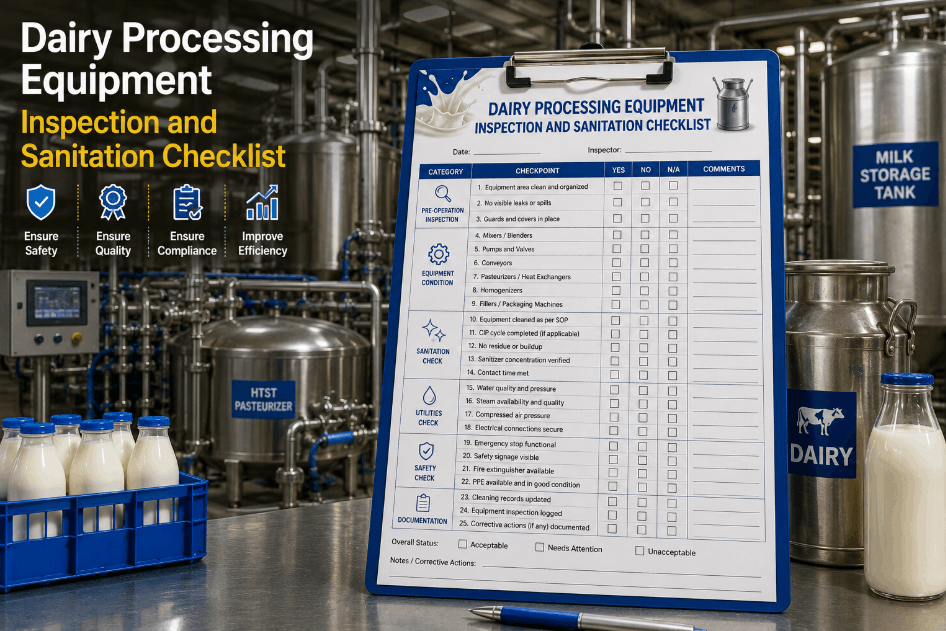
3-A Sanitary Standards govern equipment design, but it is operational data from production and CIP cycles that regulators and auditors scrutinize most closely. PMO requirements mandate specific temperature, time, and flow records for pasteurization; GFSI schemes require documented CIP effectiveness evidence. Dairy equipment analytics platforms that capture and archive this data automatically generate PMO records, CIP performance certificates, and corrective action documentation on demand — eliminating manual compilation and the transcription errors that undermine regulatory submissions.
Unified Dairy Equipment Sensor Integration and Data Historian
Consolidate PLC outputs, temperature recorder data, flow meter signals, conductivity sensors, and vibration transmitters into a single time-series historian — providing the continuous, high-resolution equipment data that predictive analytics models require for reliable failure prediction and compliance documentation across every dairy processing system.
Dairy-Specific ML Models for Fouling, Wear, and Performance Prediction
Generic predictive maintenance models deliver limited dairy accuracy. Facility-specific models trained on pasteurizer fouling history, separator vibration baselines, homogenizer pressure profiles, and CIP conductivity curves produce the precision required for reliable maintenance scheduling under PMO and GFSI compliance constraints.
Automated PMO Records, CIP Certificates, and Audit Package Generation
Connect equipment analytics outputs to quality management workflows — generating PMO temperature records, CIP performance documentation, corrective action logs, and audit packages automatically from live operational data, eliminating manual compilation delays and transcription errors that undermine regulatory submissions.
Building the Dairy Equipment Analytics Infrastructure: A Practical Roadmap for Plant Engineers
Dairy plant engineers implementing equipment analytics face three sequential infrastructure challenges: connecting PLC and sensor outputs to a unified data platform, building dairy-specific predictive models from historical data, and integrating analytics outputs with maintenance and compliance workflows. The most common barrier is data fragmentation — pasteurizer recorders, CIP historians, separator vibration transmitters, and homogenizer pressure transducers each logging to isolated systems create silos that prevent unified analytics. Data consolidation is always the critical first step. Operations teams can Book a Demo to assess their current infrastructure against 2027 analytics readiness benchmarks.
Frequently Asked Questions: Dairy Processing Equipment Analytics
What sensors are required to implement HTST pasteurizer predictive analytics?
Most dairy plants already have the required instrumentation — holding tube temperature sensors, flow diversion valve position switches, differential pressure transmitters, and PMO-compliant temperature recorders. The gap is typically data integration and analytics platform connectivity, not sensor deployment.
How does CIP analytics improve cleaning effectiveness without increasing chemical use?
Return conductivity profiling reveals exactly when caustic cleaning has removed soil — stopping the phase at the right time rather than running a fixed duration. TOC monitoring identifies circuits with increasing biological soiling, enabling targeted chemical adjustments instead of facility-wide concentration increases.
Can separator vibration analytics prevent catastrophic bowl failure?
Yes — continuous FFT vibration monitoring detects bowl imbalance signatures at rotation speed harmonics 8 to 24 hours before automatic shutdown thresholds are reached, giving engineers a planned maintenance window instead of an emergency production stop.
How does dairy equipment analytics support 3-A Sanitary Standards compliance?
Analytics platforms automatically generate CIP performance certificates, PMO temperature records, and corrective action logs from live equipment data — replacing manual records with audit-ready digital documentation that satisfies PMO, GFSI, and customer-specific requirements simultaneously.
What is the ROI timeline for implementing dairy equipment predictive analytics?
Most dairy plants see measurable ROI within 6 to 12 months, driven by reduced unplanned downtime on pasteurizers, homogenizers, and separators, plus improved CIP chemical efficiency. Plants with compliance documentation gaps typically see the fastest payback through audit-readiness gains.
Ready to Transform Your Dairy Plant Equipment Analytics?
iFactory's AI-powered dairy equipment analytics platform delivers predictive maintenance for HTST pasteurizers, UHT systems, CIP skids, homogenizers, separators, and membrane filtration — with built-in PMO and 3-A compliance documentation that eliminates manual records across every dairy processing line.




.png)