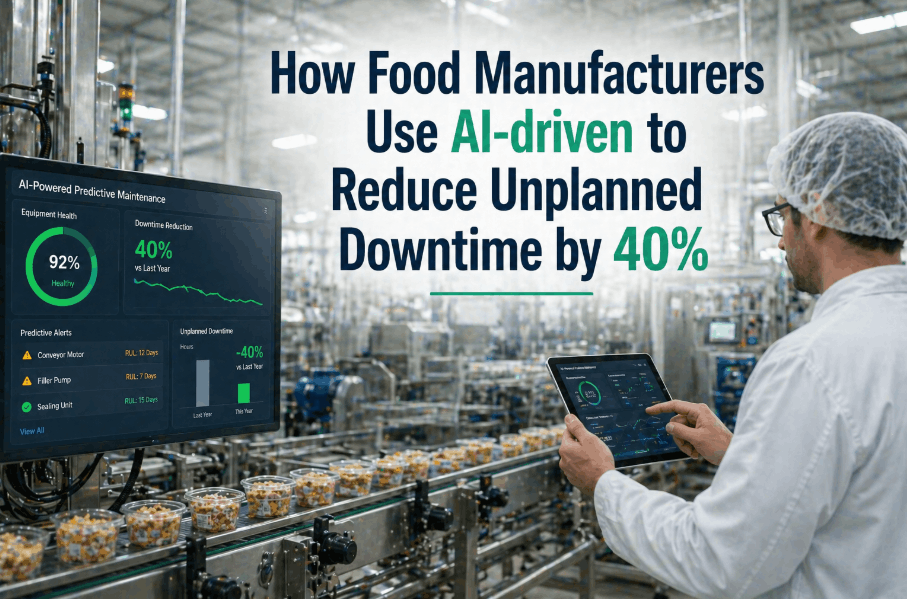
Food manufacturers operating in high-throughput environments face a relentless operational challenge: unplanned downtime that erodes margins, disrupts supply chains, and undermines OEE performance. Today, leading plants are deploying AI-driven downtime prevention strategies that reduce equipment failures by up to 40% — not through reactive maintenance firefighting, but through intelligent prediction, root cause analysis, and systematic PM optimization. If you are a plant or operations manager evaluating how to protect production uptime in 2025, this guide maps every lever that matters.
Why Unplanned Downtime Costs More Than Food Plants Realize
Most food manufacturing plants track the visible cost of downtime: lost output, wasted ingredients, overtime labor. What they rarely quantify is the compounded cost — the ripple effect across scheduled runs, customer commitments, and maintenance team capacity. A single unplanned stoppage on a high-speed packaging line can cascade into two shifts of recovery scheduling, expedited spare parts freight, and a root cause investigation that consumes a maintenance engineer for three days. When you aggregate those true costs across all unplanned events in a rolling 12 months, the figure consistently surprises plant leadership. Book a demo to run this calculation against your own plant's downtime history and see where the largest recovery opportunities lie.
The 4 AI-Driven Strategies That Deliver 40% Downtime Reduction
Food plant downtime reduction is not a single technology initiative — it is a layered operational system. The plants that achieve sustained 35–45% reductions in unplanned events consistently deploy four interconnected strategies: root cause analysis automation, PM schedule optimization, predictive alert management, and spare parts pre-staging. Each strategy eliminates a distinct failure pathway. Together, they close the gap between reactive and genuinely predictive operations.
AI-Driven Root Cause Analysis
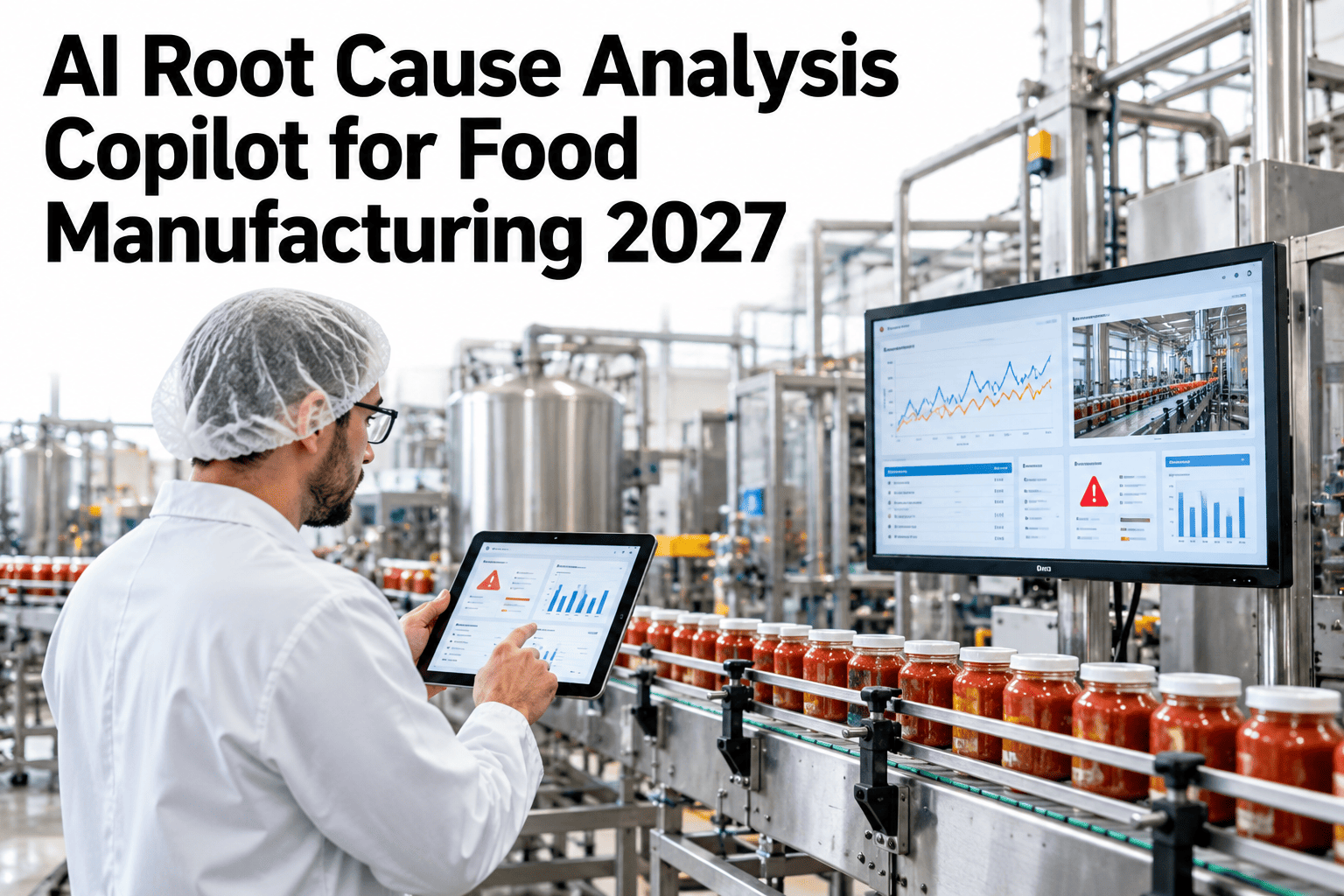
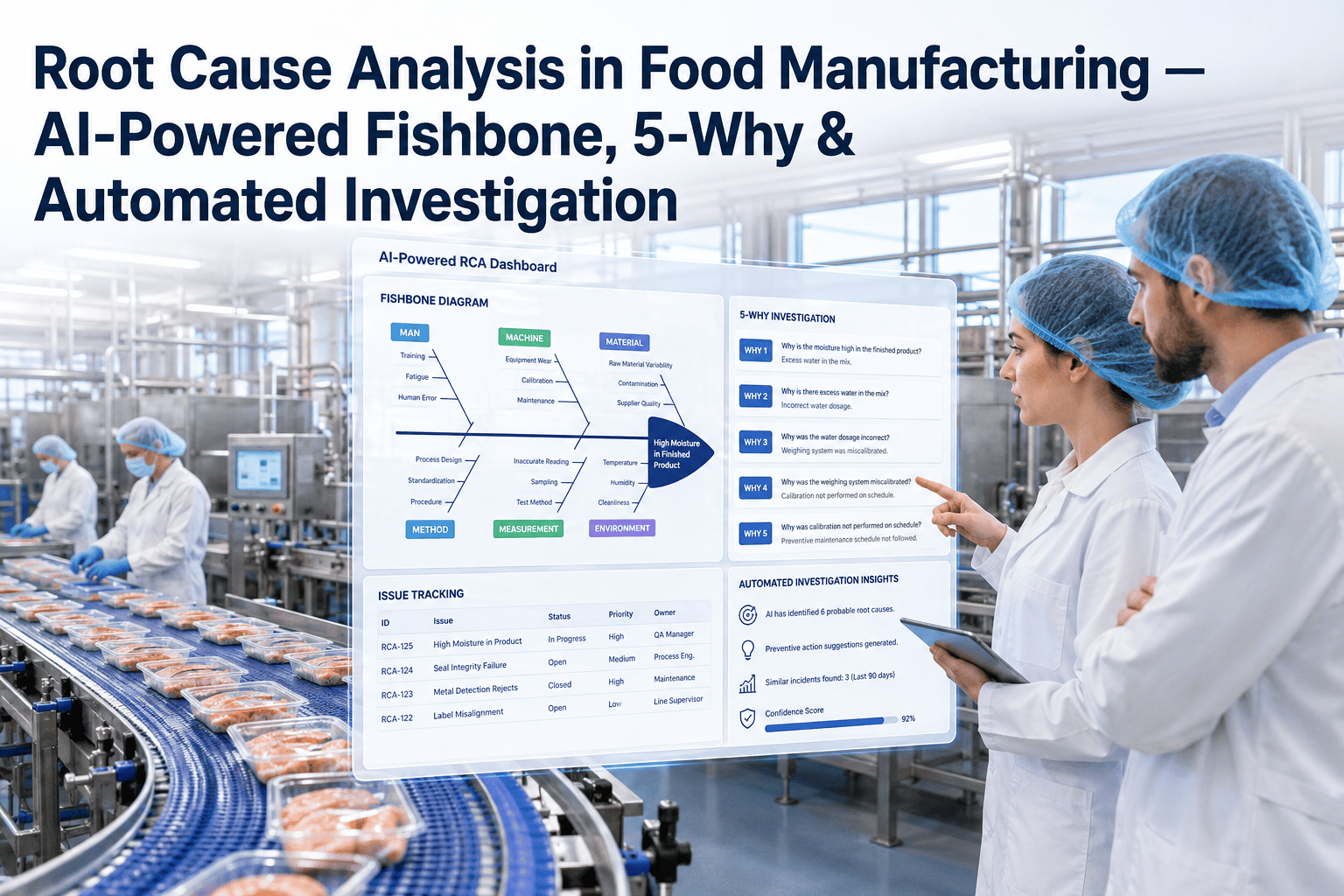
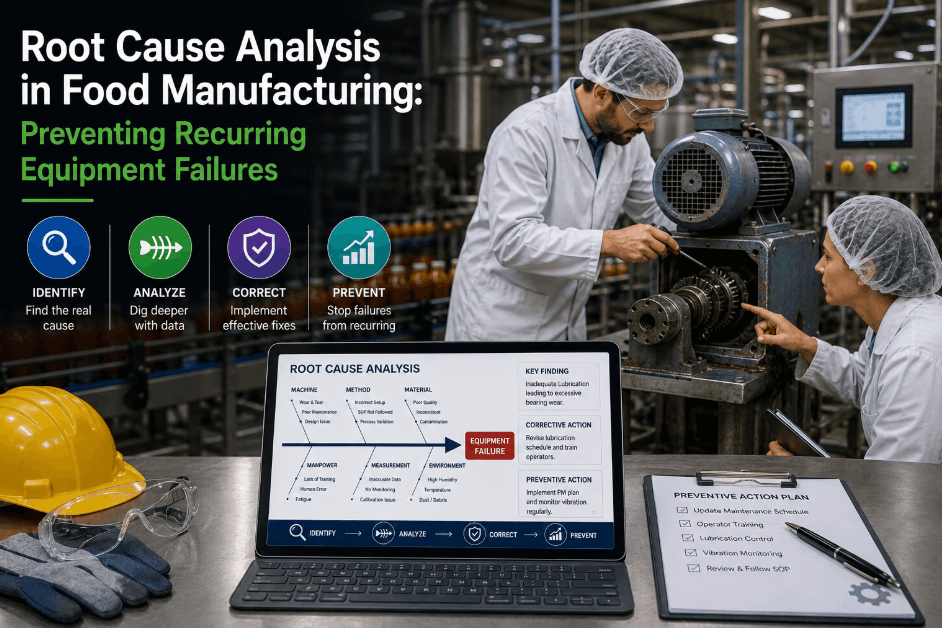
Traditional root cause analysis in food plants is retrospective and manual — engineers review historian data after the failure, reconstruct the event sequence, and document findings in a CMMS that rarely feeds back into future detection. AI-driven root cause analysis reverses this workflow. Pattern recognition models trained on failure signatures correlate sensor deviations, maintenance records, and production parameters to identify the true upstream cause — not the downstream symptom the technician arrived to fix. Plants implementing AI-assisted RCA reduce recurring failure rates by 45–60% within the first year.
PM Schedule Optimization for Food Production Assets
Fixed-interval preventive maintenance schedules were designed for eras without real-time condition data. In food manufacturing environments, where asset stress varies dramatically by production run, ingredient viscosity, line speed, and cleaning cycle frequency, calendar-based PM intervals consistently produce two failure modes: over-maintenance (unnecessary downtime and labor cost) and under-maintenance (interval misses that allow degradation to continue). AI-driven PM optimization replaces fixed intervals with condition-triggered schedules that compress maintenance windows to periods of lowest production impact while ensuring intervention before failure probability crosses a defined risk threshold.
Predictive Alerts with Automated Escalation
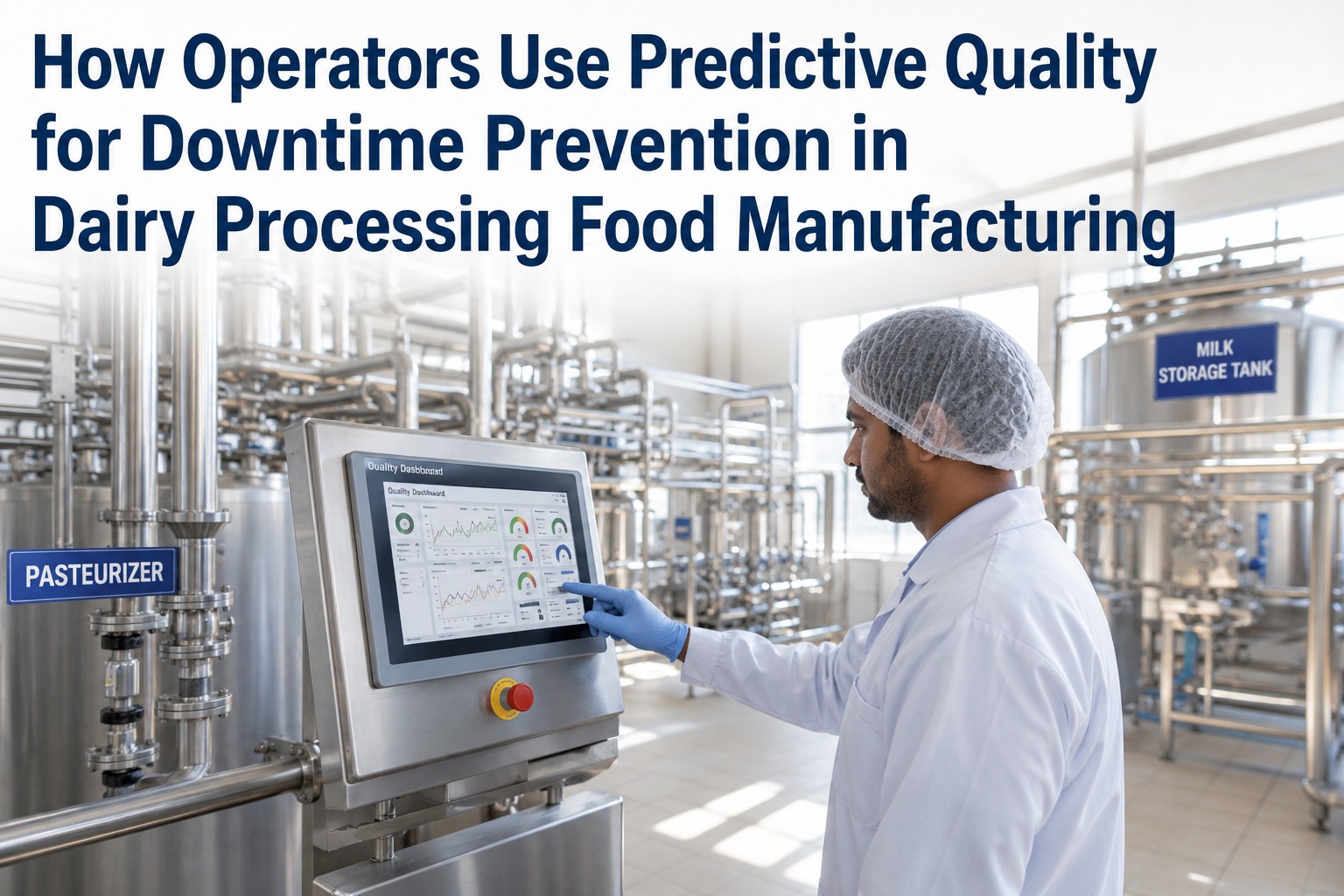
The gap between a predictive alert food manufacturing system generating a warning and a technician taking corrective action is where most downtime prevention value leaks. Without automated escalation logic, deferred alerts accumulate, risk thresholds are crossed silently, and what was a 20-minute corrective task becomes a 4-hour emergency repair. AI-driven alert platforms assign dynamic priority scores based on asset criticality, current production schedule impact, and failure probability trajectory — then escalate automatically if the alert is not acknowledged within a defined window. Book a demo to see how iFactory's predictive alert engine compares to your current condition monitoring workflow.
Spare Parts Pre-Staging and Inventory Intelligence
In food manufacturing, repair duration is frequently extended not by diagnostic complexity but by parts availability. When a predictive model identifies an impending bearing failure on an aseptic filler 48 hours in advance, that lead time is only valuable if the required parts are staged and ready. AI-driven spare parts intelligence links failure probability outputs to inventory systems, automatically triggering parts movement from central stores to line-side kitting locations before the maintenance window opens. Plants using this integration report 30–45% reductions in mean time to repair on planned corrective interventions.
Root Cause Analysis in Food Plants: From Reactive to Predictive
Effective root cause analysis for food plant downtime requires more than a 5-Why template filled out after the event. It requires a systematic data architecture that captures the right signals at the right frequency and correlates them across the entire asset population — not just the failed unit. The shift from reactive to AI-driven RCA involves three capability transitions that most food plants are still in the process of making.
From Event-Triggered to Continuous Analysis
Reactive RCA begins at failure. AI-driven RCA runs continuously, scoring asset health trajectories in real time so that degradation patterns are identified and addressed before the failure event that would trigger a traditional investigation.
From Single-Asset to Fleet-Level Pattern Recognition
Traditional RCA examines one asset in isolation. AI models trained across an entire asset fleet — or across multiple facilities — identify shared failure signatures that no single-asset investigation would surface, enabling systemic fixes rather than point repairs.
From Documented Finding to Automated Prevention
The final transition closes the loop: RCA findings are fed back into the detection model, updating alert thresholds and PM triggers for the same asset class across the facility. Each failure investigation makes the predictive system more accurate for the next potential failure.
PM Optimization: The Highest-ROI Lever for Food Production Uptime
For most food manufacturing operations, PM optimization delivers the fastest measurable ROI of any reliability investment — because the baseline is a fixed-interval schedule that is systematically wrong for a majority of assets at any given point in time. The table below maps the transition from calendar-based PM to AI-optimized PM across the dimensions that matter most for plant and operations managers making a business case for investment. Book a demo to model the PM optimization opportunity across your specific asset classes and production schedule.
| PM Dimension | Calendar-Based Approach | AI-Optimized Approach | Uptime Impact | Cost Impact |
|---|---|---|---|---|
| Interval Determination | Fixed calendar (weekly / monthly) | Condition-triggered, dynamic | High | −15–25% PM labor |
| Timing Optimization | Scheduled regardless of production load | Scheduled during lowest-impact windows | Very High | −30–50% planned downtime |
| Parts Readiness | Confirmed manually at task creation | Auto-triggered from predictive model output | High | −30–45% repair duration |
| Scope Accuracy | Standard checklist regardless of condition | Scoped to detected degradation profile | Medium | −10–20% over-maintenance |
| Post-PM Validation | Manual sign-off, no sensor confirmation | Automated condition re-check post-task | Very High | Prevents post-PM failures |
| Recurring Failure Prevention | Same interval applied after recurrence | Model updated with failure signature data | Transformational | −40–60% recurrence rate |
Predictive Alerts in Food Manufacturing: What Best-in-Class Looks Like
The architecture of a predictive alert system for food manufacturing separates average condition monitoring implementations from platforms that genuinely reduce unplanned downtime. Most plants have alerts. Few have alert systems that are tuned to asset criticality, integrated with dispatch workflows, and capable of learning from resolution outcomes. The four characteristics of best-in-class predictive alert management in food production environments are outlined below.
Spare Parts Pre-Staging: The Silent Downtime Multiplier
Equipment reliability food manufacturing teams frequently discover that their repair duration benchmarks are not limited by technician skill or diagnostic speed — they are limited by parts logistics. When an AI-driven predictive model identifies a high-probability failure window 36–72 hours in advance, that lead time is operational capital. It can be converted into staged parts, pre-briefed technicians, and a maintenance window scheduled during a low-production-impact period. Without a parts intelligence integration, that same lead time is consumed by stock confirmation calls, emergency freight, and stores department back-and-forth. Book a demo to see how iFactory's spare parts integration layer connects predictive failure windows to your existing inventory management system automatically.
Assets With the Highest AI-Driven Downtime Reduction ROI in Food Manufacturing
Not every asset delivers equal return on AI-driven reliability investment. The highest-ROI targets in food production environments combine three characteristics: high throughput impact on failure, detectable precursor signatures that give useful intervention lead time, and failure modes that respond to predictive intervention rather than purely random causes. The asset classes below consistently deliver the strongest return on food plant downtime reduction investment across beverage, dairy, bakery, and protein processing operations. Deploying Book a Demo with iFactory's team to map these asset classes to your specific facility configuration and prioritize implementation sequencing for maximum ROI.
Aseptic Fillers and UHT Processing Units
The highest-cost unplanned stoppage asset in most liquid food facilities. Failure signatures in sealing mechanisms, sterile air systems, and filling head components are detectable 24–48 hours before critical failure. Predictive intervention on these assets alone frequently justifies full platform deployment costs.
Packaging Line Drive Systems
Servo drives, gearboxes, and conveyor drive units on high-speed packaging lines generate rich vibration and thermal signatures that AI models read with high accuracy. Bearing degradation patterns — the leading failure mode — are detectable 48–96 hours before failure using vibration spectral analysis integrated with thermal monitoring.
CIP Pump and Valve Systems
CIP pump failures cause cascading sanitation schedule disruptions that extend far beyond the repair duration itself. Seal degradation and impeller wear signatures are detectable through flow rate deviation and motor current analysis — giving 24–36 hours of planning lead time before a failure that would otherwise trigger a full cleaning cycle restart.
Compressors and Refrigeration Systems
Refrigeration compressor failures in cold chain food processing trigger immediate food safety escalations that extend downtime well beyond the mechanical repair window. AI-driven monitoring of discharge temperature trending, oil pressure deviation, and current draw anomalies provides 48–72 hours of predictive lead time on the majority of compressor failure modes.
Building the Business Case: Calculating Your Downtime Reduction ROI
The ROI model for AI-driven food plant downtime reduction is more defensible than most capital investment proposals because the savings are calculable from existing plant data. Start with your last 12 months of unplanned downtime events. For each event, capture three data points: the timestamp of the first logged anomaly, the timestamp of the first corrective action, and the total production value lost during the stoppage. The gap between the anomaly timestamp and the corrective action timestamp — multiplied by your plant's throughput rate — is the recoverable value that AI-driven early intervention captures. Plants running this analysis consistently find that 35–50% of their total annual downtime cost is recoverable through predictive alert management and PM optimization alone, without any change to repair duration benchmarks.
How long does AI-driven downtime prevention take to deploy in a food plant?
Basic predictive alert integration with existing SCADA and condition monitoring infrastructure deploys within 3–5 weeks. Full PM optimization with spare parts integration and mobile dispatch typically takes 8–12 weeks for a mid-size facility. Most plants see measurable unplanned downtime reduction within 30–45 days of go-live on priority assets.
What existing data infrastructure is required for AI-driven reliability?
At minimum, a SCADA historian with 12+ months of operational data and a CMMS with work order history. Plants with vibration sensors, thermal cameras, or motor current monitoring on critical assets significantly accelerate model accuracy. iFactory's platform connects to existing infrastructure rather than requiring new sensor deployment as a prerequisite.
What is a realistic 40% downtime reduction timeline for a food manufacturing facility?
Plants that achieve 40% unplanned downtime reduction typically reach that benchmark within 9–18 months of full deployment. The trajectory is non-linear: initial gains of 15–20% in the first 60 days (from alert management and PM timing optimization) are followed by compounding gains as the AI model accumulates resolution data and improves failure pattern detection accuracy across the full asset population.
How does AI-driven root cause analysis differ from traditional failure investigation tools?
Traditional failure investigation tools are retrospective and single-asset. AI-driven root cause analysis is continuous, fleet-level, and self-improving. It identifies failure signatures across the entire asset population before events occur, correlates production and maintenance parameters to isolate true upstream causes, and feeds findings back into detection models so the same failure mode triggers earlier intervention on the next occurrence.