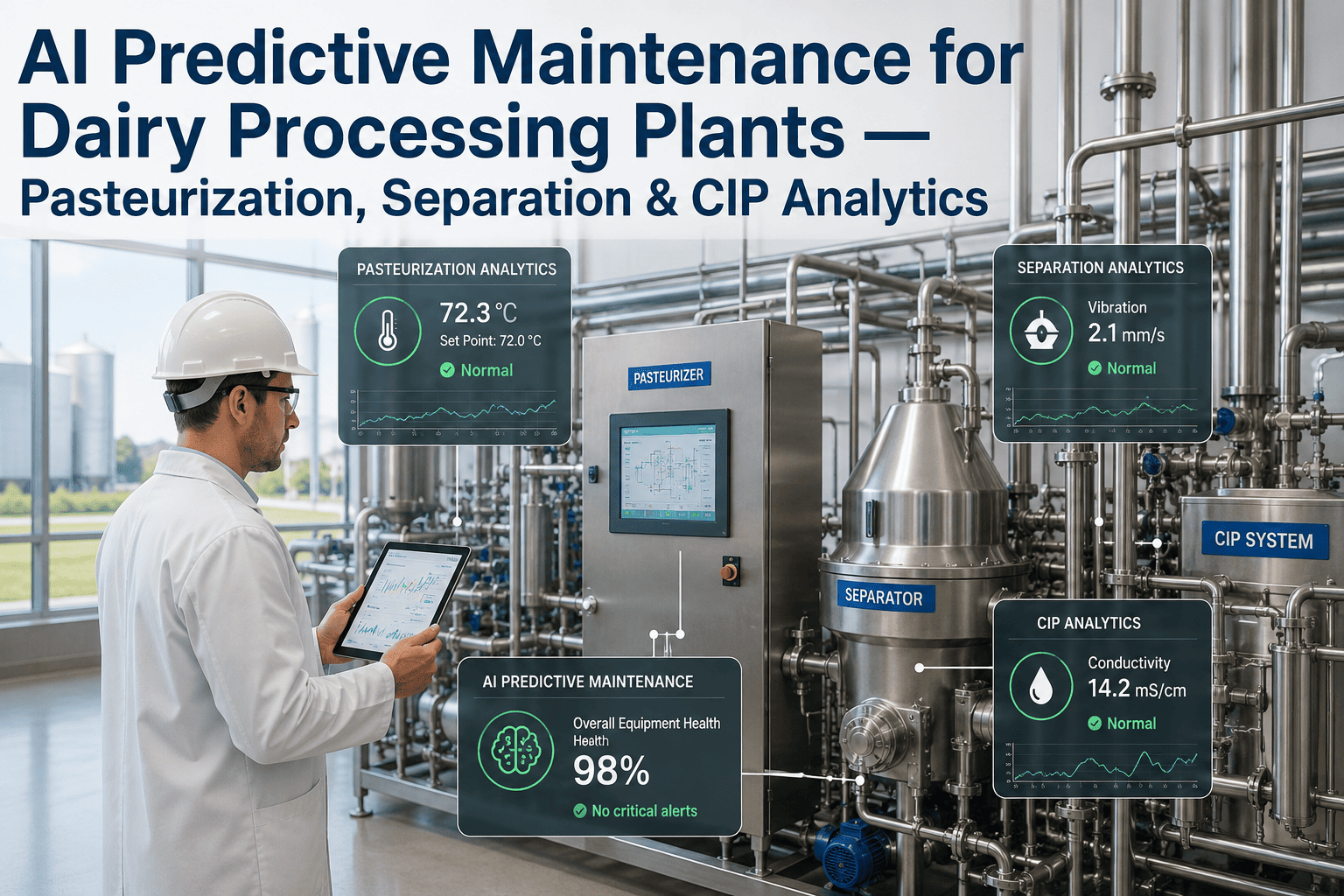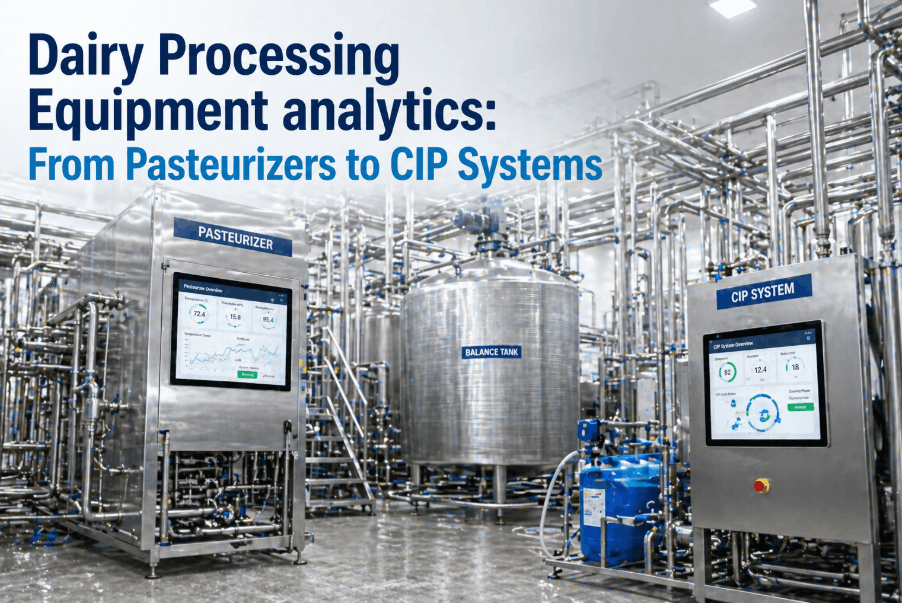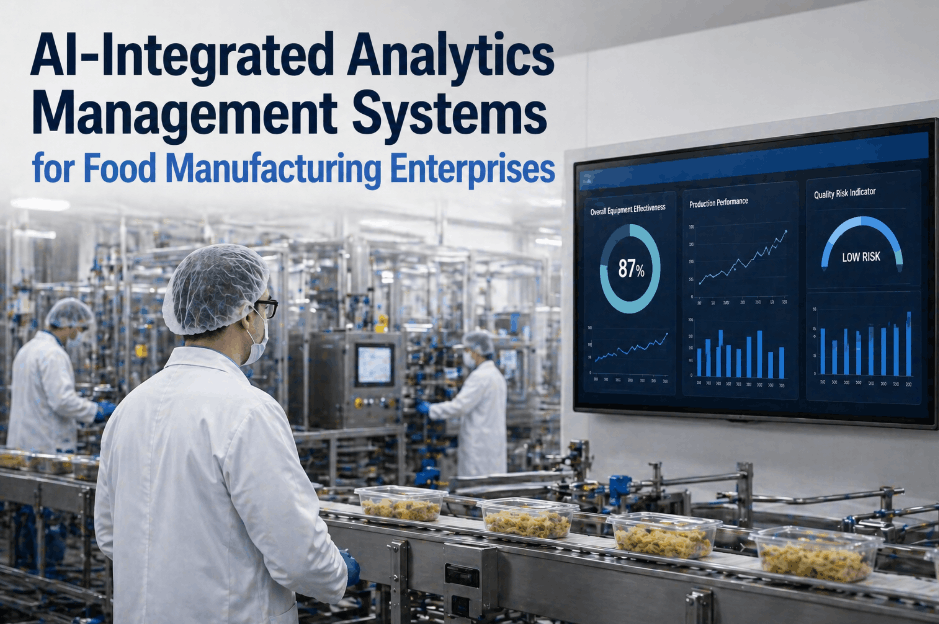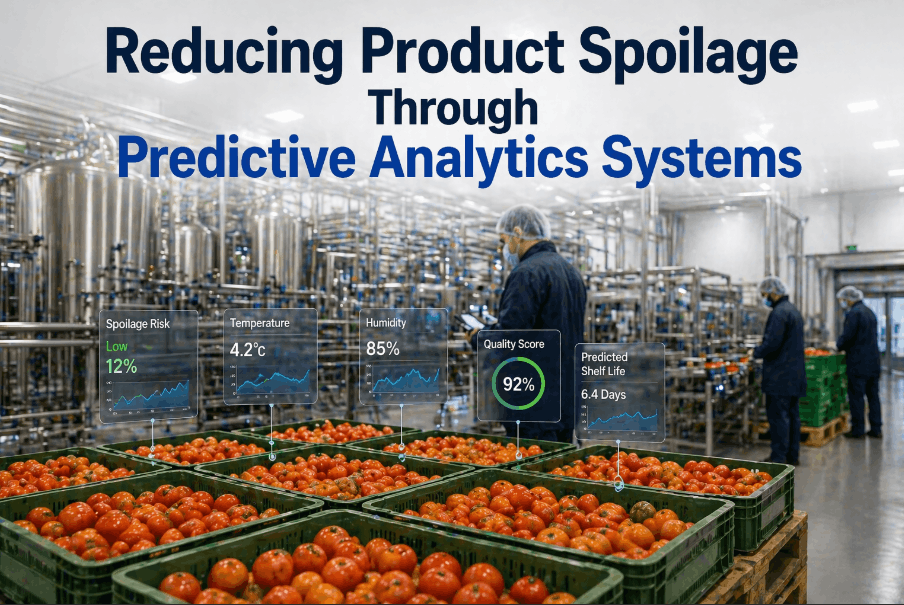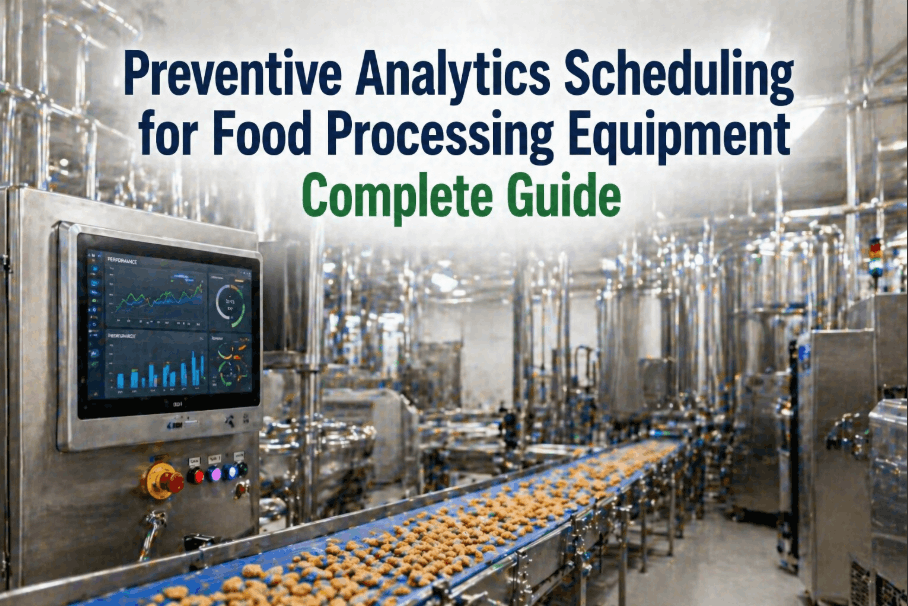
Preventive analytics scheduling for food processing equipment is no longer optional — it is the operational backbone separating facilities with consistent throughput from those perpetually reacting to unplanned downtime. Modern food plants running high-speed filling, mixing, sealing, and packaging lines generate enormous volumes of condition data that traditional preventive maintenance checklists never capture. By combining computerized maintenance management systems (CMMS) with predictive maintenance software and AI-driven planning engines, food processing operations can shift from reactive repair cycles to intelligence-led equipment reliability programs that protect product quality, reduce costs, and keep sanitation compliance intact. This guide walks through every layer of building a preventive analytics program that actually works on the plant floor.
PREVENTIVE MAINTENANCE SCHEDULING · AI MAINTENANCE PLANNING
See Predictive Maintenance Analytics Live on Your Equipment.
Discover how iFactory's AI-driven maintenance planning and condition monitoring platform reduces unplanned downtime, extends asset lifecycles, and aligns PM scheduling with your sanitation and production windows.
Why Preventive Maintenance Scheduling Fails in Food Processing Environments
Food processing environments impose constraints on maintenance scheduling that general industrial frameworks were never designed to handle. Equipment uptime windows are compressed between sanitation runs, CIP cycles, and HACCP-mandated cleaning procedures. A missed lubrication interval on a filler head does not just risk mechanical failure — it risks product contamination and an FDA FSMA recordkeeping gap. Traditional calendar-based preventive maintenance checklists assign intervals based on OEM recommendations that ignore actual operating conditions: production speed variability, ingredient abrasiveness, thermal cycling, and hygiene-driven disassembly frequency. The result is over-maintenance of low-risk assets and under-maintenance of the high-cycle components that actually fail. Preventive analytics scheduling replaces the calendar with condition signals, closing the gap between what maintenance plans assume and what equipment actually experiences.
Building the Foundation: Computerized Maintenance Management System Integration
A computerized maintenance management system (CMMS) is the operational record layer that makes preventive analytics scheduling executable. Without a CMMS capturing asset hierarchy, work order history, parts consumption, and technician labor, predictive maintenance software operates without context — generating alerts that maintenance teams cannot act on efficiently. Before deploying advanced condition monitoring systems or AI maintenance planning tools, food facilities need a CMMS architecture that maps equipment to production lines, links maintenance records to batch genealogy, and integrates with HACCP documentation flows. This integration is what transforms a maintenance database into a maintenance management software platform capable of supporting asset performance management at scale. Book a Demo to see how iFactory's platform connects CMMS data with predictive maintenance workflows.
Asset Hierarchy Mapping
Define equipment parent-child relationships — from production line down to individual components — so maintenance scheduling software can apply the right PM intervals at the right asset level and track failure history with precision.
Work Order Automation
Condition monitoring triggers automatically generate work orders within the CMMS, pre-populated with parts lists, safety procedures, and HACCP-relevant documentation requirements, eliminating manual scheduling delays.
Sanitation Window Scheduling
PM scheduling software syncs maintenance windows with sanitation and CIP schedules — ensuring technician access aligns with food safety downtime periods rather than competing with production or contaminating freshly sanitized equipment.
Parts and Labor Forecasting
Predictive maintenance planning engines use failure probability models to forecast parts consumption weeks in advance — eliminating emergency procurement costs and reducing the inventory carrying burden from excessive safety stock.
Condition Monitoring Systems: The Data Engine Behind Predictive Maintenance
Condition monitoring systems are the sensor and data acquisition layer that converts raw equipment behavior into actionable maintenance intelligence. In food processing, condition monitoring must navigate the added complexity of hygiene requirements: sensors must be wash-down rated, mounting locations must not create sanitation harborage points, and data collection must not interfere with production or cleaning cycles. The most effective condition monitoring deployments in food manufacturing combine vibration analysis on rotating equipment (pumps, conveyors, mixers), thermal imaging for motor and bearing health, ultrasonic leak detection on pneumatic and hydraulic systems, and electrical signature analysis on drives and sealing equipment. Book a Demo to review condition monitoring architectures for your specific equipment categories. When this sensor data feeds into a predictive maintenance software platform, maintenance scheduling shifts from time-based guesswork to condition-triggered precision.
AI Maintenance Planning: How Machine Learning Optimizes PM Schedules
AI maintenance planning platforms move beyond rule-based condition monitoring by correlating multi-variable equipment data with historical failure records to generate dynamic, risk-ranked maintenance schedules. Rather than triggering a PM task when a single sensor exceeds a threshold, machine learning models evaluate the combined state of vibration signature, operating temperature, runtime hours, recent maintenance history, and production throughput to calculate current failure probability. This multivariate approach dramatically reduces both false alarms that waste technician time and missed detections that lead to catastrophic failures. For food processing equipment, AI maintenance planning also incorporates production calendar data — scheduling predicted interventions during upcoming sanitation windows rather than during production runs — a capability that calendar-based maintenance scheduling software cannot replicate.
| Maintenance Approach | Scheduling Basis | Food Processing Fit | Cost Efficiency |
|---|---|---|---|
| Reactive Maintenance | Failure occurrence | Poor – production and safety risk | Highest total cost |
| Calendar-Based PM | Fixed time intervals | Moderate – misses condition variation | Over/under-maintenance waste |
| Condition-Based Monitoring | Single sensor thresholds | Good – but high false alarm rate | Moderate – labor inefficiency risk |
| AI Predictive Maintenance | Multivariate failure probability | Excellent – syncs with sanitation windows | 30–45% cost reduction vs. reactive |
| Enterprise Asset Management | Full lifecycle analytics | Excellent – HACCP and audit integration | Highest ROI across asset lifecycle |
Preventive Maintenance Checklist Design for Food-Grade Equipment
An effective preventive maintenance checklist for food processing equipment must satisfy two simultaneous requirements: mechanical reliability and food safety compliance. Generic industrial maintenance checklists address the first requirement while ignoring the second. Every PM task on food-contact or product-zone-adjacent equipment must include inspection of seals and gaskets for wear or surface degradation that creates microbial harborage, verification that lubricants are food-grade and applied to manufacturer-specified tolerances, and confirmation that reassembly following maintenance restores sanitary design integrity. Book a Demo to see how digital PM checklists integrate with HACCP documentation workflows. Maintenance scheduling software that digitizes these checklists and links completion records to batch genealogy transforms food safety maintenance from a paper burden into an auditable digital record.
Mechanical Integrity Checks
Inspect bearings, belts, chains, couplings, and drive components for wear indicators. Document vibration baseline readings and compare against condition monitoring system trend data to identify components approaching failure probability thresholds.
Seal and Gasket Sanitary Inspection
Examine all product-contact seals, O-rings, and gaskets for surface cracking, compression set, discoloration, or dimensional deviation. Replace components showing any degradation regardless of hours elapsed since last PM — food safety tolerances override maintenance interval schedules.
Lubrication and Food-Grade Verification
Confirm lubricant type, application point, and quantity against the equipment's food-safety lubrication plan. Document the NSF H1 or H2 classification of every lubricant used and log application records for FDA FSMA traceability requirements.
Post-Maintenance Sanitary Reassembly Verification
Complete a documented sanitary design verification following any disassembly — confirming all product-contact surfaces have been sanitized, reassembled without tool marks or crevices, and inspected by a qualified food safety technician before returning equipment to service.
Asset Performance Management: Linking Equipment Health to Production KPIs
Asset performance management (APM) platforms extend preventive analytics beyond individual equipment health to correlate maintenance investment with production performance outcomes. In food manufacturing, this means connecting equipment reliability metrics — mean time between failures (MTBF), mean time to repair (MTTR), overall equipment effectiveness (OEE) — with production KPIs including throughput rate, yield, quality defect rates, and sanitation compliance scores. When an APM platform surfaces that a specific filler head's declining MTBF correlates with a 3.2% increase in fill level deviations and a downstream rework cost of $18,000 per quarter, maintenance investment decisions become financially grounded rather than budget-negotiation exercises. This connection between equipment lifecycle management and production economics is what transforms maintenance from a cost center into a strategic reliability function. Book a Demo to explore APM dashboards designed for food processing operations.
OEE-Linked Maintenance Prioritization
AI maintenance planning engines rank PM tasks by their projected OEE impact — ensuring maintenance scheduling software directs technician hours toward the assets whose reliability most directly affects production throughput and quality output.
Equipment Lifecycle Cost Modeling
Enterprise asset management platforms calculate remaining useful life projections and total cost of ownership comparisons — providing maintenance planners and operations managers with the financial data needed to optimize repair-versus-replace decisions on aging food processing assets.
Cross-Line Reliability Benchmarking
Operational reliability software aggregates equipment health scores across production lines and facilities — enabling maintenance managers to benchmark PM program performance, identify underperforming assets, and replicate best-practice scheduling approaches across the plant network.
Predictive Parts Inventory Optimization
Machine learning failure probability models feed directly into MRO inventory systems — generating forward-looking parts demand forecasts that reduce emergency procurement costs while eliminating the carrying expense of excessive safety stock for rarely-needed components.
Sanitation Coordination: The Food Processing Maintenance Scheduling Differentiator
Coordinating preventive maintenance scheduling with sanitation programs is the single most operationally significant difference between a generic industrial maintenance management software deployment and one purpose-built for food processing. Every planned maintenance intervention requiring equipment disassembly must be sequenced to occur before a CIP or sanitation cycle — never after. Post-maintenance sanitation is non-negotiable, and PM scheduling software that does not model sanitation as a hard constraint will systematically generate schedules that create food safety risks or waste sanitation resources through redundant cleaning cycles. Book a Demo to see sanitation-integrated PM scheduling in action. AI maintenance planning platforms with native sanitation calendar integration eliminate this coordination burden by treating sanitation windows as scheduling constraints that PM tasks must satisfy before being committed to the work order queue.
Implementing Predictive Maintenance Software: A Staged Deployment Roadmap
Successful predictive maintenance software deployment in food facilities follows a staged model that avoids the integration complexity trap — attempting to connect every asset, sensor, and business system simultaneously before any value is demonstrated. Phase 1 targets the two or three highest-criticality assets on the highest-throughput production line: typically primary fillers, sealers, or CIP pump systems. Baseline vibration, temperature, and runtime data are collected for 60–90 days to establish normal operating signatures. Phase 2 expands condition monitoring coverage across the full production line and integrates alert data with the CMMS work order system. Phase 3 activates the AI maintenance planning engine — training failure probability models on accumulated historical data and enabling dynamic PM schedule optimization. This progression delivers measurable downtime reduction from Phase 1, operational ROI from Phase 2, and strategic asset lifecycle management capability from Phase 3.
Frequently Asked Questions: Preventive Analytics Scheduling for Food Equipment
What is preventive analytics scheduling in food processing?
Preventive analytics scheduling combines condition monitoring data, AI failure probability models, and production calendar intelligence to generate dynamic, risk-ranked maintenance plans that replace fixed-interval PM schedules. It ensures food processing equipment is maintained based on actual condition rather than elapsed time, reducing both unplanned failures and unnecessary maintenance interventions.
How does predictive maintenance software differ from a CMMS?
A CMMS (computerized maintenance management system) is a work order and asset record management system — it tracks what maintenance has been done and schedules future tasks. Predictive maintenance software adds condition monitoring analytics and AI failure probability modeling to determine what maintenance should be done and when, based on equipment health data rather than calendar intervals. The two systems work together: predictive software generates the intelligence, CMMS executes and records the work.
Can AI maintenance planning integrate with existing HACCP documentation systems?
Yes. Modern AI maintenance planning platforms integrate with HACCP documentation systems through standard APIs, automatically linking maintenance records to batch genealogy data, logging post-maintenance sanitary verification outcomes, and generating audit-ready reports that satisfy SQF, BRC, FSSC 22000, and FDA FSMA recordkeeping requirements.
What ROI can food manufacturers expect from condition monitoring systems?
Food manufacturers deploying condition monitoring systems with predictive maintenance software typically achieve 30–45% reductions in unplanned downtime, 20–35% maintenance cost reductions, and payback periods of 12–18 months. Asset lifecycle extensions of 2–4× on monitored equipment provide long-term capital cost savings that extend well beyond the initial investment horizon.
How does maintenance scheduling software coordinate with sanitation programs?
Advanced maintenance scheduling software models sanitation and CIP windows as hard scheduling constraints — ensuring that all PM tasks requiring equipment disassembly are sequenced before rather than after sanitation cycles. This prevents the food safety risk of introducing contamination into freshly sanitized equipment and eliminates redundant sanitation runs caused by uncoordinated maintenance planning.
Is predictive maintenance feasible for small and mid-size food processors?
Cloud-based operational reliability software with modular deployment models makes predictive maintenance analytics accessible to small and mid-size food processors without large capital sensor infrastructure investments. Starting with targeted deployments on the highest-criticality assets and expanding as ROI is demonstrated is the most effective approach for facilities with constrained maintenance budgets.
PREDICTIVE MAINTENANCE SOFTWARE · ASSET PERFORMANCE MANAGEMENT
Stop Scheduling Maintenance. Start Predicting It.
iFactory's AI-driven maintenance planning platform integrates condition monitoring, PM scheduling, sanitation coordination, and HACCP documentation into a single operational reliability system purpose-built for food processing environments.