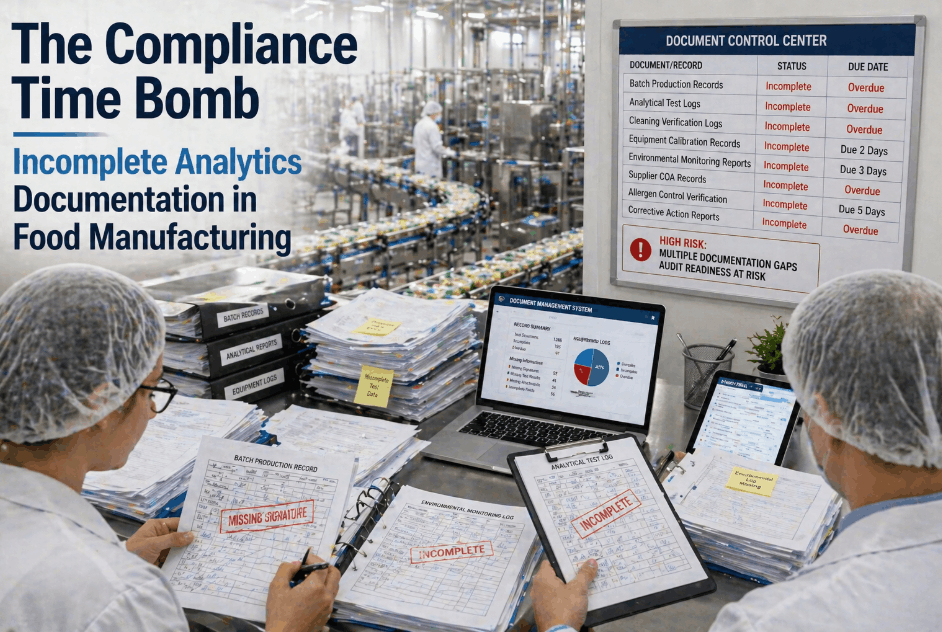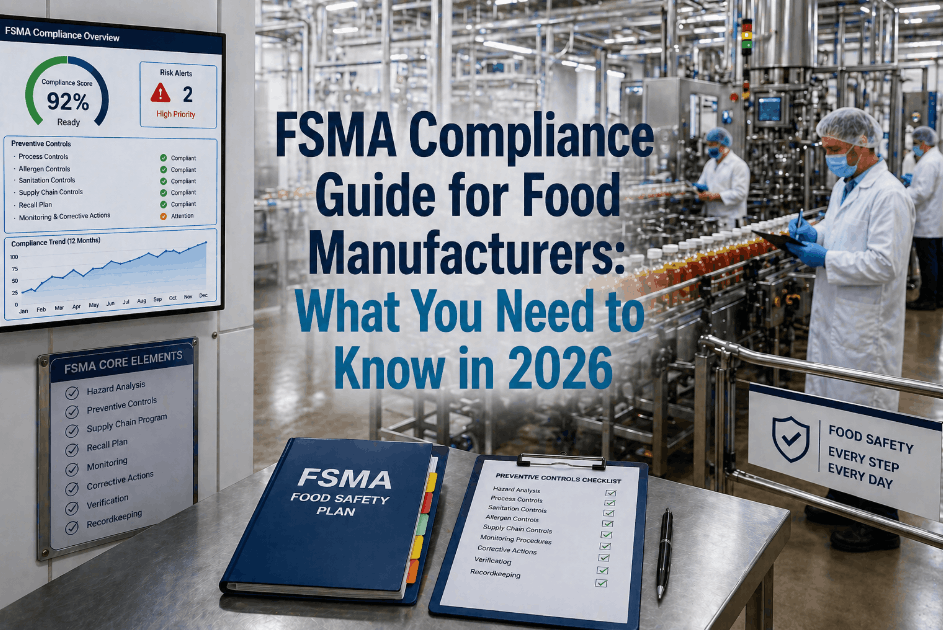
Food manufacturers operating in the United States face an increasingly complex regulatory environment in 2026. The Food Safety Modernization Act (FSMA) — the most significant overhaul of U.S. food safety law since 1938 — has transformed how manufacturers must design, document, and defend every stage of their production process. From preventive controls to the expanded traceability rule under Section 204, FSMA compliance is no longer a back-office compliance function. It is a core operational discipline that directly affects production schedules, supplier relationships, audit outcomes, and FDA inspection readiness. For regulatory compliance officers managing food manufacturing facilities, 2026 brings both tightening enforcement timelines and new documentation expectations that demand a structured, technology-supported approach.
Automate FSMA Documentation and Audit Readiness
iFactory's AI-driven compliance platform integrates with your production systems to automate FSMA recordkeeping, traceability logs, and preventive control documentation — keeping you inspection-ready 365 days a year.
What Is FSMA and Why Does It Matter for Food Manufacturers in 2026?
Signed into law in January 2011, the Food Safety Modernization Act shifted the FDA's regulatory posture from responding to food safety incidents to preventing them. The law granted the FDA broad new authority: mandatory preventive controls for human and animal food, risk-based inspection schedules, mandatory recall authority, and sweeping supply chain oversight requirements. For food manufacturers, the practical consequence is a compliance ecosystem built on documentation, hazard analysis, and continuous verification — not periodic audits alone.
In 2026, FSMA enforcement has matured considerably. The FDA has moved past the implementation grace periods that characterized the 2016–2022 phase. Warning letters, import alerts, and consent decrees tied to FSMA violations are now routine. Compliance officers who treated FSMA as a one-time program build-out are discovering that the regulation demands living systems: food safety plans that are reviewed and updated in response to new hazards, ingredient changes, process modifications, and facility expansions.
FSMA Preventive Controls Rule: Core Requirements Every Manufacturer Must Meet
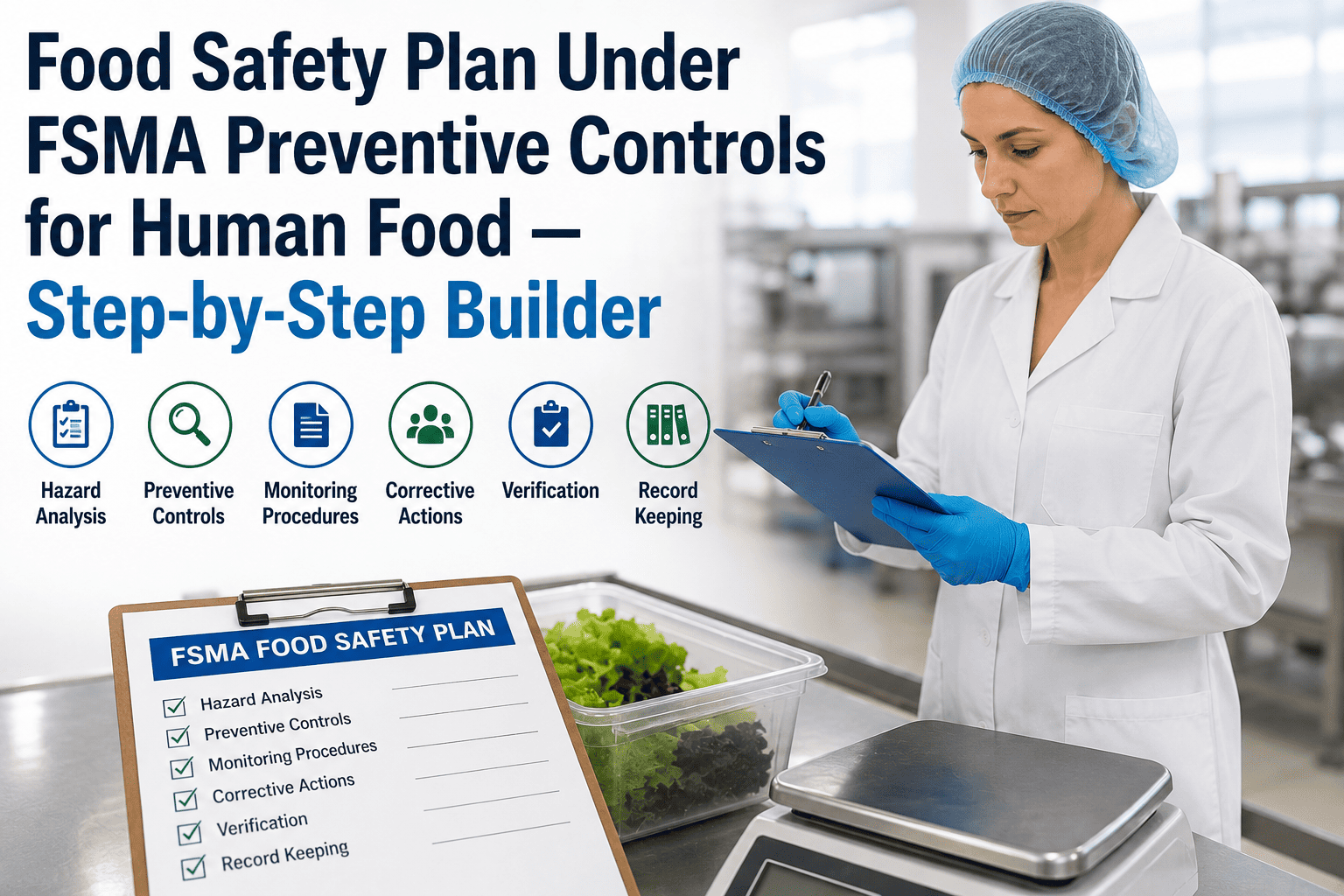
The Preventive Controls for Human Food rule — codified under 21 CFR Part 117 — is the backbone of FSMA compliance for the majority of food manufacturers. It requires facilities to develop, implement, and maintain a written Food Safety Plan covering four interconnected components: hazard analysis, preventive controls, monitoring procedures, and corrective action protocols. Facilities that operate without a qualified individual overseeing the food safety plan, or that lack documented monitoring records for each identified preventive control, are among the most common targets for FDA 483 observations during inspections. Book a Demo to see how AI platforms auto-generate and maintain your food safety plan documentation.
Hazard Analysis and Risk-Based Preventive Controls
Every food manufacturer must identify known or reasonably foreseeable biological, chemical, and physical hazards associated with each food type produced. Hazards requiring a preventive control — those that could cause serious adverse health consequences without a control measure — must be actively managed through documented, validated controls including process controls, allergen controls, sanitation controls, and supply chain controls.
Monitoring, Verification, and Corrective Action Records
FSMA requires written monitoring procedures for each preventive control, including frequency, responsible personnel, and acceptable limits. Verification activities — calibration records, environmental monitoring results, product testing data — must be documented and reviewed by a Preventive Controls Qualified Individual (PCQI) at defined intervals. Corrective actions taken in response to control failures must also be recorded, evaluated, and used to update the food safety plan.
Recall Plan and Food Safety Plan Review
Manufacturers must maintain a written recall plan that identifies responsible parties, traceability procedures, disposition options, and FDA notification protocols. The food safety plan must be reviewed and reanalyzed whenever a significant change in the facility, product formulation, process, or ingredient supply occurs — and at least every three years even in the absence of changes.
Preventive Controls Qualified Individual (PCQI) Requirements
Every facility covered by the Preventive Controls rule must designate a PCQI — an individual who has successfully completed training in the development and application of risk-based preventive controls or is otherwise qualified through job experience. The PCQI is responsible for preparing the food safety plan, overseeing validation studies, and reviewing corrective action records. In multi-site organizations, each facility requires its own PCQI oversight structure.
FSMA Section 204: The Food Traceability Rule and Its 2026 Implications
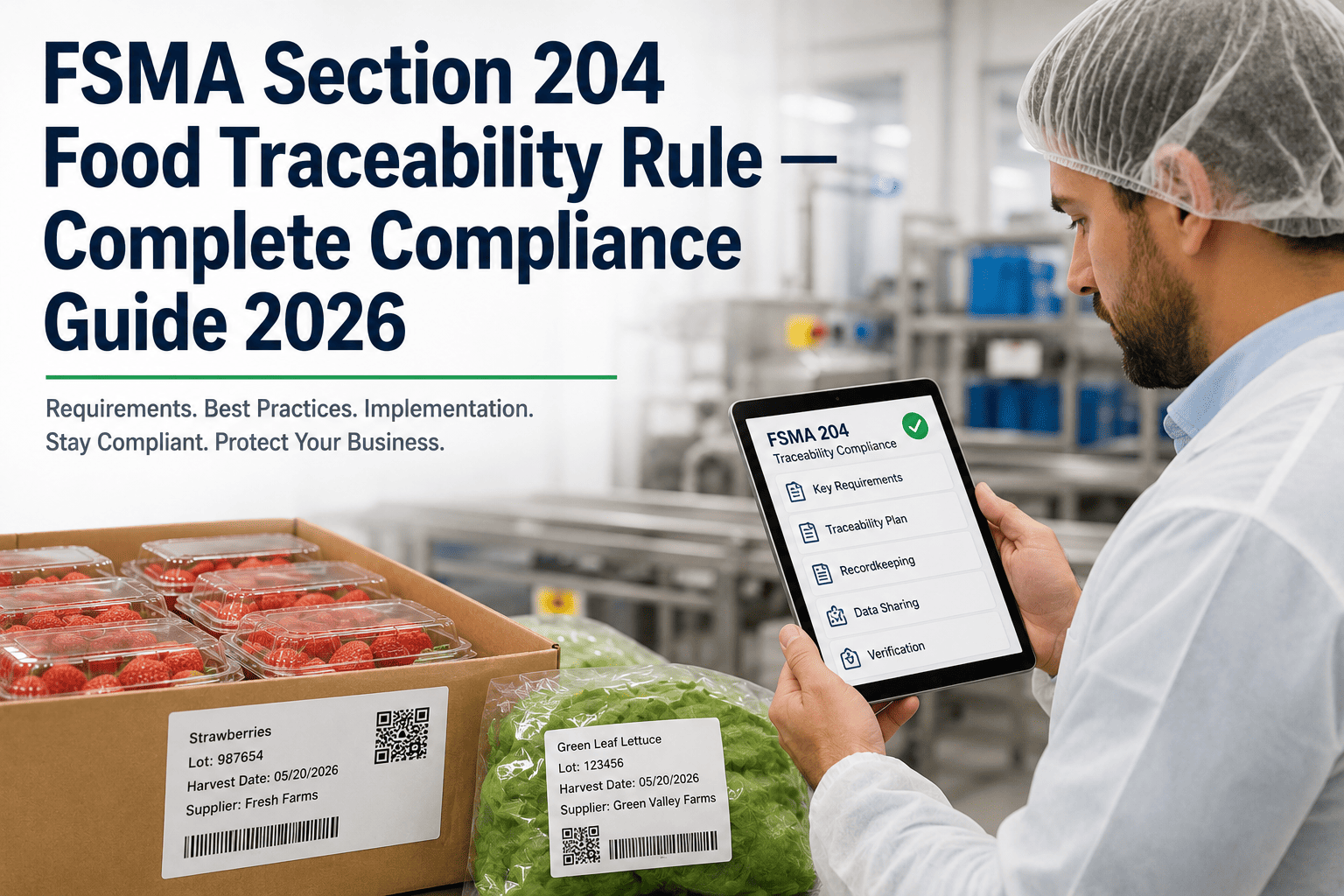
The Food Traceability Rule under FSMA Section 204 — with a compliance deadline that arrived in early 2026 for most covered entities — represents the most operationally demanding component of current FSMA enforcement. The rule requires manufacturers producing foods on the FDA's Food Traceability List (FTL) to establish and maintain records that capture Key Data Elements (KDEs) at each Critical Tracking Event (CTE) in the supply chain. This fundamentally changes recordkeeping from batch-level tracking to event-level traceability with specific data field requirements. Book a Demo to explore how automated traceability systems capture KDEs at every CTE in real time.
| Critical Tracking Event (CTE) | Key Data Elements Required | Who Must Record | Retention Period |
|---|---|---|---|
| Growing (farms) | Commodity, location, harvest date, lot code | Farms producing FTL commodities | 2 years |
| Receiving | Traceability lot code, location, date, quantity | All entities receiving FTL foods | 2 years |
| Transformation | Input lot codes, output lot codes, date, location | Manufacturers transforming FTL foods | 2 years |
| Creation (manufacturing) | New lot code, source lot codes, location, date | Manufacturers creating new food items | 2 years |
| Shipping | Lot code, quantity, recipient, transport detail | All entities shipping FTL foods | 2 years |
The operational challenge is significant: manufacturers must link inbound ingredient lot codes to outbound product lot codes at the transformation CTE — a requirement that demands integration between ERP systems, manufacturing execution systems, and warehouse management platforms. Manual spreadsheet-based systems that served as interim solutions during the implementation grace period are no longer sufficient under active enforcement. AI-driven traceability platforms that automatically capture and link KDEs at each production event are rapidly becoming the standard approach for compliance-confident manufacturers.
Current Good Manufacturing Practice (CGMP) Requirements Under 21 CFR Part 117
FSMA's modernized Current Good Manufacturing Practice (CGMP) requirements update the foundational sanitary standards that have governed food manufacturing since 1969. While the core CGMP framework — personnel hygiene, plant design, sanitation controls, pest management, and equipment maintenance — remained substantially intact, FSMA added explicit requirements for written sanitation procedures, environmental monitoring programs, and allergen cross-contact controls that were previously implied rather than mandated. Book a Demo to see how CGMP documentation workflows are automated within a modern compliance platform.
Personnel Hygiene and Training
All personnel who handle food or food-contact surfaces must receive documented training in food hygiene and food safety principles relevant to their function. Training records must be retained and accessible for FDA inspection. Illness policies requiring personnel with certain health conditions to report to supervisors must be written and communicated.
Plant and Equipment Sanitation
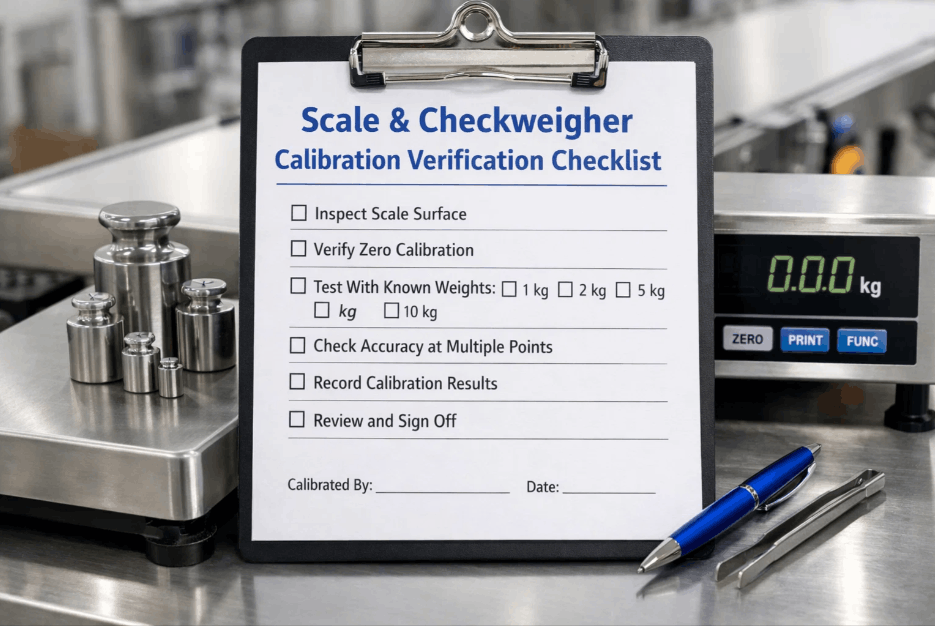
Sanitation procedures must be written, implemented, and verified through documented sanitation monitoring. Equipment must be designed for cleanability and maintained to prevent contamination. Master sanitation schedules, pre-operational inspection records, and ATP or microbiological monitoring data all serve as CGMP verification documentation during FDA inspections.
Allergen Cross-Contact Controls
Allergen control programs must address ingredient segregation during storage, dedicated or validated-clean equipment for allergen-containing products, scheduling controls for shared lines, label verification at changeover, and rework management. Allergen controls are classified as preventive controls under Part 117 and therefore require the full monitoring, verification, and corrective action documentation structure.
Water Quality and Environmental Monitoring
Water used in food production and food-contact surface cleaning must be safe and adequate. Environmental monitoring programs — particularly Listeria environmental monitoring in ready-to-eat facilities — must be risk-based, documented, and include corrective action protocols triggered by positive test results. Trend analysis of environmental monitoring data is considered best practice and is increasingly expected by FDA investigators.
FSMA Supply Chain Program: Supplier Verification Requirements
One of the most resource-intensive components of FSMA compliance is the Supply Chain Program requirement under the Preventive Controls rule. When a manufacturer identifies a hazard in a raw material or ingredient that is controlled by a supplier rather than in the receiving facility's own process, the manufacturer must implement supplier verification activities proportionate to the risk. This means moving far beyond traditional certificate-of-analysis review toward formal supplier approval programs, risk-based verification activity selection, and documented annual reassessment of supplier status. Book a Demo to explore supplier verification management within an integrated FSMA compliance platform.
Approved Supplier List and Risk Classification
Manufacturers must maintain a documented list of approved suppliers for raw materials associated with hazards requiring supply chain controls. Each supplier must be classified by risk level based on the hazard severity, supplier's food safety history, applicable regulatory requirements, and results of prior verification activities.
Verification Activities: Audits, Testing, and Records Review
Acceptable verification activities include onsite audits, ingredient testing, review of the supplier's food safety records, and certificates of conformance. For the highest-risk materials — those associated with hazards that could cause serious adverse health consequences — annual onsite audits conducted by a qualified auditor are required unless an alternative verification approach is documented and justified.
Corrective Actions for Supplier Non-Conformance
When verification activities identify a supplier's failure to implement controls, the receiving facility must take appropriate corrective action — which may include stopping use of the supplier's materials, increasing verification frequency, requiring the supplier to implement corrective actions and provide documented evidence, or transitioning to an alternative approved supplier.
Common FSMA Compliance Gaps Found During FDA Inspections
FDA inspection data and warning letter analysis from 2023–2025 reveal consistent patterns in FSMA compliance failures. Understanding these gaps allows compliance officers to prioritize internal audit activity and remediation resources before an FDA investigator identifies the same deficiencies. The most frequently cited FSMA violations cluster around documentation completeness, hazard analysis rigor, and monitoring system effectiveness — areas where paper-based or disconnected digital systems consistently underperform.
Food Safety Plan Not Reanalyzed After Process Changes
Manufacturers frequently implement new equipment, formulation changes, or production line modifications without triggering a formal food safety plan reanalysis. FSMA requires reassessment whenever a significant change occurs that could introduce new hazards or render existing controls inadequate — a requirement that demands a formal change management integration with the food safety program.
Incomplete or Missing Monitoring Records for Preventive Controls
Monitoring activities are performed but records are incomplete: missing signatures, incorrect timestamps, illegible entries, or gaps in monitoring frequency. During FDA inspections, monitoring records are among the first documents requested. Incomplete records create the presumption that monitoring did not occur — regardless of actual practice.
Hazard Analysis That Fails to Address All Reasonably Foreseeable Hazards
Hazard analyses that focus exclusively on microbiological hazards while inadequately addressing chemical hazards — such as undeclared allergens, environmental contaminants, or intentional adulteration vectors — represent a significant compliance risk. FDA investigators apply a broad interpretation of "reasonably foreseeable" that encompasses hazards documented in scientific literature, prior industry incidents, and facility-specific risk factors.
Environmental Monitoring Programs Without Adequate Trend Analysis
Ready-to-eat food manufacturers with environmental monitoring programs often collect data but fail to analyze trends. Sporadic positive environmental results that individually fall below action thresholds can represent a systemic contamination pattern when viewed in aggregate. FDA investigators increasingly expect facilities to demonstrate that trend data is reviewed by a qualified individual and acted upon proactively.
How AI-Driven Software Transforms FSMA Compliance Documentation
Modern food manufacturers are turning to AI-driven manufacturing intelligence platforms to address the documentation burden, data integration challenges, and real-time monitoring gaps that manual FSMA compliance systems cannot reliably sustain. These platforms connect production equipment, quality management systems, ERP platforms, and laboratory information systems into unified compliance data ecosystems — automatically capturing the records that FSMA requires and surfacing the analytical insights that support proactive hazard management. For regulatory compliance officers managing multi-line or multi-facility operations, the shift from manual documentation to automated FSMA compliance recordkeeping represents one of the highest-ROI technology investments available in 2026.
| FSMA Requirement | Manual Compliance Approach | AI-Driven Platform Approach | Compliance Impact |
|---|---|---|---|
| Preventive Control Monitoring Records | Paper logs, manual data entry, periodic supervisor review | Automated capture from sensors and PLCs, real-time anomaly alerts | Complete, timestamped records with zero documentation gaps |
| Section 204 Traceability KDEs | Manual lot code entry, spreadsheet linking across systems | Automated CTE capture, ingredient-to-output lot linking | 24-hour trace response vs. FDA's 24-hour mandate |
| Supplier Verification Records | Email-based certificate collection, folder storage | Centralized supplier portal, automated expiry alerts, risk scoring | Always-current approved supplier documentation |
| Environmental Monitoring Trends | Monthly manual review of printed reports | Real-time trend visualization, automated threshold alerts | Proactive corrective actions before inspector review |
| Food Safety Plan Reanalysis Triggers | Change management forms, manual cross-reference | Change event triggers automatic reanalysis workflow | No missed reanalysis requirements after process changes |
Stay Ahead of FDA Enforcement With Automated FSMA Compliance
iFactory's intelligent compliance platform automates FSMA documentation, traceability recordkeeping, and preventive control monitoring across your entire manufacturing operation — so your next FDA inspection is your best one yet.
FSMA Compliance Metrics: Measuring Program Effectiveness
Regulatory compliance officers who manage FSMA programs without formal performance metrics are operating without visibility into program health. Effective FSMA compliance programs define quantitative indicators for documentation completeness, audit observation trends, corrective action closure rates, supplier verification currency, and environmental monitoring patterns. These metrics enable compliance teams to demonstrate program effectiveness to executive leadership, prepare for FDA inspections with evidence-based confidence, and identify systemic vulnerabilities before they translate into regulatory action.
Frequently Asked Questions: FSMA Compliance for Food Manufacturers
Who is subject to FSMA's Preventive Controls for Human Food rule?
All domestic and foreign facilities that manufacture, process, pack, or hold food for human consumption in the U.S. are subject to the rule, with limited exemptions for very small businesses, certain farm operations, and facilities that qualify under the modified requirements for qualified facilities.
What foods are on the FDA's Food Traceability List under Section 204?
The FTL includes fresh leafy greens, shell eggs, nut butters, fresh herbs, cucumbers, tomatoes, peppers, melons, tropical tree fruits, soft cheeses, shell fish, finfish, smoked fish, ready-to-eat deli salads, and sprouts — high-risk categories identified based on historical foodborne illness outbreak data.
How frequently must a PCQI review corrective action records?
FSMA requires PCQI review of corrective action records within a reasonable timeframe after completion. While the regulation does not specify an exact interval, FDA investigators expect documented review to occur promptly — typically within the same production period or within seven days for recurring issues.
What is the difference between a process control and a sanitation control under FSMA?
Process controls address parameters in a food manufacturing operation — such as time, temperature, pH, and water activity — that are applied to significantly minimize or prevent hazards in the food itself. Sanitation controls address hygiene conditions and practices such as employee hygiene and sanitation of food-contact surfaces to prevent allergen cross-contact or environmental contamination.
Can FSMA compliance software satisfy FDA documentation requirements?
Yes. Electronic records generated and maintained by compliance software satisfy FSMA recordkeeping requirements provided the system ensures record integrity, prevents unauthorized alterations, and allows FDA investigators to access records in a usable format during inspections — requirements aligned with 21 CFR Part 11 principles.
How should manufacturers prioritize FSMA compliance investments in 2026?
Manufacturers should prioritize traceability system upgrades for Section 204 compliance first given active enforcement, followed by preventive control monitoring automation for the highest-risk product lines, supplier verification program digitization, and environmental monitoring trend analysis capabilities — implementing in stages that deliver measurable compliance improvements at each phase.
Ready to Build a Bulletproof FSMA Compliance Program?
From Section 204 traceability to preventive control monitoring and supplier verification — iFactory gives your compliance team a single, audit-ready platform that eliminates documentation gaps and keeps your facility inspection-ready around the clock.
-what-food-manufacturers-must-do-now.png)