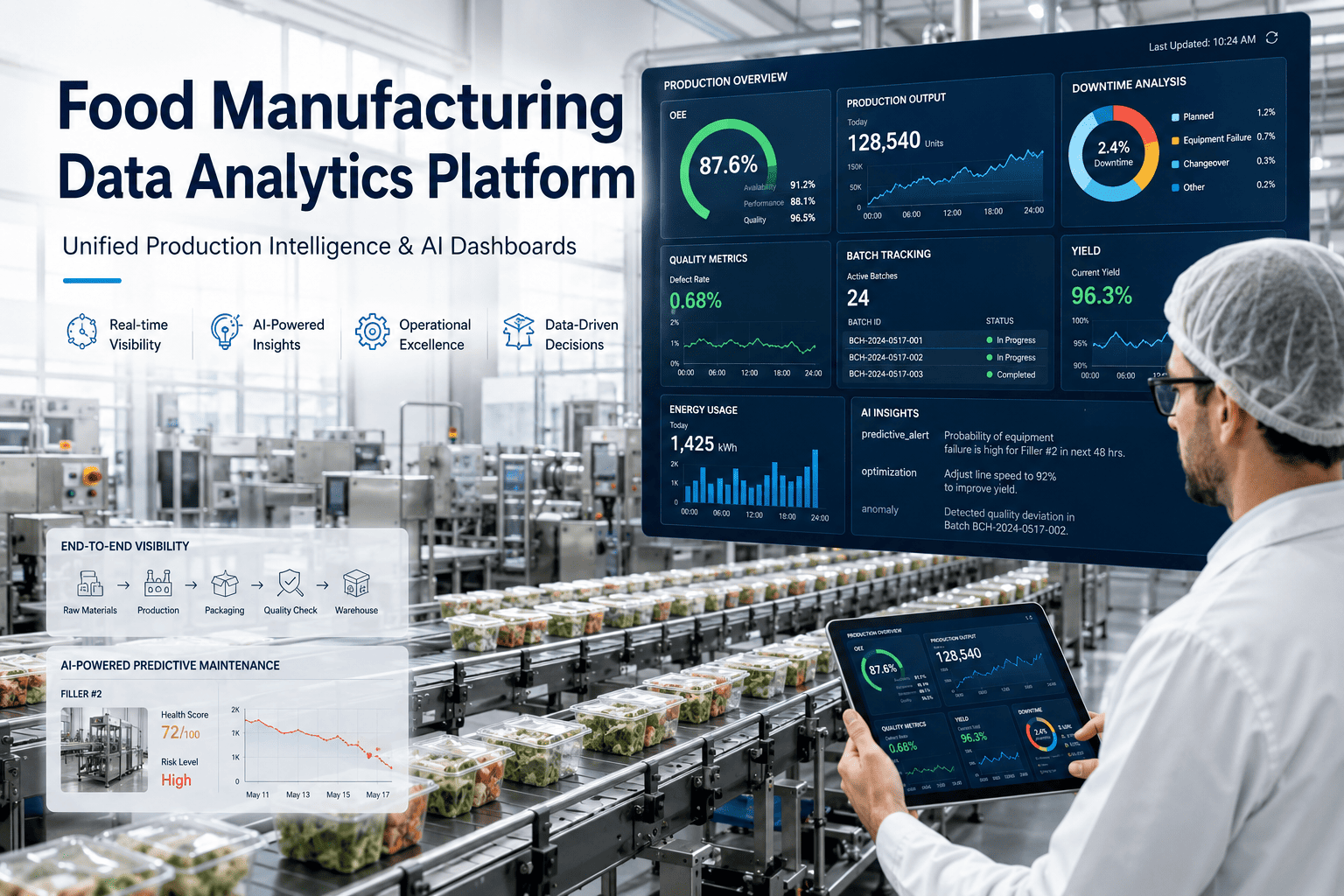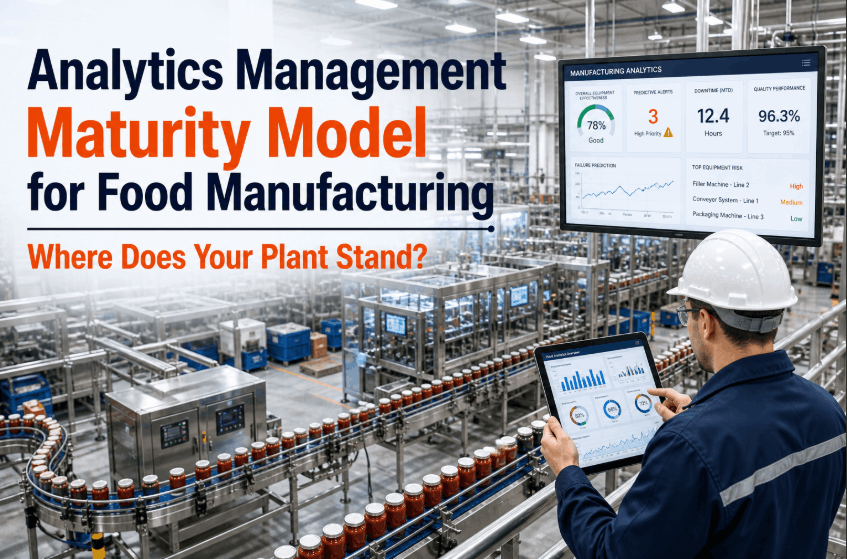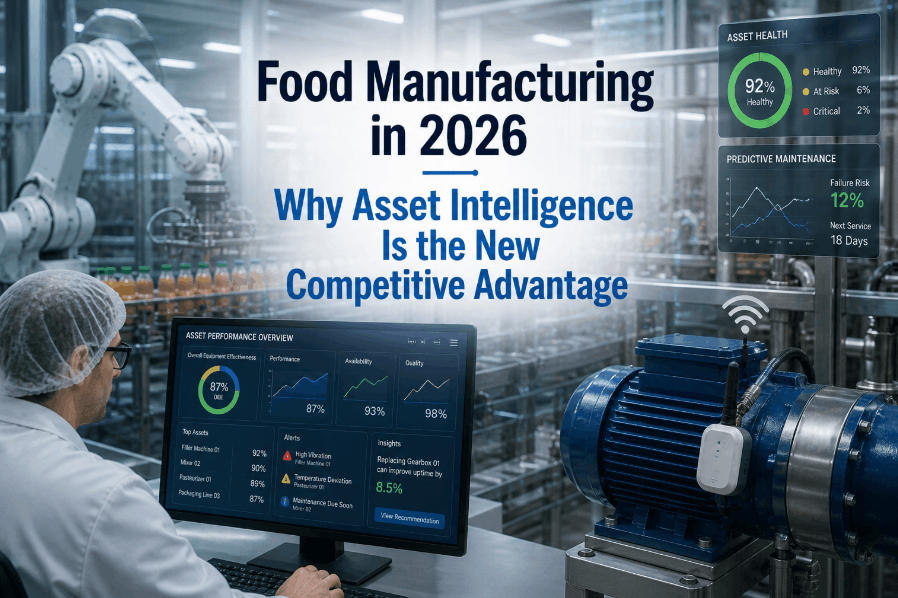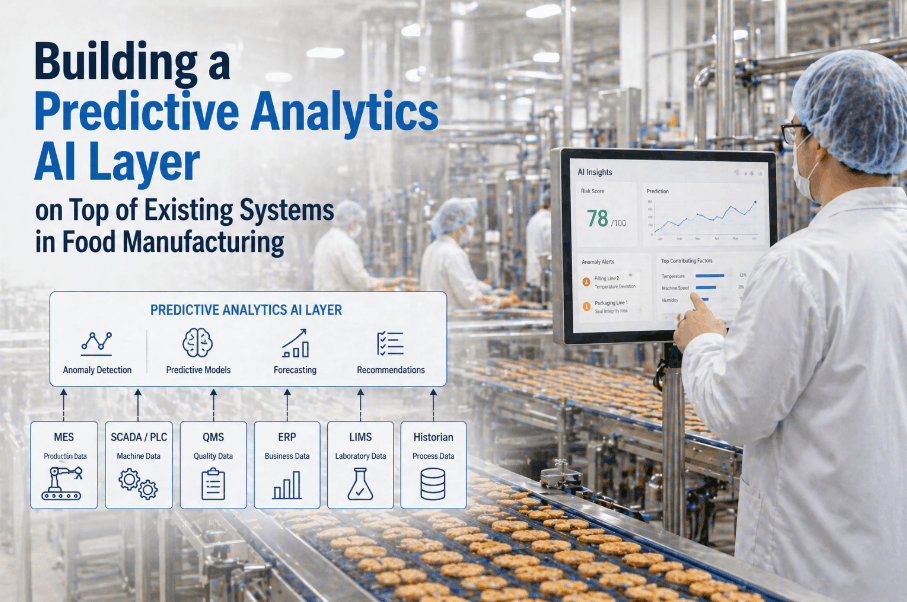
AI-integrated analytics management systems are fundamentally reshaping how food manufacturing enterprises govern assets, predict failures, and sustain operational excellence. As production complexity accelerates and regulatory pressure intensifies, legacy maintenance management software and reactive monitoring approaches can no longer support the performance demands embedded in modern enterprise operations. Enterprise asset management software powered by artificial intelligence is no longer a competitive advantage — it is the operational baseline that separates high-performing food manufacturers from those continuously absorbing preventable losses. This article examines how AI-powered manufacturing software, industrial IoT monitoring, and predictive maintenance software converge into a unified manufacturing intelligence platform capable of transforming every layer of food production performance.
Why AI-Powered Manufacturing Software Has Become Non-Negotiable for Food Enterprises
Food manufacturing enterprises face a compound operational challenge unlike any other industrial sector. Perishable inputs, strict food safety compliance frameworks, continuous production scheduling requirements, and high-consequence quality deviations create an environment where unplanned downtime and asset degradation carry consequences far beyond the cost of the failure event itself. Traditional enterprise asset management software — built for scheduled maintenance cycles and reactive work order management — was not designed for this operational density.
AI-powered manufacturing software changes the governing equation. By integrating machine learning models trained on industrial sensor data, production throughput records, quality deviation logs, and maintenance history, modern manufacturing intelligence platforms can predict asset degradation patterns 14–21 days before failure, identify root-cause drivers of yield variance, and flag compliance documentation gaps before audit exposure materializes. For food manufacturing enterprises, this shift from reactive operational management to AI-driven predictive intelligence is the difference between controlled performance improvement and compounding operational debt. Enterprises ready to explore this capability can book a demo and receive a tailored operational readiness assessment within 48 hours.
Reactive Management Costs
Food manufacturers operating on reactive maintenance cycles absorb $18,000–$65,000 per unplanned downtime hour — a cost structure that compounds across every asset in the production environment without AI-driven early warning capability.
Compliance Complexity
FSMA traceability requirements, HACCP documentation standards, and supplier risk protocols demand continuous data capture at a volume and speed that manual documentation systems structurally cannot maintain — creating latent regulatory exposure that AI-integrated compliance systems eliminate.
Production Yield Variance
Yield losses in food manufacturing are rarely random. AI-driven operational analytics software consistently identifies that 20% of process variables drive 80% of yield deviation — insights invisible to traditional OEE reporting systems.
Cross-Facility Visibility Gaps
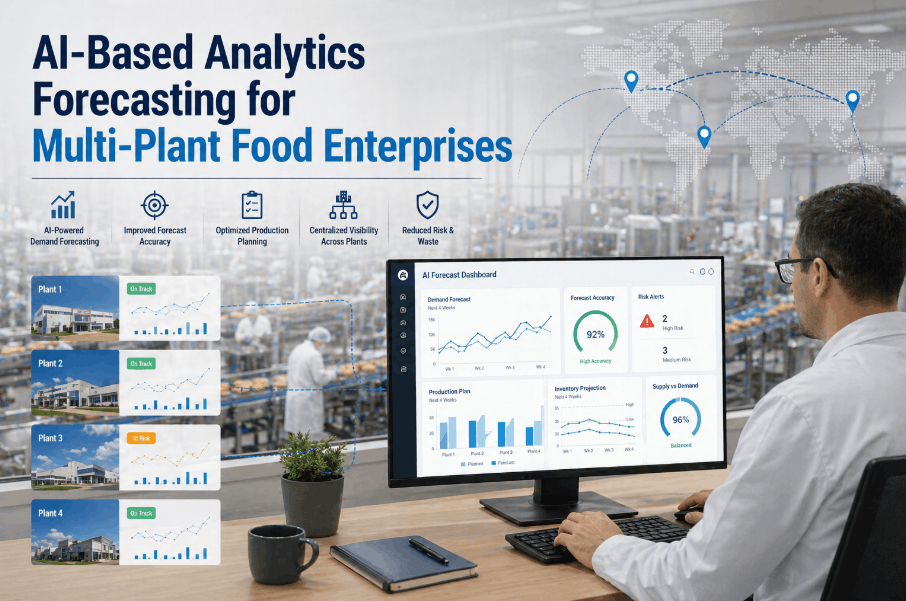
Multi-site food manufacturers operating with siloed plant-level MES instances have no enterprise-level view of comparative asset health, OEE variance, or quality performance — making capital allocation decisions data-blind by design.
AI-Driven Predictive Maintenance Software: Converting Asset Risk Into a Scheduled Variable
From Sensor Signal to Failure Prediction: The Industrial IoT Monitoring Stack
Modern predictive maintenance software operates through a layered industrial IoT monitoring infrastructure. Vibration sensors, thermal imaging arrays, acoustic emission detectors, and process variable transmitters continuously stream asset condition data into an AI analytics engine trained on millions of failure event signatures. The system does not wait for threshold breaches — it identifies the rate-of-change patterns in vibration harmonics, temperature gradients, and current draw profiles that precede specific failure modes weeks before the failure event occurs.
For food manufacturing enterprises, this transforms the maintenance function from an unscheduled cost center into a precision-managed operational process. Maintenance interventions are scheduled during planned production gaps, replacement parts are procured in advance at standard cost rather than emergency rates, and production scheduling is never disrupted by a surprise equipment failure. Leading manufacturers integrating AI-powered maintenance management software report 50–67% reductions in unplanned downtime events within the first 12 months of full deployment. Book a Demo to see our fleet intelligence in action.
Enterprise Reliability Software: Portfolio-Wide Asset Health Governance
Enterprise reliability software extends predictive maintenance intelligence beyond the individual asset to the full production fleet. When bearing degradation signatures appear simultaneously at three facilities within a 60-day window, AI-integrated analytics identifies this as a fleet-level failure pattern — triggering coordinated procurement and scheduling responses across every affected site simultaneously. Without an enterprise reliability software layer, the same failure pattern is experienced as three independent, unconnected events — each absorbed as an isolated operational disruption with no cross-facility learning applied. Manufacturers ready to explore this capability can book a demo to receive a site-specific reliability gap assessment.
| Maintenance Capability | Reactive Baseline | AI-Predictive Deployment | Operational Impact |
|---|---|---|---|
| Failure Detection Window | Post-failure, during production | 14–21 days pre-failure via IoT sensor trending | Downtime events reduced 55–67% |
| Maintenance Scheduling | Emergency reactive response | Condition-based, production-integrated scheduling | Labor cost reduced 28–34% |
| Spare Parts Management | Excess safety stock or emergency procurement | Demand-signal procurement aligned to failure forecasts | Inventory carrying cost down 22% |
| Cross-Plant Learning | Siloed — no fleet pattern detection | AI identifies failure patterns across all facilities simultaneously | Coordinated risk response, all sites |
| Annual EBITDA Contribution | Unpredictable, downside-skewed | Forecastable improvement trajectory, compounding | $1.2M–$3.8M per plant annually |
Asset Performance Management in Food Manufacturing: The AI Analytics Advantage
Asset performance management powered by AI analytics goes significantly beyond traditional condition monitoring software. Where conventional systems alert operators to threshold exceedances, AI-integrated asset performance management correlates asset health signals with production throughput data, quality deviation records, and environmental parameters to generate a complete operational risk picture — one that quantifies the financial consequence of current asset degradation trajectories in terms plant leadership and enterprise management can act upon.
Converting Engineering Metrics Into Enterprise Financial Outcomes
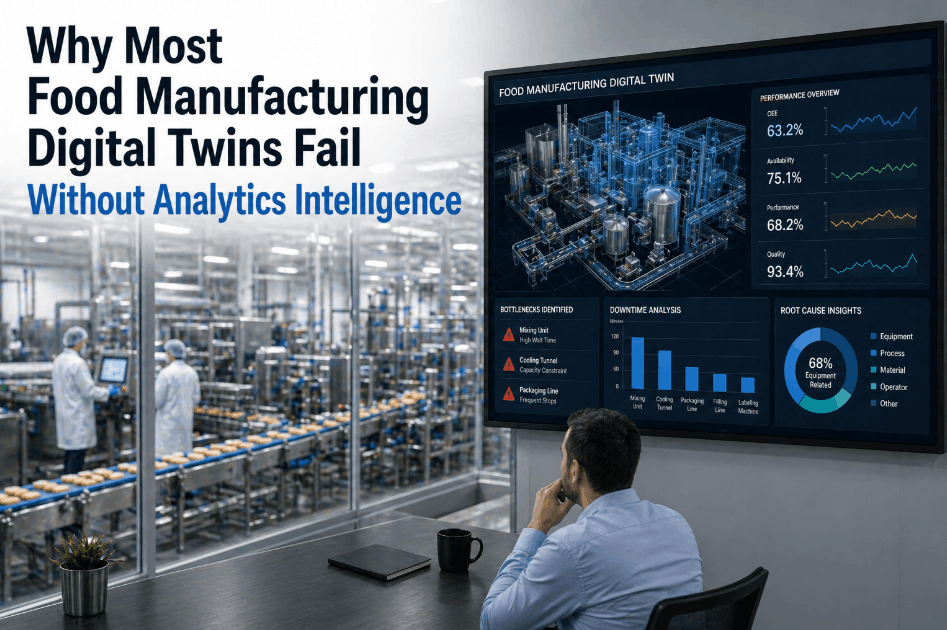
The critical capability gap in most food manufacturing asset management programs is the translation from engineering metrics to financial outcomes. A bearing operating at elevated vibration amplitude is an engineering signal. That same bearing, in the context of AI-integrated operational analytics software, becomes a projected downtime event with a specific probability, estimated occurrence window, production loss calculation, and total remediation cost estimate — all delivered to plant leadership and enterprise management dashboards in real time.
This translation capability is what elevates AI-powered enterprise asset management software from a maintenance tool to an enterprise strategic asset. When every unplanned downtime event carries a $18,000–$65,000 cost, and a production facility averages 4.2 events per month, the annual EBITDA exposure from asset unreliability becomes a precise calculation that demands proactive investment — not a vague operational risk to be managed reactively. Food manufacturers building this financial translation capability can book a demo to explore how iFactory's platform integrates with existing production environments.
The Manufacturing Intelligence Platform Architecture: AI Analytics Layers
A complete manufacturing intelligence platform integrates AI analytics across every operational domain — asset health, production throughput, quality management, compliance documentation, and supply chain risk — into a unified enterprise data environment. This integration architecture is what separates purpose-built smart factory analytics platforms from point solutions that generate siloed insights without enterprise synthesis.
Industrial IoT Data Infrastructure
The foundation of any AI-integrated analytics system is a robust industrial IoT monitoring infrastructure that captures high-frequency sensor data at the asset level and delivers it to AI processing engines in real time. Edge computing nodes process vibration, temperature, pressure, and process variable data locally — reducing latency and enabling immediate anomaly detection without cloud round-trip dependency. This layer feeds the AI analytics engine with high-fidelity input.
AI Analytics & Predictive Models
The AI analytics engine applies machine learning models — trained on industry-specific failure datasets and continuously refined on facility-specific production data — to generate failure predictions, yield optimization recommendations, and quality risk alerts. This layer also powers operational risk management intelligence, identifying process variables most predictive of quality deviations. Cross-facility model learning ensures patterns identified at one plant improve accuracy across the network.
Enterprise Compliance Automation
The enterprise intelligence layer aggregates facility-level AI analytics outputs into cross-portfolio dashboards that give enterprise management a unified real-time view of operational performance. Automated FSMA compliance documentation, supplier risk monitoring, and audit preparation workflows activate at this layer — converting compliance into a continuously maintained, AI-auditable digital record.
Digital Transformation in Food Manufacturing: The AI Analytics Sequencing That Actually Works
Digital transformation in food manufacturing fails most often not from technology selection errors, but from implementation sequencing errors. Organizations that attempt to activate full AI analytics capability — including advanced condition monitoring software, smart factory analytics, and automated compliance documentation — simultaneously across multiple facilities routinely encounter data quality failures, integration delays, and operator trust erosion that set transformation timelines back by 12–18 months. The correct sequencing prioritizes data infrastructure validation before analytics activation, and analytics governance before advanced automation deployment.
Why Most Manufacturing Intelligence Deployments Underperform Initial Projections
The most common failure mode in food manufacturing AI analytics deployments is launching advanced predictive models on unvalidated sensor data. When industrial IoT monitoring infrastructure is installed without a data quality validation phase, AI engines ingest noise alongside signal — generating false positive maintenance alerts that erode operator trust in the system and cause teams to revert to manual judgment. Establishing validated data pipelines before activating AI prediction layers is the single most important sequencing decision in a digital transformation manufacturing program. Organizations that have experienced this failure pattern and are ready to reset the foundation can book a demo to discuss iFactory's accelerated validation and redeployment pathway.
Portfolio-Level AI Operational Governance
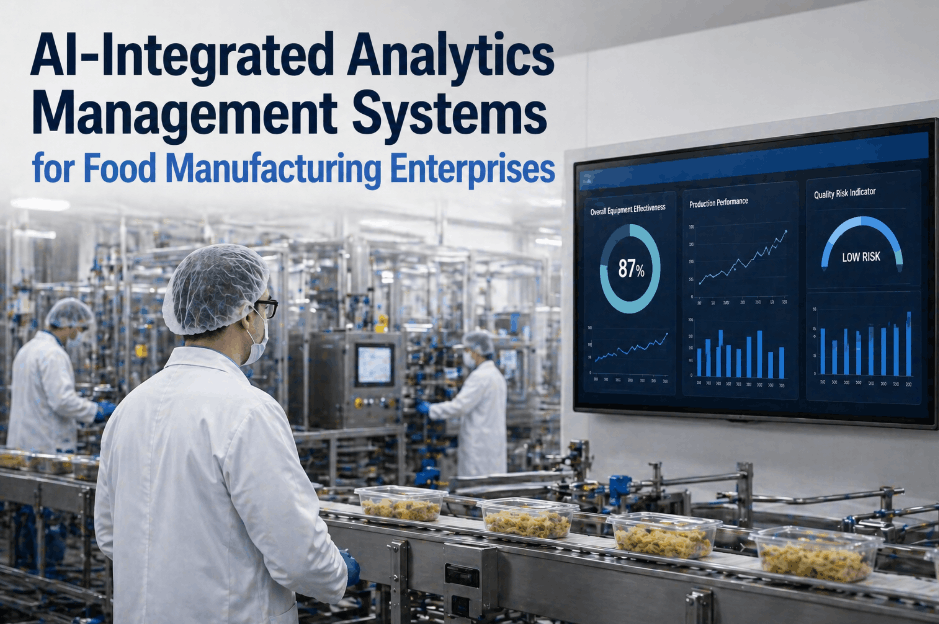
A unified enterprise dashboard delivering real-time OEE, asset health index, quality deviation frequency, and compliance status across every production facility — with AI-generated risk rankings that prioritize management attention toward the highest-impact operational vulnerabilities in the portfolio.
Facility-Level AI Production Intelligence
Real-time production monitoring software delivering throughput, quality, and asset health KPIs at the line and asset level — with AI-generated shift reports, anomaly alerts, and root-cause analysis recommendations that eliminate the data collection burden from operations personnel and focus attention on corrective action.
AI-Driven Predictive Asset Management
Cross-facility asset health trending with AI failure probability scores, projected failure timelines, and recommended intervention windows — all integrated with production scheduling to ensure maintenance interventions are executed during planned gaps with no throughput disruption, across every instrumented asset in the enterprise fleet.
AI-Integrated Compliance Management: Eliminating Regulatory Exposure at Scale
Food manufacturing compliance management — encompassing FSMA traceability requirements, HACCP documentation, supplier qualification records, and environmental monitoring data — represents one of the highest-labor, highest-risk administrative functions in the enterprise. Traditional compliance management relies on manual documentation workflows that create inherent data gaps, version control failures, and audit preparation backlogs that consume significant operations management bandwidth while still leaving residual regulatory exposure. Book a Demo to see our automated systems.
Automated Traceability Documentation: AI Analytics for FSMA Rule 204 Compliance
FSMA Rule 204 traceability requirements demand that food manufacturers capture and maintain Key Data Elements at every Critical Tracking Event across the supply chain — from raw material receipt through finished product distribution. AI-integrated manufacturing intelligence platforms automate this documentation capture at every production stage, building a continuous, auditable traceability record that satisfies regulatory requirements without adding manual documentation burden to production personnel. When an FDA audit or customer traceability request arrives, the response is generated from a validated digital record in hours — not assembled from paper logs over days.
AI-Powered Supplier Risk Monitoring for Food Manufacturing Enterprises
Supplier quality failures represent one of the most costly and least predictable risk categories in food manufacturing operations. AI-integrated supply chain visibility software continuously monitors supplier performance data — delivery reliability, quality acceptance rates, certificate of analysis compliance, and third-party audit outcomes — applying anomaly detection models that flag emerging supplier risk profiles before they convert into ingredient quality events or supply disruptions. Enterprises operating with 94% supplier risk flagging accuracy through AI-integrated monitoring report material reductions in supplier-originated quality events and ingredient-driven production disruptions. Food manufacturers ready to explore this capability can book a demo to review iFactory's supplier intelligence deployment options.
The Financial Return on AI-Integrated Analytics: Measuring the Enterprise Value of Manufacturing Intelligence
The return on investment case for AI-integrated analytics management systems in food manufacturing is not a technology investment argument — it is an operational return argument denominated in EBITDA, cost avoidance, and enterprise value creation. When the financial consequences of asset unreliability, yield variance, and compliance exposure are quantified accurately, the cost of deploying a comprehensive industrial analytics platform is measured against a return base that dwarfs implementation cost within the first operating year.
Downtime Cost Elimination
Unplanned downtime in food manufacturing carries a $18,000–$65,000 hourly cost. AI-driven predictive maintenance software reduces downtime events by 55–67% within 12 months of full deployment. At five events per month across a four-facility enterprise, elimination of the majority of these events represents $5.4M–$19.5M in annualized EBITDA impact — before yield improvement gains are counted.
Yield and Throughput Recovery
AI-driven production analytics identifies the upstream process variables — temperature control deviations, ingredient ratio drift, equipment speed variances — that drive yield loss and throughput reduction. Closing 50% of the AI-identified yield gap in a single processing line generates direct margin improvement that compounds through every production shift for the remaining operating period.
Compliance Cost Avoidance
A single FSMA enforcement action — including product recall, regulatory fine, and operational disruption costs — routinely exceeds the total multi-year investment in a comprehensive AI compliance management system. Continuous automated compliance documentation and supplier risk monitoring eliminates the largest compliance cost exposure categories before they materialize.
AI-Integrated Analytics for Food Manufacturing — Frequently Asked Questions
What differentiates AI-integrated analytics from standard manufacturing monitoring software?
Standard manufacturing monitoring software captures production data and displays it against thresholds — alerting operators when KPIs breach defined limits. AI-integrated analytics systems apply machine learning models to the same data streams to detect the patterns that precede threshold breaches — generating predictive warnings days or weeks before failure events occur. The result is not faster reaction to problems, but prevention of the problems themselves.
How long does implementation of an AI analytics platform take in a food manufacturing enterprise?
Implementation timelines depend on existing IoT infrastructure maturity. Facilities with existing sensor networks and MES integration points typically achieve initial AI analytics activation within 6–10 weeks. Greenfield installations requiring sensor deployment and MES integration typically complete in 14–20 weeks. A pre-deployment infrastructure assessment significantly compresses both timelines by identifying integration gaps before deployment begins.
Can AI predictive maintenance software integrate with existing CMMS systems?
Yes. Modern AI predictive maintenance platforms are designed to integrate with existing CMMS environments — consuming historical maintenance records and work order data as training inputs for predictive models, and outputting predictive maintenance work orders directly into CMMS workflows. This integration preserves existing maintenance management processes while adding AI predictive intelligence as an upstream layer.
How does AI analytics software support FSMA compliance documentation requirements?
AI-integrated manufacturing intelligence platforms automate capture of Key Data Elements at every Critical Tracking Event in the production and supply chain process — building a continuous, validated traceability record that satisfies FSMA Rule 204 requirements without manual documentation burden. Compliance reports can be generated on demand for regulatory submissions or customer audit responses.
What is the typical payback period for AI analytics platform investment in food manufacturing?
Most food manufacturing enterprises achieve full platform investment payback within 10–14 months of full deployment, driven primarily by downtime cost elimination and OEE gap closure. ROI accelerates as the AI models accumulate facility-specific performance data and predictive accuracy compounds through the operating period — making the return on investment stronger in years two and three than in year one.
How does operational analytics software support cross-facility performance benchmarking?
AI-integrated industrial analytics platforms normalize production data from heterogeneous source systems — multiple MES vendors, different SCADA configurations, varied ERP instances — into a standardized enterprise schema that enables true apples-to-apples KPI comparison across all facilities. This standardization is the prerequisite for identifying best practices worth replicating and underperforming assets worth prioritizing for capital investment.