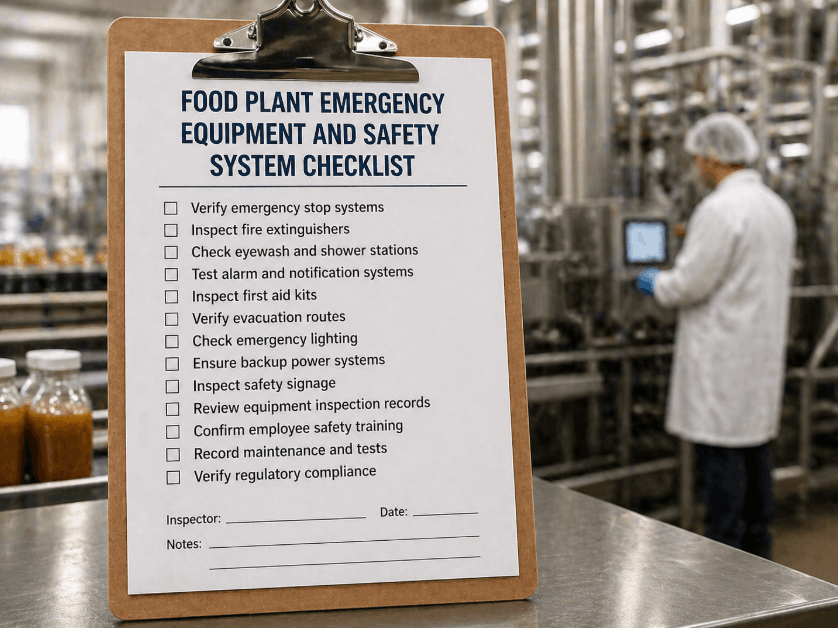
Food Plant Emergency Equipment and Safety System Checklist

By Josh Turley on April 25, 2026

food-plant-emergency-equipment-and-safety-system-checklist

Food manufacturing facilities present unique safety challenges where chemical processing, high-speed machinery, and washdown cycles converge — making emergency preparedness a critical pillar of operational integrity. A single obstructed eyewash station, an uncharged fire extinguisher, or a failed emergency light can transform a minor incident into a life-threatening crisis or a multi-million dollar OSHA liability. A comprehensive food plant emergency equipment and safety system checklist ensures your facility remains compliant with ANSI Z358.1 and OSHA 1910 standards. Book a Demo to see how iFactory's compliance tracking module digitizes your safety inspections and delivers real-time audit readiness for your next insurance or regulatory review.

COMPLIANCE TRACKING OSHA & ANSI READINESS SAFETY ANALYTICS

Eliminate Safety Gaps Across Your Food Plant with AI-Driven Compliance Tracking

iFactory tracks every eyewash flow test, fire extinguisher pressure check, and emergency lighting battery cycle — providing real-time safety dashboards and automated alerts before any inspection window lapses.

Why Food Plant Emergency Systems Demand a Dedicated Inspection Checklist

Regulatory & OSHA Compliance Obligations

Food manufacturing plants are subject to OSHA 29 CFR 1910.151 (Medical Services) and NFPA 101 (Life Safety Code). Non-compliance with emergency equipment accessibility or inspection frequency can result in "Serious" OSHA violations exceeding $15,000 per instance. Book a Demo to automate your safety compliance calendar and eliminate the risk of missed inspection dates.

Unique Hazards of Processing Environments

Unlike commercial buildings, food plants operate with high-pressure washdowns, corrosive cleaning chemicals, and extreme humidity. These conditions accelerate the corrosion of safety equipment components and can contaminate eyewash basins or first aid kits if not properly protected. Standard commercial safety protocols are insufficient; food plant checks must account for washdown-duty ratings, chemical resistance, and hygiene standards at every safety station.

1. Eyewash Stations & Safety Showers
2. Fire Suppression & Extinguisher Health
3. Emergency Lighting & Exit Signage
4. First Aid & Medical Response Readiness
5. Evacuation & Assembly Point Integrity
6. Chemical Spill Control & Containment
7. Personal Protective Equipment (PPE) Reserves
8. Communication & Alarm System Health
GET STARTED SECURE YOUR FACILITY

Digitize Your Food Plant Safety Program Today

Join leading food manufacturers standardizing eyewash tests, fire inspections, emergency lighting audits, and OSHA safety records — all in one real-time compliance platform powered by iFactory.

Benefits of Digital Emergency Equipment Management

OSHA & Insurance Audit Readiness

Timestamped digital safety records satisfy OSHA 1910 and NFPA 101 requirements, reducing citation risk and potentially lowering insurance premiums through verified diligence.

Automated Inspection Reminders

iFactory automatically tracks eyewash flushing, light testing, and AED pad expiry — sending escalating alerts before any safety deadline lapses so no equipment is left unmanaged.

Deficiency-to-Work-Order Automation

Any failed safety item instantly generates a high-priority corrective maintenance work order, ensuring that a broken emergency light or empty spill kit is resolved within 24 hours.

Mobile-First Safety Patrols

Electricians and safety officers log findings directly from their smartphones at each inspection point — replacing paper logs with GPS-tagged, tamper-proof digital records.

Multi-Facility Safety Dashboard

Monitor safety compliance scores, open deficiencies, and PPE inventory status across every plant in your food manufacturing portfolio from a single centralized command center.

Accident & Incident Data Support

Immutable, cloud-stored safety records provide verified proof of maintenance for OSHA compliance officers and legal teams in the event of an industrial accident or injury.
Food Plant Safety System FAQs

1. How often must eyewash stations be tested in a food plant?
Per ANSI Z358.1, all emergency eyewash stations must be activated weekly to verify operation and ensure that stagnant water is flushed from the piping. A more comprehensive annual inspection is required to verify flow rates, spray patterns, and water temperature compliance.
2. What are the OSHA requirements for emergency lighting tests?
OSHA and NFPA 101 require two types of tests: a monthly 30-second functional test (push-to-test button) and an annual 90-minute full-duration discharge test to ensure the batteries can sustain lighting during a prolonged evacuation.
3. Can first aid kits be stored in refrigerated processing areas?
While possible, it is not recommended. Cold temperatures and high humidity can degrade the adhesive on bandages and compromise the integrity of sterile packaging. It is best to store first aid kits in a temperature-controlled area immediately adjacent to the processing floor with clear signage.
4. What is the maximum travel distance to a fire extinguisher in a food plant?
For Class A fire hazards (common combustibles), the maximum travel distance to an extinguisher is 75 feet. For Class B hazards (flammable liquids found in sanitation chemicals or oils), the maximum travel distance is 30 to 50 feet depending on the hazard size and extinguisher rating.
5. How does iFactory manage PPE inventory for emergency response?
iFactory's compliance module tracks the stock levels and expiration dates of emergency PPE like respirator cartridges and chemical suits. When inventory hits a minimum threshold or items approach their expiration date, the system sends an automated alert to procurement.
6. What is the required travel distance to an emergency shower?
According to ANSI Z358.1, an emergency shower or eyewash station must be reachable within 10 seconds of a hazard (approximately 55 feet). In food plants using high-concentration caustics or acids for CIP (Clean-in-Place), it is recommended to place the station immediately adjacent to the chemical dosing station to minimize response time.
7. Should emergency safety systems be integrated with the facility alarm?
Yes. Integrating emergency shower flow switches and chemical spill sensors with your central monitoring system or iFactory dashboard ensures that the safety team is instantly notified when a device is activated. This allows for immediate dispatch of medical personnel even if the injured worker cannot call for help themselves.
ZERO DEFICIENCY SAFETY FIRST

Achieve Zero-Finding Safety Inspections Across Your Food Manufacturing Portfolio

Standardize your eyewash records, track AED battery dates, manage spill kit inventory, and generate corrective work orders automatically — all inside iFactory's safety compliance platform.


Share This Story, Choose Your Platform!