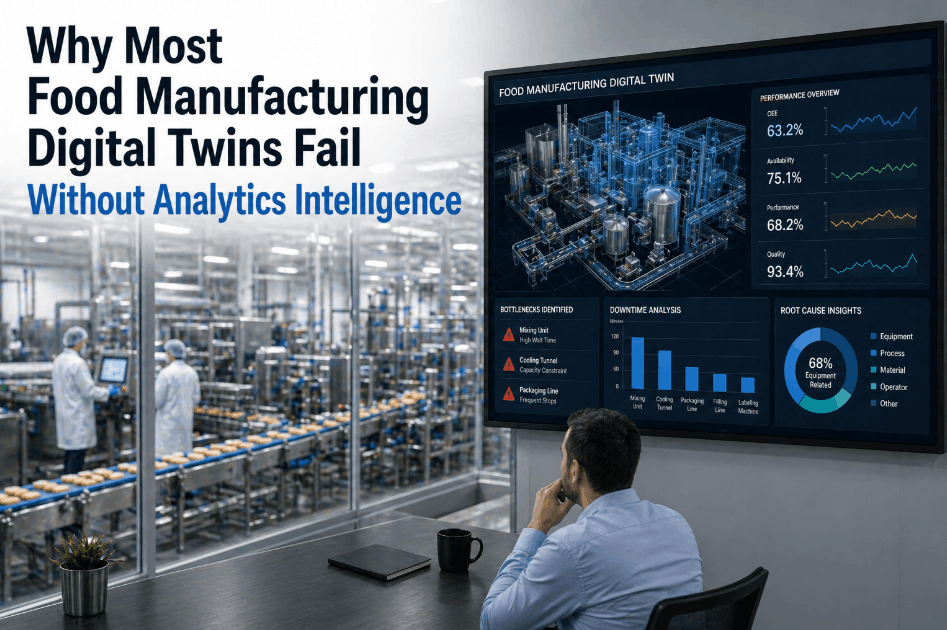
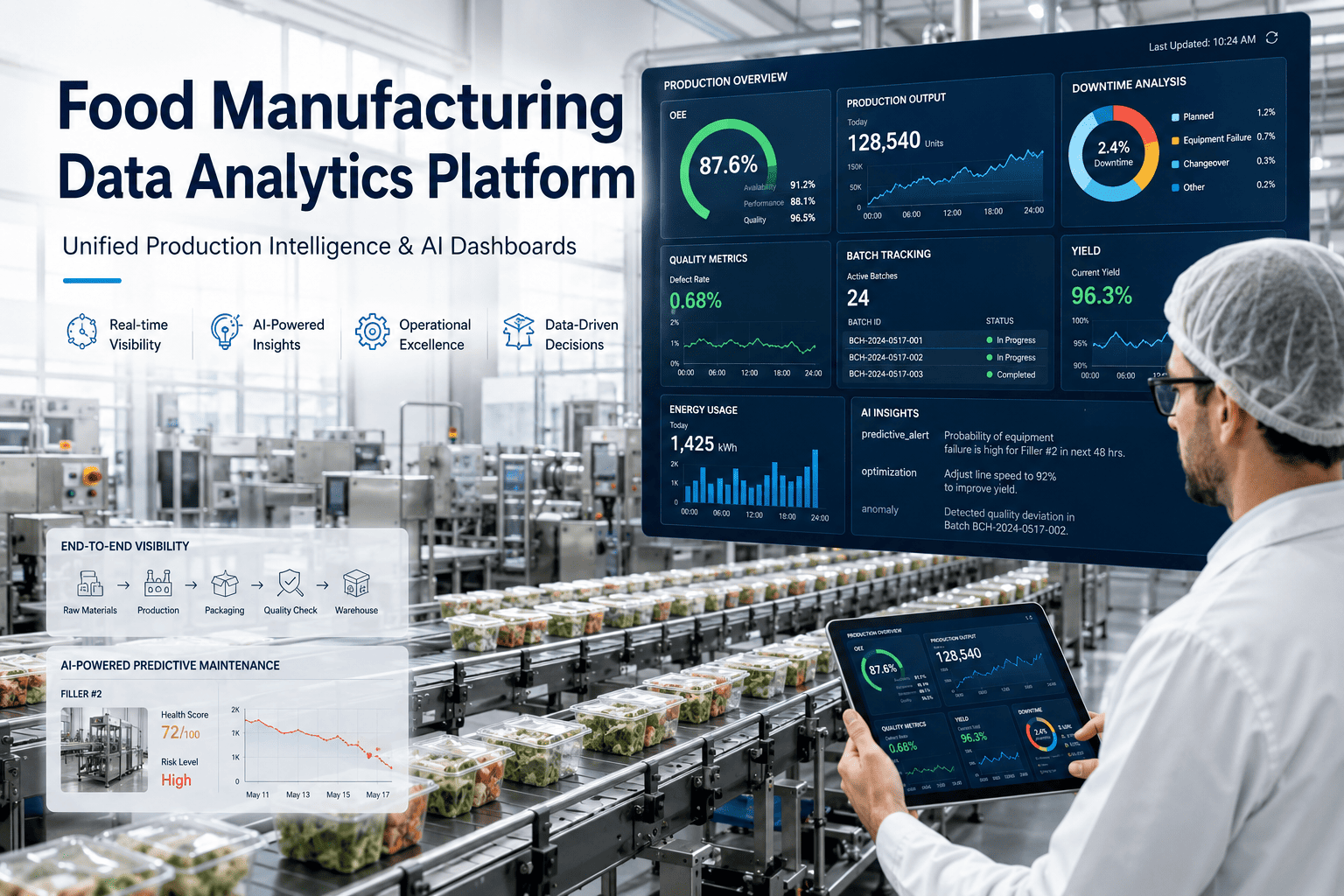
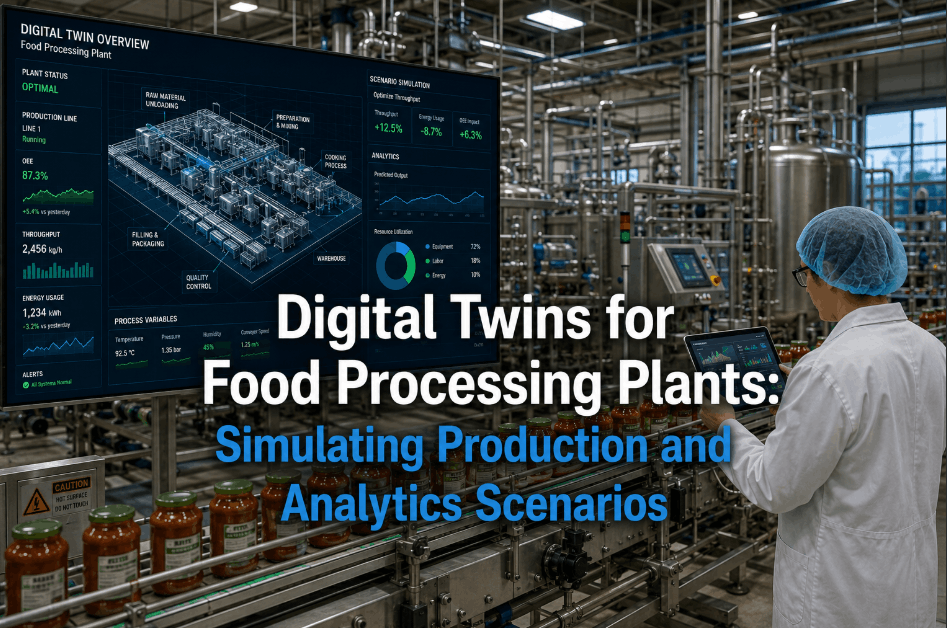
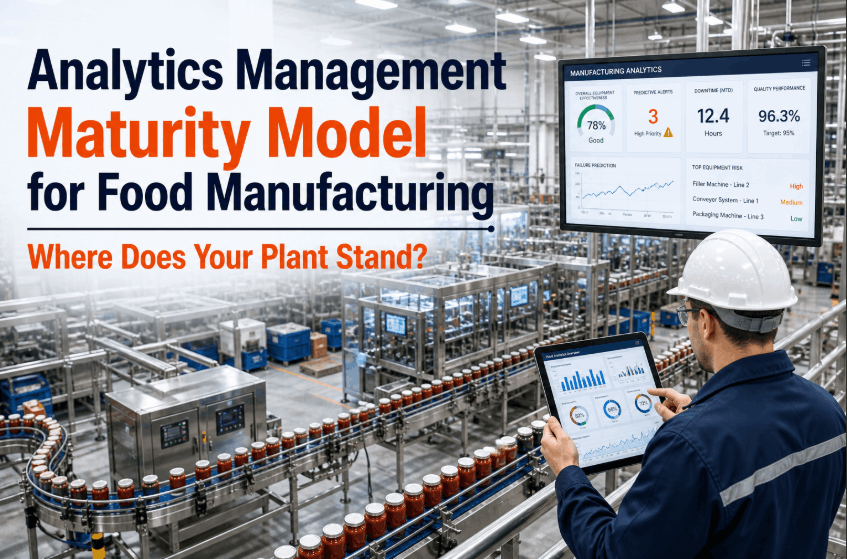
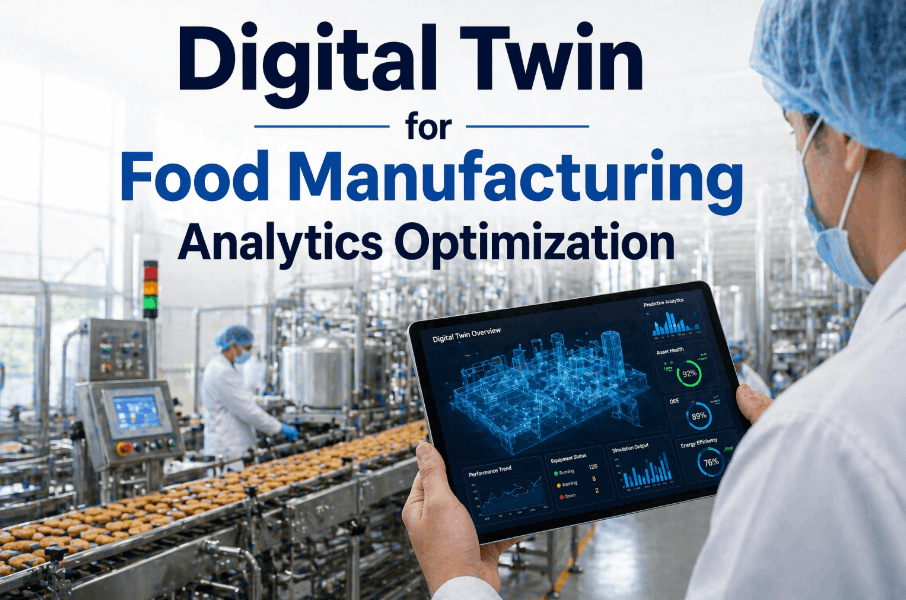
Digital twin software has become one of the most aggressively marketed solutions in food manufacturing — yet up to 75% of digital twin projects fail to deliver measurable ROI. The reason is rarely the simulation engine or 3D visualization. It is the missing analytics intelligence layer that turns a virtual replica into operational decision-making capability. Most food plants invest in industrial IoT platforms expecting transformation, only to discover that without unified data integration, manufacturing intelligence software, and predictive maintenance analytics built into the twin architecture, the result is an expensive visualization tool rather than a working smart factory. Book a demo to see how iFactory closes the analytics gap that breaks most twins.
DIGITAL TWIN ANALYTICS
MANUFACTURING INTELLIGENCE
FOOD & BEVERAGE
Stop Building Digital Twins That Look Smart but Cannot Make Decisions
iFactory delivers the analytics intelligence layer most digital twins are missing — unifying production, quality, and equipment data into a decision-ready manufacturing intelligence platform purpose-built for food and beverage operations.
The Digital Twin Crisis in Food Manufacturing — Why Most Implementations Fail
The global digital twin market is projected to grow from $33.97 billion in 2026 to $384.79 billion by 2034, yet food and beverage adoption sits between 30 and 50% with a disproportionately high failure rate. The pattern is consistent: significant investment in industrial IoT platforms, asset performance management software, and 3D simulation engines, followed by a gradual realization that the twin produces dashboards rather than decisions. A digital twin without an analytics intelligence layer is a synchronized model — not a manufacturing intelligence system. It can show what is happening on the production line in real time, but it cannot tell you why outcomes are deviating, predict where the next failure will occur, or recommend the corrective action that protects yield.
75%
of digital twin initiatives miss ROI expectations due to weak data infrastructure
65%
of factories have limited maturity, making twin investment premature without analytics
92%
of analytics-enabled twins report positive ROI within 12 to 36 months
3-5x
performance gap between analytics-driven and visualization-only twins
Failure Mode Analysis
Six Critical Reasons Food Manufacturing Digital Twins Fail Without Analytics Intelligence
The reasons digital twin software fails in food manufacturing are predictable, recurring, and almost entirely traceable to the absence of a properly architected analytics intelligence layer. Food plants evaluating digital twin investments can book a demo to see how each failure mode is addressed by analytics-first twin architecture.
Failure 01
Fragmented Industrial Data Sources
The twin pulls real-time sensor data but cannot reconcile it with quality lab results, supplier batch records, or maintenance history. The result is a synchronized model with massive blind spots.
Impact: Twin outputs contradict floor-level reality
Failure 02
Visualization Mistaken for Intelligence
3D rendering becomes the deliverable, with analytics treated as a secondary enhancement. Plant managers receive an impressive replica that requires expert interpretation to extract decisions from.
Impact: Low adoption, dashboard fatigue, no behavior change
Failure 03
Pipeline Latency and Sync Drift
Real-time data ingestion is undersized for production volumes. The twin lags reality by minutes or hours — making predictive maintenance alerts arrive after the failure has already occurred.
Impact: Twin trusted by nobody on the production floor
Failure 04
Unclear Decision Use Cases
The twin is built without specifying which decisions it should improve, which KPIs it should move, or which workflows it should integrate into. Technical implementation succeeds while business outcome fails.
Impact: Stalled pilots, no scale-up justification
Failure 05
Poor Data Quality Erodes Trust
The analytics layer is fed by data with inconsistent timestamps and missing values. Predictive models produce sophisticated-looking wrong answers — and operator trust is nearly impossible to recover.
Impact: $12.9M average annual loss from poor data quality
Failure 06
Scaling Beyond the Pilot Line
A single-line proof-of-concept is treated as plant-wide validation. When scaled across multiple lines, integration complexity multiplies — and the twin gets quietly retired to the original pilot scope.
Impact: Twin remains stuck on 8-12% of plant operations
Architecture Reality
The Digital Twin Architecture Stack — Where Each Layer Typically Breaks Down
A genuinely intelligent digital twin in food manufacturing is not a single piece of software — it is a layered architecture where each layer must function correctly for the twin to deliver decision-grade outputs. The majority of failed implementations have one or more layers either missing entirely or implemented as an afterthought. You can book a demo to see this stack instrumented against your specific production environment.
Decision Activation Layer
Push-based intelligence delivery — gets recommendations to the right operator inside the workflow they already use.
Common Failure: Twin outputs require login + navigation, so they never reach floor decisions.
Analytics Intelligence Layer
Predictive models, root cause analysis, condition monitoring, and process optimization embedded directly inside the twin.
Common Failure: Twin shows real-time state but cannot predict, prescribe, or correlate.
Model Synchronization Layer
The virtual representation that mirrors the physical asset or process, with enforced state consistency between digital and physical.
Common Failure: Sync drift of minutes-to-hours makes the twin lag production reality.
Unified Data Foundation Layer
Industrial data integration across PLCs, sensors, MES, ERP, LIMS, and CMMS — normalized to a single source of truth.
Common Failure: Fragmented sources and inconsistent timestamps — every layer above inherits the noise.
Comparison Analysis
Digital Twins With Analytics Intelligence vs. Twins Without — The Performance Reality
The performance differential between food manufacturing digital twins built with an integrated analytics intelligence layer and those built as visualization-first replicas is not subtle. It is the difference between a project that delivers measurable improvement in OEE, quality, and yield within the first production quarter and a project that becomes a stranded asset on the IT roadmap.
Digital Twin Performance Benchmark — Analytics-Driven vs Visualization-Only
Scroll to view full comparison →
Industry Reality Check
A large North American dairy processor invested $3.1 million deploying a digital twin platform across three production lines — high-fidelity 3D models, real-time synchronization, and a polished operations command center. Eighteen months in, an audit found the twin was being used to confirm production status by management but was not influencing a single shift-level decision. The twin had no analytics intelligence layer. After deploying iFactory's manufacturing intelligence software on top of the existing twin infrastructure — without replacing the visualization platform — the same operation reduced unplanned downtime by 58%, recovered 3.4 percentage points of yield within the first production quarter, and moved from 22% to 89% daily floor-team adoption.
Book a demo to see how iFactory adds the analytics layer to existing twin investments.
Strategic Framework
Five Pillars of Analytics-Driven Digital Twin Success in Food Manufacturing
Building a digital twin that genuinely transforms food manufacturing operations requires a structured approach that addresses data foundation, model integrity, analytics intelligence, decision integration, and organizational adoption simultaneously. These are the five pillars that distinguish twin deployments that deliver measurable ROI from those that become stranded technology investments.
01
Foundation-First Data Architecture
Before any modeling work begins, every critical operational data source — production sensors, quality LIMS, ERP, CMMS, supplier records, environmental monitoring — must be integrated into a unified industrial data platform with enforced quality validation.
Outcome: Reliable single source of truth for cross-functional analytics
02
Decision-Driven Use Case Definition
Every analytics capability built into the twin must trace directly to a defined operational decision and a measurable KPI — preventing the most common failure mode of building technical capability without specifying business outcome.
Outcome: Twin investment defended by quantified operational impact
03
Embedded Analytics Intelligence Layer
Predictive analytics, condition monitoring, asset performance management, and process optimization must be embedded inside the twin architecture — not bolted on as separate platforms requiring separate access.
Outcome: Twin shifts from descriptive replication to prescriptive intelligence
04
Workflow-Native Decision Delivery
Analytics outputs must be pushed into the operational tools floor teams already use — making the twin invisible to the user while making its intelligence inseparable from daily operations.
Outcome: 78–92% active daily floor-team usage versus typical 15–25%
05
Continuous Learning and Model Governance
Mature platforms include automated model performance monitoring, drift-triggered retraining, and version governance — ensuring the twin maintains accuracy as production operations evolve over time.
Outcome: Twin maintains accuracy and trust across operational evolution
AI ANALYTICS
PREDICTIVE MAINTENANCE
ENTERPRISE INTELLIGENCE
Ready to Deploy AI-Integrated Analytics Across Your Food Manufacturing Enterprise?
iFactory's industrial analytics platform delivers real-time asset performance management, predictive maintenance intelligence, and cross-facility operational visibility — purpose-built for food manufacturers pursuing digital transformation.
Implementation Roadmap
Adding Analytics Intelligence to Existing Digital Twin Investments — A 90-Day Deployment Framework
Food manufacturers with existing digital twin investments do not need to start over. The analytics intelligence layer can be deployed on top of current twin infrastructure, transforming a visualization-first implementation into a decision-grade manufacturing intelligence platform within a defined 90-day cycle.
Phase 01Days 1 – 20
Twin Audit & Data Foundation
Comprehensive audit of the existing twin architecture, data sources, and current decision coverage. Deployment of the unified data foundation connecting all critical operational systems with validated quality controls.
Deliverable: Validated unified data foundation
Phase 02Days 21 – 50
Analytics Intelligence Activation
Activation of the embedded analytics layer — predictive maintenance models, quality early warning, yield optimization, and condition monitoring algorithms tuned to food manufacturing process signatures.
Deliverable: Embedded predictive intelligence
Phase 03Days 51 – 75
Workflow-Native Decision Delivery
Push-based decision delivery configured for shift supervisors, line operators, quality teams, and maintenance technicians — integrated into existing operational workflows rather than separate platforms.
Deliverable: Floor-team adoption infrastructure
Phase 04Days 76 – 90
ROI Validation & Continuous Learning
Performance benchmarking against pre-deployment baseline produces quantified ROI documentation. Continuous model governance — drift detection, retraining workflows, version control — is activated.
Deliverable: Documented ROI + governance infrastructure
Frequently Asked Questions — Digital Twin Software, Analytics Intelligence, and Food Manufacturing
Why do most digital twin projects in food manufacturing fail to deliver ROI?
Up to 75% of digital twin initiatives miss ROI expectations because they prioritize visualization over the analytics intelligence layer. Without unified data integration and predictive analytics, the twin reflects production reality but cannot improve it.
What is the difference between a digital twin and manufacturing intelligence software?
A digital twin is a synchronized virtual model. Manufacturing intelligence software is the analytics and decision-support capability that turns the twin's data into operational action. Most failed projects build one without the other.
Can analytics intelligence be added to an existing digital twin without replacing it?
Yes. Modern manufacturing intelligence platforms integrate with existing twin infrastructure through standard APIs. The analytics layer can be deployed on top of current twin software within 90 days — preserving the visualization investment.
How long does it take to see measurable ROI from analytics-driven digital twin deployment?
Food manufacturing operations typically realize first-line ROI within 6 to 12 months, with documented OEE improvements of 18–24 percentage points, downtime reductions of 55–68%, and yield recovery of 3–6%.
What data sources must be integrated for an analytics-driven food manufacturing digital twin?
The unified foundation must include production sensor data, quality LIMS results, ERP transactions, CMMS history, supplier batch records, environmental monitoring, and packaging line telemetry — without these, the analytics layer operates with critical blind spots.
How does iFactory's analytics intelligence layer differ from generic digital twin software?
iFactory is purpose-built for food manufacturing — analytics models, decision workflows, and integration patterns are pre-configured for food and beverage operational realities, delivering measurable ROI in the first production quarter rather than year three.
90-DAY DEPLOYMENT
DOCUMENTED ROI
FOOD MANUFACTURING
Add the Analytics Intelligence Layer Your Digital Twin Is Missing
iFactory's manufacturing intelligence software integrates with your existing digital twin investment — adding the unified data foundation, predictive analytics, and decision delivery infrastructure that transforms a visualization tool into operational competitive advantage.