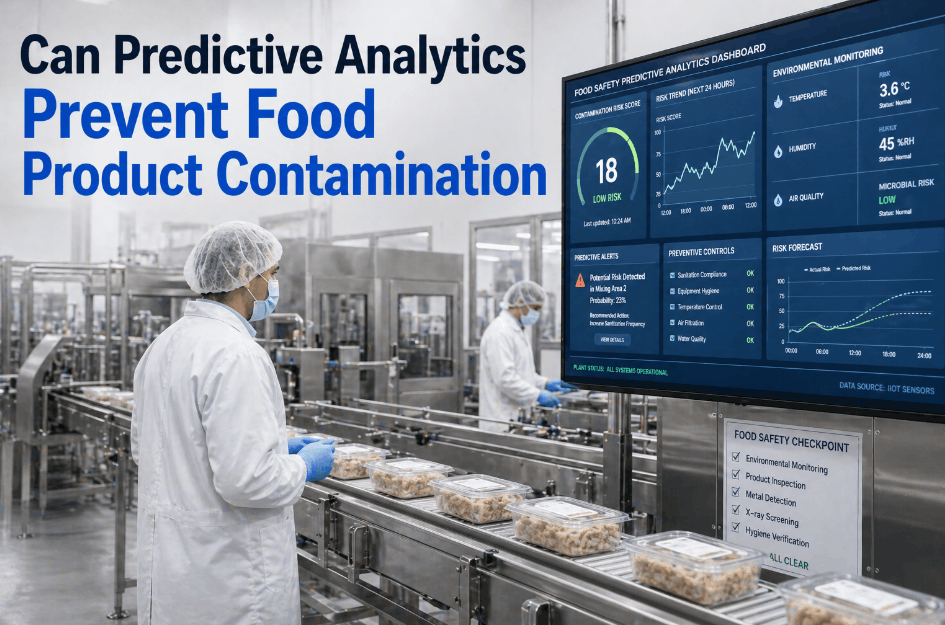
Food product contamination remains one of the most costly and brand-damaging risks in modern food manufacturing. Each year, contamination-related recalls cost the industry an estimated $10 billion in direct losses—and that figure does not account for the long-term erosion of consumer trust. Predictive analytics for food safety is fundamentally changing the equation. By continuously analyzing sensor data, environmental conditions, supplier inputs, and process variables, AI-powered food safety platforms can detect contamination risk patterns hours or even days before a deviation becomes a recall event. For food manufacturers operating under FSMA, HACCP, and GFSI mandates, this shift from reactive recall management to intelligent prevention is not just a competitive edge—it is rapidly becoming the regulatory expectation.
Stop Contamination Before It Reaches Your Line
iFactory's AI-driven food safety monitoring platform delivers real-time hazard detection, predictive contamination alerts, and automated HACCP compliance—purpose-built for food and beverage manufacturers.
Why Traditional Food Safety Monitoring Fails to Prevent Contamination
Conventional food safety programs rely on scheduled inspections, end-of-line sampling, and manual HACCP log entries. These approaches share a structural flaw: they are inherently backward-looking. By the time a contamination event registers in a traditional monitoring system, product may already be packaged, distributed, or consumed. Manufacturers who book a demo with iFactory typically discover that their existing data infrastructure already contains the precursor signals of past contamination events—signals that went unanalyzed because no predictive layer was in place to surface them.
Reactive Detection Lag
Traditional microbiological testing requires 24–72 hours for results. By the time a positive pathogen test returns, thousands of units may already be at risk. Predictive models identify contamination conditions before cultures are even plated.
Incomplete CCP Visibility
Manual HACCP monitoring covers only a fraction of critical control points in a high-throughput line. AI-driven platforms monitor every instrumented CCP continuously, correlating multi-variable deviations no manual checklist can capture.
Siloed Data Systems
When environmental monitoring data, supplier COAs, and sanitation logs exist in separate systems, the cross-variable patterns that predict contamination risk are invisible. Predictive platforms unify all streams into a single risk intelligence layer.
Audit-Driven Compliance
Compliance programs built around periodic audits create a false sense of security between certification cycles. Continuous digital monitoring ensures the state that passed the audit is maintained every hour of every production day.
How AI-Powered Food Safety Monitoring Detects Contamination Risk in Real Time
Predictive food safety platforms ingest continuous streams of environmental, process, and supply chain data through machine learning models trained on thousands of historical contamination scenarios. When a risk pattern matching a historical contamination precursor forms, the platform generates an alert and recommended corrective action before any product is compromised. Manufacturers who schedule a demo frequently describe seeing their facility's risk profile mapped in real time as a defining moment in their food safety strategy.
Environmental Monitoring Intelligence: From Sampling to Continuous Surveillance
Predictive analytics fuses ATP sensor data, airflow modeling, temperature and humidity mapping, and traffic pattern analysis into a continuous environmental risk score for every production zone. When a score trends upward—even before any positive result returns—the platform triggers enhanced monitoring protocols and sanitation interventions automatically.
Supplier Ingredient Risk Scoring: Contamination Prevention Starts at Receiving
Predictive platforms assign dynamic risk scores to supplier lots based on COA data, historical deviation frequency, transport condition logs, and seasonal pathogen prevalence. High-risk lots trigger enhanced incoming inspection protocols automatically—intercepting contamination vectors at receiving rather than through finished product testing.
Predictive HACCP Software: Transforming Compliance From Documentation to Prevention
Modern AI-powered HACCP software converts every CCP measurement into a dynamic risk signal, correlating deviations across multiple control points and issuing corrective action guidance before a HACCP limit is breached—not after. Food manufacturers can request a demo and receive a plant-specific risk modeling session rather than a generic product tour.
Preventive Controls Monitoring Under FSMA: What Digital Platforms Deliver
FSMA's Preventive Controls rule requires documented monitoring of process controls, allergen controls, sanitation controls, and supply chain controls. Predictive platforms deliver continuous, automated monitoring across all four categories—generating verified electronic records while simultaneously predicting and preventing the control failures that generate compliance findings.
| Food Safety Challenge | Traditional Approach | Predictive Analytics Approach | Risk Reduction Impact |
|---|---|---|---|
| Pathogen Detection | 24–72 hr microbiological testing | Real-time environmental risk scoring | Detection 18–36 hrs earlier |
| Temperature Excursions | Manual log review at shift end | Continuous deviation alerting with trend forecasting | Excursion events reduced by 61% |
| Allergen Cross-Contact | Visual inspection and swabbing | AI-driven changeover validation and residue risk scoring | Allergen incidents reduced by 78% |
| Supplier Ingredient Risk | Periodic supplier audits and COA review | Dynamic lot-level risk scoring at receiving | Incoming risk flagging accuracy: 94% |
| Sanitation Verification | Post-CIP swab testing, 24–48 hr results | Real-time ATP trend monitoring with predictive alerts | Sanitation failures detected 8× faster |
| FSMA Compliance Documentation | Manual record compilation, 3–5 day audit prep | Automated continuous compliance log, inspector-ready export | Audit prep time cut by 72% |
Predictive Analytics in Action: Food Contamination Prevention Across Production Categories
Predictive food safety analytics applies differently across production categories. Below are the primary risk profiles where AI-driven platforms deliver measurable contamination prevention outcomes.
Listeria Prevention Through Environmental Intelligence
RTE facilities face the most acute contamination risk, with Listeria monocytogenes as the dominant pathogen threat. Predictive platforms model harborage conditions—moisture zones, temperature gradients, traffic pathways—and trigger environmental interventions before harborage occurs, not after a positive swab.
Pathogen Risk Modeling at Scale
Fresh produce facilities contend with seasonal pathogen variability and complex wash water chemistry. AI platforms integrate regional surveillance data, wash water pH trends, and chiller profiles into a unified contamination risk model that updates continuously with every harvest region and growing season change.
Allergen & Pathogen Control in High-Complexity Lines
Protein facilities managing multiple species and allergen formulations face simultaneous risk from pathogens and cross-contact. Predictive platforms model both risk types together—issuing integrated corrective action guidance without requiring separate monitoring systems for each compliance dimension.
Deploying a Predictive Food Safety Platform: A Three-Phase Implementation Roadmap
Successful deployment requires a structured approach that builds data quality before activating predictive models. Skipping foundational steps typically causes excessive false positives that erode operator trust and undermine the contamination prevention mission the platform was deployed to accomplish.
Sensor Infrastructure & Data Integration Foundation
Deploy environmental monitoring sensors, instrument all critical control points, integrate supplier data feeds and LIMS systems, and establish a validated data historian. Pre-deployment gap analysis—mapping current sensor coverage against contamination risk zones—prevents costly remediation in later phases.
Predictive Model Calibration & Risk Intelligence Activation
Commission contamination risk models using historical environmental data and facility-specific pathogen profiles. Calibrate alert thresholds to minimize false positives, then activate HACCP monitoring, allergen risk scoring, and supplier lot intelligence modules. This is where measurable contamination prevention begins.
Continuous Intelligence Expansion & Compliance Automation
Integrate predictive outputs with ERP, MES, and quality management systems. Activate automated FSMA compliance reporting, inspector-ready audit documentation, and continuous traceability logging. The model improves continuously as it accumulates facility-specific contamination pattern data.
The Financial Case for Predictive Food Safety Analytics: ROI Beyond Recall Avoidance
Direct Recall Cost Avoidance
A single Class I food recall averages $10 million in direct costs. Predictive platforms that prevent even one recall per three-year period deliver ROI that exceeds platform cost by an order of magnitude—with payback periods under 12 months under conservative assumptions. Manufacturers building this business case find that booking a demo delivers a plant-specific expected value model in under an hour.
Operational Quality Cost Reduction
Predictive platforms reduce hold-and-test costs, lower microbiological testing frequency, cut rework events from temperature excursions, and eliminate significant compliance labor. Food manufacturers spending $80k–$200k annually on manual monitoring workflows find this cost base substantially reducible through platform deployment.
Brand Equity Protection
Consumer trust, once broken by a contamination event, recovers slowly—and for some brands, incompletely. Facilities demonstrating continuous AI-driven contamination surveillance differentiate their quality story in a market where food safety credibility is a genuine competitive advantage with retail buyers and foodservice customers.
Predictive Food Safety Analytics — KPI Impact Across Food Manufacturing Facilities
The benchmarks below reflect average improvements achieved within 12 months of full platform deployment, based on iFactory customer data spanning beverage, dairy, protein, RTE, and produce processing environments.
Predictive Analytics for Food Safety — Frequently Asked Questions
How does predictive analytics differ from standard food safety monitoring software?
Standard food safety software records and displays compliance data. Predictive analytics adds a machine learning layer that correlates multi-variable patterns against historical contamination events to generate forward-looking risk scores—so you know what contamination risk your current plant state is about to create, not just what already happened.
What data sources does a predictive food safety platform require?
Platforms integrate environmental sensor data (temperature, humidity, ATP), LIMS results, PLC/SCADA streams, supplier COA data, and sanitation logs. Most deployments achieve meaningful accuracy with 60–75% of data sources connected at launch. Book a demo for a live data readiness assessment specific to your facility.
Can predictive analytics prevent allergen contamination as well as pathogen contamination?
Yes. Leading platforms apply AI risk scoring to allergen cross-contact through changeover validation intelligence and residue risk modeling. Allergen and pathogen risk models operate within the same integrated platform—eliminating separate monitoring systems across both compliance dimensions.
How does predictive food safety software support FSMA compliance?
Predictive platforms deliver continuous automated monitoring across all four FSMA Preventive Controls categories, generate electronic records inspectors verify, and produce inspector-ready compliance exports—reducing audit preparation from days to under 18 hours with a verified, time-stamped evidence trail at every production stage.
What is the typical ROI payback period for a predictive food safety platform?
Most food manufacturers achieve full payback within 8–14 months, driven by recall risk reduction and operational quality cost savings. Avoiding a single recall event typically returns 10–20× the total platform cost over a three-year investment horizon.
How long does implementation take?
Full deployment typically requires 10–20 weeks for a mid-size facility. Plants with existing IoT infrastructure can achieve initial predictive risk intelligence within 4–6 weeks. iFactory's pre-deployment facility risk assessment significantly reduces integration complexity and accelerates time-to-value.
Deploy the Food Safety Platform That Prevents Contamination Before It Happens
iFactory's predictive food safety analytics platform delivers continuous contamination risk intelligence, automated HACCP compliance, and AI-driven environmental monitoring—purpose-built for food and beverage manufacturers who cannot afford a recall.