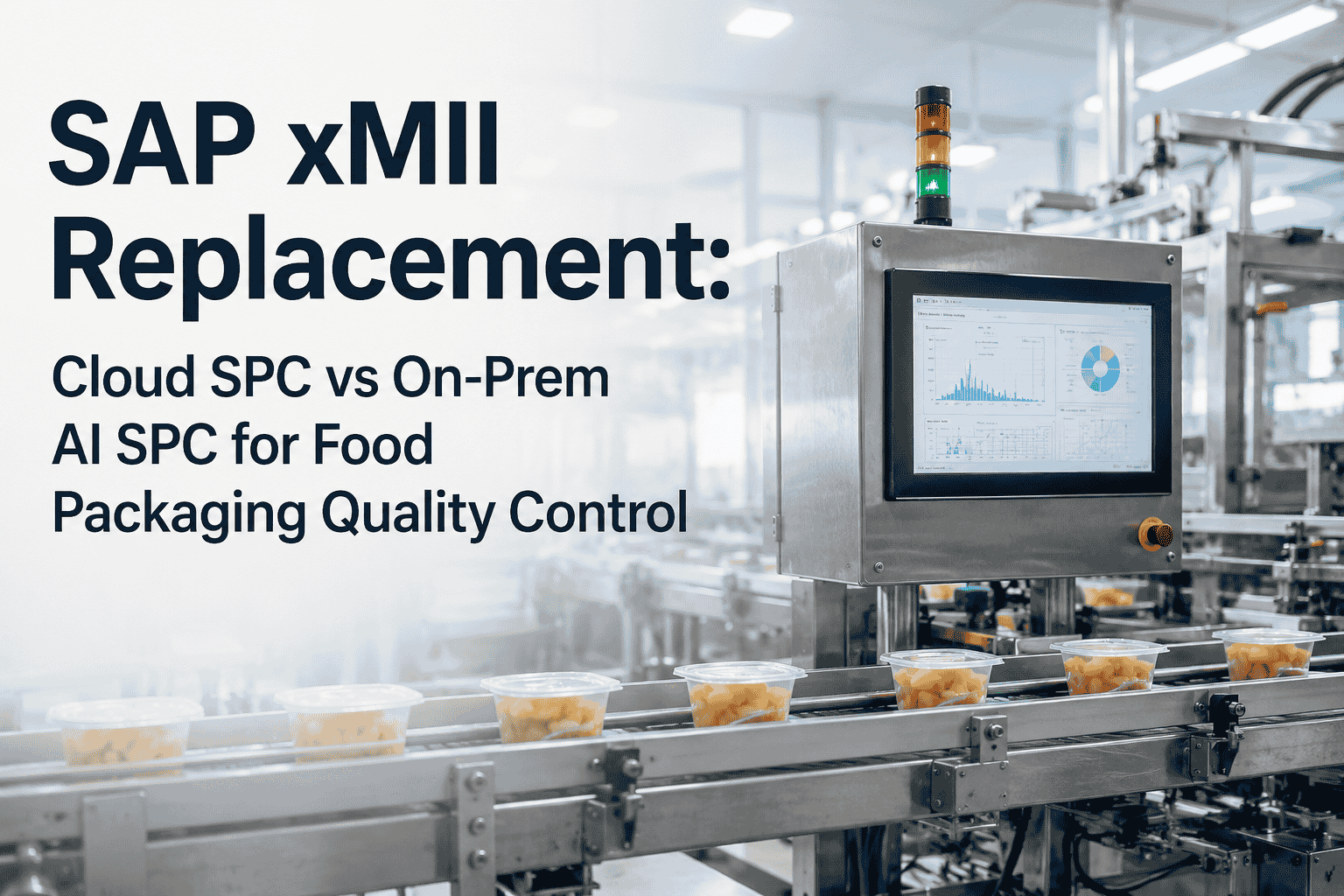
Where your SPC platform runs isn't just an IT decision—it determines latency, data sovereignty, compliance posture, and whether your quality intelligence survives an internet outage. For food manufacturers managing allergen tracking, recipe IP, and FDA/GFSI compliance records, the cloud-vs-on-prem question carries regulatory weight that other industries don't face. Cloud SPC offers faster deployment and lower upfront cost. On-prem AI SPC delivers sub-millisecond latency, guaranteed data sovereignty, and the ability to run quality intelligence even when the network goes down. This guide compares both deployment models across the dimensions that actually matter for food manufacturing quality operations. Book a demo to see which deployment model fits your plant's compliance, latency, and capability requirements.
SPC Deployment Guide
Cloud SPC vs On-Prem AI SPC
Two deployment models — one has critical advantages for food manufacturing
Cloud SPC
Lower upfront cost
Fast initial deployment
Vendor-managed updates
Latency depends on internet
Data leaves your facility
Fails during outages
On-Prem AI SPC
Sub-ms latency at the edge
100% data sovereignty
Runs during network outages
Higher initial investment
On-site hardware management
Updates require coordination
Head-to-Head: Every Dimension That Matters
The cloud-vs-on-prem comparison for SPC isn't the same as for general enterprise software. Quality control in food manufacturing has unique latency, sovereignty, and compliance requirements that shift the calculus significantly toward on-prem or hybrid architectures. Here's how they compare across the eight dimensions food quality teams care about most.
Dimension
Cloud SPC
On-Prem AI SPC
Edge
Latency
50–200 ms round-trip to cloud
Sub-1 ms — data never leaves plant
On-Prem
Data Sovereignty
Data stored on vendor servers
100% on-site — you control everything
On-Prem
Network Dependency
Fails or degrades during outages
Fully operational — zero internet dependency
On-Prem
FSMA / GFSI Compliance
Vendor SLA ≠ compliance proof
Full audit trail under your control
On-Prem
Upfront Cost
Lower — subscription model
Higher — hardware + deployment
Cloud
5-Year TCO
Subscriptions compound over time
Lower long-term — no recurring cloud fees
On-Prem
AI Model Training
Trained on shared cloud infrastructure
Trained on your data, stays on your servers
On-Prem
Deployment Speed
Days to weeks for initial setup
Weeks to months for full deployment
Cloud
Need help choosing the right deployment model? Book a deployment assessment demo — we'll evaluate your latency, sovereignty, and compliance requirements in 30 minutes.
See On-Prem AI SPC Running at Your Plant's Edge
In a 30-minute workshop, we'll compare deployment models for your specific facility, show latency differences on your process data, and map the architecture that fits your compliance requirements.
Why Data Sovereignty Matters More for Food Manufacturing
Food manufacturers carry data obligations that most industries don't face. Recipe IP, allergen tracking records, batch traceability, and food safety compliance documentation all have regulatory and commercial sensitivity that makes the cloud sovereignty question uniquely high-stakes.
Formulations Are Trade Secrets
Your recipes, process parameters, and ingredient ratios are competitive IP worth millions. Sending this data to a cloud vendor's servers—where it's subject to the vendor's security practices, subprocessor agreements, and potentially foreign jurisdiction laws—creates IP exposure that an on-prem deployment eliminates entirely.
Compliance Records Must Be Controllable
FDA's FSMA preventive controls and GFSI frameworks require demonstrable control over quality records—not just access, but control over storage, retention, and audit trail integrity. A vendor's SOC 2 certification proves their infrastructure is secure. It does not prove that you are in control. On-prem gives auditors what they actually want: records under your direct governance.
Allergen Data Carries Liability
Allergen tracking, cross-contamination logs, and segregation records carry direct consumer safety liability. If cloud data becomes temporarily inaccessible during an allergen recall investigation, the consequences are measured in public health risk and regulatory penalties—not just operational inconvenience.
The Hybrid Architecture: Best of Both Worlds
The most sophisticated food manufacturers don't choose cloud or on-prem—they use both. On-prem AI handles real-time SPC, process control, and data sovereignty. Cloud handles analytics aggregation across multiple facilities, long-term trending, and non-latency-sensitive reporting. The architecture puts each workload where it performs best.
On-Prem (Plant Edge)
Real-time SPC and adaptive control
AI model inference (sub-ms latency)
Compliance records and audit trails
Recipe IP and allergen data
Runs independently — zero internet dependency
Cloud (Enterprise)
Multi-plant OEE dashboards
Long-term Cpk trending across facilities
AI model retraining on aggregated data
Executive reporting and benchmarking
Enhances — but never required for plant-level quality operations
Want a hybrid architecture designed for your multi-plant operation? Schedule a deployment architecture demo with our team.
Expert Perspective
"For food and beverage specifically, the on-premise data sovereignty requirement is the strongest argument for the AI intelligence layer being a separate, plant-resident system rather than a feature of the cloud MES. Food safety records, allergen tracking, and recipe IP have data residency requirements that get cleaner with on-prem AI than with cloud-hosted SPC modules."
— F&B Manufacturing Architecture Best Practice, 2026
<1 ms
on-prem latency vs. 50–200 ms cloud round-trip
100%
data sovereignty with plant-resident AI
Zero
internet dependency for quality-critical operations
Ready to deploy AI SPC at your plant's edge? Request a demo to see on-prem predictive quality running on your process parameters.
Conclusion: Put Quality Intelligence Where It Performs Best
Cloud SPC works when latency doesn't matter, data sovereignty isn't a concern, and internet connectivity is guaranteed. In food manufacturing, none of those conditions reliably hold. Your SPC platform needs sub-millisecond response for real-time process control, your compliance records need to be under your direct governance, and your quality system needs to keep running when the network doesn't. On-prem AI SPC delivers all three—while a hybrid architecture adds cloud-level analytics for multi-plant visibility without compromising plant-level sovereignty. The deployment model you choose today determines your compliance posture, your Cpk capability, and your operational resilience for the next decade.
Deploy AI SPC Where It Performs Best
In a 30-minute workshop, we'll compare cloud, on-prem, and hybrid architectures for your specific compliance, latency, and multi-plant requirements.
Frequently Asked Questions
What is the latency difference between cloud and on-prem SPC?
Cloud SPC requires data to travel from plant sensors to cloud servers and back—a round-trip that adds 50–200 ms of latency depending on internet quality and geographic distance. On-prem AI SPC processes data at the plant edge with sub-1 ms latency because data never leaves the facility. For real-time process control where drift detection needs to happen within seconds, that 50–200 ms gap multiplied across thousands of data points per minute creates meaningful detection lag.
Book a demo to see the latency difference on your process data.
Does cloud SPC satisfy FDA and GFSI compliance requirements?
A vendor's SOC 2 or ISO 27001 certification proves their infrastructure is secure—but it doesn't prove that you are in control of your compliance records. FSMA preventive controls and GFSI frameworks require demonstrable governance over quality data: storage location, retention policies, access controls, and audit trail integrity. On-prem deployment gives auditors what they actually look for—records under your direct governance with complete chain of custody.
What happens to cloud SPC during an internet outage?
Most cloud SPC platforms degrade or fail entirely during internet outages—real-time control charts stop updating, alerts don't fire, and quality decisions revert to manual processes. Some offer limited edge caching, but the AI inference, adaptive limits, and root-cause correlation remain cloud-dependent. On-prem AI SPC is fully operational with zero internet dependency—every AI capability runs locally at the plant edge, unaffected by network status.
Is on-prem SPC more expensive than cloud SPC?
On-prem has higher upfront cost (hardware, deployment, configuration) but lower 5-year total cost of ownership because there are no recurring cloud subscription fees that compound annually. Cloud SPC starts cheaper but subscription costs accumulate—and typically include per-user, per-device, and per-data-volume charges that grow as your operation scales. For a mid-size food plant running 4–8 lines over 5 years, on-prem typically achieves lower TCO while delivering better latency, sovereignty, and resilience.
Can I use a hybrid cloud + on-prem SPC architecture?
Yes—and this is the approach most sophisticated food manufacturers are adopting. On-prem AI handles real-time SPC, adaptive control, and compliance-sensitive data at each plant. Cloud aggregates data across multiple facilities for enterprise-level OEE dashboards, long-term Cpk trending, AI model retraining, and executive reporting. The key design principle: cloud enhances but is never required for plant-level quality operations. If the internet goes down, every plant runs independently.