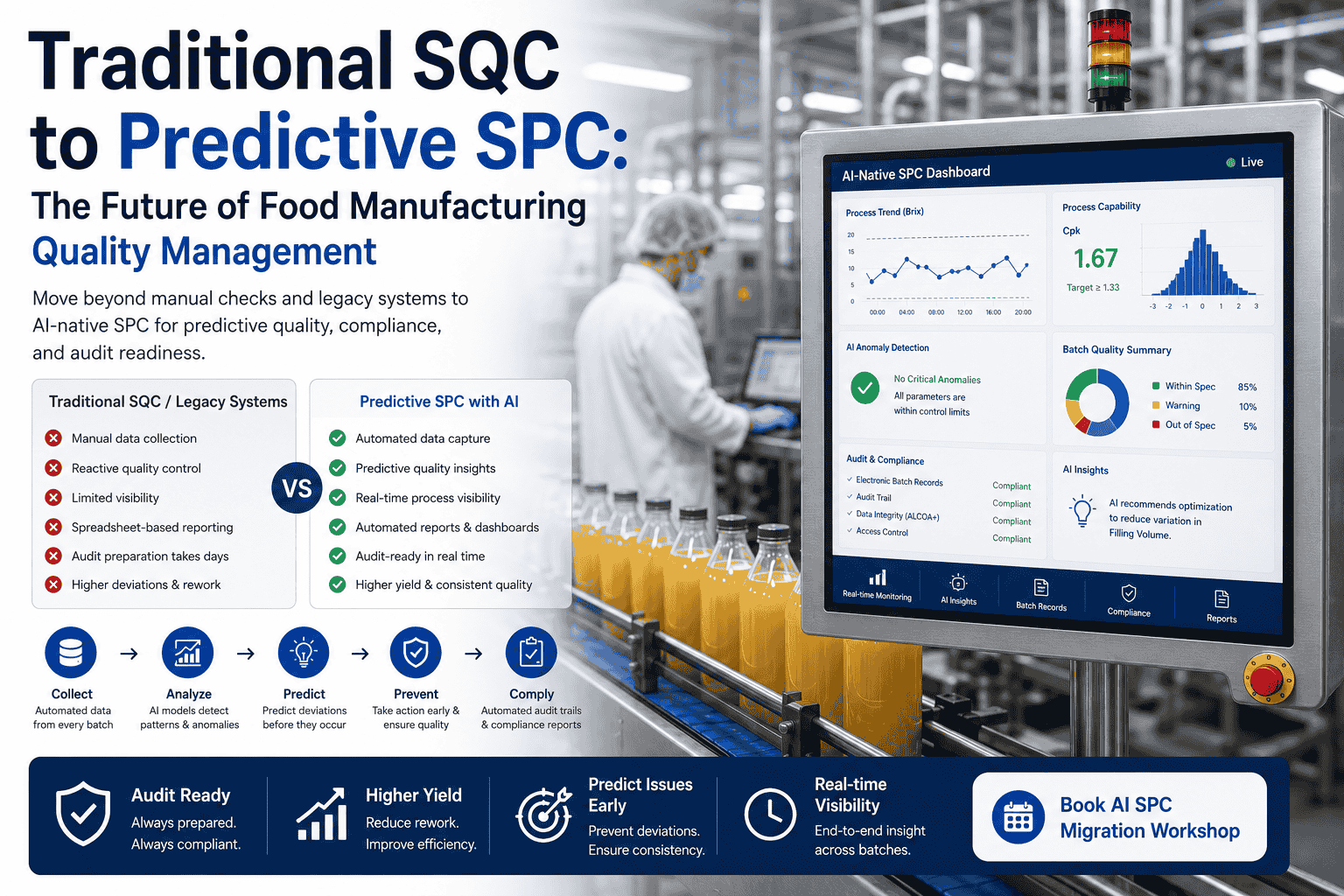
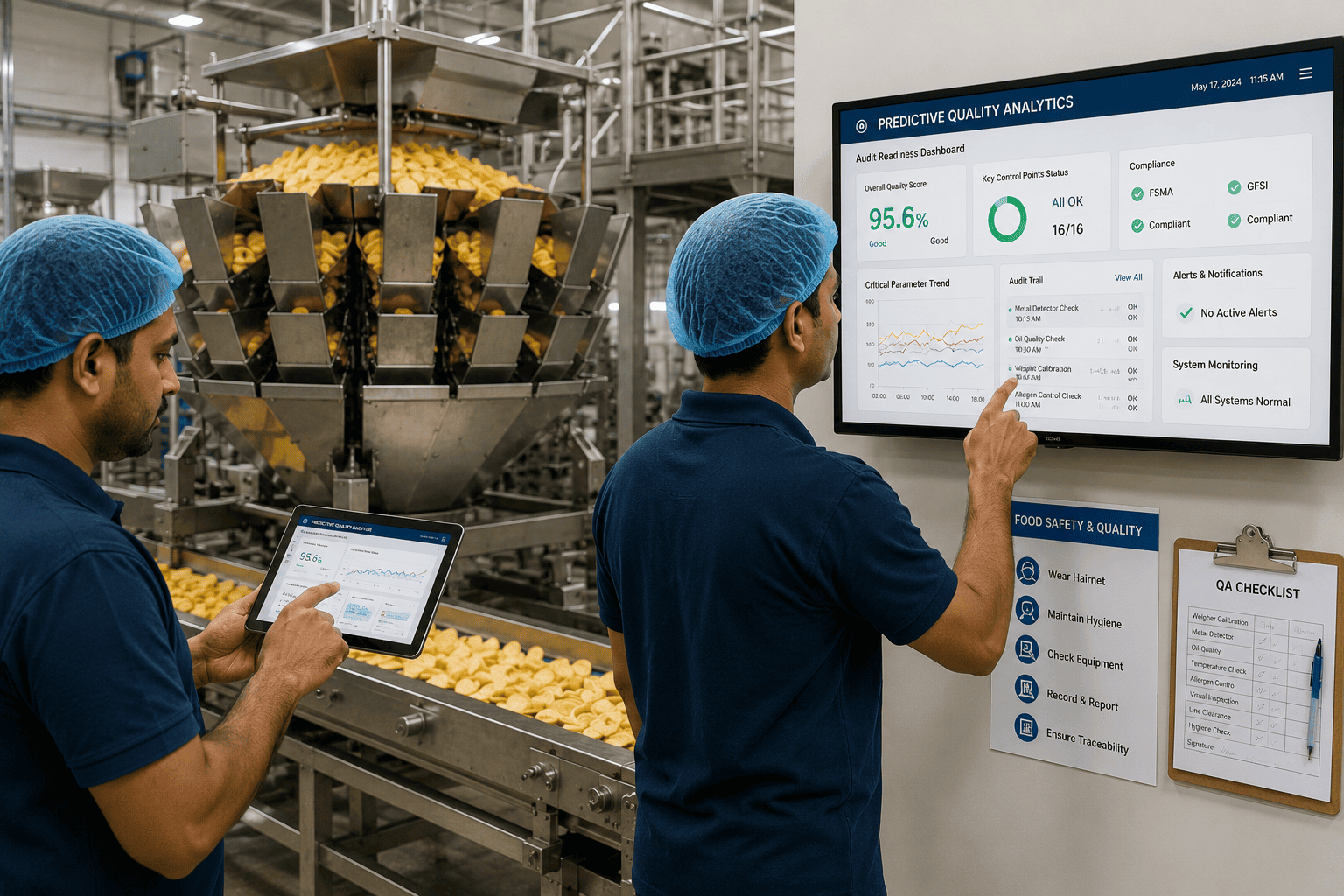
Food manufacturing quality control has evolved through three distinct eras over the past seven decades. Traditional Statistical Quality Control (SQC) dominated from the 1950s through the 1990s with acceptance sampling and lot-by-lot batch testing. Traditional Statistical Process Control (SPC) emerged in the 1990s with real-time process monitoring and rule-based control charts. Predictive SPC is the current evolution — AI-driven prediction of variation before defects fire, paired with autonomous root cause analysis and continuous audit-ready documentation. For F&B operations still running on SAP xMII or traditional SPC platforms, the move to Predictive SPC isn’t a platform migration so much as a quality philosophy upgrade. Book an AI SPC migration workshop to map the predictive SPC capabilities against your specific operation.
ERA 01 · 1950s–1990s
Traditional SQC
Statistical Quality Control
Method: Acceptance sampling, lot-by-lot inspection, batch acceptance testing
Decision timing: Post-production accept/reject
Limit: Reactive. Defects already produced before detection. No process insight.
ERA 02 · 1990s–2010s
Traditional SPC
Statistical Process Control
Method: Real-time control charts, rule-based limits, in-process monitoring
Decision timing: When parameter crosses control limit
Limit: Still reactive to violations. Single-parameter analysis. No prediction.
ERA 03 · 2020s–2026
Predictive SPC
AI-Native Predictive Intelligence
Method: ML-driven multivariate prediction, autonomous RCA, continuous audit trail
Decision timing: 4–24 hours before defects fire
Capability: Proactive. Multivariate. Self-learning. Audit-ready by default.
The Evolution of Food Manufacturing Quality Control
Quality control in food manufacturing has evolved deliberately over seven decades, with each era addressing the limitations of the prior. The evolution wasn’t arbitrary — it tracked manufacturing complexity, regulatory pressure, and technology capability. Understanding where your plant sits in this evolution is the first step toward modernization, because the migration path from era 1 to era 3 is different from the migration path from era 2 to era 3. The four evolutionary forces below explain why the eras shifted when they did, and why era 3 is the current state-of-art for F&B operations modernizing in 2026.
01
Increasing Production Volumes
Acceptance sampling worked when production volumes were measured in dozens of batches per week. As F&B operations scaled to hundreds of batches per week and thousands of packaging units per minute, sampling-based quality control became operationally impractical. Real-time monitoring (era 2) was the response.
02
Regulatory Pressure Intensifying
FDA, USDA, and customer audits have become more stringent over decades. FSMA Rule 204 (Food Traceability Final Rule) and expanding 21 CFR Part 117 enforcement require evidence trails that lot-by-lot inspection cannot provide. Continuous monitoring (era 2) and continuous evidence generation (era 3) responded to these pressures.
03
Customer Quality Expectations Rising
Customer scorecards, GFSI-recognized certifications (SQF, BRCGS, IFS), and brand reputation requirements have pushed quality standards far above regulatory minimums. Real-time monitoring captures variance; predictive intelligence prevents it. Era 3 emerged because customers demanded fewer defects, not better defect detection.
04
AI & Compute Capability Maturing
Edge AI inference at sub-50ms latency on pre-configured industrial appliances became practical around 2022–2024. ML model training pipelines on F&B-specific data matured. The technical foundation for predictive SPC arrived, and the early adopters captured competitive advantage by deploying era 3 capability ahead of broad market adoption.
05
Supply Chain Complexity Growing
F&B supply chains have become globally complex with multiple suppliers, ingredient sources, and distribution paths per product. Lot-level traceability requirements compound across the supply chain. Era 1 SQC (lot acceptance) and era 2 SPC (process monitoring) don’t structurally connect ingredient supply data to finished product. Era 3 predictive SPC integrates supply data with process intelligence natively.
06
Quality Workforce Pressure
Experienced quality engineers, SPC analysts, and HACCP specialists are harder to retain and recruit than they were a decade ago. Era 2 platforms require these scarce specialists to interpret data, build reports, and configure controls. Era 3 systems take over the work that scarce specialists used to do — making quality intelligence accessible to broader plant teams.
Want to identify which era your operation is currently in and what era 3 capability gaps matter most? Book an AI SPC migration workshop — the assessment maps your current quality control approach against the three eras and identifies the specific predictive SPC capabilities that move your operation forward.
Traditional SQC: What It Was, Why It Falls Short Today
Traditional Statistical Quality Control (SQC) is the oldest formal quality discipline in food manufacturing — rooted in Walter Shewhart’s 1920s work but operationalized broadly through the 1950s–1990s. SQC’s defining characteristic is acceptance sampling: producing lots, sampling them statistically, testing the samples, and accepting or rejecting the lot based on results. It worked well when production volumes were lower and regulatory expectations were focused on finished-product safety rather than process traceability. In 2026, SQC alone is operationally inadequate for F&B operations facing modern regulatory frameworks and customer expectations.
SQC Strength
Sampling Statistics Foundation
SQC introduced the discipline of statistical sampling: acceptable quality levels (AQL), operating characteristic curves, switching rules. The statistical foundation remains valid and informs modern SPC approaches. SQC’s mathematical rigor is its lasting contribution to quality science.
SQC Strength
Lot-Level Quality Verification
SQC produces lot-level pass/fail dispositions that satisfy basic finished product testing requirements. For products where lot-level acceptance is the primary quality concern, SQC delivers what it was designed to deliver. Many small-batch artisanal producers still operate effectively with SQC-based approaches.
SQC Limit
Reactive by Architecture
SQC tests finished or near-finished product. Defects are already produced before SQC catches them. No process insight, no ability to prevent the next batch from producing the same defect. Scrap and rework costs compound. For modern F&B economics, post-production rejection of entire lots is uneconomic.
SQC Limit
No Process Traceability
SQC produces lot acceptance records, not process traceability. FSMA Rule 204 source-to-shelf 24-hour traceability is structurally not what SQC was designed for. Plants relying primarily on SQC face significant regulatory exposure on traceability requirements that have become operationally critical.
SQC Limit
Sample-Driven Blind Spots
Statistical sampling inherently misses defects that don’t happen to land in samples. For high-consequence quality issues — allergen contamination, pathogen presence, foreign object inclusion — sample-based detection allows defective product to ship. Modern customer scorecards and recall economics make sample-based blind spots unacceptable.
SQC Limit
No AI Path Forward
SQC as a discipline doesn’t connect to AI or ML approaches naturally. Predictive intelligence requires process data, not finished-product test results. Plants operating primarily on SQC need to bypass era 2 (traditional SPC) and skip directly to era 3 (predictive SPC) to capture AI capability.
Traditional SPC: The Step Forward and Its Limits
Traditional Statistical Process Control (SPC) emerged as the response to SQC’s reactive limitations. SPC shifts quality control upstream from finished product to the process itself — monitoring parameters in real-time against control limits, flagging violations as they occur, enabling intervention before excessive scrap is produced. SAP xMII rule-based SPC, AVEVA Wonderware SPC modules, Rockwell FactoryTalk Production Suite, and dozens of point solutions all operate in this era. SPC was a major advance over SQC, but in 2026 its limitations are becoming operationally significant — particularly its inability to predict and its single-parameter analysis.
SPC Strength
Real-Time Process Monitoring
SPC monitors process parameters as production runs. Operators see violations as they occur, not after the lot is finished. Faster intervention reduces scrap compared to SQC’s post-production approach. Real-time visibility is genuinely valuable and remains foundational to predictive SPC.
SPC Strength
Control Chart Discipline
SPC introduced disciplined control charts (X-bar, R, S, p, np, c, u, EWMA, CUSUM) with statistical rigor on what constitutes a real signal versus normal variation. The control chart discipline remains valid — predictive SPC uses control limits as one input among many, not the sole signal.
SPC Limit
Still Reactive to Violations
SPC flags when parameters cross control limits. By that point the violation has occurred and intervention is corrective rather than preventive. Subtle drift toward limits is invisible until the threshold is breached. The fundamental architecture is "detect and react" rather than "predict and prevent."
SPC Limit
Single-Parameter Analysis
Traditional SPC monitors one parameter at a time against its own control limits. Multivariate patterns that emerge from combinations of parameters (a slightly elevated temperature plus a marginal pH plus an ingredient lot variation) are invisible to single-parameter SPC. Real F&B quality variance is almost always multivariate.
SPC Limit
No Self-Learning
Traditional SPC uses static control limits set during process characterization. As recipes evolve, equipment ages, and ingredient supply changes, those limits become misaligned. Manual recalibration cycles introduce gaps. Self-learning quality systems adapt continuously without manual intervention.
SPC Limit
Audit Documentation Still Manual
SPC platforms produce data; humans assemble that data into audit-ready documentation. FSMA Rule 204 traceability, 21 CFR Part 11 electronic records, SQF and BRCGS evidence packages all require manual compilation. Era 2 didn’t solve the documentation burden; era 3 does.
Operating in era 2 (traditional SPC) and evaluating the move to era 3? Book an AI SPC migration workshop — we’ll assess where your current SPC capability stops and what predictive SPC adds for your specific F&B batch quality control operations.
Predictive SPC: The AI-Native Future
Predictive Statistical Process Control (Predictive SPC) is the current evolution of food manufacturing quality control — the era 3 capability set that combines real-time monitoring with ML-driven prediction, multivariate analysis, autonomous root cause analysis, and continuous audit-ready documentation. Predictive SPC doesn’t replace SPC’s real-time monitoring discipline; it adds layers above and around it. Plants deploying predictive SPC in 2025–2026 are capturing competitive advantages across yield, audit readiness, recall response, and customer scorecard performance that era 2 platforms architecturally cannot deliver.
Capability 01
4–24 Hour Prediction Window
ML models trained on plant-specific historical data anticipate quality drift 4–24 hours before defects fire. Supervisors receive ranked predictive alerts with confidence scores and intervention recommendations. The fundamental shift from "detect violations after they occur" to "prevent violations before they occur."
Replaces: Era 2 reactive control chart violations
Capability 02
Multivariate Pattern Recognition
Correlates dozens of parameters simultaneously: ingredient lots, equipment state, recipe parameters, environmental conditions, operator actions. Detects multivariate patterns that single-parameter SPC architecturally cannot see. The patterns producing F&B quality variance in the real world are almost always multivariate.
Replaces: Era 2 single-parameter control charts
Capability 03
Autonomous Root Cause Analysis
AI agents maintain continuous causal hypothesis about plant operations. When anomalies fire, root cause is pre-computed: operator sees evidence-backed explanation in 3–5 minutes vs 30–60 minutes manual investigation. RCA closes during the event, not after.
Replaces: Manual multi-system investigation cycles
Capability 04
Self-Learning Quality Systems
Agents improve continuously based on plant-specific batch outcomes. Models refine as outcome data accumulates. Adapt to recipe changes, equipment changes, ingredient supply shifts. Capture experienced operator intuition over time. Become more accurate the longer they operate in your specific plant.
Replaces: Static control limits, periodic recalibration
Capability 05
Continuous Audit-Ready Documentation
FSMA Rule 204 batch genealogy, 21 CFR Part 11 electronic records, HACCP CCP monitoring, SQF/BRCGS evidence trails — all generated continuously as a byproduct of operation. Compliance is a default state, not a project. Audit becomes review, not assembly.
Replaces: Manual audit prep cycles
Capability 06
GenAI Conversational Quality
Natural language interface for operators, supervisors, and quality teams. Ad-hoc plant questions answered in seconds with evidence-backed responses. Sub-second response times via on-prem inference. Conversational quality intelligence replaces rigid dashboards and pre-built reports.
Replaces: Era 2 dashboards, manual reporting
Want to see era 3 predictive SPC running against your specific F&B batch operations? Book an AI SPC migration workshop — we’ll demonstrate predictive SPC capabilities on representative scenarios from your recipe portfolio and CCP configurations.
Audit Readiness Through Predictive SPC
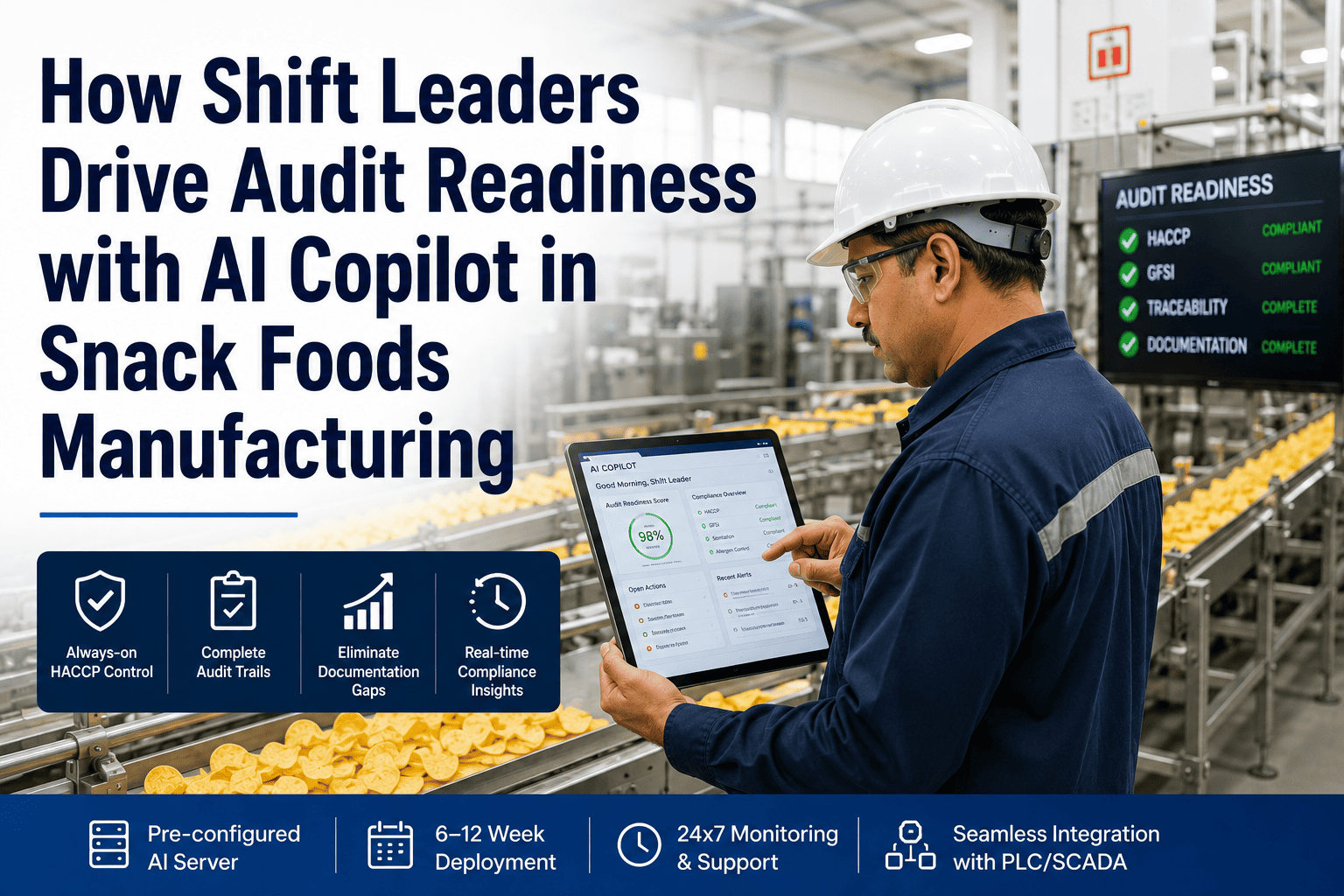
Audit readiness is the primary KPI for predictive SPC modernization in F&B batch operations. The audit experience changes fundamentally between era 2 and era 3. With traditional SPC, auditors review data assembled before their arrival — supervisors and quality teams pulled from regular work for days to build evidence packages from raw SPC data. With predictive SPC, auditors review evidence that’s been current continuously throughout the period — including the predictive alerts that prevented problems from happening at all. The four dimensions below explain how predictive SPC specifically delivers audit readiness.
Dimension 01
Predictive Evidence Trail
Predictive SPC creates an evidence trail of prevented problems, not just managed problems. Auditors see: predicted drift on date X, supervisor intervention based on recommendation, drift averted, no excursion. This is qualitatively different evidence than "excursion occurred, corrective action taken" trails that traditional SPC produces.
Auditor sees prevention, not just management
Dimension 02
Continuous CCP Monitoring Records
HACCP Critical Control Points captured every second of operation, not at sample intervals. The continuous record makes any deviation immediately visible and provides the granular evidence FSIS, FDA, and certification auditors increasingly expect. Sample-interval CCP records have gaps; continuous records do not.
CCP records granular & continuous
Dimension 03
Auto-Generated Compliance Packages
SQF, BRCGS, customer-specific audit packages generated automatically from continuous batch record data. No pre-audit assembly. Auditors arrive to find documentation already current and queryable. Audit duration compresses 30–50% because the documentation review is faster.
Audit prep eliminated entirely
Dimension 04
Recall Scope in Minutes
When recall events occur, affected batches identified in minutes via natural language query. Predictive SPC maintains the batch-to-distribution chains automatically. FSMA Rule 204 24-hour traceability is satisfied with substantial margin. Recall response cost reduces proportionally to scope identification speed.
Recall response: minutes vs days
Move From Era 2 to Era 3 Predictive SPC
A migration workshop assesses your current quality control era, identifies predictive SPC capability gaps, demonstrates era 3 capabilities against your representative batch scenarios, and produces a documented modernization plan with realistic timeline.
Expert Perspective
"The conversation about predictive SPC in food & beverage is often framed as platform comparison or feature evaluation, but the better framing is era transition. Most F&B operations we evaluate are operating in era 2 — traditional SPC with rule-based control charts and real-time monitoring — while their best competitors are deploying era 3 predictive SPC capabilities. The capability gap shows up across multiple operational dimensions but concentrates particularly in audit readiness and recall response. The audit experience under era 3 predictive SPC is qualitatively different. Auditors see evidence trails that include the prediction-and-prevention cycles, not just the violation-and-correction cycles. CCP monitoring is continuous rather than sampled. Compliance documentation is current throughout the audit period rather than assembled before the audit. Recall response that took days under era 2 takes minutes under era 3. For F&B operations evaluating modernization investment in 2026, the era framing helps cut through vendor-specific feature debates. The question is not which platform; the question is which era. Era 3 capabilities are now accessible to plants of all sizes through on-prem AI appliances, and the competitive advantage of operating in era 3 while peers remain in era 2 is the period during which early adopters extract disproportionate value."
— F&B AI Manufacturing Practice, 2026 perspective
3 Eras
SQC, traditional SPC, predictive SPC
4–24 hr
prediction window vs era 2 reactive
30–50%
audit duration compression vs era 2
Modernize From Traditional SPC to Predictive SPC
The half-day AI SPC Migration Workshop assesses your current era (SQC, traditional SPC, or hybrid), maps predictive SPC capabilities against your specific F&B batch quality control workflows, demonstrates era 3 capabilities on representative scenarios, and produces a documented era 3 deployment plan.
Frequently Asked Questions
What’s the actual difference between SQC, SPC, and predictive SPC?
Three distinct quality control approaches separated by decades of evolution. Statistical Quality Control (SQC) is sampling-based finished-product testing: produce lots, sample them, accept or reject based on sample results. Reactive by architecture — defects are already produced. Traditional Statistical Process Control (SPC) is real-time process monitoring with rule-based control charts. Better than SQC because monitoring is in-process, but still reactive to violations. Predictive SPC uses ML to anticipate variation 4–24 hours before defects fire, with multivariate analysis, autonomous root cause analysis, and self-learning capability. The three approaches can coexist (finished product acceptance testing for some products, real-time SPC for processes, predictive SPC for high-value lines), but the modernization arc moves from SQC dominant to SPC dominant to predictive SPC dominant.
Which era is our plant operating in?
Most F&B operations evaluated for modernization in 2025–2026 are operating primarily in era 2 (traditional SPC) with era 1 elements (SQC for finished product acceptance) still present. Specific era 2 indicators: SAP xMII rule-based SPC, AVEVA Wonderware control charts, custom Excel SPC dashboards, manual CCP recording at sample intervals, audit prep cycles requiring days of team work before each audit. Era 3 indicators (mostly absent): predictive alerts 4–24 hours before defects fire, multivariate root cause analysis pre-computed, GenAI conversational quality interface, continuous audit-ready batch records.
Book a migration workshop to formally assess your current era and identify the era 3 capability gaps for your operation.
Do we need to bypass era 2 if we’re primarily on SQC?
Yes — plants operating primarily on SQC (finished product acceptance, no real-time process SPC) can skip era 2 entirely and deploy era 3 predictive SPC directly. The reason is architectural: predictive SPC requires process data, not finished-product test results. Plants without real-time process monitoring need to add that capability anyway, and it’s more cost-effective to add the era 3 capability than to add era 2 first and then upgrade. The modernization path "SQC directly to predictive SPC" is faster than "SQC to traditional SPC to predictive SPC" because it avoids deploying era 2 infrastructure that gets replaced. Plants in this position typically see faster ROI on modernization than plants already in era 2.
What ROI is realistic for moving from era 2 to era 3?
F&B operations moving from era 2 (traditional SPC, often on SAP xMII or similar platforms) to era 3 (predictive SPC) typically see four ROI categories within 12–18 months. (1) Yield improvement of 5–10 percentage points from predictive prevention of drift-driven scrap. (2) Cpk improvement of 0.3–0.6 on key parameters from continuous monitoring and recipe optimization. (3) Cost of quality reduction of 40–65% from prevented scrap and faster RCA cycles. (4) Audit duration reduction of 30–50% from continuous documentation and recall scope reduction from days to minutes. The specific ROI mix depends on baseline yield, current scrap cost, audit frequency, and compliance complexity. Workshop output includes a documented ROI model against your specific baseline.
How does this connect to SAP MII end-of-life timing?
SAP MII mainstream support ends December 2027 (extended support to 2030 at premium pricing). Plants currently on SAP MII operating in era 2 (traditional SPC) face two simultaneous decisions: which platform replaces SAP MII for execution, and which quality intelligence approach replaces SAP MII rule-based SPC. Predictive SPC addresses the second question directly — AI-native platforms deploy alongside SAP DM (the SAP MII execution successor) or alongside whatever execution platform continues operating. The era transition is independent of the platform decision, but the SAP MII deadline creates the practical migration window. Plants modernizing both layers (execution and quality intelligence) typically deploy them in parallel rather than sequentially.