Predictive Quality for Dairy Processing Food Manufacturing: An Operator's Guide to Audit Readiness
By Riley Quinn on May 26, 2026
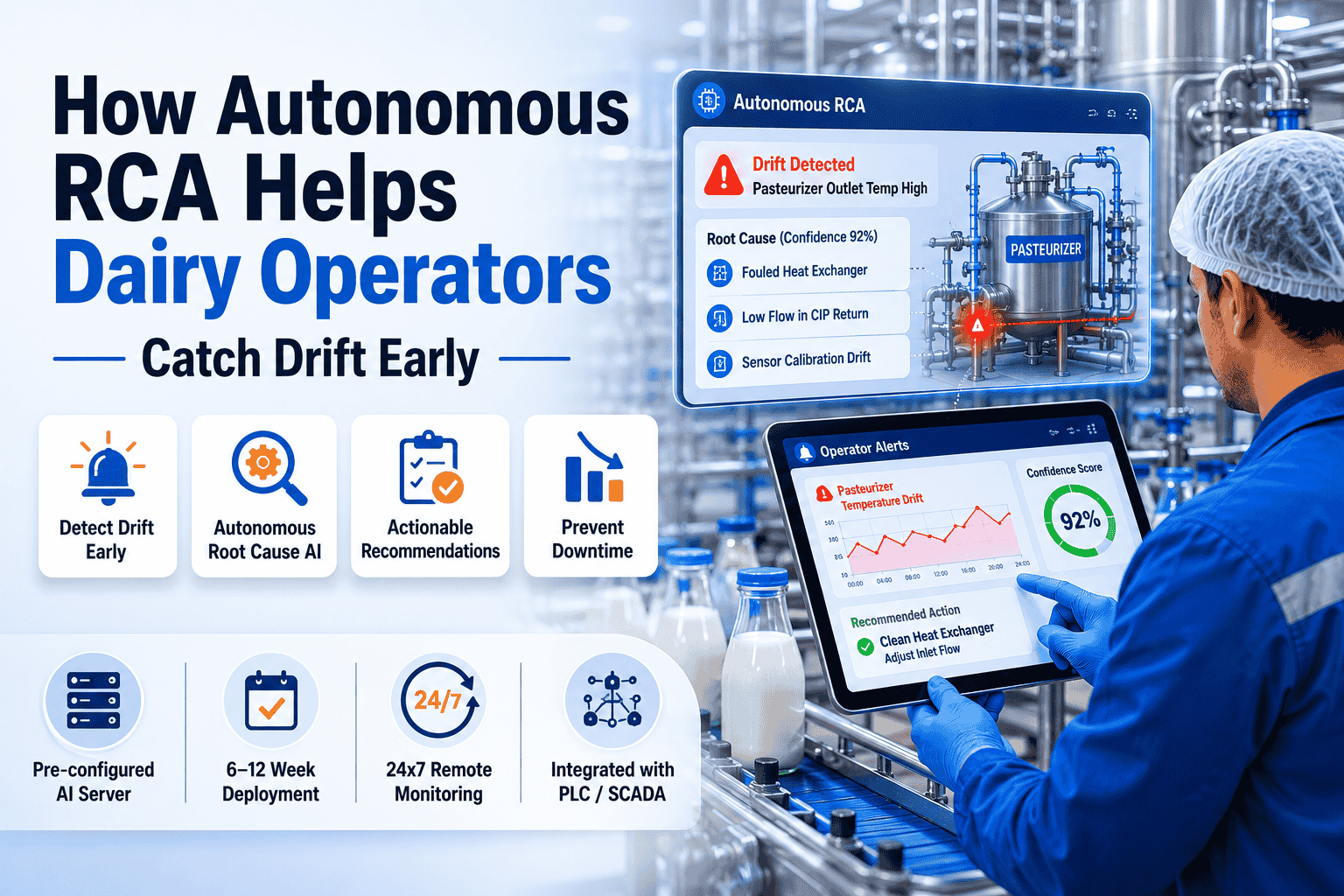
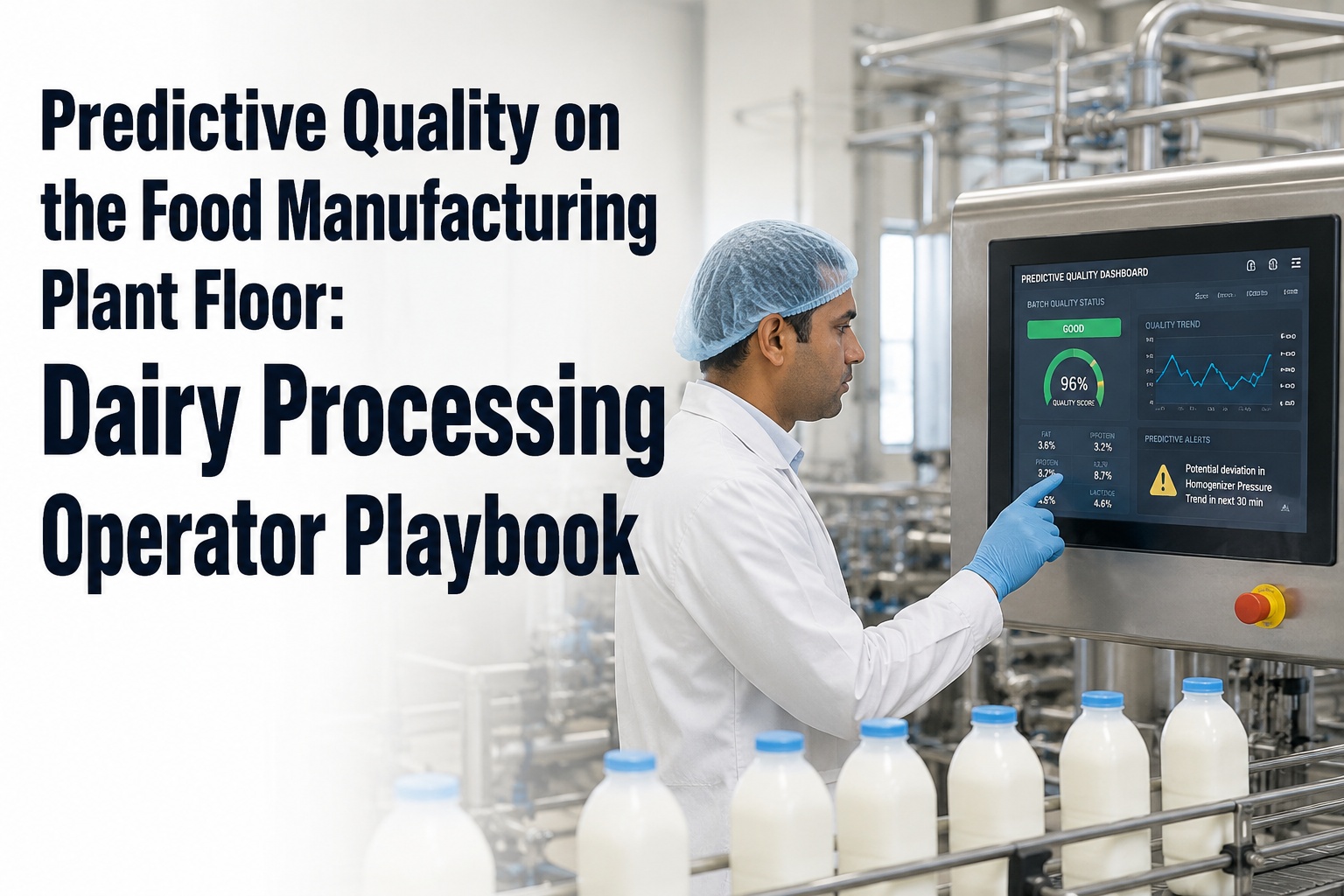
Most dairy plants treat predictive quality and audit readiness as two separate projects. The quality team buys the AI platform to catch drift before defects form. The compliance team builds the document control system to satisfy GFSI auditors. Two budgets, two implementations, two software stacks, two operator workflows. The plants that figured out 2026 know something different: every predictive intervention is also a compliance record. The same sensor reading that lets the AI catch a hold-tube temperature drift 8 minutes before diversion is the same time-stamped, signed-off, immutable evidence that a BRCGS auditor wants to see. The same prescriptive action that saves the batch becomes the documented preventive control under 21 CFR 117 Subpart C. Predictive quality and audit readiness aren’t two projects — they’re the same project viewed from two different angles. This guide shows operators how AI-native predictive quality automatically generates the GFSI, SQF, and BRCGS evidence layer most plants spend weeks assembling manually for every inspection. Book a demo with us to see your line’s predictive interventions producing your audit trail in real time.
Two Views, One Platform
Same Data Layer · Different Audiences
The operator sees a prescriptive alert. The auditor sees a documented preventive control. Same event. Same data. Zero duplicate work.
View 01 · Operator
Predictive Quality
Live sensor data flagged before drift becomes defect. Prescriptive HMI alerts. Batches saved. Lines kept in spec.
Why GFSI Auditors Now Expect More Than Paper Records
GFSI itself isn’t a certification — it’s a benchmarking framework that recognizes four major schemes: SQF, BRCGS, FSSC 22000, and IFS. Each one has tightened evidence expectations significantly in the most recent editions. BRCGS Issue 9 mandates documented management review evidence, SQF Code Edition 9 requires demonstrated process controls, and 21 CFR Part 11 governs the electronic records that increasingly replace paper logbooks. The common thread: auditors want continuous evidence of preventive controls in action, not retrospective paperwork assembled the week before inspection.
SQF
Safe Quality Food
North America · Asia-Pacific export
Three-tier structure (Fundamentals, Food Safety Level 2, Quality Level 3). Built on HACCP principles with detailed prerequisite programs. Level 2 is the typical retail threshold; Level 3 adds quality management beyond food safety.
Key requirementDemonstrated process controls
BRCGS
Brand Reputation Compliance
UK · Europe · global retail
Stringent audit process with strong supplier control requirements. Issue 9 mandates documented management review evidence. Robust food fraud prevention and food defense measures.
Key requirementManagement review evidence
FSSC 22000
Food Safety System Cert
Multinationals · ISO-aligned
Built on ISO 22000 plus sector-specific PRPs from ISO/TS 22002-1. Combines food safety management with quality management system architecture. Preferred by large multinationals.
Key requirementDocumented PRPs & OPRPs
IFS Food
International Featured Stds
Germany · France · EU retail
Commanding position in German, French, and broader European retail supply chains. Detailed product safety and quality requirements with emphasis on process control evidence.
Key requirementProcess verification trail
Want to see how your existing dairy processes map to BRCGS Issue 9 or SQF Edition 9 evidence requirements? Book a 30-minute working session with our dairy compliance specialists.
The Five Predictive Interventions That Automatically Generate Audit Evidence
This is where the duality becomes concrete. Each predictive intervention the AI runs in the background produces a specific audit artifact required by GFSI-recognized schemes. The operator sees the alert and acts; the auditor sees the documented control and the time-stamped evidence trail. Same event, two outputs, zero additional work.
Swipe horizontally to compare operator and auditor views
Predictive Intervention
What the operator sees
What the auditor sees
HTST hold-tube drift detection
Alert: temperature trending toward 72°C floor. Steam adjustment recommended.
CCP 6 monitoring with continuous T-t records. Preventive control documented per 21 CFR 117.
CIP cycle conductivity verification
CIP-03 rinse-out flattening earlier than baseline. Caustic check prompted.
SQF cleaning verification records. BRCGS validated cleaning evidence with signed-off cycle parameters.
Fat-protein ratio multivariate monitoring
Ratio walking off-target. Cream valve trim suggested.
Continuous standardization evidence. Compositional consistency records for finished-product specs.
Allergen changeover validation
Changeover sequence flagged at risk. Extra flush cycle recommended.
BRCGS Issue 9 allergen control evidence. Documented validation with timestamped operator signoff.
No-orphan-deviation logs. Every CCP deviation auto-paired with corrective action under FSMA 21 CFR 117.
What "Always-On Audit Readiness" Actually Means on the Shop Floor
Plants used to operate in two modes: production mode (eleven months a year) and audit mode (the month before inspection). Always-on audit readiness collapses those into one. Five operational realities change once the platform is live, and each one removes a familiar source of audit-week stress.
01
Records retrieve in seconds
Inspector asks for time-temperature records from a specific 4-hour window three months ago. Replay loads in 90 seconds. FSMA 24-hour retrieval requirement passed with hours to spare.
FSMA 21 CFR 117
02
Records can’t be edited after the fact
21 CFR Part 11 tamper-evident architecture. No more inspector concerns about uniformly-clean paper records. Audit-trail integrity is structural, not procedural.
21 CFR Part 11
03
No orphan deviations
Every CCP deviation auto-paired with the corrective action taken. The recurring “deviation logged but no CAPA found” finding disappears structurally.
HACCP · SQF
04
Management review auto-generated
BRCGS Issue 9 documented management review requirements satisfied through continuous quality dashboards. Quarterly meetings have data prepared, not retrospectively assembled.
BRCGS Issue 9
05
No more pre-audit panic week
Quality team verifies the platform’s integrity check is green. No paper pulled, no binders touched, normal operations continue. Audit week becomes Tuesday.
All schemes
One Platform, Two Outcomes — in 6–12 Weeks
iFactory ships a pre-configured AI server tuned for dairy — HTST, separator, homogenizer, filler, CIP, packaging. Predictive quality interventions and GFSI-ready evidence trails generated from the same continuous data layer. 24x7 monitoring, integrated with your existing PLC and SCADA.
Anatomy of a Single Event — Operator Action and Audit Evidence in Parallel
This is the duality at its most concrete: one real event, two simultaneous outputs. Walk through what happens when the AI catches an HTST hold-tube drift at 03:47 on a Tuesday graveyard shift — and what each audience sees from the same underlying data.
AssetHTST Pasteurizer Line 3
ShiftTuesday B-Shift · 03:47
StatusActive alert
03:39
Baseline
03:41
Drift starts
03:43
AI detects
03:45
Alert fires
03:47
Action taken
AI detects steam pressure drift cascade. Hold-tube temperature predicted to breach 72°C floor in 6 minutes.
Operator confirms; valve adjusted; line stays in spec; batch saved.
Result
Hold-tube returns to 72.6°C target. Diversion prevented. No batch loss.
What the auditor sees
CCP record
Continuous T-t data captured 03:39–03:47. CCP 6 monitoring per HACCP plan. No diversion threshold reached.
Preventive control
Documented per 21 CFR 117 Subpart C. Operator signoff timestamped 03:46. Tamper-evident audit trail.
Evidence package
Auto-paired with corrective action. No orphan deviation. BRCGS Issue 9 evidence complete.
Want to walk through one of your recent quality events with this dual-view applied? Book a working session and we’ll map an actual event from your historian.
The Audit-Ready Stack — What Sits Where
The duality only works if the architecture supports it. iFactory’s audit-ready stack has four layers that turn raw PLC and SCADA signals into both predictive alerts AND evidence-grade compliance records simultaneously.
04
Evidence Layer
21 CFR Part 11 immutable audit trail · auto-paired CAPA records · GFSI scheme-specific evidence packages
PLC · SCADA · historian · inline NIR · CIP controllers · standardized via OPC UA / MQTT
Expert Perspective
"Pursuing GFSI certification with a paper-based system puts a tremendous administrative burden on already busy quality teams. Plants attempting it with rudimentary digital systems not compliant with 21 CFR Part 11 create other problems for themselves — leaving themselves open to audit findings and even audit failures. The solution isn’t a separate compliance platform bolted onto a separate quality platform. It’s recognizing that every predictive quality intervention the AI runs is, by structural necessity, also an audit evidence event. One data layer. Two audiences. Zero additional work for the operator. That’s where the always-on compliance posture actually comes from."
— Dairy Manufacturing Compliance Practice, 2026 industry insight
4 schemes
GFSI-recognized: SQF, BRCGS, FSSC 22000, IFS
21 CFR Part 11
FDA standard for electronic records and signatures
24 hr
FSMA records retrieval compliance window
Conclusion: The Project That Was Always One Project
Predictive quality and audit readiness have lived in separate boxes on dairy plant org charts for too long. The quality manager owned one budget; the compliance officer owned the other. The result was duplicated infrastructure, divided operator attention, and audit weeks that disrupted the production schedule. AI-native predictive quality dissolves that division. The same continuous data layer that catches hold-tube drift before diversion is the same layer that produces the BRCGS Issue 9 evidence package. The same prescriptive action that saves the batch is the same documented preventive control under 21 CFR 117. The same operator signoff that closes the alert is the same tamper-evident timestamp the SQF auditor needs. One platform. Two views. Zero additional operator work. The plant that opened this guide treating audit week as crisis week finishes with audit week feeling like Tuesday. Book a demo with us to see both views on your line.
Bring Both Views to Your Dairy Line
iFactory’s dairy practice deploys predictive quality and audit-ready evidence generation in 6–12 weeks against your existing PLC and SCADA — one platform, one data layer, two audiences served simultaneously. Get a free 30-minute working session built around your next GFSI audit.
How does a predictive quality platform actually produce GFSI audit evidence?
By recognizing that every predictive intervention is structurally also a compliance event. When the AI detects a hold-tube temperature drift and prescribes a corrective action, three artifacts get generated automatically: the continuous time-temperature record (CCP 6 monitoring evidence for HACCP), the operator’s signed-off corrective action (preventive control documentation under 21 CFR 117 Subpart C), and the tamper-evident audit trail of the entire event (21 CFR Part 11 electronic records compliance). The operator’s normal workflow produces the auditor’s required evidence as a structural byproduct. No separate documentation step, no audit-week reconstruction.
Which GFSI schemes does this approach satisfy?
All four major GFSI-recognized schemes for food manufacturing: SQF (most prevalent in North America), BRCGS (UK and European retail standard), FSSC 22000 (multinational and ISO-aligned plants), and IFS Food (German and French retail supply chains). The continuous data layer satisfies BRCGS Issue 9 management review evidence requirements, SQF Code Edition 9 process control documentation, FSSC 22000 PRP records, and IFS Food product safety evidence requirements. Each scheme has slightly different documentation structures, but they share the same underlying requirement: continuous, time-stamped, tamper-evident evidence of preventive controls in action.
What is 21 CFR Part 11 and why does it matter for dairy plants?
21 CFR Part 11 is the FDA standard governing electronic records and electronic signatures. It requires that any electronic record used to satisfy regulatory recordkeeping be tamper-evident, time-stamped, attributable to a specific person, and retrievable on demand. Most dairy plants are moving away from paper chart recorders toward electronic data capture — and when they do, Part 11 compliance becomes mandatory rather than optional. The risk isn’t hypothetical: rudimentary digital systems not Part 11 compliant create audit-finding exposure and can lead to outright audit failures with GFSI-recognized schemes.
Does this replace our existing QMS, LIMS, or document control system?
No. iFactory’s predictive quality and audit-readiness layer sits above your existing systems and feeds them better-quality data. Your QMS continues to manage CAPAs, change controls, and supplier qualifications. Your LIMS continues to manage lab results and microbiology testing. Your document control system continues to handle SOPs and training records. What changes is that all the in-process, time-stamped, continuous data from PLCs, SCADA, and inline analyzers now flows into a Part 11-compliant evidence layer that connects each predictive intervention to its corresponding preventive-control record — the missing link between your real-time production data and your compliance documentation.
How long does deployment take and what does day one look like for operators?
Deployment runs 6–12 weeks. The first 2–3 weeks cover PLC and SCADA integration plus historian ingest. The next 4–6 weeks train the predictive models on 6–8 weeks of your plant’s historical data with dairy-specific pre-configured templates accelerating the work. The final 2–4 weeks tune alert thresholds and verify the evidence trail mapping against your specific GFSI scheme requirements. For operators, day one looks identical to the day before — the HMI is the same, the controls are the same. What changes is that the alerts that appear now arrive with prescriptive actions attached, and every action taken silently generates the audit evidence in the background.