An FDA inspector arrives unannounced on Tuesday morning. They ask for time-temperature records on Pasteurizer 2 between 03:00 and 03:15 on a specific Thursday three months ago. They want to see the FDV test from that morning, the CIP cycle that preceded it, the operator who was on shift, and the phosphatase test result from the batch produced. In a traditional paper-driven plant, this triggers a frantic two-day search through binders, chart rolls, and email threads — with a real risk of a 24-hour-retrieval finding that turns a routine inspection into a major event. With a manufacturing digital twin running on your dairy line, the same request takes ninety seconds. Every sensor reading, every operator action, every CIP cycle, every alert, every corrective action, time-stamped and immutable, replayed exactly as it happened. This is what audit readiness looks like in 2026 — not a quarterly mock audit, but a plant that’s permanently ready because the twin remembers everything. Book a demo with us to see a digital twin replay running on your historian data.
Hold tube temp
72.4°C
PMO compliant
Hold time
15.2 s
PMO compliant
FDV position
Forward
Tested 06:00
CIP last cycle
02:14
Conductivity OK
Phosphatase
Negative
Confirmed 04:18
Operator
B Shift
Signed off
What a Manufacturing Digital Twin Actually Is — in Plain Operator Language
The marketing definition of a digital twin is vague. The operator definition is exact: it’s a continuously updated virtual copy of your dairy line that knows every sensor value, every operator action, every batch ID, every CIP cycle, every alert, every fix — from the moment it went live, forever. You can scroll back to any second of any shift. You can simulate forward to see what would happen if you changed a setpoint. You can hand the auditor a tablet and let them walk the plant’s history themselves. Three properties make a twin different from a historian or a SCADA archive.
Synchronized in Real Time
Every PLC tag, every SCADA reading, every operator HMI action streams into the twin within seconds. Nothing about your line’s state goes unrecorded.
Replayable to Any Second
Scrub backward to any point in history. See the entire plant state as it was — not a summary, not an average. The actual instantaneous reality.
Simulatable Forward
Run what-if scenarios — change a setpoint, change a recipe, change a CIP schedule — and see the modeled effect before committing to live changes.
Why Dairy Audits Are Different — and Why They’re Getting Harder
Other manufacturing audits ask about quality systems. Dairy audits ask about food safety control points where deviation means recall. FDA Grade A PMO, FSMA 21 CFR 117, HACCP Codex CAC/RCP 1-1969, GMP 21 CFR 110.80, SQF Code Edition 9, EU Regulation 853/2004 — the alphabet soup of dairy compliance frameworks has grown denser every year, and inspectors increasingly expect electronic, time-stamped, on-demand evidence. The 24-hour records retrieval requirement under FSMA isn’t a guideline. It’s a compliance test.
PMO Grade A
Weekly FDV functional testing, continuous temperature recording with calibration trail, indicating thermometer verified to ±0.5°F against certified reference.
FSMA 21 CFR 117
Preventive controls, hazard analysis, CCP monitoring with corrective action documentation, 24-hour records retrieval under FTL.
HACCP Codex
CCP 6 verification: time-temperature parameters documented for every processing run, with corrective action evidence.
SQF Code Ed 9
Section 11.7 process controls, validated cleaning, environmental monitoring, traceability across the full production chain.
The compounding pressure is that inspectors no longer accept gaps. A single missing calibration record, a CCP log with no matching corrective action, or uniform readings that look suspiciously identical across shifts — any one of these triggers broader records requests and credibility concerns with the inspector. The plants that pass routine inspections in 2026 are the ones whose answer to every question is the same: here’s the data, time-stamped, signed off, retrievable in under a minute.
What an Audit Looks Like With and Without a Digital Twin
The before-and-after isn’t subtle. It’s the difference between a plant where audit week is the worst week of the quarter, and a plant where the auditor leaves on time with no observations. Same regulations, same equipment, same operators — different evidence layer.
Without a Digital Twin
Audit Week as Crisis
3 weeks before
Quality team starts pulling paper chart rolls, scanning binders, cross-referencing operator logs against batch records.
2 weeks before
Gaps emerge. Calibration record from one quarter missing. Two FDV tests on adjacent weeks have identical values — possible copy-paste flag.
1 week before
Mock audit. Operators retrained on records protocol. Production schedule disrupted for documentation review.
Audit day
Inspector requests records for a specific 4-hour window. Search takes 90 minutes. Two of seven CCP records cannot be produced within 24 hours.
With a Digital Twin
Audit Week as Tuesday
3 weeks before
Quality team verifies the twin’s integrity check is green. No paper pulled, no binders touched, normal operations continue.
2 weeks before
Auto-generated compliance summary pulled in two clicks. Every gap surfaced is addressable in hours, not days.
1 week before
Production continues uninterrupted. Operators read their shift summaries on the HMI as usual.
Audit day
Inspector requests records for a specific 4-hour window. Replay loads in 90 seconds. Every signal, every action, every signoff produced on demand.
Want to see this transformation modeled against your last audit’s actual records request? Book an audit readiness demo with our dairy specialists.
The Six Audit-Critical Workflows the Twin Automates
Audit readiness isn’t one task. It’s six workflows that have to be defensible at any moment for any window of production. A digital twin handles all six in the background while operators run the line. Here’s what gets automated and what the operator still owns.
01
Time-Temperature Recording
Twin: Continuous sensor readings stored every 60 seconds, immutable audit trail, redundant cloud storage.
Operator: Review shift summary, sign off, intervene on alerts.
02
FDV Functional Testing
Twin: Weekly test scheduled automatically, signed-off result captured with timestamp and operator ID.
Operator: Execute the test, confirm result, document anomaly if any.
03
Instrument Calibration Records
Twin: Calibration certificates linked to asset record; drift alarms fire before next-due date passes.
Operator: Trigger calibration request when scheduled, confirm post-cal verification.
04
CIP Cycle Verification
Twin: Conductivity, temperature, and time curves recorded per cycle; deviations flagged with corrective action prompts.
Operator: Acknowledge cycle completion, intervene on flagged deviations.
05
CCP Monitoring & Deviation Logs
Twin: Every CCP monitored continuously; deviation auto-pairs with the corrective action taken — no orphan deviations.
Operator: Execute corrective action, confirm root cause flag, sign off.
06 + Traceability
Batch Genealogy & Recall Readiness
Batch-by-batch traceability from raw milk receipt to dispatch. A recall request resolves in minutes instead of days.
Book a Demo
From Weeks of Audit Prep to Minutes — in 6–12 Weeks
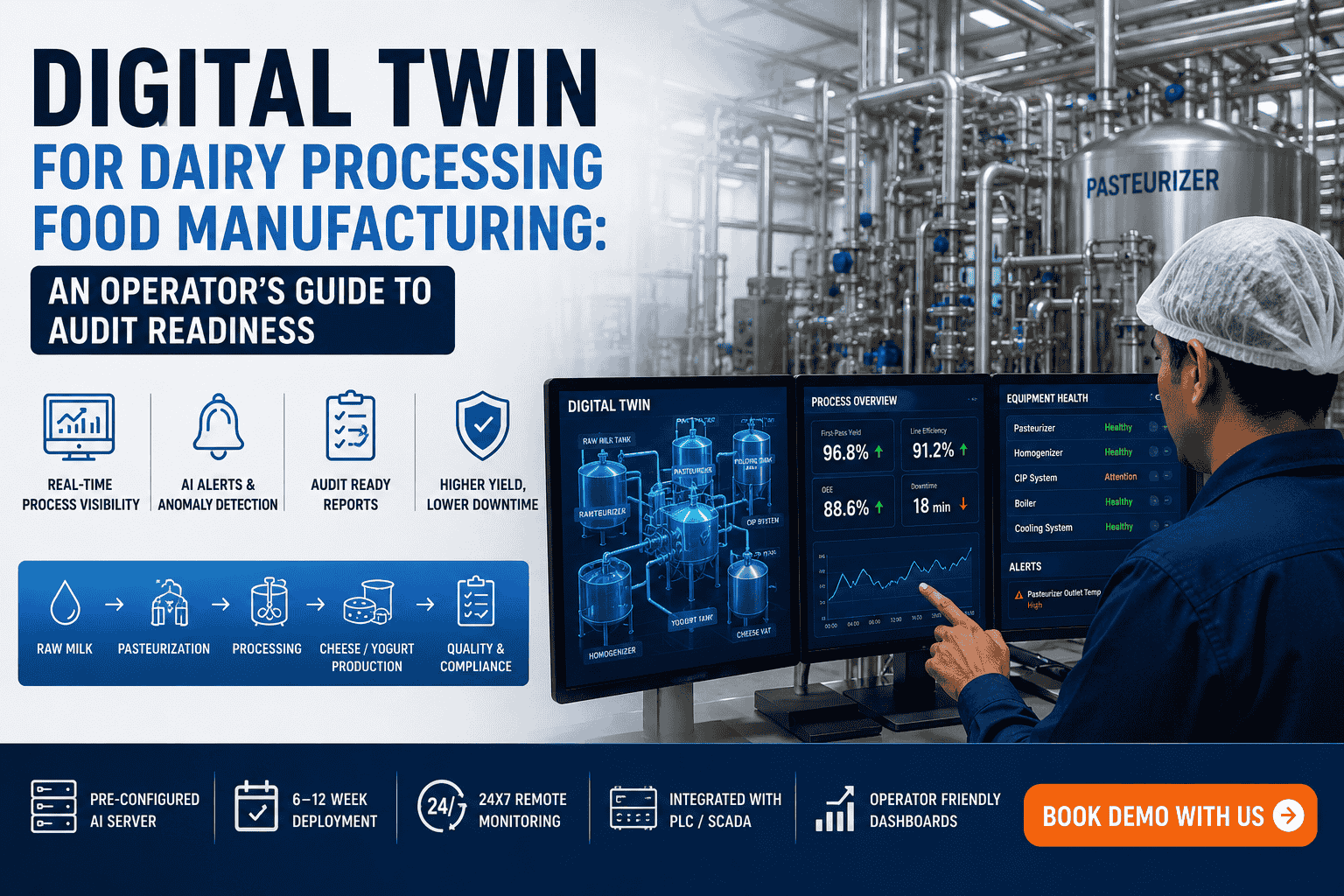
iFactory ships a pre-configured AI server with the manufacturing digital twin tuned for dairy — HTST, separator, homogenizer, filler, CIP, packaging. Integrates with your existing PLC and SCADA, 24x7 monitoring, audit-ready documentation from day one of go-live.
The Yield Bonus: Why Audit-Ready Plants Also Ramp Faster
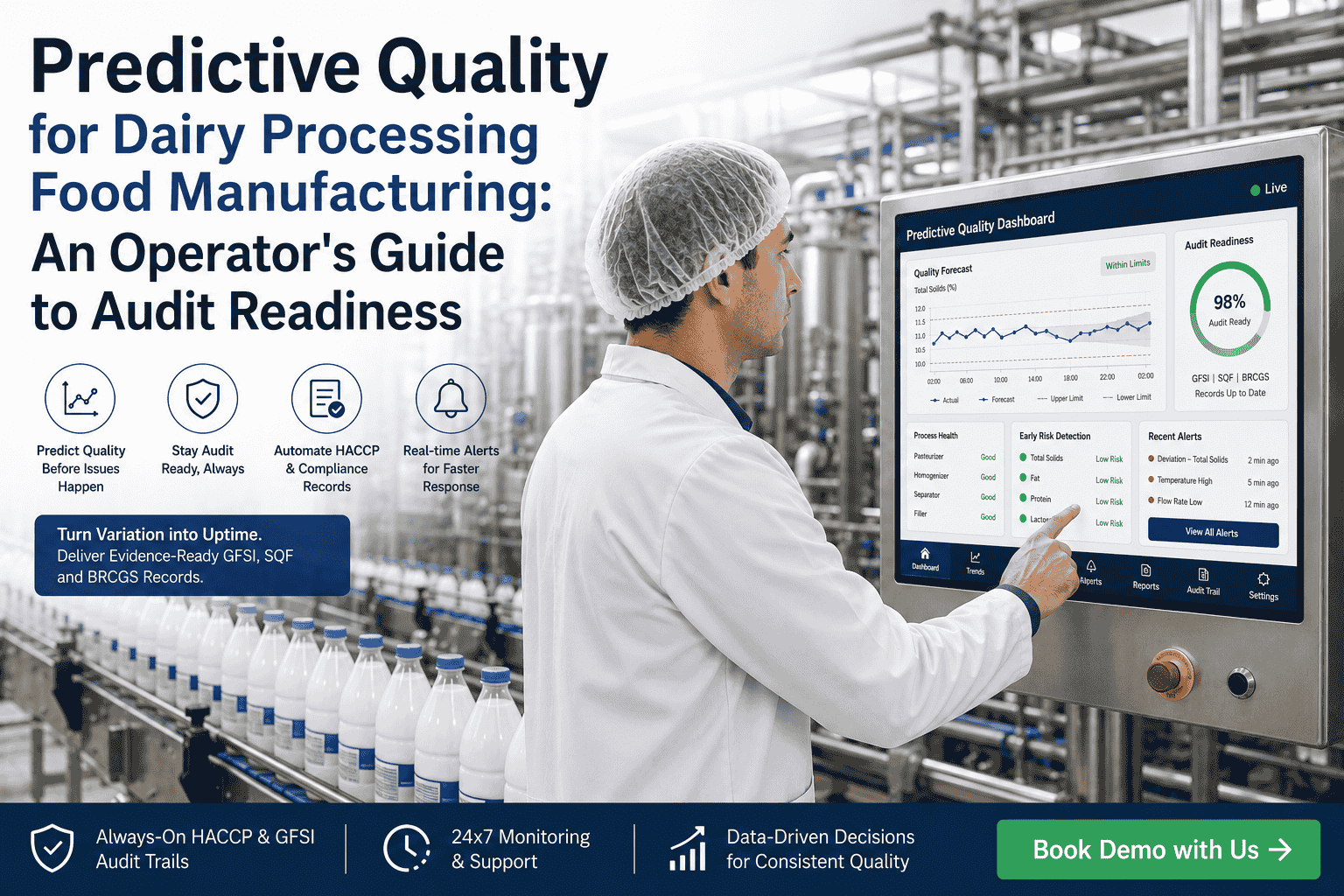
Operators often discover that the same digital twin that compresses audit prep from weeks to minutes also lifts first-pass yield on cheese and yogurt lines. The reason isn’t coincidence — it’s the same instrument doing two jobs. The continuous signal trace that proves PMO compliance is the same trace that catches the early indicator of fat-protein drift, the same trace that flags homogenizer pressure wear before texture defects form, the same trace that surfaces the CIP rinse-out anomaly hours before contamination risk shows up downstream.
+4–8 pts
first-pass yield lift
Cheese and yogurt lines see meaningful FPY gains from the same predictive intelligence that powers audit readiness.
90 sec
records retrieval
Any 4-hour window of any process tag, replayable on demand. FSMA 24-hour requirement passed with hours to spare.
100%
CCP coverage
No orphan deviations, no missing calibration records, no copy-paste flags. Every critical control point continuously monitored.
6–8 wk
to first validated alerts
Predictive intelligence operational quickly. The audit-readiness benefit lands from day one of integration.
Want to model the yield lift alongside the audit transformation on your line? Book a 30-minute walkthrough with our dairy team.
Expert Perspective
"Continuous compliance readiness, not annual audit prep, is the model dairy plants need to operate under in 2026. Inspectors increasingly judge a plant not on whether records exist, but on how quickly they can be produced and whether they show the natural variability of real production. A digital twin delivers exactly that — immutable, time-stamped evidence of every reading from every sensor with every operator action attached. Plants running this model treat audit week like any other week, because the evidence layer is always live. The compliance benefit is obvious; the yield benefit, which often funds the deployment, comes from the same continuous signal trace doing predictive work in the background."
— Dairy Compliance & Manufacturing Practice, 2026 industry insight
72°C / 15s
HTST minimum required under FDA Grade A PMO
24 hr
FSMA records retrieval compliance window
≤10 CFU/mL
PMO finished product coliform limit
Conclusion: The Plant That’s Always Ready
Audit readiness isn’t a quarterly project. It’s the permanent operating state of a plant whose evidence layer is always live, always complete, always retrievable. A manufacturing digital twin gives a dairy operator that state by default — every PMO time-temperature reading, every FDV test, every calibration certificate, every CIP cycle, every CCP deviation, every corrective action, time-stamped and signed off, replayable for any second of any shift. The audit-week crisis dissolves. The yield bonus from the same predictive intelligence funds the deployment. And the question that opened this guide — can you produce time-temperature records for a specific 15-minute window three months ago? — gets the only acceptable answer in 2026: here it is, in ninety seconds, exactly as it happened. Book a demo with us to see the twin running on your line.
Bring Audit Readiness to Your Dairy Line
iFactory’s dairy practice deploys the manufacturing digital twin in 6–12 weeks against your existing PLC and SCADA — 24x7 monitoring, immutable audit trail, predictive intelligence, FSMA/PMO/SQF-ready documentation. Get a free 30-minute working session built around your last audit’s gaps.
Frequently Asked Questions
What is a manufacturing digital twin in a dairy processing context?
A manufacturing digital twin is a continuously updated virtual copy of your dairy line that captures every sensor reading, every operator action, every batch ID, every CIP cycle, every alert, and every corrective action — time-stamped, immutable, and retrievable to any second of operation. Unlike a historian or SCADA archive, the twin synchronizes in real time with the physical line, can be replayed backward to any past moment, and can be simulated forward to test what-if scenarios. For audit purposes, this means a complete evidence layer for PMO, FSMA, HACCP, and SQF compliance is always live — not assembled retroactively when an inspection is scheduled.
How does a digital twin actually compress audit prep from weeks to hours?
Traditional audit prep is dominated by document assembly — pulling paper chart rolls, cross-referencing batch records against operator logs, finding the calibration certificate for the right instrument from the right month. The twin removes that work entirely because every record is already in the same time-synchronized database. A typical inspection request for a specific time window resolves in roughly 90 seconds: the operator or quality team scrubs to the window in the replay interface, exports the relevant signals and actions, and delivers them to the auditor. The 24-hour records retrieval requirement under FSMA stops being a compliance test and starts being a routine task.
Does the digital twin help with cheese and yogurt yield, or only compliance?
Both, from the same instrument. The continuous signal trace that proves PMO compliance is the same trace that catches early indicators of fat-protein drift, homogenizer pressure wear, CIP rinse-out anomalies, and pasteurizer hold-tube swings — all of which directly impact first-pass yield on cheese and yogurt lines. Plants typically see 4–8 point FPY lift alongside the audit transformation. The yield benefit often funds the deployment within the first year, with the audit readiness benefit landing essentially for free as a structural by-product of having the evidence layer always live.
Does deploying a digital twin require replacing our PLC, SCADA, or HMI?
No. iFactory’s manufacturing digital twin sits above your existing controls stack. It reads from any PLC vendor and SCADA system through standard industrial protocols, ingests data into the twin’s time-series database, and pushes prescriptive alerts back to the operator HMI. Your existing instruments, paper chart recorders if still in use, indicator thermometers, and FDV controls continue functioning exactly as they do today. The twin captures and stores the data they generate — the control loop and existing audit-of-record systems are not replaced. Most dairy plants reach a fully operational twin within 6–12 weeks.
Will inspectors accept digital twin records as valid audit evidence?
Yes — the regulatory direction has been moving toward electronic data for over a decade. The FDA Grade A PMO Appendix H Section V explicitly endorses electronic data collection as a beneficial replacement for paper chart recorders. Electronic records that meet 21 CFR Part 11 requirements (tamper-evident, time-stamped, audit-trailed, retrievable on demand) are increasingly the expected evidence form rather than an alternative. The advantage of a digital twin is that it natively meets these criteria. The risk is the opposite — plants still running paper-only records face growing inspector skepticism because uniform-looking readings, missing entries, and 24-hour retrieval delays raise immediate credibility concerns.