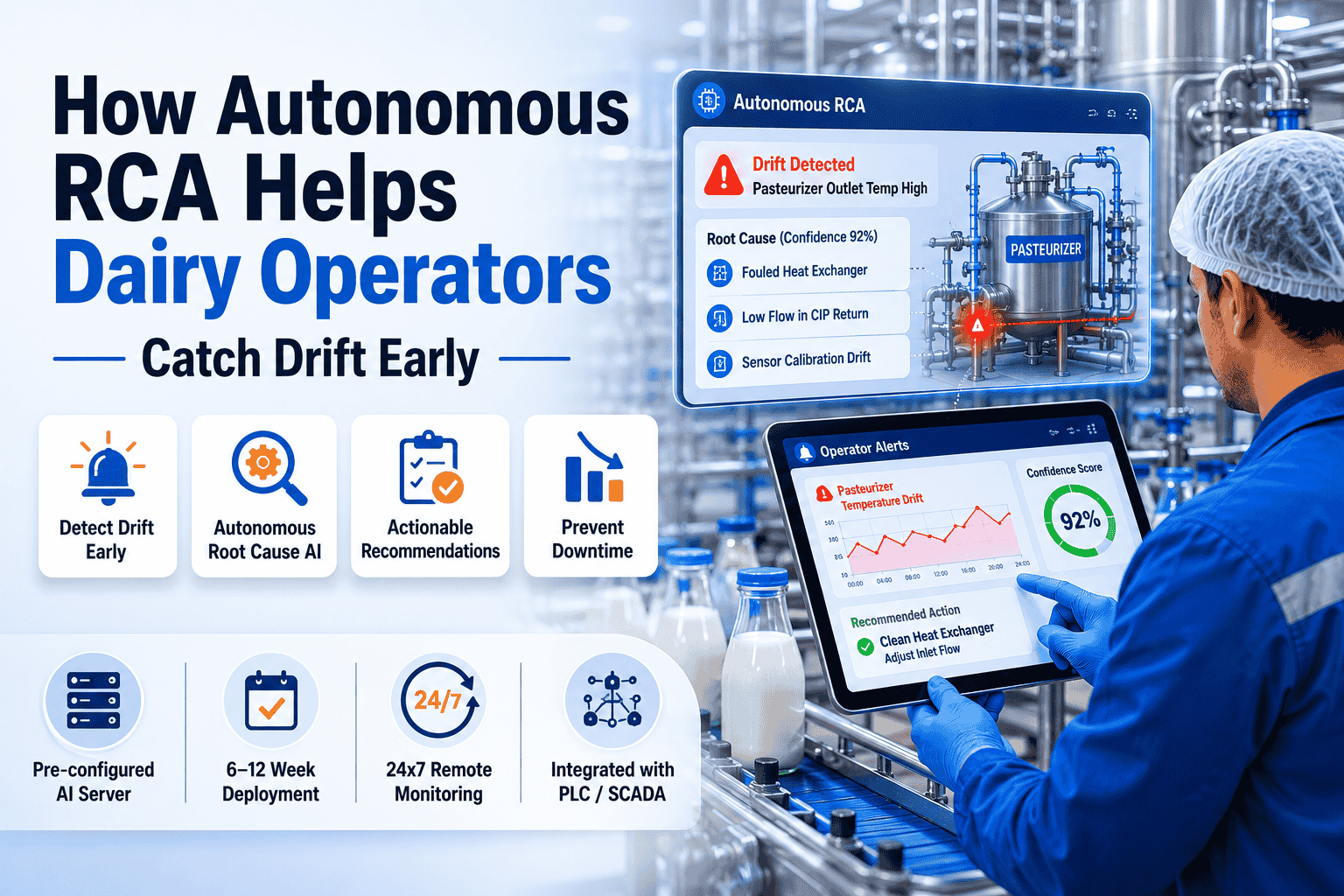
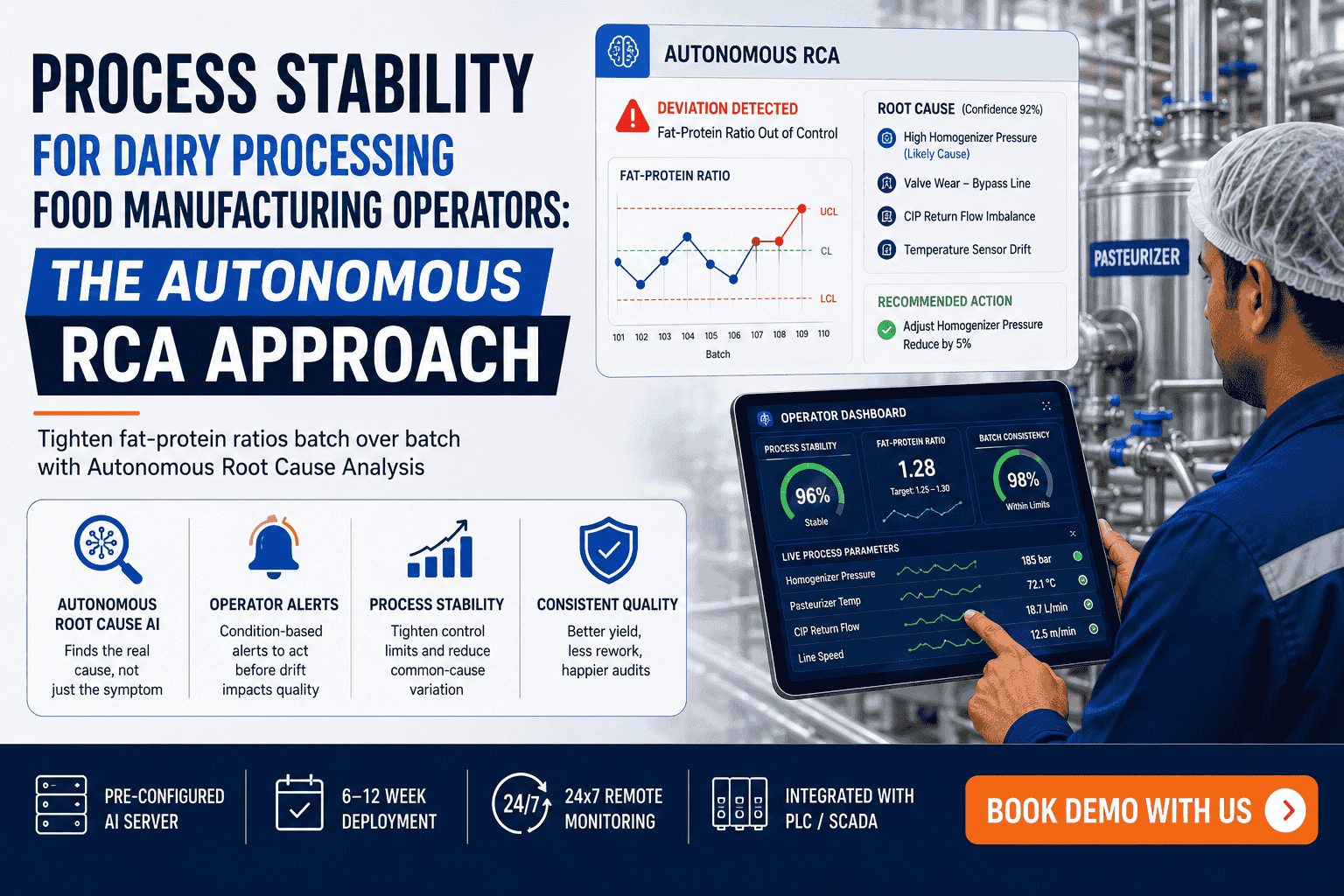
Manual root cause analysis on a dairy line is a forensic exercise. The defect already happened, the batch is already diverted, and the operator is rebuilding what occurred from logs, samples, and memory — usually after the next shift has already started running the same equipment that caused it. Autonomous RCA inverts the entire workflow. Five diagnostic agents run continuously in the background: one detects the anomaly, one generates causal hypotheses, one validates the evidence, one plans the remediation, and one captures the outcome for next time. By the time the operator sees an alert on the HMI, the investigation is already complete — with a ranked root cause, supporting evidence, and a prescriptive action attached. The drift gets caught early, the operator acts in seconds instead of minutes, and the same defect doesn’t recur. This is how condition-based alerts replace forensic RCA on dairy lines in 2026. Book a demo with us to see autonomous RCA running on your line.
A1
Anomaly Inference
Detects drift across 80+ tags
A2
Causal Hypothesis
Ranks probable root causes
A3
Evidence Validation
Confirms with historical data
A4
Remediation Planning
Generates prescriptive action
A5
Outcome Capture
Logs for failure-pattern library
What "Autonomous" Means — in a Way That Actually Matters on a Dairy Line
Most AI software still requires the operator to interpret results. A dashboard shows the anomaly, the operator decides whether it’s real, the operator investigates the cause, the operator decides on a fix. Autonomous RCA closes every one of those loops upstream. By the time the alert reaches the operator HMI, five diagnostic agents have already completed the investigation. The operator’s job becomes execution and judgment on edge cases — not pattern detection and hypothesis testing on a moving line.
Detection
Self-Detecting Drift
One-class SVM models learn the line’s normal behavior continuously. New, unlabeled anomalies surface without anyone configuring an alarm threshold.
Diagnosis
Self-Reasoning Cause
Neural network permutation algorithms quantify each variable’s contribution to the detected fault. The model doesn’t guess — it computes contribution scores.
Learning
Self-Updating Database
Every newly diagnosed fault is added to the failure-pattern library automatically. Next time the same signal appears, the response is faster and more confident.
Action
Operator-Ready Output
No raw data dump. The operator receives a ranked root cause, a confidence score, and a recommended setpoint adjustment — ready to act on in seconds.
Inside the Five Diagnostic Agents — How They Actually Work Together
The strength of autonomous RCA isn’t in any single agent. It’s in the orchestration — how the five agents hand work to each other to break a complex reasoning task into sub-processes. Multi-agent frameworks like these have been shown to reduce hallucination and improve interpretability compared to single-model AI. On a dairy line, that translates to alerts the operator can trust on the first shift of deployment.
What it does
Continuously monitors 80+ process tags across pasteurizer, separator, homogenizer, filler, CIP. Uses sliding-window reconstruction analysis to detect deviations from learned normal behavior.
Key signal
Hold-tube temperature deviating 0.4°C from baseline at 03:47, 8 minutes after a steam pressure dip 12 seconds long.
What it does
Takes the detected anomaly and generates ranked candidate root causes. Each candidate gets a probability score based on the variable contribution analysis.
Key signal
Steam supply pressure drift (87% probability) · Regenerator fouling (8%) · Feed pump variance (5%).
What it does
Validates the top-ranked hypothesis against historical patterns from your plant’s failure-pattern library. Confirms or downgrades the cause before it reaches the operator.
Key signal
12 similar steam-pressure cascade events in last 90 days, all resolved by trimming boiler load. Confidence: 94%.
What it does
Selects the proven remediation action from the failure-pattern library. Composes an HMI alert with the specific setpoint to adjust, expected resolution time, and downstream impact.
Key signal
Recommend: increase steam supply +0.4 bar. Expected resolution: 3 min. Hold-tube temp will stabilize at 72.6°C.
What it does
After the operator acts, monitors the resolution outcome and updates the failure-pattern library. Self-updating database means the next event of this type resolves faster.
Key signal
Hold-tube temp stabilized at 72.6°C in 2 min 48 sec. Logged. Confidence on next similar event: 96%.
Live walkthrough
See the 5 agents on your data
30-minute working session running the autonomous RCA stack against your historian.
Book a Demo
Want to see this 5-agent flow operate against your line’s last unplanned downtime event? Book a 30-minute working session with our dairy specialists.
From Threshold Alarms to Condition-Based Alerts
Legacy alarm systems fire on absolute thresholds — the temperature crossed 71.8°C, the pressure dropped below 180 bar, the conductivity exceeded the rinse-out limit. Condition-based alerts fire on patterns. The temperature is still at 72.4°C, but the trajectory at the current trend will cross spec in 9 minutes, and the upstream steam pressure has been drifting for 14 minutes. The alarm system would say "in spec, do nothing." The autonomous RCA system says "act now, here’s why, here’s how."
Threshold Alarm
"In spec, do nothing"
TriggerAbsolute value crosses a static limit
Lead time0 minutes — defect already formed
ContextSingle tag, no upstream link
Action"Investigate" — operator builds hypothesis
OutcomeRecurrence likely — pattern not captured
Condition-Based Alert
"Act now, here’s why"
TriggerPattern of drift across correlated tags
Lead time5–15 minutes before defect would form
ContextRanked root cause, evidence trail, confidence
ActionSpecific setpoint adjustment with expected outcome
OutcomeLogged to library — recurrence prevented
From Forensic RCA to Autonomous in 6–12 Weeks
iFactory ships a pre-configured AI server with the autonomous RCA agent stack tuned for dairy — HTST, separator, homogenizer, filler, CIP. Integrates with your existing PLC and SCADA over standard protocols, delivers first validated condition-based alerts within 6–8 weeks of go-live.
Five Drift Patterns Autonomous RCA Catches Before They Bite
The five most common drift patterns on dairy lines all share a property: they’re invisible to threshold-based alarms because they unfold over minutes of normal-looking values. Autonomous RCA catches every one of them in the early signal phase — before the defect forms, before the alarm fires, before the operator has anything to investigate.
01
Pasteurizer Hold-Tube Slow Drift
Hold tube trends 0.05°C/min toward 72.0°C floor over 10 minutes. Threshold says “in spec.” Autonomous RCA flags it 8 minutes before diversion would trigger.
Lead time: 8–12 min
02
Homogenizer Pressure Decay
Pressure trending 1 bar/hour below 220 bar baseline due to seat wear. Single-tag alarms ignore this; multivariate RCA correlates it with downstream texture risk.
Lead time: 60–120 min
03
Fat-Protein Ratio Slow Walk
Individual signals stay in spec; the ratio between them drifts outside target band. Single-variable SPC misses this completely.
Lead time: 20–40 min
04
CIP Conductivity Rinse-Out Stall
Conductivity curve flattening earlier than baseline. Cycle will run to scheduled length but rinse won’t complete, risking carryover into next batch.
Lead time: 15–25 min
05
Filler Head Asymmetric Drift
One head on a multi-head filler trending 0.4g below target. Line-average alarms miss it; per-head autonomous RCA segments and flags the failing nozzle.
Lead time: 5–15 min
Want these five drift patterns mapped against your line’s recurring downtime events? Book a drift-pattern demo with our dairy team.
The Operator’s Job Gets Sharper, Not Replaced
One of the most common operator concerns about autonomous RCA: “Does this make my judgment irrelevant?” The honest answer is that it sharpens three roles that the previous toolset blunted — and removes the work that operators were never built to do anyway.
01
Judgment on Edge Cases
95% of alerts arrive with clear action. The 5% of novel patterns the AI hasn’t seen before need operator interpretation — the work humans excel at.
02
Physical Validation
When the agents flag valve seat wear or sensor drift, the operator walks the asset and confirms. Ground-truth feedback refines the model.
03
Cross-Shift Authorship
Forward-looking handovers replace defensive explanations. Operators bring context the AI can’t see: equipment age, vendor history, plant lore.
Expert Perspective
"The transition from rule-based alarms to autonomous RCA is the biggest workflow change happening on dairy lines this decade. Multi-agent diagnostic frameworks break complex reasoning tasks into sub-processes — anomaly detection, causal hypothesis, evidence validation, remediation planning — and that decomposition is what makes the alerts trustworthy on the first shift. Operators stop second-guessing the platform within the first month because the alerts arrive with their investigation already complete. That’s where the downtime prevention number actually comes from. The agents do the work humans were never built for. The operator does the work the agents can’t."
— Industrial AI Diagnostics Practice, 2026 industry insight
35.4%
accuracy gain documented on drift-aware adaptive models vs static
42.3%
RMSE reduction after two incremental updates in benchmark studies
85–90%
classification accuracy on known faults in autonomous RCA literature
Conclusion: The Investigation Already Done
Dairy operators in 2026 don’t need to be better at root cause analysis. They need a platform that does the RCA for them — continuously, autonomously, before the defect forms — and hands them the result with the action attached. Five diagnostic agents running in the background. One trustworthy alert on the HMI. Five to fifteen minutes of lead time before the line goes out of spec. A failure-pattern library that gets smarter every shift. The drift gets caught early. The downtime gets prevented. The morning huddle stops being a recap of yesterday’s surprises and starts being a forecast of today’s opportunities. Book a demo with us to see autonomous RCA running on your line.
Bring Autonomous RCA to Your Dairy Line
iFactory’s dairy practice deploys autonomous RCA in 6–12 weeks against your existing PLC and SCADA — five diagnostic agents, condition-based alerts, 24x7 monitoring, no rip-and-replace required. Get a free 30-minute working session built around your line.
Frequently Asked Questions
What is autonomous RCA on a dairy processing line?
Autonomous RCA is a multi-agent AI system that performs the entire root cause investigation continuously in the background, without operator intervention. Five diagnostic agents work together: anomaly inference detects drift across 80+ process tags, causal hypothesis generation ranks probable root causes, evidence validation confirms with historical patterns, remediation planning generates a prescriptive operator action, and outcome capture logs the result for the failure-pattern library. By the time the operator sees an HMI alert, the investigation is complete — with ranked cause, confidence score, and recommended setpoint already attached. The whole workflow takes seconds where manual RCA takes minutes to hours.
How is this different from the alarms our SCADA already sends us?
SCADA alarms are threshold-based — they fire when a value crosses a fixed limit, after the deviation has already happened. Autonomous RCA fires on patterns, not absolute values. The hold-tube temperature can still be 72.4°C and well within spec, but if the trajectory and the upstream steam pressure trend together suggest a 9-minute window to breach, the alert fires now. The operator gets 5–15 minutes of lead time on most drift patterns. SCADA alarms typically arrive with zero lead time because the limit has already been crossed.
Does autonomous RCA replace our PLC, SCADA, or HMI?
No. iFactory’s autonomous RCA platform sits above your existing controls stack. It reads from any PLC vendor and SCADA system through standard industrial protocols, runs the five diagnostic agents on a pre-configured AI server, and pushes condition-based alerts back to your existing operator HMI or mobile devices. PLCs continue to run control logic exactly as today. SCADA continues to display threshold alarms operators are trained on. The autonomous RCA layer adds the predictive intelligence above — it doesn’t replace the deterministic safety controls underneath.
How does the AI know what's a real root cause vs a false alarm?
Three mechanisms compound. First, evidence validation: every ranked hypothesis from Agent 02 gets cross-checked against your plant’s historical failure-pattern library by Agent 03 before reaching the operator. Second, confidence scoring: every alert carries an explicit confidence percentage. Third, self-updating learning: when the operator confirms or refutes an action, the model updates — so false positives diminish progressively over the first 4–6 weeks of operation. The neural network permutation algorithm specifically quantifies each variable’s contribution to the fault, providing mathematical evidence rather than statistical pattern matching alone.
How long does deployment take and what operator training is needed?
Typical deployment runs 6–12 weeks. The first 2–3 weeks cover PLC and SCADA integration and historian ingest. The next 4–6 weeks train the five diagnostic agents on 6–8 weeks of your plant’s historical data, with iFactory’s dairy-specific templates accelerating most of this work. The final 2–4 weeks tune alert thresholds with the operator team to eliminate false positives. Operator training is light by design — typically a 60–90 minute walkthrough plus shift-side support during the first week of live alerts. The reason training is light is that the operator’s physical workflow doesn’t change — only the quality of information arriving on the HMI does.