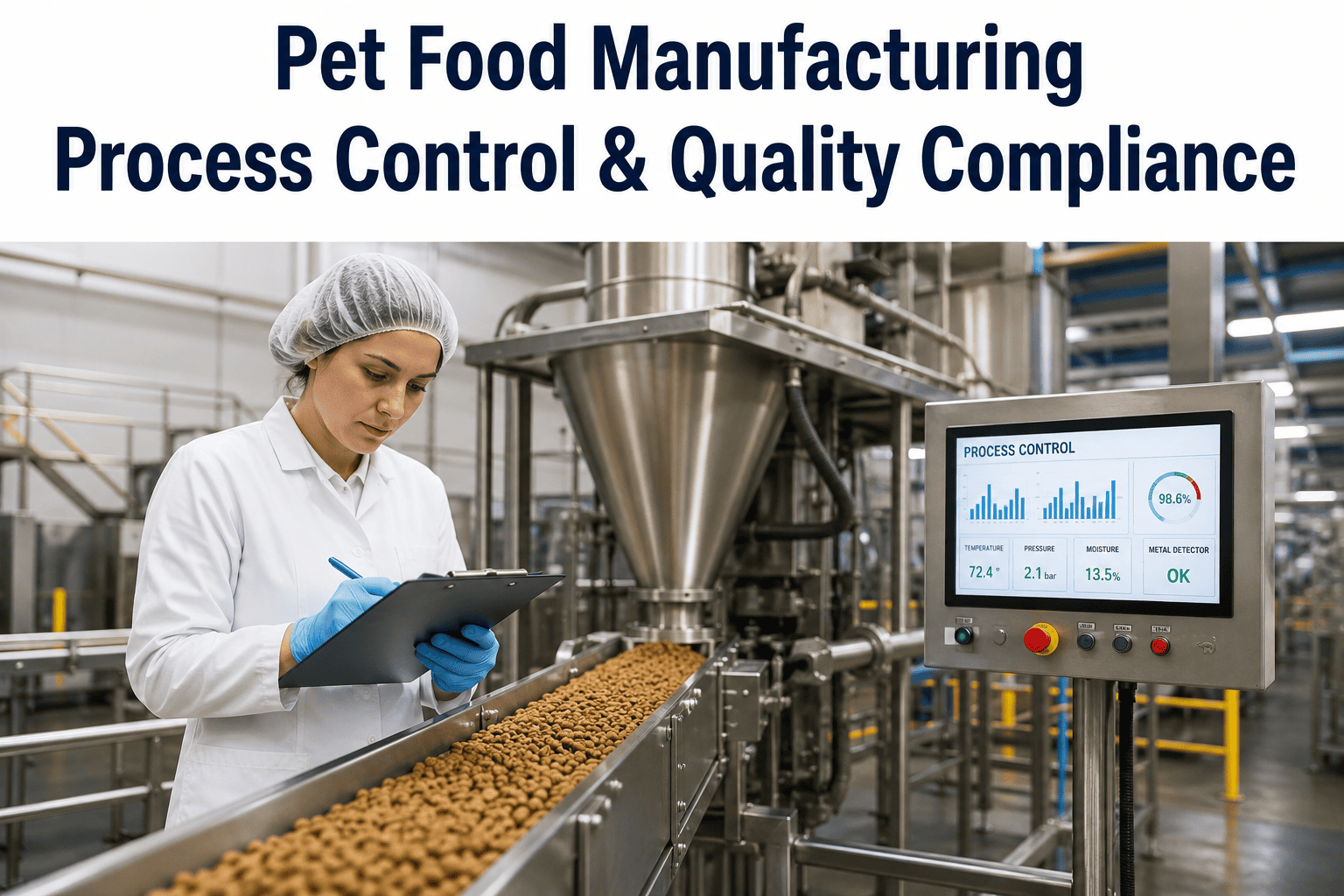
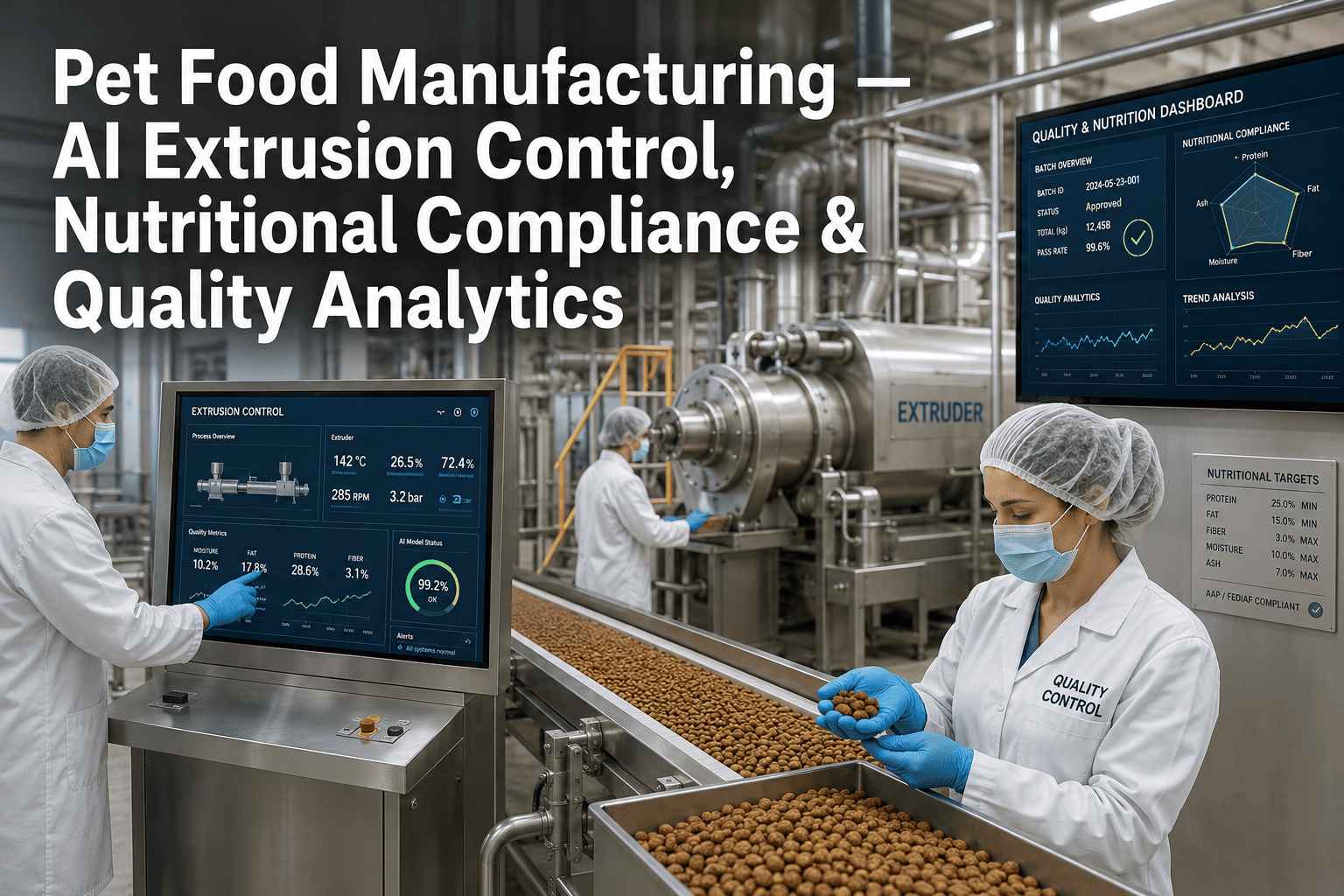
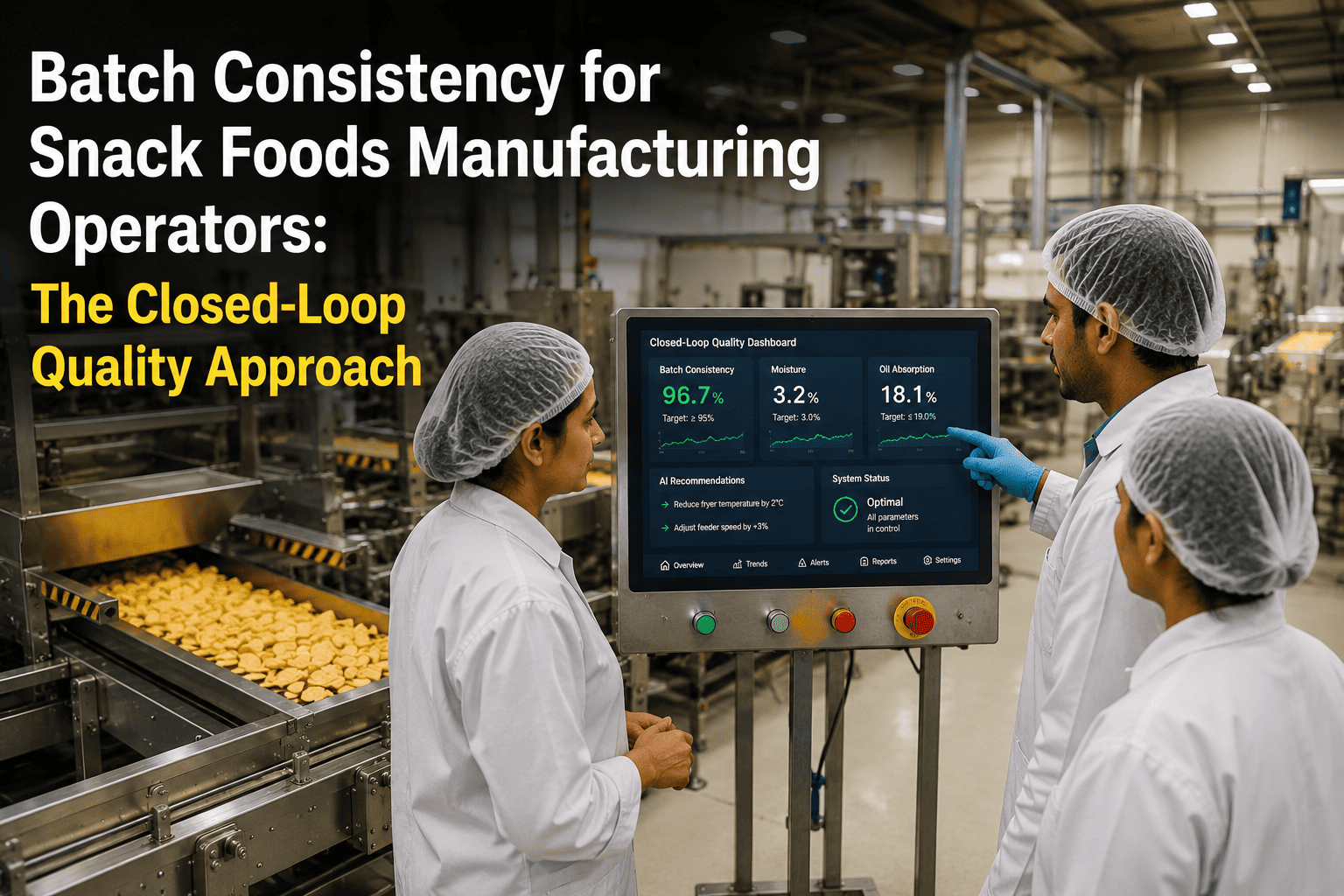
A kibble batch that fails AAFCO nutrient specification does not usually fail because the recipe was wrong. It fails because extrusion temperature drifted two degrees over an hour, moisture content crept up during a shift change, and nobody connected those two small changes to the assay results that came back three days later. Process Engineers running dry, wet, or raw pet food lines are expected to hold nutritional consistency across every batch while extrusion, drying, and coating variables shift constantly in the background. Book a demo to see how continuous process monitoring closes that gap before a batch ever reaches the lab.
Pet Food Manufacturing · Process Engineering
Catch Nutrient and Moisture Drift Before It Becomes a Failed AAFCO Assay
AI-driven extrusion monitoring, ingredient traceability, and batch consistency tracking for dry, wet, and raw pet food lines — built to keep every batch inside spec and recall-ready.
Where Batches Go Off Spec
The Four Points in a Pet Food Line Where Drift Turns Into a Failed Batch
Nutrient variance rarely comes from one dramatic event. It builds gradually across a few process points, and each one is a place where continuous monitoring catches what a lab assay only reports after the fact.
1
Ingredient Intake and Blending
Moisture and protein content in incoming raw materials vary batch to batch, and a formulation built for one moisture level compounds error if intake variance is not measured before blending starts.
2
Extrusion Temperature and Screw Speed
Barrel temperature and screw speed together determine starch gelatinization and nutrient retention, and small drifts here degrade heat-sensitive vitamins in ways that only show up in an assay later.
3
Drying and Moisture Removal
Final moisture content drives both shelf stability and nutrient density per gram, and dryer zone variance across a long run can leave one end of a batch out of spec while the other end passes.
4
Coating and Palatant Application
Fat and palatant coating uniformity affects both nutrient labeling accuracy and product consistency, and uneven application is difficult to catch without continuous coverage tracking across the coating drum.
The Compliance Reality
What AAFCO Compliance and Recall Readiness Actually Require
Batch-Level Traceability
Every ingredient lot needs to be traceable to the finished batch it went into, so a recall can be scoped to the affected lots instead of an entire product run.
Documented Process Parameters
Extrusion temperature, moisture, and drying data need to be logged continuously and tied to each batch, not reconstructed from memory when a regulator asks for records.
Nutrient Verification Before Release
Process data that correlates reliably with lab assay results lets a plant flag a likely out-of-spec batch before it ships, rather than after a customer complaint arrives.
Consistency Across Dry, Wet, and Raw Lines
A multi-format plant needs one system that understands the different process variables that matter for extrusion, retort, and raw processing rather than three disconnected tracking methods.
iFactory Connects Extrusion Data to Batch Records Automatically
Continuous process monitoring, ingredient traceability, and AAFCO-aligned batch documentation configured for your dry, wet, or raw production lines.
Recall Readiness Checklist
Six Items a Pet Food Recall Investigation Will Ask For First
Recall readiness is not a document a plant writes once. It is whether these six things are already true on the day an investigation starts.
✓
Ingredient lot numbers linked to every finished batch, retrievable in minutes
✓
Extrusion temperature and moisture logs retained for every production run
✓
Nutrient assay results tied back to the specific batch and process conditions
✓
A defined process for isolating affected lots without halting unaffected production
✓
Supplier documentation for every raw material lot used in a given batch
✓
A named owner responsible for pulling and submitting records during an investigation
We had a moisture excursion on a dry kibble line that we did not catch until the assay came back three days later, and by then we had already shipped two more days of product from the same formulation. Tracing which pallets came from which extruder run took our team the better part of a week, going through paper logs and shift notes. After we put continuous moisture and temperature tracking on the extruder tied directly to batch numbers, the same kind of drift got flagged within the hour instead of three days later, and when we did need to trace a batch for an unrelated supplier issue, it took minutes instead of days.
— Process Engineer, Multi-Format Pet Food Manufacturer
Frequently Asked Questions
What Process Engineers Ask About AI-Driven Pet Food Monitoring
How does this connect to our existing extrusion control system?
The monitoring layer typically reads from the sensors and control system already installed on the extruder, rather than replacing the equipment's native controls. It adds a continuous analysis and logging layer on top of that data, correlating temperature, moisture, and screw speed trends against batch outcomes so drift gets flagged well before it shows up in a lab assay result.
Can this help us meet AAFCO nutrient adequacy documentation requirements?
Continuous process logging strengthens the documentation trail behind a nutrient adequacy claim by tying process parameters directly to batch outcomes and assay results over time. It is not a substitute for the underlying formulation and testing program a plant already runs, but it does make the connection between process conditions and nutrient outcomes far easier to demonstrate during a review.
Does raw and wet pet food processing require different monitoring than dry kibble?
Yes, meaningfully. Raw and wet processing lines are typically more concerned with cook lethality, retort validation, and cold chain integrity than with extrusion parameters, while dry kibble lines center on extrusion temperature, screw speed, and drying. The monitoring configuration is built around the specific process a given line runs rather than a single generic template applied across formats.
How quickly can ingredient traceability actually shrink a recall's scope?
When ingredient lots are linked to finished batches automatically, a recall investigation can identify exactly which production runs used a specific supplier lot in a matter of minutes rather than days of manual log review. That precision is often the difference between recalling a narrow window of affected product and pulling several weeks of otherwise unaffected inventory out of caution.
Book a demo to see how the traceability mapping works for your specific line configuration.
What does implementation look like for a plant running multiple product lines?
Implementation is typically scoped line by line, starting with whichever line carries the highest volume or the tightest nutrient tolerance, so the team can validate the monitoring against real production data before expanding.
Contact support to talk through a rollout sequence that fits your plant's specific mix of dry, wet, and raw production.
Every Batch That Passes Assay Started With Process Data That Was Already Telling You the Answer.
Continuous extrusion monitoring, ingredient traceability, and AAFCO-aligned batch documentation — configured for your plant and reviewed with your quality and regulatory team before go-live.